Start with one purpose where you want support, pick a single strategy, and practice it until it works. The full article covers nine purposes, with example resources and courses for each: https://t.co/TN75Kxv2TK
#TeachingStrategies#InstructionalStrategies#TeacherTips
The strategy you choose matters as much as the content you teach in your classroom. Take a look at our latest article on instructional and teaching strategies, organized by nine classroom purposes: https://t.co/TN75Kxv2TK
Do you want to do this with your own standards? Our full article explains DOK levels in more detail, assists you in planning lessons, and also asks you to reflect on how AI might be used as a tool for improving thinking, rather than replacing it.
Read it here: https://t.co/b3CUG1AJcv
#Rigor #WebbsDOK #TeacherTips
A teacher wants a more rigorous lesson, so she asks students to define 10 words instead of 5. Unfortunately, that is simply more work and does nothing to help improve a student’s thinking. This is still a reality in many classrooms today. Our latest article revisits Webb’s Depth of Knowledge (DOK to better understand rigor[paste article URL]
Here’s an example. Assigning more bar graphs for practice adds work at the same level. If you want to instead extend student thinking, ask your students to critique a set of graphs and draw conclusions on the data. The task is thin shifted from Skills and Concepts up to Strategic Thinking.
The easy "high probability" behaviors roll right into the "low probability" task- no standoff.
And it's not just for behavior. It works for academic tasks too, like easing a reluctant kid into writing or math.
New Course: Using AI Mega-Prompts to Help Build & Differentiate Lessons.
Many of us will hand an AI model a one-line prompt and hope it builds a lesson plan they can actually use. Then spend time going back and forth, just to get it right. 🧵
In about an hour, you'll:
-Learn about 3 common AI tools teachers can use for free
-Build two of your own (one simple, one more advanced)
-Leave with two dozen other classroom tasks you can start handing off
We cover what works at each stage (think, pair, and share), plus ideas to facilitate real academic discussion, in our latest article.
Read it here: https://t.co/ZQgiqYAQtv
#TeachingStrategies
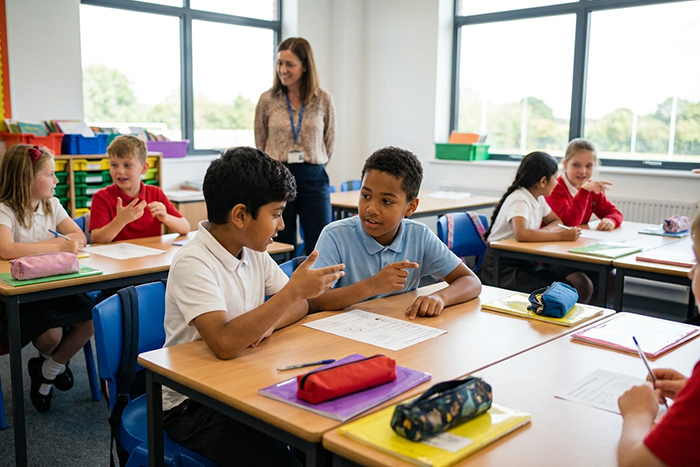
The common Think-Pair-Share is a staple in classrooms everywhere. But a quick turn-and-talk can quietly hide the students who never engaged.
Here's how to get real thinking out of it. 🧵
Then have students write at each stage. Writing builds individual accountability and gives you something concrete to check while you circulate.
Watch the pairs who agree in five seconds flat. Fast agreement usually means neither student dug in.





![ModelTeaching's tweet photo. A teacher wants a more rigorous lesson, so she asks students to define 10 words instead of 5. Unfortunately, that is simply more work and does nothing to help improve a student’s thinking. This is still a reality in many classrooms today. Our latest article revisits Webb’s Depth of Knowledge (DOK to better understand rigor[paste article URL]](https://pbs.twimg.com/media/HNXPeLYXwAAcEOC.jpg)