The MLJ is dedicated to promoting scholarly exchange among researchers and teachers of all modern foreign languages and English as a second language. #NFMLTA
Teaching modal verbs through concepts works. But does it matter which concepts you choose? Cognitive linguistics materials gave learners a lasting advantage.
Zhao & Lantolf (2026). The Modern Language Journal.
https://t.co/hDhy9dKA5G
How do some immigrant families sustain heritage languages against English monolingual pressure? This study centers rare successes and the class barriers behind them.
Wang & Wang (2026). The Modern Language Journal.
https://t.co/II3NMEN3mX
Is L2 motivation research facing a crisis?
This article introduces identity-based motivation theory as a promising alternative to the L2 Motivational Self System.
Strietholt (2026). The Modern Language Journal.
https://t.co/yLVFThhk77
Can EFL teachers become advocates for social justice?
A 2-year action research project in Argentina shows how teachers shifted from focus-on-form to critical pedagogy.
Banegas, San Martin, Sacchi, & Porto (2026). The Modern Language Journal. https://t.co/4BuxCHWrkk
What if every study you read came with all its materials ready for everyone to use?
MLJ introduces a new culture of openness and transparency.
Hiver, Al-Hoorie, & Huensch (2026). The Modern Language Journal. https://t.co/2PcJe7Bq8T
We train teachers to plan lessons, design materials, and assess students. But what about the moment when no one wants to speak?
Ro & Kim (2026). The Modern Language Journal. https://t.co/BO20nTrO1A
For 110 years, The Modern Language Journal has shaped how we understand language learning, teaching, and policy.
Until now, the only way to keep up was to check the journal itself.
That changes today. MLJ is now on Facebook and X.
Follow us & join the conversation.
#MLJ
The Modern Language Journal is now accepting proposals for special issues. The journal welcomes proposals addressing innovative topics and issues of broad relevance to researchers and practitioners in the field of language teaching and learning.
https://t.co/RBpK7Du1oW
لمن يرغب في المساهمة ف�� هذا العدد الخاص حول الشراكات بين الباحثين والممارسين، لا يزال باب استقبال الأبحاث مفتوحًا. وستُنشر الأبحاث المقبولة في مجلة اللغات الحديثة (The Modern Language Journal).
للتفاصيل:
https://t.co/rOIW43vBIH
لإبداء الرغبة:
https://t.co/oOBaZCzR1v
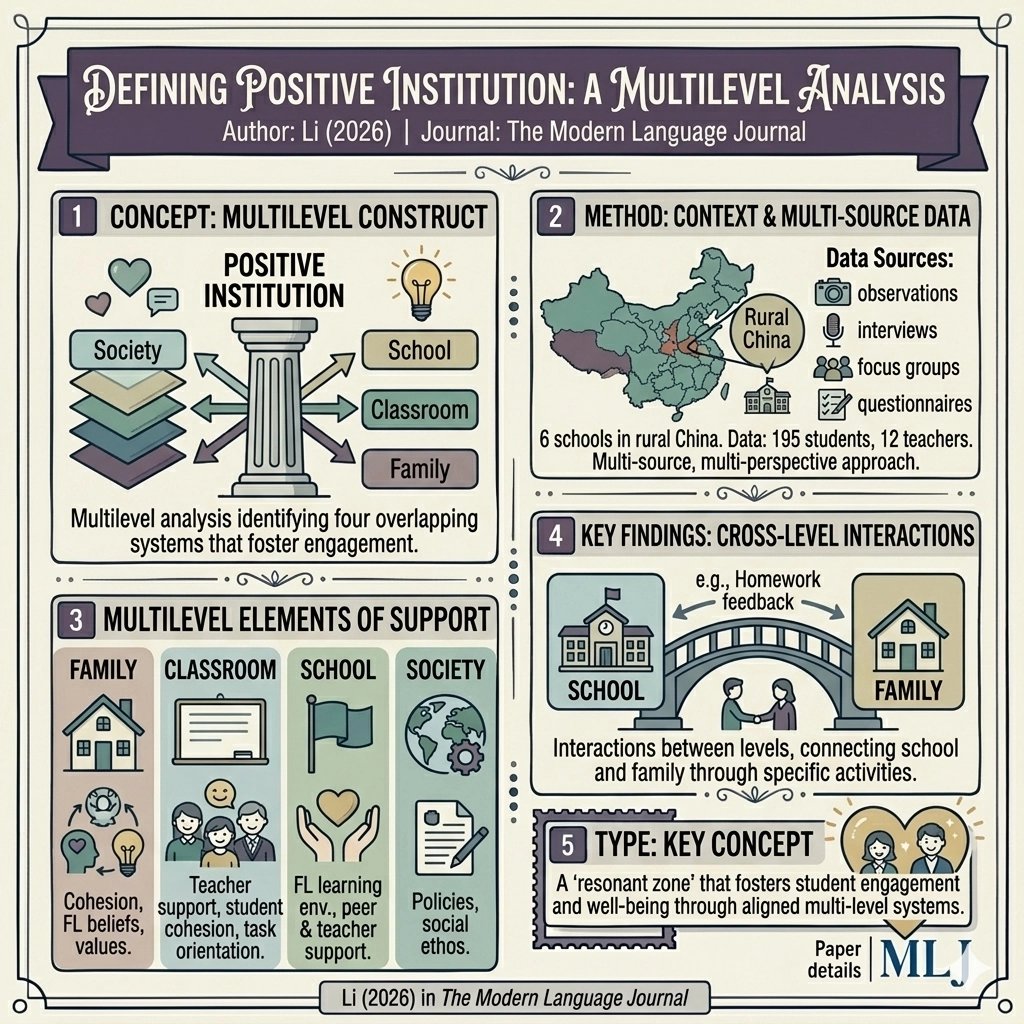
What counts as a positive institution?
Li maps support across family, classroom, school, and society in rural China.
Li (2026). The Modern Language Journal. https://t.co/ikYMDZckg5
#MLJContentSeries
Applied linguistics rarely considers maternal well-being.
Han et al examine how South Korean mothers experience well-being while managing their children's English education.
Han, Park, & Kim (2026). The Modern Language Journal. https://t.co/ebNMojbozw
#MLJContentSeries
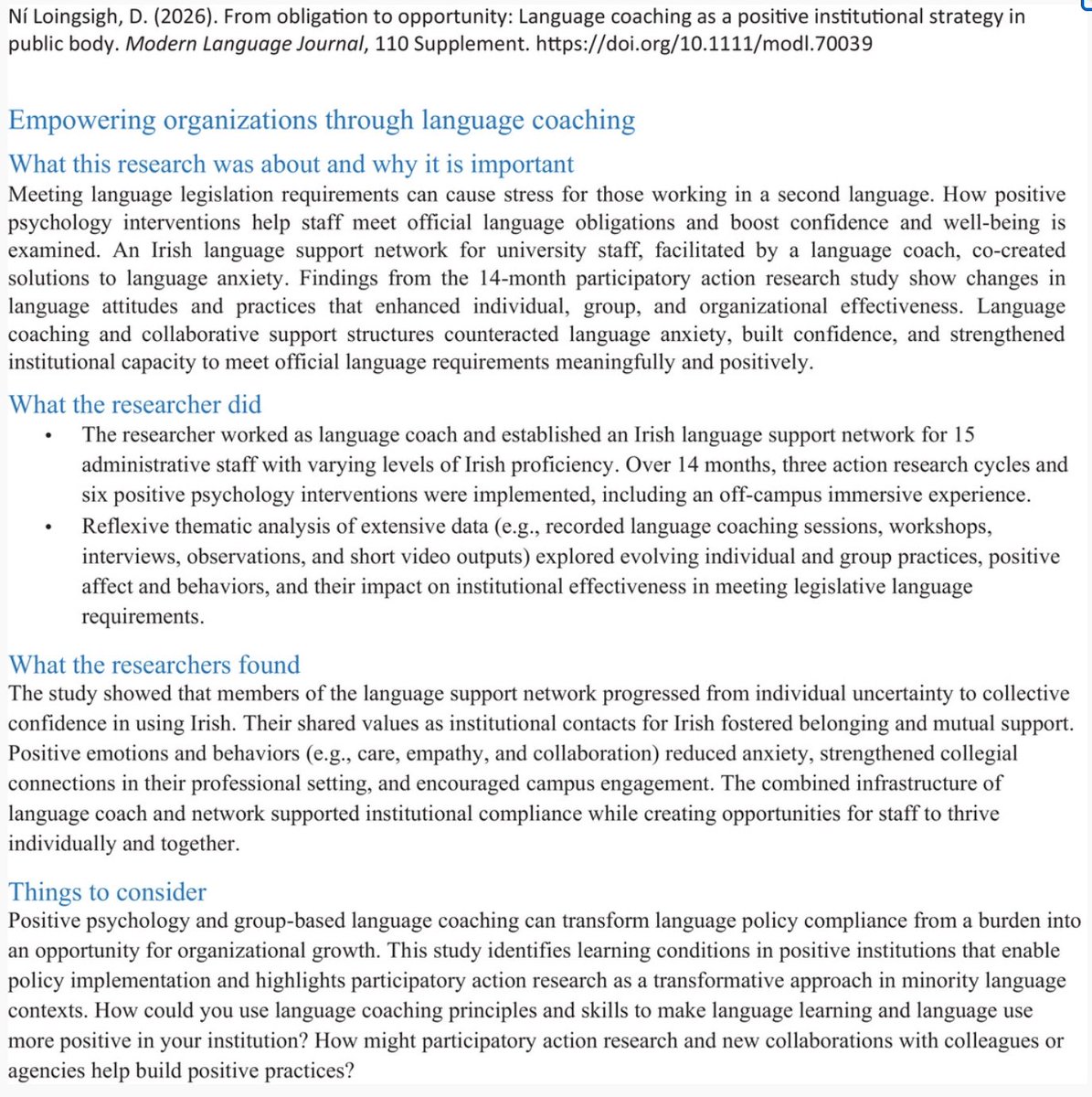
When language compliance feels like a burden, can coaching turn it into opportunity?
Ni Loingsigh studies Irish language support in a university.
Ni Loingsigh (2026). The Modern Language Journal. https://t.co/1wru0JwYkL
#MLJContentSeries
What does a positive institution look like in practice?
Driver examines a Buenos Aires school where institutional support enabled participatory action research.
Driver (2026). The Modern Language Journal. https://t.co/yagrx78HjY
#MLJContentSeries
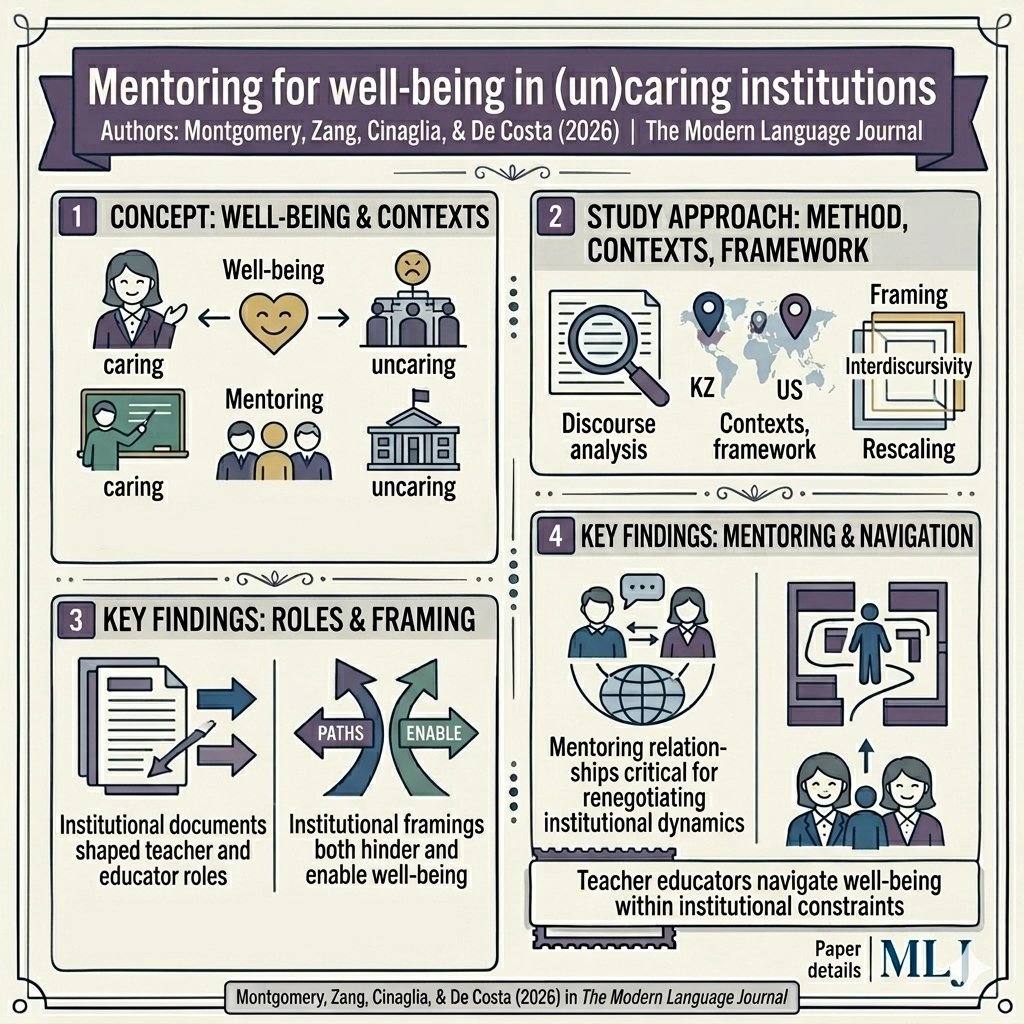
What can mentoring do inside uncaring institutions?
Montgomery et al. show how mentoring can support teacher well-being while facing institutional limits.
Montgomery et al. (2026). The Modern Language Journal. https://t.co/J2GqhuFQYs
#MLJContentSeries
The Modern Language Journal-MLJ announces that, starting July 1, 2026, authors must provide free and public access to research materials (when possible) in an appropriate repository as a condition for manuscript review.
Read more:
https://t.co/d7SLCZYUB3
Positive school leadership matters for teacher well-being. But the everyday culture between all employees matters more.
Resnik et al. (2026). The Modern Language Journal. https://t.co/m4Qsub7vJN
#MLJContentSeries
Research on teacher well-being is expanding. But who studies the well-being of those who train the teachers?
Mercer and Gregersen examine how institutions shape LTE flourishing.
Mercer & Gregersen (2026). MLJ. https://t.co/vaPYQhCDPd
#MLJContentSeries
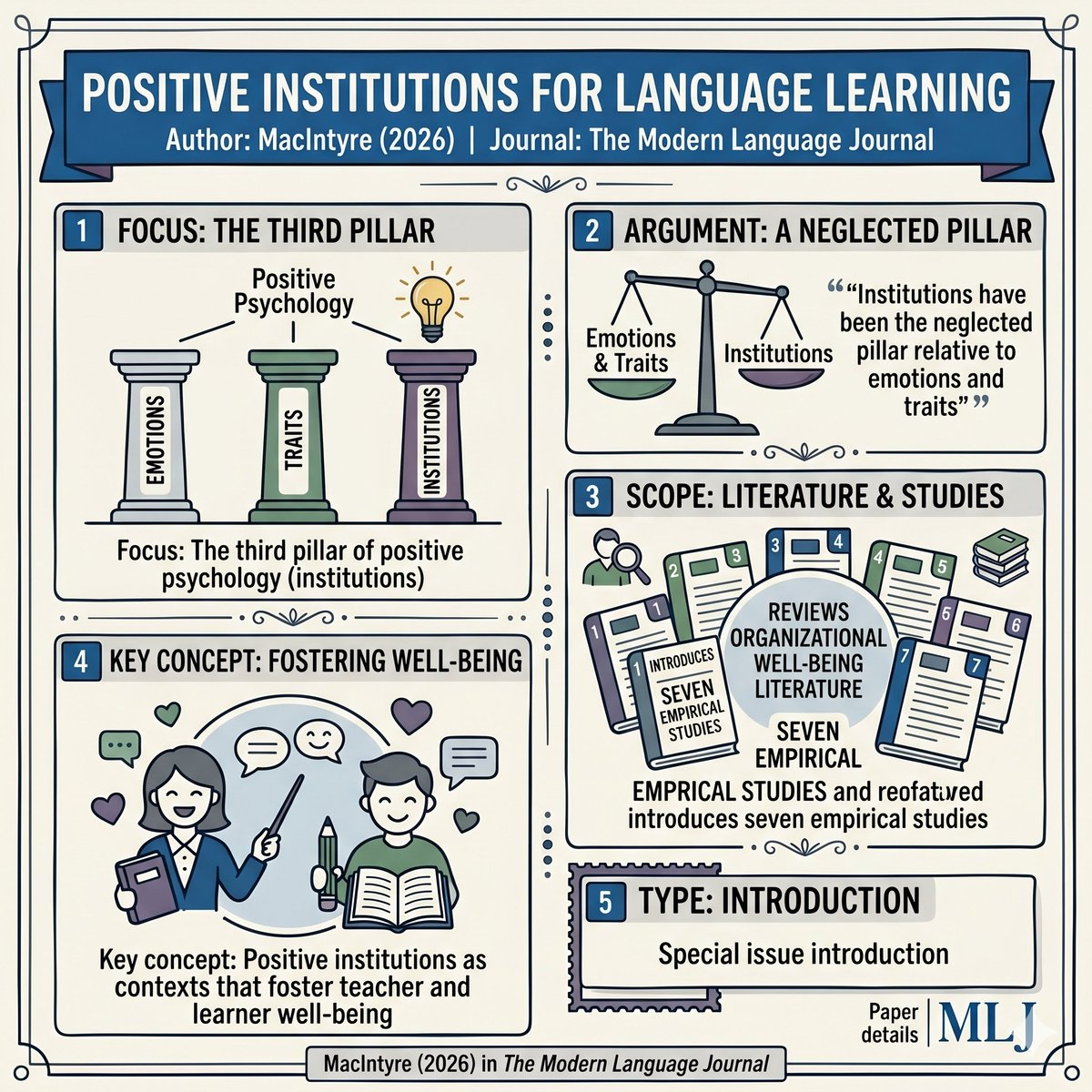
What makes an institution positive? Why has this question been overlooked in language education?
MacIntyre introduces the MLJ SI on positive psychology's neglected third pillar: positive institutions.
MacIntyre (2026). The Modern Language Journal. https://t.co/FUXCkYLXo7
Positive psychology in language education has two well-studied pillars: emotions and traits. The third, institutions, remains underexplored.
A new MLJ special issue with 8 studies changes that.
https://t.co/FTFIKTlbER
#MLJContentSeries#PositivePsychology
SLA is not in crisis. It is flourishing.
Pekarek Doehler et al. argue that pluralism is not a problem to be solved but a condition to be valued.
Pekarek Doehler et al. (2026). The Modern Language Journal. https://t.co/NCXFwaN8kz