Warner Bros lost $50 million on Tenet. Then they made a decision that has sent $1.2 billion to their rival Universal so far.
Tenet came out in September 2020, mid-pandemic. It made $365M on a $200M budget. Not enough.
Warner Bros panicked. Three months later they announced every 2021 movie would go straight to HBO Max the same day it hit theaters. They didn't warn a single director.
Christopher Nolan had made them The Dark Knight, Inception, and Interstellar over 20 years. He said filmmakers went to bed working for the greatest studio and woke up working for "the worst streaming service."
Then he took his next movie shopping. His asking price was simple. Pay for the film, promise it plays in theaters only, and give me 20% of every ticket.
Universal said yes. That movie was Oppenheimer. $976 million. Best Picture.
Warner Bros begged him to come back. He said no. His new film The Odyssey just opened to $264 million, the biggest debut of his career.
The cheapest thing Warner Bros ever lost was $50 million.
I’ve worked on Iran for nearly 20 years. Our options are never great, but I’ve never seen things this bad. For the first time in my career, I’m at a loss.
When this war began, I warned that Iran would likely emerge weakened but more aggressive and risk-tolerant—leaving the region trapped in a cycle of military clashes and chronic instability. That has happened. What I underestimated was the leverage Iran would gain through its stranglehold over the Strait of Hormuz.
For a moment, the MOU offered a possible way out. It was deeply flawed, but better than the alternatives. Then vague terms and shoddy negotiating caused it to collapse: Iran believed it could retain some control over the Strait; Washington believed the Strait would reopen to international shipping.
But the fundamental problem wasn’t the negotiation. It was Trump’s catastrophic decision to go to war in the first place.
The result: higher oil prices, economic shocks, depleted US missile-defense stocks, immense regional damage and civilian suffering, alienated allies and very little achieved in return.
So what now?
We could pay Iran off through sanctions relief, oil exports and access to the international banking system. But after surviving forty days of war, Tehran is angry, distrustful and convinced it holds the stronger hand. Its price is so high – and so humiliating – that Trump will never accept it.
We could escalate militarily, which is what the US is doing. But bombing has not produced meaningful Iranian concessions, and Trump appears unwilling to bear the costs of the maximalist alternatives. More pressure means an expensive, dangerous and potentially endless war, with serious risks to US forces and the entire region as we tragically saw this weekend. And it has little chance of success.
Or we could encourage the Gulf states to negotiate a regional arrangement. That may ultimately be the most promising path, but the Gulf states are divided, this remains fundamentally a US-Iran conflict, and any agreement will require major American concessions while leaving Iran strategically stronger than it was before the war. So this isn’t very appealing and hard to get to as well.
The likeliest outcome is therefore that we are looking at a new normal: recurring US-Iran clashes, periodic American or Israeli strikes on Iran’s nuclear program, Iranian control over the SOH, higher oil prices and a larger, longer-lasting American military presence in the Middle East. But since the costs of all out escalation are too high both sides try to keep it from going there, though there is always a risk.
Iran’s leverage will eventually depreciate as countries build pipelines, diversify energy supplies and establish alternative trade routes. But that could take years.
Eventually, exhaustion may produce a deal. Iran may decide that controlling the Strait while living under blockade is unsustainable. Washington may accept that it must offer more. The Gulf states may finally unite around a workable diplomatic framework. But not soon.
Trump took a situation in which better options plainly existed, started an unnecessary war and produced a strategic disaster that will take years to unwind.
For now, we are all stuck with this mess.
🟥🇺🇲🇸🇬Un jour, la CIA tenta de recruter le chef des services de sécurité intérieure de Singapour.
L’agent américain chargé de l’opération fut arrêté sur-le-champ.
À Washington, la panique fut immédiate. Pour étouffer l’affaire, un émissaire de haut rang fut dépêché en urgence à Singapour. Dans la plus grande discrétion, il proposa à Lee Kuan Yew 3,3 millions de dollars afin d’acheter le silence.
Lee Kuan Yew refusa net. Froidement, il formula une contre-proposition qui claqua comme un rappel à l’ordre :
Singapour n’avait pas besoin de pots-de-vin, mais de 33 millions de dollars d’aide économique.
Cinq ans plus tard, il décida de rendre l’affaire publique.
Le Département d’État américain nia aussitôt.
C’est là que l’offense devint double.
D’abord parce qu’ils avaient cru que les dirigeants de Singapour étaient à vendre.
Ensuite, parce qu’en niant les faits, ils traitaient Lee Kuan Yew de menteur.
Alors, il convoqua la presse et posa un ultimatum sans détour :
si les États-Unis persistaient dans le déni, les documents et les enregistrements seraient rendus publics.
Quelques heures plus tard, Washington recula.
Le Département d’État reconnut intégralement la véracité de sa version.
Cette histoire rappelle une vérité trop souvent oubliée :
la souveraineté d’un pays ne se mesure pas à sa taille, mais au caractère de ceux qui le dirigent.
Quand un État se respecte, même les empires finissent par reculer.’🇺🇲🟥🇸🇬
When George W Bush won re-election in 2004, he said: “I earned capital in the campaign, political capital, and I intend to spend it.”
I’ve waited 20 years plus for a Dem to take a similar approach to spending capital. Tonight we saw @ZohranKMamdani do it. 3 for 3, about to be.
Some common-sense things Trump said today that were nevertheless shocking:
Everybody else has ballistic missiles, why can’t Iran?
The frozen money belonged to Iran, and the U.S. needed to release it otherwise nobody would trust the dollar system. Why should we steal their money?
Neighboring countries use nuclear power for electricity, why can’t Iran?
Israel shouldn’t knock down entire buildings in Beirut every time a drone or two crashes harmlessly in the desert.
Trump would’ve become Herbert Hoover in a few weeks once oil ran out and the market crashed. He had no choice but to end the war.
The predicament Trump is in, and has been since he started the Iran War with Netanyahu, illustrates why it was so stupid and destructive to start this war in the first place. From the start, there were only two real options:
1) Take seriously all the stated war aims and try to fulfill them, which would require a protracted, self-destructive, devastating, years-long war of the kind Trump spent a decade vowing to avoid, or,
2) End the war quickly and prematurely, and then have to scurry around to find some way to claim that the US "won", which would -- at a minimum -- force Trump to credibly claim he got more than Obama's JCPOA gave, thus justifying all the massive bloodshed, instability and cost from the war.
If reports are correct (and it's a big "if"), Trump is choosing option (2). But his case that he actually won anything consequential beyond what the Obama Deal provided is close to laughable, while the losses to the US (and wins for Iran) are self-evident.
Incorrect. He had a visa. From the US Embassy in Nairobi. It was valid. They vetted him there, and gave him a visa.
Then he landed in Miami, was detained for 11 hours, and deported to Istanbul.
THEN they branded him a terrorist.
A FIFA referee, simply because he’s Somali.
Bruno Fernandes is now joint-top for most assists (21) in a single season across Europe’s top five leagues:
21 assists — Lionel Messi (2019/20)
21 assists — Thomas Müller (2019/20)
21 assists — Bruno Fernandes (2025/26)
Magnifico.
Exactly. What too many Democrats just can't seem to understand is that this is not just about Biden's policy or winning certain voters. It is about whether the Party understands what is happening in the world, whether it has a moral framework, and whether it has credibility to fight for anything.
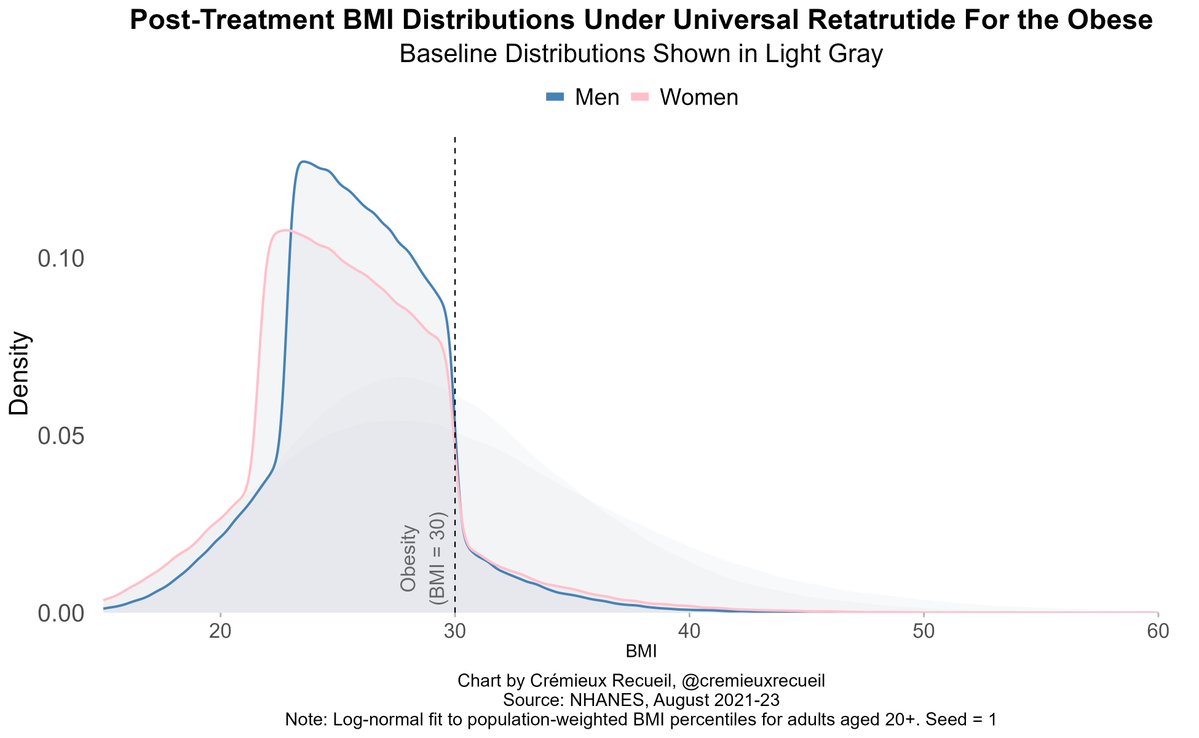
Now that we have phase-3 results for retatrutide, it's time to revisit the question:
What would happen to obesity if we gave every obese (BMI 30+) person the drug for just one year?
Well, the obesity rate would fall by more than 80%! We'd be skinnier than the U.S. circa 1980!
If covid infections make you *more vulnerable* to almost every other pathogenic infection by multiple mechanisms, then you'd expect increases in almost every other pathogenic infection.
And that's what we see.
Ten completely unsurprising news stories:
Aramco just confirmed what the data already showed.
Even if Hormuz opens tomorrow — rebalancing takes months.
And if the closure extends a few more weeks?
Normalization pushed to 2027.
This means:
▸ June → Operational Stress Level (7.6B barrels)
▸ September → Operational Floor (6.8B barrels)
▸ 2027 → earliest possible normalization
The market is not pricing a 2027 recovery timeline.
It’s pricing a quick fix that Aramco just said won’t happen.
This changes everything.