देश के हर दलित व्यक्ति का जन्म से मृत्यु तक, हर जगह, हर ��दम अपमान किया जाता है।
उनकी जितनी बुलंद आवाज़ होती है, उनपर उतना तेज़ हमला होता है।
कांग्रेस अध्यक्ष मल्लिकार्जुन खरगे जी के साथ हल्द्वानी में जो भी हुआ वो "शुद्धिकरण" का नाम दे कर उनके खिलाफ़ छुआछूत है - और छुआछूत भारत के संविधान के अनुसार दंडनीय अपराध है।
इस बात को 20 दिन हो गए - मगर अब तक कोई कार्रवाई नहीं की गई, कोई FIR दर्ज नहीं हुई।
नरेंद्र मोदी जी, देश के हर दलित व्यक्ति को आपकी यह दलित विरोधी विचारधारा साफ़ दिखाई दे रही है।
अब गेंद BJP के पाले में है - जल्द से जल्द SC-ST क़ानून के तहत FIR दर्ज हो, कार्रवाई हो और न्याय हो - वरना कांग्रेस पार्टी न्याय हासिल करना अच्छे से जानती है।
I started digging into India’s power capex story
Initially I thought it was mainly about power generation
Then I started following the companies behind it
Transformers
Cables
Transmission lines
Substations
Switchgear
Smart meters
Cooling
There’s a much bigger story here 🧵
Pravin Sawhney dropped part 2 and it is brutal.
Chauhan sat there and tried to sell a 4 day clash as a victory. Better satellites, free hand from the top, we picked the ceasefire time and now victory supposedly means "speed and sophistication."
That is not winning. That is dressing up a limited political operation and hoping people clap.
The brief itself was a joke on the Indian people. End Pakistan's terrorism in a few days, hit only terror camps, stay below the war threshold. Anyone who has watched this theatre for years knew that was never the real military objective.
Then they spent two days scrambling because the first plan was already failing and suddenly military targets were back on the table.
This is the pattern. Modi wants the big visual. Chauhan plays along. The force gets boxed in by political limits first, then told to call it success later.
Pravin is one of the few still saying it straight: competence got pushed aside, the public got the victory speech.
The country deserves the unfiltered version, not the photo-op version. https://t.co/iBYGYdN4Wh
"¿Que clase de gente son los soldados israelíes que permiten que un niño de 14 años se desangre delante de ellos durante 40 o 45 minutos de agonía? ¿Que clase de personas son sus mandos militares que fomentan que se desangren niños?".
Chris Sidoti, de la Comisión de Investigación de la ONU, denuncia el sadismo de los soldados sionistas, que dejaron que un niño palestino de 14 años se desangrara hasta la muerte mientras lo observaban.
Mama,
I last saw you and Papa together more than 35 years ago. Since the day Papa left, I have watched you face everything life threw at you with never-ending courage and dignity. Only Priyanka and I really know what you have been through, and how difficult your life after Papa truly was.
I am happy, and so proud, that your story - “Belonging: A Journey of Love” - will finally be read by the millions of people who love you. I know how hard it was for someone as private as you to tell the world your beautiful story.
Today, on his birthday, I can see Papa smiling and looking down proudly at his beautiful Sonia.
Love,
Rahul
From Forging to Casting: Meet the Company That Melts Metal Into Perfect Shapes — Investment & Precision Castings
We've spent three companies hammering, pressing, and squeezing hot metal into shape. Now let's switch tools entirely because casting solves the same problem in a completely opposite way, and IPCL is the perfect company to learn it through.
First, the story you need before anything else what's the actual difference between forging and casting?
Imagine you want to make an ice sculpture.
Method 1 Forging: You take a solid block of ice and carve/hammer it into shape using force. The ice stays solid the whole time, and because you're compressing it, the internal structure gets denser and stronger in the direction you pushed it.
Great for simple, strong shapes but you can't carve a hollow, twisty internal channel this way. That's forging heat the metal until it's soft and bendable (but still solid), then hammer or press it into shape.
Method 2 Casting: Instead, you melt water into liquid, pour it into a mold shaped exactly like what you want even something with hollow tunnels, thin curved walls, or intricate detail and let it freeze solid inside that mold.
You can make shapes this way that would be nearly impossible to carve by hand. That's casting melt the metal completely into liquid, pour it into a mold, let it solidify, then break the mold away.
Here's the trade-off that decides which one a company uses:
-->Forging wins on strength and simple, symmetrical shapes think crankshafts, axle beams, railway wheels, heavy gears. The directional hammering aligns the metal's internal grain with the stresses the part will face in real life.
-->Casting wins on complexity think turbine blades with internal cooling channels, pump impellers, valve bodies, medical implants. Things too intricate to ever hammer into shape.
Now, what is "Investment Casting" specifically — the technique IPCL pioneered in India?
Also called the "Lost-Wax Process," and the name itself tells the story:
1. You make a precise disposable pattern traditionally carved in wax, today often 3D-printed plastic shaped exactly like the final part.
2. You coat that pattern in a ceramic slurry, layer after layer, until it hardens into a ceramic shell around it.
3. You then melt the wax pattern out completely it's "lost," draining away and leaving a perfectly detailed hollow cavity inside the ceramic shell.
4. You pour molten metal (steel or a superalloy) into that cavity.
5. Once it cools and solidifies, you break the ceramic shell away, revealing a metal part with fine detail and a smooth finish needing almost no extra machining afterward.
It's essentially:
→ sculpt in wax
→ encase in ceramic
→ melt the wax out
→ pour metal in its place.
The wax "invests" its exact shape into the final metal part, then disappears.
Now — Investment & Precision Castings Limited (IPCL), the pioneer of this exact process in India
IPCL was founded in 1975 in Bhavnagar, Gujarat, and holds the distinction of being the pioneer of Lost-Wax Investment Casting in India 51 years of operating history.
Their pedigree goes back to historic technical collaborations with global casting leaders like Arwood Corporation (USA), Zollern (Germany), and Associated Foundries Engineering (Japan).
Three plants, each built for a different level of difficulty
-->Plant 1: Commercial Casting Division (1,800 TPA) using Air-Melt Induction Melting to cast Carbon Steel, Low-Alloy Steel, Stainless Steel, and Ductile Iron.
This feeds automotive powertrain parts, turbocharger components, pumps, industrial valve bodies, agricultural machinery, and fire & safety hardware the everyday, high-volume end of the business.
-->Plant 2: Commercial & High-Spec Division (1,200 TPA) using Air-Melt Casting and a Block Mould Process capable of casting single pieces up to 330 kg with investment-casting-level surface finish. Materials: Stainless Steel, Aluminum Alloys, Copper Alloys.
This feeds aerospace structural hardware, defense mechanisms, power generation turbine housings, and electrical switchgear a genuine step up in complexity and value.
-->Plant 3: Specialized Vacuum Melting Division (60 TPA):- this is the crown jewel, using Vacuum Induction Melting (VIM), Vacuum Investment Casting, and Roll-over Furnaces.
Here's why "vacuum" matters: certain superalloys Nickel-base and Cobalt-base, like Inconel react badly with oxygen when molten. Melt them in normal air and the metal oxidizes, weakening it.
Melt them in a vacuum chamber instead, and you get an extremely pure, defect-free metal that can survive the brutal heat and stress inside a jet engine.
This plant feeds hot-gas-path turbine blades, structural airframe housings, fuel system components, military missile/ordnance hardware, and even orthopaedic medical implants parts where failure simply isn't an option.
They also run 45 CNC/VMC machines (up to 5-axis capability) for in-house finish machining even though investment casting needs far less machining than forging, the highest-precision parts still need that final touch.
The moat and this one is built on trust that took decades to earn
-->Vacuum Induction Melting superalloy infrastructure melting reactive superalloys in an air-free vacuum prevents oxidation, delivering the extreme purity and high-temperature stress-rupture resistance that aerospace gas turbines and missile propulsion systems demand. Very few Indian companies can do this.
-->Indigenous defense and DRDO technology transfers IPCL is genuinely embedded in India's strategic defense supply chain, having secured specialized technology transfers from DRDO for advanced ceramic/superalloy cores. They hold official supplier status with HAL's Foundry & Forge Division and DGAQA certification.
-->Rigorous aerospace and medical accreditations NADCAP approval for Non-Destructive Testing, EN 9100:2018 (Aerospace Quality), ISO 13485 (Medical Devices), and IATF 16949 (Automotive). These audits take years to clear and create real switching barriers — once an aerospace client certifies you, they don't casually move to someone else.
-->Direct-on-Line (DOL) vendor status with Maruti Suzuki and Mahindra & Mahindra, meaning their parts skip the usual incoming-inspection queue entirely and go straight to the assembly line. That's the kind of trust only years of consistent quality earns.
-->50% spare capacity as a growth lever in FY26, IPCL produced ~1,500 tons against a total installed capacity of 3,060 tons roughly 50% utilization. That's enormous headroom to grow high-margin aerospace and defense output without needing to spend heavily on new plants first.
Now the numbers — Q1 FY27, and this quarter genuinely accelerated
Standalone, Q1 FY27 versus Q1 FY26:
-->Revenue from Operations: ₹44.02 Cr → ₹53.34 Cr, up 21.16% YoY.
-->Total Income: ₹44.31 Cr → ₹53.52 Cr, up 20.79% YoY.
-->Operating EBITDA: ₹6.99 Cr → ₹11.21 Cr, up 60.26% YoY.
-->EBITDA Margin: 15.78% → 20.94%, up 516 bps — a massive jump in a single year.
-->PBT: ₹3.02 Cr → ₹7.10 Cr, up 135.53% YoY.
-->PAT: ₹2.18 Cr → ₹4.99 Cr, up 129.47% YoY.
-->PAT Margin: 4.91% → 9.33%, up 442 bps.
-->Diluted EPS: ₹2.18 → ₹4.99, up 128.90% YoY.
Revenue grew 21%, but PAT grew 129% — nearly 6x the revenue growth rate. That's a company whose product mix is shifting hard toward the higher-value casting work, exactly the pattern I keep finding across this whole content series.
The quarter-over-quarter trajectory backs this up too — Total Income moved from ₹44.31 Cr (Q1 FY26) to ₹51.01 Cr (Q4 FY26) to ₹53.52 Cr (Q1 FY27), with EBITDA margin climbing steadily from 15.8% to 18.6% to 20.9% across those same three quarters — not a one-off spike, but a genuine trend.
Where the growth goes from here
-->Strategic pivot to Aerospace & Defence — positioning A&D as a core growth pillar under the "Aatmanirbhar Bharat" defense indigenization push.
-->Industry leadership platform — CMD Piyush Tamboli was appointed Gujarat State Chairman of the Society of Indian Defence Manufacturers (SIDM) for 2026-27, giving IPCL direct strategic engagement with national defense policy forums and major Tier-1 defense contractors.
-->Margin expansion via product mix — scaling their vacuum superalloy turbine blades and medical implant casting lines, both of which command meaningfully higher gross margins than commercial casting.
-->Captive renewable cost offsets — a commissioned 4 MW solar farm plus 2.5 MW of wind turbines now source 25%+ of total plant energy from green power, insulating them somewhat from grid electricity inflation.
-->Unlocked capacity leverage — that 50% spare capacity means they can scale revenue meaningfully without needing heavy near-term greenfield capex.
The risks worth understanding
-->Long aerospace/defense qualification cycles — prototyping, First Article Inspection, and PPAP sign-offs for critical aerospace turbine parts can take 12-24 months before translating into steady production run-rates. This is a patient business, not an instant one.
-->Raw material volatility — heavy dependence on imported primary nickel, cobalt, and specialized master alloys means input costs are genuinely sensitive to global commodity swings.
-->Automotive concentration — despite active diversification into aerospace and defense, commercial vehicle and automotive pump/engine components still make up a sizable share of the current base volume.
Why I'm sharing this
I'm not calling this risk-free — the aerospace and defense qualification cycles genuinely take 1-2 years to convert into recurring revenue, so a meaningful part of this thesis depends on patience, not just optimism.
I'm sharing it because a 51-year pioneer with genuine DRDO technology transfers, NADCAP and aerospace-grade certifications most competitors don't hold, and 50% spare capacity ready to absorb high-margin growth without fresh capex, are exactly the traits my checklist is built to catch.
Not investment advice. First casting-focused company in this series — curious how you'd compare this vacuum-melt superalloy niche against the pure forging plays I've covered so far. Let me know below
#Investing #IndianStockMarket #SmallCap #Casting #IPCL
INDIAN MANUFACTURING'S STORY
1) Manufacturing’s share of India’s value added rose from about 10.5% in 1950-51 to around 17% by the late 1970s, but has remained in the 14-17% range for the last several decades rather than rising continuously.
2) In 2025-26, manufacturing accounted for ~14.8% of GVA, showing that manufacturing has not increased its relative weight in the economy very strongly compared with services.
3) This matters for employment and jobs because mfg. creates large numbers of factory, logistics, maintenance, engineering, supply-chain and ancillary jobs, including opportunities for workers moving out of agriculture.
4) A higher manufacturing share can also support better-quality and more productive employment, especially when growth occurs in labour-intensive sectors such as textiles, food processing, footwear, electronics assembly, automobiles and other MSME-linked industries.
5) Manufacturing is also closely linked with exports because a larger and more competitive industrial base can increase merchandise exports, integrate India into global value chains, reduce dependence on imports and generate foreign exchange.
#IndianManufacturing #Factories
It is not that India has not been progressing. But we are simply running to stay in the same place.
Where we stand globally is one way of looking at it.
At the time of independence, our GDP stood at 9th place. Now we are at 6th place.
Most important is GDP per capita. From 97th rank in 1960, we are now at 147th. The 147th rank not only indicates how poor we are; given the huge inequality, probably 80% of the population is simply struggling to survive.
As I pointed out the other day, even if you adjust for Purchasing Power Parity, our rank is still 125th.
We have completely missed the manufacturing bus. In 1950, manufacturing was 12% of GVA and now it is 14%.
Except for Tamil Nadu and Gujarat, where manufacturing is growing on par with how China used to grow in its peak years, our manufacturing story is yet to begin.
Lee Kuan Yew once said:
“India cannot grow into a major economy on services alone. Since the industrial revolution, no country has become a major economy without becoming an industrial power.”
What was obvious about India to Singapore policymakers did not hit the vision of our policymakers.
Our share of global merchandise exports was 1.85% in 1950. After 75 years, we are still stuck at 1.69%.
And for nearly the last five decades, our GDP per capita growth has been only around 4.5% annualised, barely sufficient to move the needle from such a low base.
That is why we are still at $2,800 GDP per capita, a low income country ranked 147th globally.
The Centre and every single state have an enormous amount of work to do in numerous areas. This is not to become a superpower or a rich nation, but to achieve a decent GDP per capita of $10,000 around 2050.
As I pointed out the other day, despite whatever narrative we set, the crux is this:
During the last 12 years, our GDP has just doubled and our GDP per capita has not even doubled.
Those who ask why we should look at the numbers in dollars need to understand that the exchange rate itself reflects productivity, competitiveness, and capital flows.
अंकिता भंडारी के परिवार से 2 दिन पहले मिला। चार साल बीत चुके हैं, लेकिन आज भी वो न्याय का इंतज़ार कर रहे हैं - अपनी बच्ची के ख़िलाफ़ एक ऐसे अपराध के लिए जिसकी कोई माफी नहीं।
सिर्फ 19 साल की ���ंकिता वनंतरा रिज़ॉर्ट में रिसेप्शनिस्ट थीं जहां एक "VIP" मेहमान की शर्मनाक मांग का विरोध करने पर चीला नहर में डुबो कर उनकी हत्या कर दी गई। पोस्टमार्टम रिपोर्ट ने हिंसा और डुबोने के सबूतों की पुष्टि भी की।
मगर, रिज़ॉर्ट में अंकिता के रूम को किसी भी तरह की जांच होने से पहले ध्वस्त कर दिया गया जो खुद में संदेहपूर्ण है।
इस दुखद मामले में सबसे शर्मनाक बात है कि राज्य सरकार खुद आज तक उस "VIP" को संरक्षण दे रही है। क्यों? क्योंकि वह BJP-RSS का बड़ा नेता है।
यही BJP की विकृत मानसिकता है बलात्कारियों और अपराधियों को बचाना, उनका राजनीतिक संरक्षण करना, यहां तक कि बलात्कार के दो���ियों का फूल-मालाओं से स्वागत करना। दुनिया में सबसे घिनौने इंसान वो होते हैं जो बलात्कारियों की रक्षा करते हैं और BJP में ऐसे लोगों की भरमार है।
भारत तब तक आगे नहीं बढ़ सकता, जब तक महिलाओं को पुरुषों के इस्तेमाल की वस्तु समझने वाली यह अमानवीय मानसिकता खत्म नहीं होती। भारत तभी आगे बढ़ेगा, जब भारत की महिलाएं आगे बढ़ेंगी - सम्मान, सुरक्षा, समानता और न्याय के साथ।
This is the third company in my Forging & Casting series — Happy Forgings — and this is the company that made me understand what "3-ton components" actually means for a business model
After Ramkrishna Forgings and Rolex Rings, I thought I understood the ceiling on how big a single forged piece could get.
Happy Forgings is pushing that ceiling from 250 kg parts toward 3-ton mega-components — and building an entire growth story around who can even attempt that.
Let me walk you through why.
A 47-year-old company that's #2 and #3 in its own categories
Happy Forgings Limited is headquartered in Ludhiana, Punjab, and has been manufacturing since 1979 — 47 years of operating history.
They're the #2 producer in India of commercial vehicle and high-horsepower industrial crankshafts, and the #3 largest engineering-led manufacturer of safety-critical heavy forgings and machined components domestically.
They run 3 vertically integrated facilities in Ludhiana (Kanganwal I, Kanganwal II, and Dugri), strategically positioned near Dedicated Freight Corridors and Inland Container Depots, and carry an AA/Stable credit rating from both CRISIL and ICRA.
Their manufacturing edge — heavy-tonnage presses most competitors simply don't have
-->Current forging capacity: 152,000 MTPA, with a 4,000T press line commissioned in Q1 FY27 alone.
-->Current machining capacity: 75,200 MTPA, with 7,200 MTPA added in Q1 FY27.
-->Critically, 90% of finished products sold are fully machined — not sold as raw forgings.
Their installed press fleet includes 1×14,000T, 1×10,000T, 3×8,000T, 1×6,300T, 2×4,000T, 1×3,150T, and 1×2,500T presses, plus 9 hammers ranging 1.5T to 5.0T. Today, that fleet handles components up to 250 kg per piece.
Now here's where it gets genuinely interesting — they're adding a 1×14,000-Tonne Press, a 1×125-Tonne Counterblow Hammer, and a 1×8,000-Tonne Vertical Upsetter for near-net forging, adding 35,000 MTPA of capacity by FY28.
This new fleet is specifically designed to handle components up to 3,000 kg (3 tons) per piece — targeting AI data center mega-shafts, energy sector components, locomotive crankshafts, and wind turbine housings. Very few global suppliers can even attempt forgings at that scale.
Where the revenue actually comes from — five segments, each with its own story
-->Commercial Vehicles (33% of revenue) — 4-cylinder and 6-cylinder diesel engine crankshafts, front steering knuckles, front axle beams, brake flanges, transmission gear shafts. Domestic CV revenue grew 18% YoY in Q1 FY27 on infrastructure capex and fleet renewal demand.
Export CV declined 12% YoY due to transit routing delays on DDP terms to Europe and Turkey — though underlying OEM order commitments stayed intact, meaning this looks like a logistics delay, not lost demand.
-->Farm Equipment (32% of revenue) — tractor crankshafts, crown wheels, pinion shafts, bull gear blanks, differential housings. Grew in the mid-20% range YoY, with domestic agricultural volumes up over 20% YoY, notably outpacing subdued US/European farm equipment cycles.
-->Industrials & Data Centers (16% of revenue, the fastest-growing segment) — high-horsepower engine crankshafts, planetary carriers, valve bodies, wind gearbox components, turbine shafts, oil & gas high-pressure fittings.
Surged ~50% YoY, driven by structural capital investment in AI data center cooling/power infrastructure, electrical grid upgrades, and renewable energy installations.
-->Off-Highway & Earthmoving (11% of revenue) — heavy suspension bucket links, track rollers, chassis joints, hydraulic cylinders for mining and construction. Delivered 40%+ YoY growth across both domestic and export markets.
-->Passenger Vehicles & EVs (8% of revenue) — SUV engine crankshafts, electronic axle (E-Axle) drive components, lightweight steering knuckles, differential cases. Revenue expanded 70%+ YoY (domestic up 40%+, export shipments more than doubled), gaining wallet share with Tier-1 OEMs.
By geography: 72% domestic, 16% direct exports, 12% deemed/indirect exports — a 28% total export footprint.
The moat — and this one is genuinely capital-intensive to replicate
-->Integrated machining intensity — 90% value addition through precision machining using Landis and Junker automated lines. Machined components yield ₹253/kg realizations and industry-benchmark 31.3% EBITDA margins at ₹79/kg EBITDA.
-->Heavy press infrastructure as a literal capital barrier — commissioning heavy press lines (14,000T, 10,000T, 8,000T) requires a ₹650 Cr capex program and complex engineering, including foundations dug 80 feet deep over 1.5-2 years. That multi-year implementation cycle is real protection from low-cost competitors trying to enter this space quickly.
-->Pioneering 3-ton mega-forgings — expanding from 250 kg parts to 1.8-3 ton components puts them among a limited group of global suppliers capable of forging mega-parts for energy and data centers, with individual piece realizations reaching ₹28-30 Lakhs per component.
-->Permanent contractual price revisions — they successfully concluded ~4.5-5.0% price increases with OEMs to offset multi-year inflation on non-raw-material inputs, establishing a higher baseline margin starting Q2 FY27.
-->Structural cost protection via solar — installing a 20 MW captive solar facility (powering up by January-April 2027), expected to deliver 100-150 bps of EBITDA margin savings from FY28 onward through lower power costs.
Now the numbers — and every single line moved in the right direction
Q1 FY27 versus Q1 FY26 (consolidated):
-->Finished Goods Volume: 14,457 MT → 17,793 MT, up 23.1% YoY.
-->Realization per Kg: ₹245/kg → ₹253/kg, up 3.2% YoY.
-->Revenue from Operations: ₹354 Cr → ₹449 Cr, up 27.0% YoY.
-->Gross Profit: ₹205 Cr → ₹273 Cr, up 33.1% YoY. Gross Margin: 57.9% → 60.7%, up 276 bps.
-->Operating EBITDA: ₹101 Cr → ₹141 Cr, up 39.3% YoY. EBITDA Margin: 28.6% → 31.3%, up 275 bps.
-->EBITDA per Kg: ₹70/kg → ₹79/kg, up 13.1% YoY.
-->PBT: ₹89 Cr → ₹123 Cr, up 38.3% YoY.
-->PAT: ₹66 Cr → ₹91 Cr, up 39.2% YoY. PAT Margin: 18.6% → 20.4%, up 178 bps.
-->Diluted EPS: ₹6.96 → ₹9.68, up 39.1% YoY.
Volume up 23%, but PAT up 39% — both volume growth AND margin expansion working together here, not one at the expense of the other.
The multi-year trend shows genuinely rare consistency
FY21 to FY26:
Revenue ₹585 Cr → ₹1,546 Cr (21% 5-yr CAGR).
EBITDA ₹159 Cr → ₹471 Cr (24% 5-yr CAGR).
PAT ₹86 Cr → ₹302 Cr (28% 5-yr CAGR).
Gross Margin expanded from 57.0% to 59.1%, a full 215 bps improvement over five years.
Notice PAT's CAGR (28%) outpacing EBITDA's (24%) which outpaces revenue's (21%) — a clean, compounding margin story sustained over five straight years, not a single good quarter.
The balance sheet is genuinely pristine
-->Net cash position — Net Debt/EBITDA at -0.19x, with liquid cash and investments of ₹421 Cr exceeding gross borrowings of ₹330 Cr.
-->Debt-to-Equity: just 0.15x, on a Net Worth of ₹2,128 Cr.
-->ROCE of 18.2% and ROE of 15.2% in FY26, while still investing ₹461 Cr in gross block expansion.
-->Inventory days optimized to 50 days as of June 30, 2026.
Where the growth goes from here
-->Order book pipeline — visibility on ₹950 Cr of incremental peak annual revenue ramping up over the next 2-3 years. Breakdown: Industrials ~40%, PV ~25-30%, CV ~25-30%. Channel mix: 60% export-oriented, 40% domestic.
-->Portfolio transformation by FY29 — Industrials expected to double its revenue contribution to ~30% of sales. Passenger Vehicles targeted to reach 12-15%. Combined, high-margin Non-CV (PV + Industrial) is expected to make up 45-50% of total sales, a structural shift away from CV dependency.
-->Ultra-heavy line commercialization — completion targeted by end of FY27, with commercial revenue ramping from FY28. Margin profile on these new high-horsepower lines: ~60-65% Gross Margin on forged output, ~80-85% on machined output, translating to ~50% EBITDA margins — nearly double their current blended margin.
-->FY27 guidance — high-teen volume growth, with EBITDA margins maintained at or above 30%.
-->M&A optionality — with ₹400 Cr+ in liquid surplus, they're evaluating bolt-on acquisitions and technology JVs specifically in Aerospace and Superalloys (Titanium, Inconel metallurgy). Management has explicitly ruled out acquisitions in traditional CV or Farm sectors due to elevated valuations, staying disciplined toward high-technology, margin-accretive targets only.
The risks worth knowing
-->Sea freight and geopolitical transit delays — DDP export shipments to European and Turkish clients face extended voyage timelines, temporarily elevating goods-in-transit inventory (the same issue behind the export CV softness this quarter).
-->Capex execution timelines — the ₹650 Cr heavy forging program requires deep precision tooling and extended customer sample validation cycles before reaching full commercial scale in FY28-29. That's a multi-year execution window, not an instant payoff.
-->Agricultural equipment cyclicality — prolonged high interest rates and subdued farmer incomes across North America and Europe could dampen export demand growth for farm equipment forgings, even as domestic volumes stay strong.
Why I'm sharing this
I'm not calling this risk-free — the 3-ton ultra-heavy line doesn't commercialize until FY28, so a meaningful chunk of this growth story is still ahead of execution, not behind it, and export softness tied to shipping delays needs to genuinely resolve.
I'm sharing it because a 5-year track record of PAT growing faster than EBITDA growing faster than revenue, a net-cash balance sheet with an AA credit rating, and a genuinely rare capability to forge 3-ton components most global suppliers can't touch, are exactly the traits my checklist is built to catch.
Not investment advice. Third company in my Forging series — curious how you'd rank the mega-forging bet here against Ramkrishna's diversified footprint or Rolex Rings' comeback story. Let me know below
#Investing #IndianStockMarket #SmallCap #Forging #HappyForging
While the upper middle class is in trouble, India's poor have never had it this good.
Yet, that is precisely the problem with India's economy right now.
Read the article to understand why
I have always maintained that GDP and per capita GDP targets should be taken with a large dose of salt- unless they are set as realistic, aspirational goals by states that are already performing well, have a clear roadmap, and can achieve them under plausible scenarios.
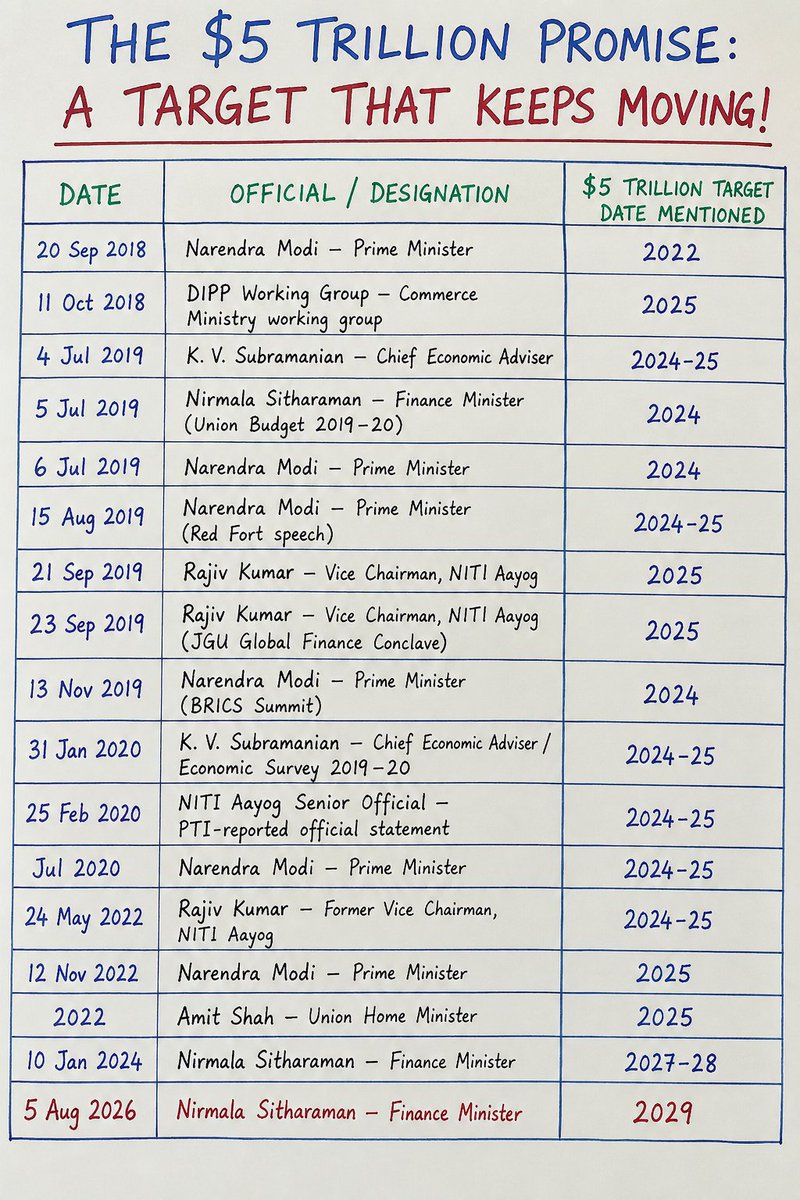
This image has been developed by Manoj Arora (@manoj_216).
Prime Minister Modi first set the target of a $5 trillion economy by 2022. Today, the IMF confirms India’s current GDP at $3.92 trillion.
The government has now revised the target year to 2029.
How many still remember the 2024 election campaign slogan of "Modi ki Guarantee" that India would soon become the world’s third largest economy?
It may or may not happen - most likely not within the promised timeframe. Either way, it makes little real difference to ordinary citizens.
What really matters is GDP per capita.
India’s GDP per capita rank in the world stands at 147. For those who insist we should only look at PPP (Purchasing Power Parity) terms, the rank is still an abysmal 127.
We have only doubled our GDP over the last 12 years and GDP per capita has not even doubled.
Given our extremely low base, this is not the performance we should have delivered.
Wasted opportunities.
EXTRAORDINARY SPEECH FROM AN ORDINARY REHDI WALA
"Govt talks about Logistics, to increase the GDP of the Country, Govt provides low-interest loans and cheap electricity to big businesses; however, Sir, if you do fail to provide Labourers fair compensation basic wages for their labor, then your GDP is of no use." raising concerns for Poor Labourers of our Nation.
"We earn Rs. 500 & bring it home; we buy salt, soap, rice, and flour, and we pay taxes on those purchases too. We are taxpayers of India; we do not live on anyone's charity." He became breathless as he spoke up for the poor laborers, and he began to weep.
"I have heard somewhere that this country is going through a 'golden age,' yet even today, the majority of Indians survive on less than the minimum income and work as manual laborers." his soft eloquent smile will melt your conscience, make your heart shudder and shake you to your very core; you will feel his anguish, but alas ! the helplessness, what can we do ?
"No one talks about the laborer; the laborer cannot take to the streets, Sir. If he misses even a single day of work, the hearth in his home won't be lit, the laborer cannot protest." & he started crying...No government has the right to inflict such oppression and cruelty upon laborers.
As I watched this video, I was compelled to think again, how can a Labourer, a rehdiwala, without have basic education, only using Google, hassuch a deep knowledge of Economic Crisis, spills the beans on sad State of Affairs of India's Labourers after being a 5 Trillion Economy ? Such a Clarity of thoughts on Subjects beyond his reach n Intellectual. Such ppl rise from the Slums, Life-Struggles, speak their heart, wisdom flows in their words like a fluent river, strikes our spinal cord n keep echoing in our Minds till a long time. Now, I feel proud that such ppl exist, Despite being poor, they are the heritage of this land, the future of our country, possessing an ideology that is bright and pure.
Question is, who is responsible for their pitiful life, who cares for such ppl, who will assure justice to them, who will raise his voice for these poor Labourers?
Let's use our Social Media for them, support them & save them from disappearing like snow-flakes in the air of Ignorance.
Least we can do is, Tag all the Political Party Leaders along with this Video & help them make their Livelihood better. I have done my part, have you ?