Radio + print journalist focusing on the environment. Docs for @Atlanticvoice @CBCQuirks, @cbcideas, words in @thewalrus, @hakaimagazine, @csmonitor. She/her
Greenhouses are energy hogs - and they're proliferating rapidly. But as I explored for @AmbrookResearch people are developing low or no-carbon alternatives - by tapping into the heat beneath our feat
Out of renewable energy sources, geothermal is one of the least discussed. But that's changing!
Around the country, indoor farmers are pulling heat from inside the earth to power their greenhouses. New from @MoiraDonovan:
https://t.co/GtzXcq82de
In the name of finding wonder in difficult times, sharing this story I wrote for @hakaimagazine on fascinating work by @kagiadi — 6 million years ago, the Mediterranean nearly dried up. How it recovered (or didn't) has lessons for our present moment
For CBC, I explored a project that's investigating the efficacy & impact of ocean carbon dioxide removal — and the ambivalence scientists feel about work that emissions have made necessary. As one scientist said: "We have to try. I wish we didn't have to" https://t.co/vH7gMUCtKU
With an expansion of insect agriculture on the horizon, insect farmers and researchers say we need to start considering: what does welfare look like for an insect? And for that, they're digging into the question of sentience. My story for @AmbrookResearch
As insect agriculture scales up rapidly, there's a growing cohort of scientists and advocates trying to determine if bugs can feel pain, and if we should develop insect welfare regulations.
Fascinating new piece from @MoiraDonovan: https://t.co/DPXiG2IfFR
With an expansion of insect agriculture on the horizon, insect farmers and researchers say we need to start considering: what does welfare look like for an insect? And for that, they're digging into the question of sentience. My story for @AmbrookResearch
As insect agriculture scales up rapidly, there's a growing cohort of scientists and advocates trying to determine if bugs can feel pain, and if we should develop insect welfare regulations.
Fascinating new piece from @MoiraDonovan: https://t.co/DPXiG2IfFR
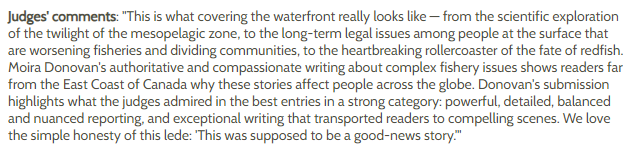
Wow - completely floored by this. This is bittersweet, given Hakai's uncertain future (help them if you can!) But for now, honoured to be recognized by @sejorg alongside the incredible team at @hakaimagazine for stories in this crucial and underreported area
Amazing news! @MoiraDonovan just won first place at the @sejorg awards for "Outstanding beat reporting" for a collection of five @hakaimagazine stories all about fishing.
Hakai may be on it's way out, but we're doing it with a bang.
https://t.co/z6GEoeUYEt
For @thenarwhalca I wrote about the bitter fight over an artificial lake that’s being maintained by provincial order - despite Mi’kmaq objections and scientific advice - dividing both the ecosystem and the town around it
Threats, a lawsuit and a town divided: how an artificial lake in the small community of Windsor, Nova Scotia became a battleground over environmental and Indigenous Rights. New from @MoiraDonovan: https://t.co/x6OMIDo1Jc
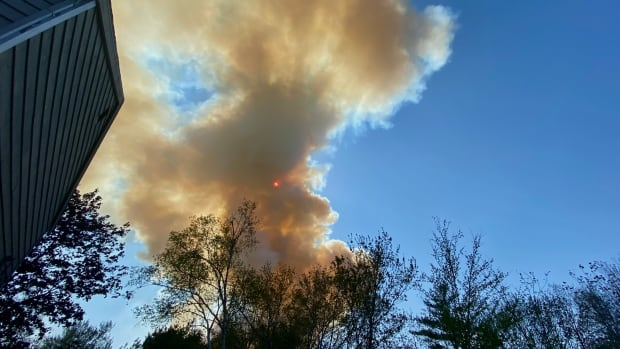
New research aims to help Nova Scotians prepare for, respond to poor air quality https://t.co/HkVE4W0QJ9 @MoiraDonovan
Get weekly updates: https://t.co/CNRgsiBFbH 🍁
Ropeless gear can protect whales — but its use is controversial. A project deploying the gear to reopen a fishery shuttered by whale protections is showing how collaborations can overcome mistrust. My latest for @hakaimagazine with excellent edits as always from @_ColinS_
The Long Road to Ropeless Fishing
The first step to overcoming fishers' resistance to the new conservation-focused technology is building trust.
https://t.co/wrmXSqDuVn
In Nova Scotia, rivers are still suffering the effects of acid rain — and funding to restore them is limited. But the realization restoring rivers could help remove C02 offers a glimmer of hope - my latest for @CBCNS https://t.co/a25bb9RcKG
ICYMI - Tidal power's struggle to stay afloat. I spoke to @MoiraDonovan for The Jolt podcast about her recent @Foresight_CE article on tidal power in Canada and the struggle to get projects off the ground. Listen here: https://t.co/rymnSlRnsM
Gutting news about a special outlet and an exceptional team - Hakai’s closing is a huge loss to the ocean-loving public, to the science journalism community, and (selfishly) to me, because I love working with them so very much. Hoping against hope that a funder can be found
Today, I’m heartbroken as the news is out—@hakaimagazine, a publication I helped launch with my dear friend and colleague @judeisabella, is done at the end of 2024. It’s such a shame for my colleagues, freelancers, readers, the science community and much, much more.
Recently passed bill aims to address practice of disproportionately situating polluting industries and environmental hazards near Indigenous, Black and marginalized communities. @MoiraDonovan has the story. https://t.co/PYna7cvp4J
As the gap through which we squeeze to even 2 degrees of warming narrows, entrepreneurs, scientists, and government officials are increasingly looking to the ocean as a tool for carbon removal. For @thewalrus , I spoke to some of the people asking the question: are we ready?
Start-up executives and scientists argue that progress on ocean carbon dioxide removal is necessary to avert climate catastrophe. But the momentum fuelling the development of geoengineering is surpassing scientific consensus on it, writes @MoiraDonovan.
https://t.co/P73NGfkq5h
Very honoured (and also, stunned) to have been chosen for this award, amid so many outstanding nominees - a big thank you to @caj for the recognition, and to @hakaimagazine editors (especially @toughcitywriter) for seeing the importance of & supporting this story🐟🎉
Thrilled to be nominated alongside these brilliant journalists - thank you to @caj for the nomination, and to @hakaimagazine's editors (including @toughcitywriter) for supporting the exploration of a situation that will shape fisheries on the east coast for years to come