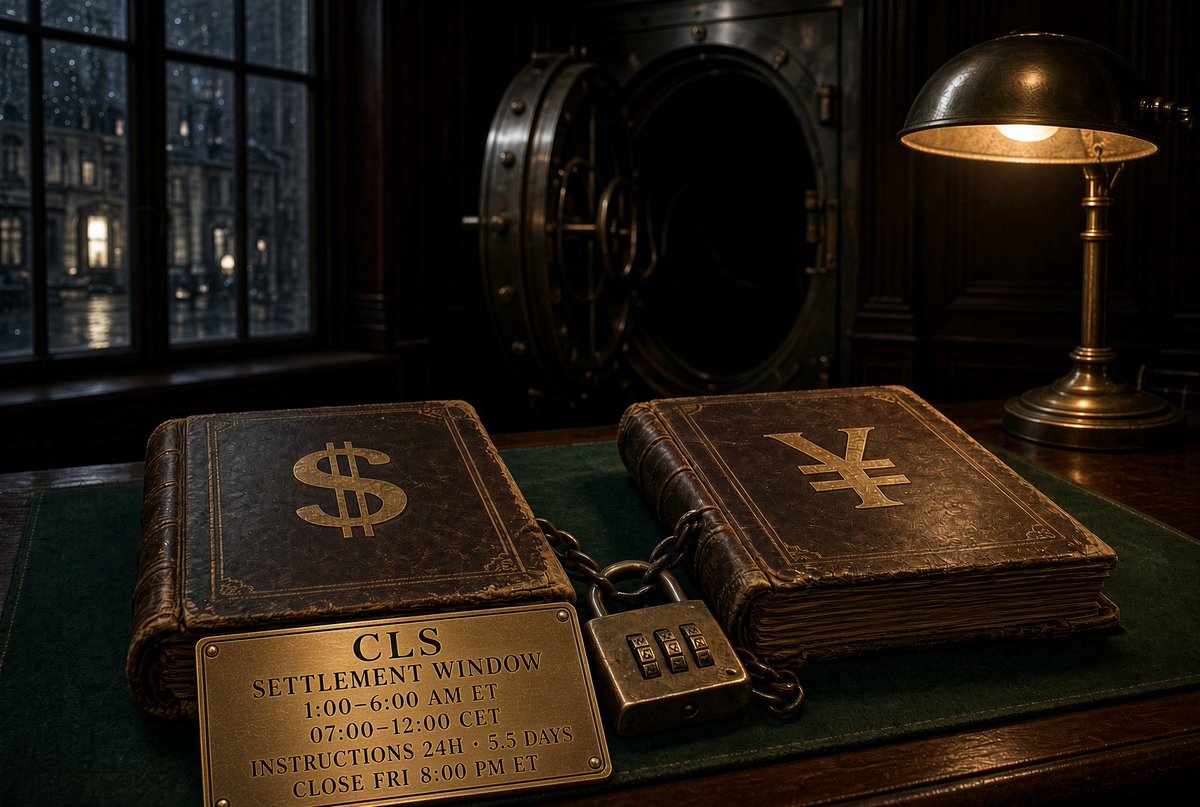
A Bank called Continuous Linked Settlement 🏦
When you change dollars into yen, two payments have to happen. You send dollars. They send yen. If one side pays and the other side dies mid-wire, you are out the money.
That gap has a name from 1974: Herstatt. A German bank was shut while New York was still open. Marks had been sent. Dollars never came back.
CLS - Continuous Linked Settlement - is the lock a few of of large banks came up with to stop that 🔒
It is a special bank in New York. About 75 of the world’s large banks have an account there. Each morning they send in only the net they owe in each currency from the day before. CLS holds both sides and releases them together. Both legs or neither - “PvP”
Roughly $8 trillion a day gets processed this way. CLS is only open for a few hours when every major payment system is awake.
Eighteen currencies get passed that lock. There are more than 180 others that do not. Most of Latin America, most of Africa, most of ASEAN. Those pairs still settle the old way: one bank pays, then waits.
You have never heard of it because you are not one of the 75. There are thousands of banks that are not members. A Thai bank, a credit union in Milwaukee, a Nairobi wallet - they do not call CLS. They call JPM or Citi, and those banks call CLS. No seat, no key 🔐
The name is American. The stack is not. CLS Bank International sits at 32 Old Slip under a New York Edge Act charter. The Fed watches it like a bank. That is where the lock lives - the multi-currency accounts and final ledger “both legs or neither.”
Above the edge act bank is London. A UK intermediate owns the New York charter. Sister companies in London run the pipes: they take the SWIFT instructions, match the two sides of the trade, build the morning net for each member in each currency, time the pay-in window to every central bank’s RTGS, and keep the session from breaking.
The money does not sit in London. Instructions and the timetable does. FX pricing is at market
Above London is CLS Group Holdings AG in Lucerne. Swiss private company. Not a listed stock. The shareholders are the same large banks that settle on the New York books - JPM, Citi, Barclays, HSBC, Deutsche, MUFG, and the rest of that member list.
They get a vote and a board seat mix. They do not get a dividend. It is a “mutual utility”: built by the club, owned by the club, run for the club.
The Fed still treats the Swiss parent as a bank holding company and is the primary overseer of the whole group. Other central banks watch the currencies they issue. A U.S. license, Swiss cap table, London plumbing.
That lock only works for money that still lives on a bank’s books - deposits
A reserved PPSI payment stablecoin is cash that can leave. It does not have a CLS account. It does not wait for morning. It does not close on Friday at 8 o’clock.
Eighteen flags and 75 doors were the whole design. Everything else was always outside the lock.
@Monetaryguy589
Microsoft has laid off thousands of employees while investing billions in AI. Now Outlook goes down, and everyone is depending on human engineers to get things running again.
It’s interesting how companies keep talking about replacing people until something breaks and they need people to fix it.
The coin is cash. The deposit is a claim.
A bank deposit is a loan you made to the bank. The bank lends it out. Your name is on every entry. Every card tap still says it is you. When you pay, the claim just moves - and you wait on a correspondent and a cut-off. If the house fails, you are a creditor, and insurance has a cap. The deposit wins the statement. It does not travel on its own.
Cash wins the street. No name, no ledger, no freeze on an address. You hand it over and walk away. What cash cannot do is the trip: pay someone who is not in the room, at any hour, across a border, without a suitcase or a correspondent.
A dollar built to the GENIUS structure sits between them, and it is not a deposit. Fully reserved, one-for-one, in a vault that is not the issuer’s. When you pay, the obligation is extinguished. 24/7. You pay a wallet, not a routing number. No branch, no card network, no correspondent. A foreigner can hold it without a U.S. checking account.
The privacy of a stablecoin is the part that works like cash. They take your ID when you buy the coin - the same as cashing a check at the bank - and again if you convert it back into a deposit. In between, you can pass it along anonymously - wallet to wallet. The bank does not need to know who you paid. The ledger shows millions of wallets and might show amounts, but your name is not on any of them. Your name still sits back at the door where you originally acquired it.
🪙A freeze on a coin hits a single wallet address - you can have as many wallet addresses as you want
💳A freeze on a checking account has your name on it - impacting other things with your name on it
💵Cash has no freeze at all.
Cash wins the street. The deposit wins the statement. The reserved coin wins the trip that was never the bank’s business to begin with - and you can make that trip with nothing but a phone and QR code.
In the U.S. we have $7.4T of Treasury Bills outstanding- which means we must refinance $600B of Bills each - or about $300B each Tuesday and Thursday
It’s naive to assert a run on a stable coin issuer holding bills - even a large run - would have any impact on Treasury pricing.
It would just get sucked up into Repo along with the other Bills being refinanced that day
⚠️ALERT: A GLOBAL Microsoft outage has knocked out Outlook, Teams and Copilot across 74 countries, hitting software used by 450 MILLION work accounts.
It has dragged on for more than 5 hours, and Microsoft has not confirmed the cause.
At the centre of it is something most of us never think about, but rely on every day.
Exchange Online, the system that delivers Outlook email for businesses, began failing around midday Eastern time on Thursday.
By 1:25 PM, problem reports had jumped from fewer than 15 a minute to 19,650.
Outlook reports alone ran 2,000 times above normal.
A US state government and two hospital systems in Michigan lost access to email.
It even reached ChatGPT and Claude, whose makers said their Microsoft connections were affected.
Reports spiked for Amazon’s AWS too, until Amazon said it was “operating normally” and called the outage reports “inaccurate.”
Microsoft says a number of its servers became “unexpectedly unavailable.”
It paused all deployments and began restarting them.
Hours later, it said its fixes “have not provided the anticipated relief.”
Even Defender, the platform companies rely on to detect cyberattacks, is caught in the outage.
Earlier the same day, Teams had already gone down for over an hour in North America.
Microsoft has not said whether the two are linked, and it has not pointed to an attack.
Reports have eased from a peak near 130,000 to about 37,000 as some servers return, but Microsoft has not declared it fixed or said how many customers were cut off.
DTCC going to Solana is not a payment story, and it is not DTCC picking a winner over XRPL.
DTCC is putting digital twins of US stocks, ETFs and Treasuries onto several chains - Canton and a private network already, Stellar then Solana and Circle’s Arc next year. Official books stay at DTC. Only registered membership wallets.
The cash that pays for those twins, and the cash that crosses a border, is a completely different object. DTCC itself still lists “digital cash” as future work.
A Crypto prime can finance a crypto trade. It does not, by itself, get a foreign firm into the US securities warehouse, and it does not extinguish a payment claim.
A BNY tokenized deposit is a claim on a bank. Useful if you already have an account there. If you don’t, the check doesn’t clear. Banks like that layer: take a reserved coin and fold it back into a deposit or a repo.
Ripple Prime is the only shop that sits across all these rooms. It has doors into US Treasury and equity clearing (FICC’s government-securities division, an NSCC listing that clears through Pershing, and Nodal Clear for derivatives), it can hold a vault-backed stablecoin, and a foreigner can carry that coin without a US checking account. Prime is the teller who will take foreign cash that walks and still get you into the domestic U.S. warehouse.
The cross-border piece people keep missing: paying someone in another country is not “put the Treasury on Solana.” It is two reserved coins meeting and extinguishing, 24/7, without a correspondent or a cut-off - "cross border settlement"
If the other jurisdiction has no reserved coin of its own, it ends up being forced to hold the dollar coin - what Türkiye's FSB just called "digital dollarization". The clerk for that meet is a public permissionless ledger. The dollar leg is a GENIUS compliant reserved coin.
When a second official coin shows up on the same clerk, the trade writes itself.
If we are going to tokenized sovereign assets and currencies, there must be a way to transfer those intrinsic values with settlement finality from one soverign to another (something that doesn't really occur today).
Blockchain technology allows countries to circumvent correspondent dollar rails and the concept of expanded nostro balances - it also allows both parties to extinguish claims (settle) with a neutral permissionless clerk and auto FX if so desired.
The U.S. response was to go first - via segregated and fully reserved high security payment stablecoins - "digital cash". Dollars that are not bank deposits and whose claims can be extinguished against another similar sovereign claim (with a native crypto asset as the settlement layer between the two soverign claims)
While not conceding the dollar reserve status, I would assume the U.S. is definitely concerned about these new technologies - hence the ongoing narrative from Treasury about the expansion of dollar stables and how they will preserve this status.
Yes - nominal growth and earnings are a real part of the equity story. They sit next to a second fact that matters more. QT did not shrink the Fed Layer the way the headline balance sheet suggests.
The Fed's total assets peaked at $8.97 trillion on April 13, 2022, bottomed at $6.54 trillion on December 3, 2025, and were $6.75 trillion on November 4, 2026 - a $2.2 trillion decline. Almost all of that was offset, for the banking system, by runoff of the overnight RRP facility, which fell from a $2.37 trillion peak in September 2022 to essentially zero.
Securities minus the TGA minus RRP was $5.59 trillion when QT started in June 2022 and $5.52 trillion in September 2026 — nearly unchanged, and still about $2.1 trillion above February 2020.
The deposits-minus-loans gap is still $5.54 trillion, versus $3.28 trillion just before COVID. The stock of deposits that can bid for assets was not taken away.
They told you QE was "money printing" and that it would show up in your grocery bill.
Look at the order it actually happened in:
1️⃣ 🟦Reserves +104% YoY, May 2020
2️⃣ 🟧Nasdaq +69%, Mar 2021 (10 months later)
3️⃣ 🟩Home prices +20.8%, Mar 2022 (12 months later)
4️⃣ 🟥CPI 9.0%, Jun 2022 (3 months later)
5️⃣ 🟪Rents 8.8%, Mar 2023 (9 months later)
That's 34 months from the Fed “printing it” until it hits your rent.
Reserves never reach the public. They sit on the balance sheets of the largest domestic and foreign banks, outside M2, and the first thing they inflate is asset prices. Consumers feel it last, through housing.
Since 2008 reserves are up 65x while bank loans are up only 2.1x. CPI averaged 1.6% from 2009 to 2019. The money didn't go into productive loans into the economy. It went into the asset base.
Powell went on TV and said "we print it digitally" without explaining any of this. The affordability crisis isn't a mystery. It's the Fed Layer, and the people selling you the money printing story are skipping over it
Moody’s has rated Ripple USD (ethereum:0x8292bb45bf1ee4d140127049757c2e0ff06317ed), the first stablecoin to receive a rating from a major credit agency.
Rajeev Bamra of @moodysratings joins @RemyBlaireNews to discuss how stablecoin credit fundamentals aren’t going away, with the risks relocating into the digital wrapper.
I fully expect the U.S. to have tokenized gold and/or tokenized gold convertible interest bearing bonds.
The trick will be, once countries do this, how will that intrinsic value transfer digitally across borders without moving the physical.
If you own a U.S. gold backed token, will it be accepted elsewhere, and if so, how will that intrinsic value settle outside U.S. jursidiction.
Agreed on the physical goods comment, but to your USD stablecoin comment, its important to understand we don't have OCC approved PPSI's yet (lots of new applicants however)
Also, I don't see how we move away from Treasuries as the best form of base financial collateral. Interest bearing collateral is what makes the system work and allows for easy expansion 🤔
It will be interesting to see what happens if/when we get FIAT pegged payment stablecoins backed by gold or other commodities whose values can float - and FIAT pegged payment stablecoins backed sovereign cash/bonds without interest (GENIUS type not floating) and how these may interoperate and settle
Cash Money 🤑
As of last week, there was $2.89T of dollar denominated currency printed by the Federal Reserve
About $400B sits in Federal Reserve Banks. Of the $2.49T in circulation, 45% ($1.1T) is located outside the United States
83% ($2.1T) of all currency is denominated in $100 bills
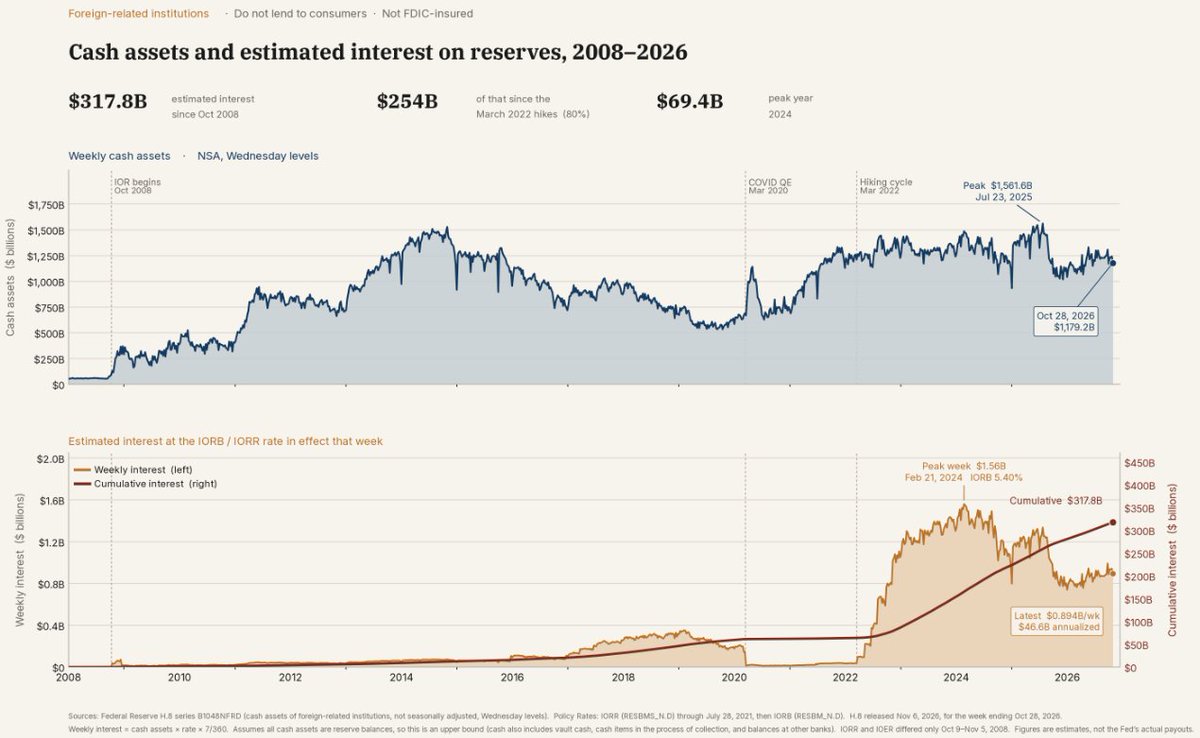
With the recent hike in IORB up to 3.9%, the Fed is now paying about $900M per week in interest on approximately $1.2T of Reserve balances held by Foreign Bank Branches in New York district #2.
These Foreign Banks don't make loans to U.S. consumers and are not FDIC insured.
They told you QE was "money printing" and that it would show up in your grocery bill.
Look at the order it actually happened in:
1️⃣ 🟦Reserves +104% YoY, May 2020
2️⃣ 🟧Nasdaq +69%, Mar 2021 (10 months later)
3️⃣ 🟩Home prices +20.8%, Mar 2022 (12 months later)
4️⃣ 🟥CPI 9.0%, Jun 2022 (3 months later)
5️⃣ 🟪Rents 8.8%, Mar 2023 (9 months later)
That's 34 months from the Fed “printing it” until it hits your rent.
Reserves never reach the public. They sit on the balance sheets of the largest domestic and foreign banks, outside M2, and the first thing they inflate is asset prices. Consumers feel it last, through housing.
Since 2008 reserves are up 65x while bank loans are up only 2.1x. CPI averaged 1.6% from 2009 to 2019. The money didn't go into productive loans into the economy. It went into the asset base.
Powell went on TV and said "we print it digitally" without explaining any of this. The affordability crisis isn't a mystery. It's the Fed Layer, and the people selling you the money printing story are skipping over it