$SPCX is reportedly considering a direct-to-consumer Starlink mobile service in the U.S., which could put it in direct competition with $VZ, $T and $TMUS.
SpaceX is trying to move beyond carrier partnerships and turn Starlink into a full consumer connectivity platform.
$ASTS $SPCX: Starlink declaring that it is going to compete directly with MNOs just exponentially INCREASED AST SpaceMobile's strategic value to AT&T, Verizon, T-Mobile, Deutsche Telekom, KDDI, NTT Docomo, Softbank, Vodafone, Orange, Telefonica, Saudi Telecom, Telus, Bell, AND MORE
Also tech cos competing with SpaceX/Tesla will increasingly look to partner w/ AST, just like Google and Meta already have
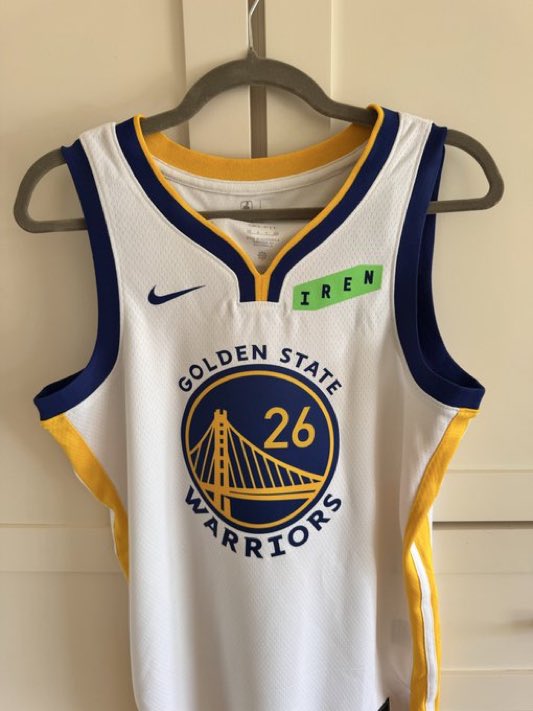
Australia-founded IREN will have its logo featured on the jerseys of the Golden State Warriors starting next season, the latest sign of the AI data center boom going mainstream https://t.co/4I4mBxLzNl
IREN is building AI infrastructure at gigawatt scale. Becoming the provider customers think of first takes more than building it. It takes presence where decisions get made.
Our Golden State Warriors (@warriors) partnership brings us deeper into the Bay Area AI ecosystem: closer to the customers, partners and talent shaping what's next.
As we serve a widening base of enterprises, AI labs and startups, that presence is how IREN stays in the conversations that matter.
Deal is apparently 50m per year for GS NBA, WNBA and G-League team. 50m per year is alot and more than I like. Really IREN shows up with revenue beats next earnings if they are comfortable spending this.
https://t.co/9Mw5ZkbcrI
$IREN Gold State Jersey: Why?
As a software engineer, I dislike advertising spend. My first reaction was negative: why would IREN spend $20m a year on NBA advertising? The previous Golden State Warriors sponsor, Rakuten, had a 3 year 60 million contract to get their logo on the Golden State Warriors Jersey (1). Those were in GS's championship contention years but likely the price is still around that price range.
Some people are mad at @danroberts0101 for communicating that IREN was targeting hyperscaler customers that don't need software or marketing. Both the Mirantis acquisition and the GS sponsorship are without a doubt not for selling to capacity to hyperscalers and Metas of the world but for small enterprise customers that currently need orchestration software. So why the sudden pivot?
This comes back to Nvidia GPU allocation and Nvidia's incentives. Nvidia's mold of the Neocloud is one that competes with the hyperscalers. Nvidia is not going to allocate GPUs to IREN if all IREN is going to do is build out capacity for Microsofts and Metas of the world when both are attempting their own ASICs. Nvidia is going to allow IREN to sell some capacity to hyperscalers but they better also be benefitting the Nvidia agenda.
To fit the Nvidia agenda, IREN needs to be compete against the hyperscalers for customers. You see, hyperscalers own the customer relationship and are attempting to swap out the GPU layer with their own ASICs ala TPU and Trainium. Nvidia need to hedge with a different store front for these small enterprise customers. Nvidia has worked very hard to secure HBM, with Jensen essentially going to Korea to kowtow to SK and Samsung for capacity and HBM is sold out for all of 2026 (2), so it's clear that GPU is sold out for 2026. GPU access is essentially HBM access since they are co-packaged.
GPU access problem for IREN in 2026. In order to address this for 2027, Nvidia probably demanded the following: become a Neocloud that sells to small enterprise customers. IREN has no choice but to agree and make the pivot for half their capacity. This is clear in the sequence of events:
1. Nvidia sets up IREN to acquire Mirantis for orchestration software.
2. IREN becomes a Nvidia partner and Nvidia is given options to buy IREN stock contingent on GPU deliveries.
3. IREN has to show up and market to small enterprise customers. Showing up means acquire-hire of Awaken marketing company and sponsoring GS so that IREN will hav reach to small enterprise customers. Once Nvidia sees that IREN is getting traction with small enterprise customers, then Nvidia will be able to allocate IREN GPUs as it benefits Nvidia's long term strategy.
Going forward IREN will sell both to large enterprises and small enterprises. Small enterprises to fit the mold that Nvidia has for Neoclouds. IREN has to fit the Nvidia mold to not repeat it's 2026 problem: GPU priority.
IREN will be getting enough GPUs to fill out it's 3.7B but getting them later in the schedule delayed debugging of it's current buildout. I expect IREN to hand over H1 in late July or August and clear expectations for bring up. H1-4 will be IREN's large enterprise deliverable and IREN will likely have to sell to smaller enterprises for the 50k B300s ordered earlier this year. This will require the Mirantis acquisition to finish in August which also explains why the 50k B300s are un-contracted for now.
$ASTS hit $63 for the first time in the first week of Oct, 2025. The stock is trading at the same price today, but since Oct 2025, $ASTS has:
- Signed a definitive commercial agreement with Verizon for direct-to-cell satellite service in the U.S.
- Verizon agreement expanded beyond the original strategic investment into a commercial deployment agreement.
- Shipped the first next-generation BlueBird Block 2 (BlueBird-6/FM1) satellite to India for launch preparations.
- BlueBird Block 2 became the company's largest and most capable satellite ever built.
- Announced a 10-year agreement with STC Group.
- STC committed $175 million in prepaid capacity to support deployment in Saudi Arabia and neighboring markets.
- BlueBird satellite design was recognized by TIME Best Inventions 2025.
- Continued scaling Block 2 production ahead of the first launch.
- Expanded satellite manufacturing workforce in Texas.
- Advanced integration of additional Block 2 satellites for the 2026 launch cadence.
- Successfully launched BlueBird-6, the first Block 2 satellite.
- Launch performed aboard Indian Space Research Organisation's LVM3 rocket.
- BlueBird-6 became the company's largest commercial communications satellite to reach orbit.
- Demonstrated continued execution after transitioning from prototype satellites to commercial-generation satellites.
- Ended 2025 with six operational satellites in orbit.
- Entered 2026 fully funded to deploy 45–60 satellites through 2026.
- Reaffirmed commercial service plans for the U.S., Europe and Japan.
- Expanded government business development efforts.
- Highlighted ambitions in connected vehicles, IoT and enterprise connectivity.
- Continued manufacturing multiple Block 2 satellites simultaneously.
- Announced plans to repurchase portions of outstanding convertible notes to optimize capital structure.
- Raised additional equity through registered direct offerings tied to debt management.
- Continued strengthening liquidity for constellation deployment.
- Announced two new manufacturing facilities.
- Expanded production footprint into Midland, Texas.
- Expanded production footprint into Homestead, Florida.
- Increased domestic satellite manufacturing capacity.
- Added a fifth Texas facility.
- More than doubled employee count to over 1,800.
- Continued vertically integrating manufacturing and testing operations.
- Launched BlueBird-7 aboard Blue Origin's New Glenn
- First commercial customer payload flown on New Glenn.
- Launch failed to reach the right orbit after a vehicle anomaly.
- Rapidly shifted focus to BlueBird-8 through BlueBird-10 following the failure.
- Insurance reduced the financial impact of the lost satellite.
- Continued production of satellites through BlueBird-37.
- Prepared next Falcon 9 launch campaign.
- Continued expanding relationships with government customers.
- Continued manufacturing at multiple U.S. facilities simultaneously.
- Successfully launched BlueBird-8.
- Successfully launched BlueBird-9.
- Successfully launched BlueBird-10.
- Three satellites launched together aboard SpaceX Falcon 9.
- Expanded constellation from seven to ten satellites launched overall.
- Demonstrated recovery from the April launch failure in only two months.
- Confirmed satellites capable of nearly 200 Mbps direct-to-phone data rates.
- Confirmed Block 2 arrays span roughly 2,400 square feet, the largest commercial communications arrays in LEO.
- Confirmed BlueBird-11 through BlueBird-13 were already nearing shipment.
- Confirmed additional launches targeted roughly every 1–2 months.
- Announced another Falcon 9 launch planned for early August.
- Patent portfolio exceeded 3,800 patents and patent claims.
Overall, from October 2025 to June 2026, $ASTS checked off a remarkable number of execution milestones: 2 major commercial agreements (Verizon and STC), 4 Block 2 launch attempts (3 successful, 1 failed), 4 Block 2 satellites reaching orbit (BlueBird-6, 8, 9, 10), major manufacturing expansion, over 1,800 employees, 3,800+ patents, nearly 60 MNO partners covering ~3 billion subscribers, continued government contract expansion, and confirmation that the production line is building satellites through at least BlueBird-37.
The stock price is trading the same.
$RKLB was selected by NASA for three Electron missions including two PolSIR launches and one TSIS-2 launch from New Zealand in early 2027.
The awards add more government-backed visibility to Electron and reinforce Rocket Lab’s role as a trusted NASA launch provider.
Electron has been selected by @nasa for three launches in 2027 to deploy its PolSIR and TSIS-2 Sun and Earth sciences missions.
We've been delivering reliability, precise orbital accuracy, and on-demand launch for NASA missions for almost a decade - and we're ready to deliver that once again for PolSIR and TSIS-2 from Launch Complex 1 early next year.