built a Job Application Tracker
Automation for a logistics company using n8n.
Hiring can become chaotic when applications start coming in.
Candidates wait days for a response,
HR has to manually check inboxes, update spreadsheets, and send emails. It's repetitive work that slows down the hiring process.
So I built an automation to handle it.
Here's how it works:
A candidate submits a job application through a Google Form.
The automation then:
Stores the application automatically in Google Sheets.
Sends the applicant an instant confirmation email.
Notifies the HR team in Slack that a new application has been received.
Uses JavaScript inside n8n to evaluate the applicant's years of experience.
Then the workflow makes a decision.
If the applicant meets the required experience:
Updates the applicant's record in Google Sheets automatically.
Sets:
Level: Senior / Mid-Level / Junior
Qualified: True
Status: Interview Invitation
Waits for a predefined period.
Sends an interview invitation email.
Notifies HR in Slack that the interview has been scheduled.
If the applicant doesn't meet the requirements:
Sends a polite email informing them they were not selected.
The result
No copying and pasting.
No forgotten emails.
No manual spreadsheet updates.
No constantly checking for new applications.
Instead, HR can spend more time interviewing qualified candidates while the automation takes care of the repetitive work.
Built an AI-Powered Real Estate Lead Automation System with n8n.
Most agencies lose leads because of:
❌ Slow responses
❌ Manual data entry
❌ Poor lead qualification
❌ Delayed follow-ups
❌ No lead prioritization
This workflow automatically:
✅ Captures leads from forms, landing pages, ads, and property portals
✅ Stores and organizes lead data
✅ Uses AI to identify intent, budget, location, and property type
✅ Scores leads based on quality and buying potential
✅ Matches prospects with suitable properties
✅ Sends personalized property recommendations
✅ Notifies agents instantly
✅ Tracks the entire lead journey automatically
Result:
⚡ Faster response times
⚡ Less manual work
⚡ Better-qualified leads
⚡ Improved customer experience
⚡ More opportunities to close deals
Another step forward in my AI Automation
Hey @X algorithm 👋
Looking to connect with people interested in:
• SaaS
• Frontend Development
• Backend Development
• Full-Stack Development
• DevOps
• App Development
• AI & Automation
• AI & ML
• Data Science
• Data Analytics
• LeetCode & DSA
• Freelancing
• Building in Public
• Salesforce Development
If that's you, let's connect! 🤝
#buildinpublic #100DaysOfCode #SaaS #Frontend #Backend #FullStack #DevOps #AI #Automation #MachineLearning #DataScience #DataAnalytics #LeetCode #DSA #connect
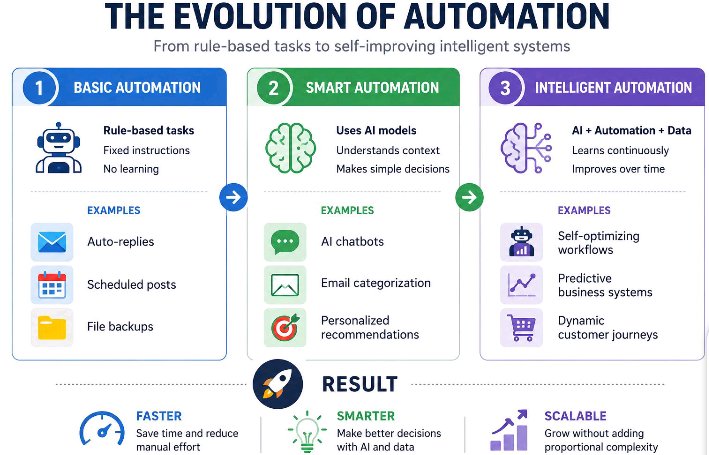
There are 3 levels I'm learning to recognize:
1) Basic automation: simple rule-based tasks (e.g. auto-replies, scheduled posts)
2) Smart automation: systems that use AI to make decisions (e.g. chatbots that understand intent)
3) Intelligent automation: combines AI, automation & data to continuously improve itself
Most businesses are still stuck at level 1 which means there's a massive opportunity for anyone who understands levels 2 & 3.
The main goal of this automation is to take repetitive, time-consuming work off HR's plate so they're not stuck being a bottleneck. It handles the routine stuff automatically, which frees up the team to focus on things that actually need a human, like people decisions, culture, and problem-solving that a system can't do.
built a Job Application Tracker
Automation for a logistics company using n8n.
Hiring can become chaotic when applications start coming in.
Candidates wait days for a response,
HR has to manually check inboxes, update spreadsheets, and send emails. It's repetitive work that slows down the hiring process.
So I built an automation to handle it.
Here's how it works:
A candidate submits a job application through a Google Form.
The automation then:
Stores the application automatically in Google Sheets.
Sends the applicant an instant confirmation email.
Notifies the HR team in Slack that a new application has been received.
Uses JavaScript inside n8n to evaluate the applicant's years of experience.
Then the workflow makes a decision.
If the applicant meets the required experience:
Updates the applicant's record in Google Sheets automatically.
Sets:
Level: Senior / Mid-Level / Junior
Qualified: True
Status: Interview Invitation
Waits for a predefined period.
Sends an interview invitation email.
Notifies HR in Slack that the interview has been scheduled.
If the applicant doesn't meet the requirements:
Sends a polite email informing them they were not selected.
The result
No copying and pasting.
No forgotten emails.
No manual spreadsheet updates.
No constantly checking for new applications.
Instead, HR can spend more time interviewing qualified candidates while the automation takes care of the repetitive work.
I used to think learning automation was about watching enough tutorials.
Watch one more video. Read one more guide. Understand one more concept. Then I'd finally "get it."
That's not what happened.
What actually worked was breaking things. Building a workflow, watching it fail, staring at the error, fixing it, and doing that again the next day. And the day after that.
Nobody becomes good at automation by understanding it in theory. You become good at it by doing it badly first, a lot.
If you're starting out and it feels messy right now, that's not a sign you're behind. That's just what learning looks like.
Open the tool. Build something small. Let it break. Try again tomorrow.
That's the whole trick.
What's one thing you learned by breaking it first?