Focus on business outcomes vs. the tech.
Case in point: Hyundai Motor Group completed a test using the @avax blockchain for live cross-border stablecoin transfers. Partnering with @tether and @AxiymFinance, Hyundai Card transferred $20,000 in USDT from its U.S. subsidiary to its Mexican office in just 7 minutes, reducing traditional multi-hour banking delays.
Summit is going to be top tier.
From the build out and design to the speaker lineup, attendees, media, and swag, every detail has been intentionally thought through.
You’ll be surrounded by some of the smartest founders, builders, institutions, policymakers, and operators in the world.
But what excites me most is that this isn’t another conference where everyone is talking about crypto to other crypto people.
This is where you’ll see how blockchain is actually being adopted by businesses, governments, and institutions around the world. The conversations are real. The use cases are real. The people building the future are all in one place.
If you want to understand where this industry is actually headed, you don’t want to miss Summit.
https://t.co/YlL6N8CTR2
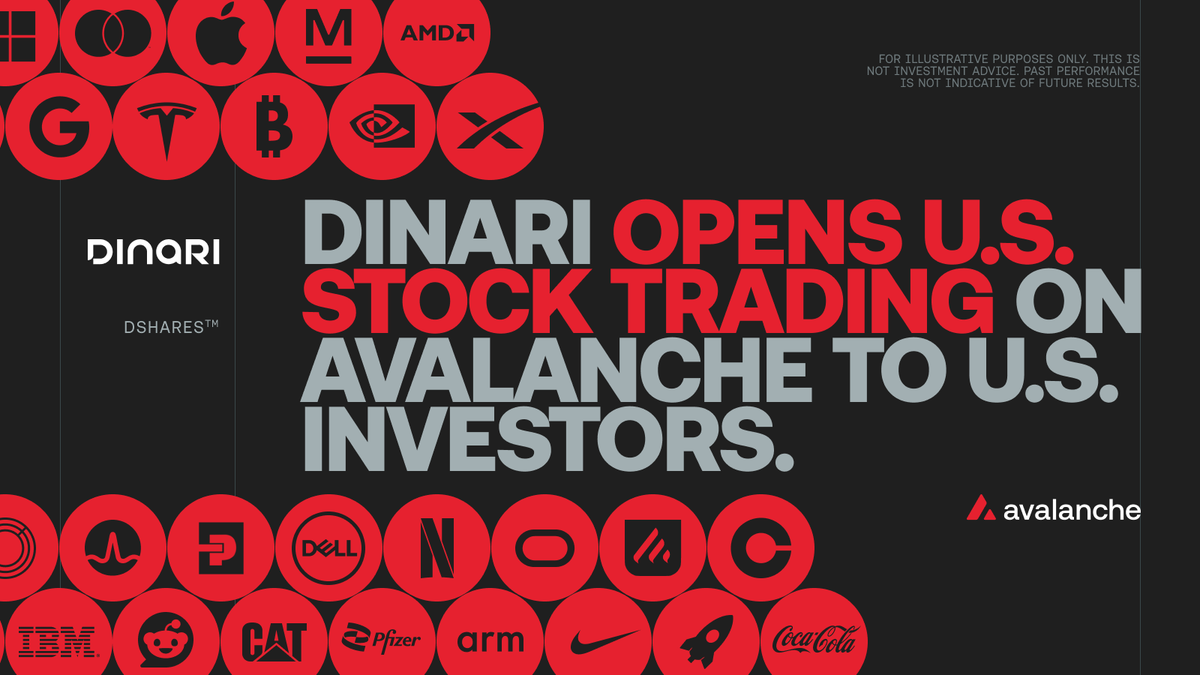
Everyone talks about bringing real-world assets onchain. @DinariGlobal just did it with 724 tokenized U.S. stocks including the full S&P 500, live on Avalanche for U.S. investors. What makes this work different is the registered broker-dealer, real shares in real brokerage accounts, USDC settlement via @circle, and self-custody. There also aren't any synthetic wrappers or offshore workarounds. This level of work is what I mean when I say blockchain needs to be the infrastructure and not the headline. The rails are Avalanche. The experience is just better 🔺
Dinari's advantage is that dShares are positioned as securities under U.S. securities law rather than around it, and that regulated posture is what a broker-dealer's risk committee can sign off on
Kudos to @DinariGlobal for bringing tokenized stocks to U.S. investors
BREAKING: U.S. investors and businesses can now trade U.S. stocks via Dinari on Avalanche
724 tokenized U.S. stocks and ETFs from @DinariGlobal, including the entire S&P 500, are now available to U.S. investors on Avalanche C-Chain via the Dinari Trading App.
Martin Small's tokenization comments on the @BlackRock Q2 call were about distribution.
Tokenization is becoming a channel-migration argument. Asset managers win or lose on where the account lives, so when a credible new venue appears you buy presence early, while it's cheap. For BlackRock: $500M of revenue by 2030, against a firm doing $7B a quarter, is an option premium.
3 precedents:
> 1975: May Day killed fixed commissions. Schwab's payoff wasn't cheap trades; it was Mutual Fund OneSource in 1992. Own the account, become the shelf, & fund managers stop selling thru distribution + start paying for it.
> 1993: SPY launched. Barclays Global Investors launched iShares in 2000, and BlackRock bought BGI in 2009. Its dominance in ETFs came from buying into the channel vs inventing it.
> 2019: @RobinhoodApp moved the venue to the phone. Schwab went to 0 commissions that October & re-monetized the balance instead (net interest, cash sweep, order flow).
Each of these looked like a fight over fees + turned out to be a fight over who held the account.
Every time we say "built for business," I think about what it actually requires.
It's not faster transactions. That's table stakes now.
It's the decisions a network makes when it has to choose between convenient and right. Higher uptime standards. Staking economics that reward long-term commitment over short-term yield. Flexibility for institutional participants who can't lock up capital for two weeks.
Helicon is six of those decisions made at once, and is a great starting point for more foundational change to come.
This is what a blockchain looks like when it gets serious. Not just faster. It’s more dependable, more professional, more built for the businesses that are here, and the ones that are coming. 🔺
The global financial system is undergoing a fundamental reset. Traditional assets are moving onchain, and stablecoins are maturing into a critical piece of financial infrastructure.
The stablecoin market is ~$300 billion today, with industry projections reaching as high as $4 trillion by 2030. Yet many enterprises are still determining what tokenized money means for their business, where they should participate, and how to move from interest to implementation.
That’s why we partnered with @Deloitte to develop the Stablecoin Playbook: a practical guide to the different roles institutions can play across the stablecoin ecosystem and the capabilities each path requires.
The playbook covers models ranging from issuance and payments to custody, reserve management, liquidity, treasury and settlement. It also helps institutions assess the business case, regulatory considerations, operating model, technology, governance and partnerships needed to execute effectively.
The central takeaway is that there is no single stablecoin strategy. The right path depends on an institution’s customers, capabilities, regulatory posture and commercial objectives.
This aligns closely with how we think about Technology Built for Business on @avax. The opportunity is not simply to put money onchain, but to build the infrastructure and ecosystem that allow stablecoins to solve real business problems.
We are already seeing that thesis take shape through initiatives like the Avalanche Payment Collective and our work with Hyundai and Axiym on cross-border treasury and commercial payment flows.
The next phase of stablecoin adoption will be defined by practical use cases, trusted partners and technology that fits into how businesses actually operate.
This playbook is designed to help institutions take that next step.
BREAKING: Deloitte & Avalanche Publish Stablecoin Playbook
As stablecoins increasingly become part of mainstream financial infrastructure, institutions need trusted partners to help guide them in the right direction.
Developed with @Deloitte, the playbook covers adoption strategies, regulation, and moving from vision to execution.
An honest conversation about what it takes to build the RWA market at ecosystem scale.
Here’s what we discussed with Olivia @cryptoreine from @AvaLabs:
• why the world’s largest asset managers are increasingly choosing @avax
• what effective RWA distribution actually looks like
• how Ava Labs helps tokenisation projects & asset managers scale
• which asset class could take RWAs from 0 to 1
• who to follow on X to stay on top of the RWA space
All of this – and much more – in the latest episode of Onchain, Honestly!👇🎙️
nOPAL is a tokenized vault issued by @blackopal_fi, backed by institutional-grade Brazilian credit card receivables. Now live on Avalanche.
When a merchant in Brazil accepts a credit card payment (especially in installments), they don’t receive the funds immediately. Instead, they get a receivable that settles later through Visa or Mastercard. @blackopal_fi buys these receivables at a discount, advances cash to the merchant, and collects directly from the payment networks later.
The most interesting part: These receivables are registered as a True Sale in Brazil’s C3 Registry at the Central Bank. This establishes clear ownership and routes collections automatically through Visa and Mastercard’s existing infrastructure.
This eliminates the risk of double pledging or multiple claims on the same receivable and removes virtually all merchant credit risk. The result is a real-world credit instrument with a 0% default rate since inception.
By tokenizing these assets on Avalanche, Brazilian merchants gain access to global liquidity, getting paid faster and cheaper, and improving their working capital.
Global investors, in turn, get attractive low-risk yields backed by real payment flows.
Everyone wins.
JUST IN: @plumenetwork’s nOPAL is live on Avalanche.
Issued by @blackopal_fi, the tokenized vault gives allocators access to FX-hedged Brazilian credit card receivables, generating yield as those payments settle.
Avalanche brings together issuers and capital in one ecosystem.
This chart helps explain why we've been so focused on asset-backed finance, specialty finance, and fintech lending.
These categories have reached meaningful scale faster than many more familiar RWAs, not despite the complexity of the underlying markets, but partly because of it.
Much of private credit and specialty finance does not operate on highly standardized infra. Assets are fragmented across originators, servicing systems, custodians, lenders, and financing vehicles. Data can be difficult to verify, ownership records are often siloed, and transactions still depend heavily on manual reconciliation and bespoke processes.
That creates a particularly strong case for blockchain.
The opportunity is to improve the full lifecycle of credit:
Origination → verification → funding → distribution → collateralization → servicing → repayment
This is becoming increasingly important as credit itself moves faster. Short-duration receivables, embedded lending, BNPL, merchant cash advances, payroll-linked products, and other forms of fintech credit are being originated at greater speed and in larger volumes. But the infra supporting these products has not kept pace.
Avalanche is working to help close that gap by providing a shared, programmable system for tracking assets, coordinating participants, moving capital, and automating payments and servicing.
And the opportunity goes beyond making existing markets more efficient. Better infra can enable entirely new financing models, distribution channels, and credit products that would be difficult to support using today’s fragmented systems.
That is exactly why the category is so compelling for the @avax ecosystem.
Different categories of tokenized assets have scaled at very different rates.
Asset-backed credit hit $1 billion in market cap in just 185 days. Specialty finance crossed the same threshold in under two years.
At the other end of the spectrum, venture capital took more than seven years to reach $1 billion, while active strategies took nearly as long.
More complex structures with longer time horizons take more time.
Avalanche Ecosystem Call 🔺
@JohnNahas84, @MorganKrupetsky, @__arielle__, @frostLedger and more will recap the recent big milestones, share ecosystem & network updates, and preview what’s next for Avalanche.
Live on X
Tomorrow | 12PM ET
I asked @StaniKulechov: Why deploy Aave v4 on Avalanche? His response was clear. This was a calculated bet on where DeFi is headed and institutions want to build.
Why is Avalanche Summit in New York?
The capital. The institutions. The regulators. The builders turning ideas into real products.
New York is home to many shaping the industry, and a meeting point for builders everywhere.
You should be there, too: https://t.co/Q6Vj9cKMZl
Avalanche Summit brings us all together for two focused days of big ideas, connections, and opportunities that move the industry forward.
September 16–17
Chelsea Industrial, NYC
BREAKING: Aave V4 has launched on Avalanche, marking its first expansion beyond Ethereum.
Laying the groundwork for dedicated credit markets for tokenized assets.