What happens when a metal is thinned down to the 2D limit?
Today, in Physical Review Letters, we demonstrate Anderson localization in two-dimensional Pd5AlI2.
To learn more check out the Physics Synopsis about our work: https://t.co/dTW4YsoeIM
I'm happy to share that my paper on Anderson Localization was highlighted as an Editors' Suggestion by Physical Review Letters! https://t.co/ytLWFZ26cl
#PRLtrending for the week of 2026-3-9 #physics#trending
https://t.co/IWMUXAwzJr
https://t.co/lKGpYoAVTi
https://t.co/OFgOhoLNhO
https://t.co/pdMQReZ9Dy #OpenAccess
I'm happy to share that my paper on Anderson Localization was highlighted as an Editors' Suggestion by Physical Review Letters! https://t.co/ytLWFZ26cl
On July 15th, I defended my Ph.D. thesis in Chemical Physics entitled Quantum Localization in Metals. After 5 years working with the amazing people in the Chemistry/Physics departments @Columbia, I will be making the move to @Harvard for my postdoc at the end of this week!
Attended my partner Afton Gustafson's seminar @nyuchemistry on optically active carbyne knots. Great to see her success calculating optical gyration tensors using DFT methods! 😍
I discovered a one-dimensional charge density wave in electron doped CrSBr using STM/S. My co-author Margo achieved the high level of doping necessary to cause this CDW through some nifty chemical intercalation. Great things happen when chemists and physicists work together!
Amazing work, congratulations Handa-San! @XYZ_Columbia Many more exciting works using THz spectroscopy at the 2D limit should come from this new method discovered by Taketo.
Our paper came out last week! We report the observation of very efficient and broadband THz emission from 2D vdW ferroelectric NbOI2 and utilize it for on-chip near-field THz spectroscopy. Thanks a lot to my collaborators and colleagues🙏 THz goes 2D!
https://t.co/8140MHsiCA
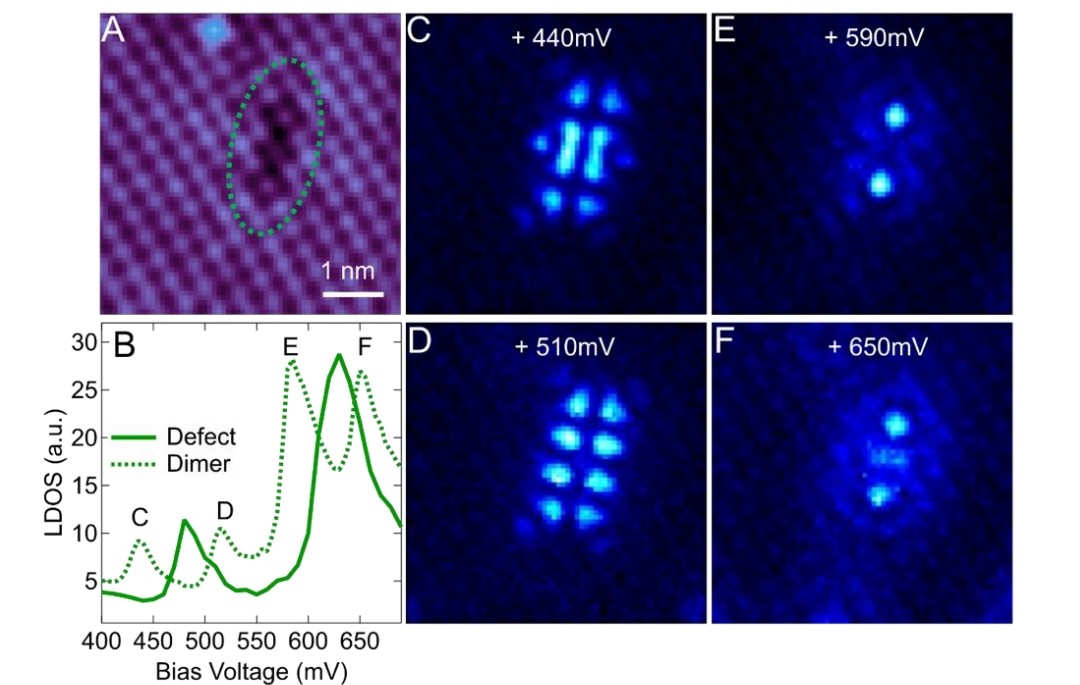
Lastly, we got to see some nice looking shapes! (The whole reason someone would do STM). When our BICs are close together they form molecular-orbital-like bonding and antibonding patterns in spectroscopic imaging!
In this work we used STM to find uniquely localized defect states can exist in a 2D metal with a topologically non-trivial flat band. These "electronic bound states in the continuum" are experimental evidence for "Compact Localized States".
Bound states in the continuum (BICs) are quantum states which could be useful for quantum technologies, but have only been observed in optics and acoustics. Our work is the first characterization of localized electronic bound states in the continuum!
In the Lab | @PhysicsColumbia PhD student Jordan Pack talks about a new technique to study the electronic properties of quantum materials. https://t.co/TLNpYBtsci
New paper on arXiv! I'll get into it in more detail when it's published, but really awesome collaboration. Thank you @rpa_queiroz for pulling me in and @MorganThinel at @ColumbiaQuantum for this nice experiment-theory work: https://t.co/skM3e31op7
New paper on arXiv! I'll get into it in more detail when it's published, but really awesome collaboration. Thank you @rpa_queiroz for pulling me in and @MorganThinel at @ColumbiaQuantum for this nice experiment-theory work: https://t.co/skM3e31op7
Congratulations to postdoctoral research scientist @MechCU Chiara Trovatello, who has been awarded the L’Oreal Italy UNESCO For Women in Science prize.
The award is given to just six outstanding female researchers in STEM, providing support for their research in the last year of their postdoctoral program.
The prize will help advance Chiara’s quantum computing research in the James Shuck Lab. An experimental physicist, Chiara studies the optical properties of two-dimensional materials similar to graphene.
Her research is in the field of photonics, particularly lasers, and she uses ultrafast spectroscopy and nonlinear optics techniques to explore these new materials, which are revolutionizing optoelectronics and quantum communications.
Chiara is pictured in the center at the recent L'Oreal Italia for Women and Science event.