Today marks the one-year anniversary of the MorphoSource 2.0 launch-- we would like to thank everyone for their support over the past year, and look forward to making year two the best one yet!
We are happy and grateful to announce that @NSF has awarded MorphoSource a sustainability grant (DBI-2149257). Over 5 years, it will allow us to continue serving our diverse user communities and to help support exciting new scholarship achieved through access to 3D data!
The origin of the phylum, Bryozoa, has long been debated by researchers, but a new analysis of a fossil from the Cambrian of Australia and South China pushes back its origin by 35 million years! Read more at https://t.co/xwZ0tC9XWU and https://t.co/O2mr4Z4cRl
@MorphoSource Thanks for all the work done by the MorphoSource Team. Easily my most important data source and data repository by now. Transformative for the way we can share CT and 3D data!
New research from @UNED has identified what could be the largest terrestrial lizard fossil in Europe! An analysis of a fossil specimen suggests that a member of the Varanus genus was found in the Iberian Peninsula before previously expected. Read more at https://t.co/oPlazYaqCC
Calling all educators! MorphoSource is excited to release a holiday lesson plan activity for k-12 students. Students can explore festive 3D scans on MorphoSource and learn more about paleontology! Check it out at: https://t.co/kqZeKWSAo0
Exciting new research finds that dolphins and whales evolved their large brains before echolocation! This find adds evidence to the idea that large brains are necessary to support complex cognition. Check out their paper and scans: https://t.co/Ihbiu2zNvn https://t.co/6wdN0VJFYZ
What did dinosaurs eat? Fossilized gastric pellets can answer this question! Researchers have used regurgitalites of the Troodon formosus to explore the dino diet and found evidence of mammal remains. Read more at https://t.co/bn3sF88oUN and https://t.co/SzkI4mvfcZ
Thanks to #oVert for making the original skull scan available (https://t.co/c15TJlKNDX) and to researchers at @UAlberta for adding value! https://t.co/Pgz9lyQ5O7
The marine iguana has its home on land and underwater, but what underlies its uniqueness? Scientists from @UAlberta reveal their distinct morphological features that give us clues into their evolutionary past. Read more at https://t.co/pS5TRusGYp and https://t.co/hIWmnrbgAa
How do the specimens you see in zoos differ from their wild counterparts? Researchers from @FieldMuseum measured the trunk vertebrae in xenarthran species to see how wild vs captive ecology impacts bone microstructure. Check out https://t.co/A5y4JoUlar and https://t.co/st3hqkAPLS
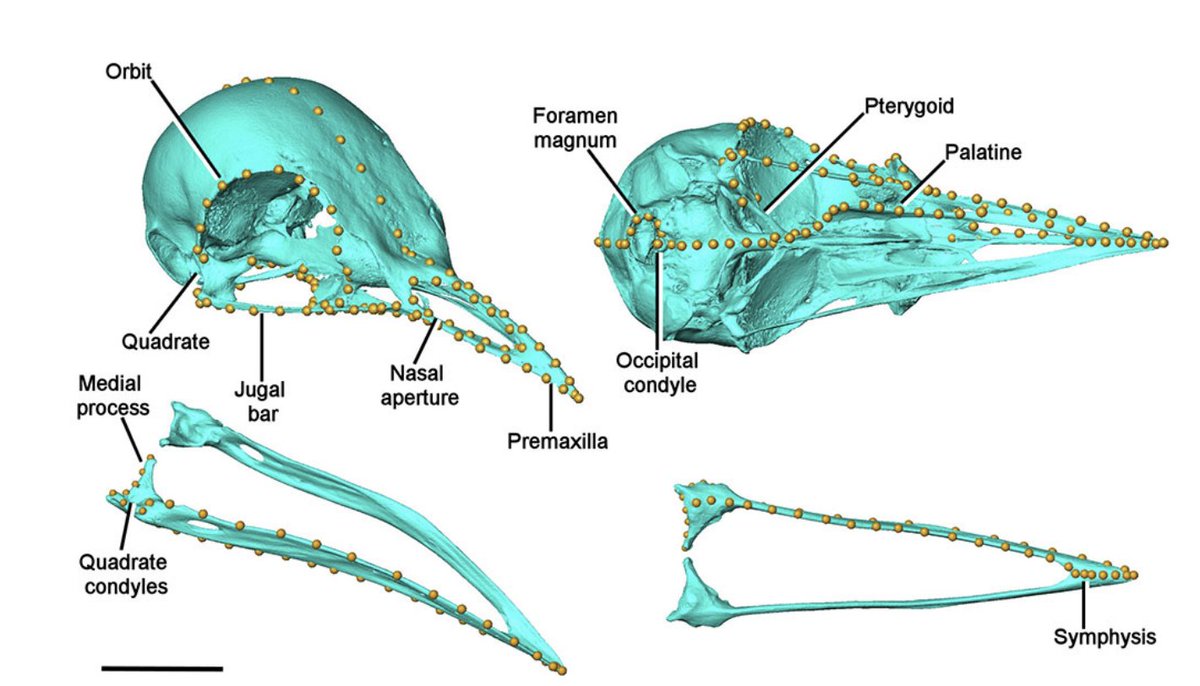
The era of big data is here, and it has exciting potential for revealing macroevolutionary drivers of biodiversity. Researchers at @uniofoxford shared CT scans of 149 bird species on MorphoSource (https://t.co/HPyPLrn8nA) and new methods to quantify variation across bird taxa
Do your tooth roots indicate your body size? Recent research from @NCState uses the tooth root surface area to predict the body size of primates, which also helps researchers make sense of incomplete fossils! Read more at https://t.co/idZw8H8nnd and check out the CT scans below!
Check out an impressive dataset of a carnivorous dinosaur's skull bones (https://t.co/7X4n1d8zPA) shared by @DeepTimeScience today #FossilFriday#MadCretaceous
As part of the MorphoSource 2.0 launch, we’ve created some videos to cover new features available on the site. An overview of the new site: https://t.co/EKM8rCAY7N Tips and tricks for using the new color and CT-capable web viewer: https://t.co/cqw6HsnTav
After more than two years of work, we are happy to announce MorphoSource 2.0 is available! Includes color mesh and CT scan web previews, expanded metadata for non-CT modalities, and a greatly improved UI. Let us know what you think! https://t.co/D0zx9PDDE3