The latest @EarthmillUK Summer 2026 Newsletter highlights the continued operational and commercial momentum across the O&M business.
Key developments include:
⚡ Repowering projects delivering significant generation uplift
⚡ Anemos Analytics condition monitoring - reducing unplanned downtime
⚡ Continued UK-wide team growth and operational scale-up
⚡ Supporting recurring service revenues with >900 supported turbines in the UK & Ireland
⚡ Growing exposure to long-term renewable infrastructure demand
Since joining EGT earlier this year, Earthmill has continued to strengthen its position as one of the UK’s leading onshore wind turbine service and maintenance specialists.
Read the full newsletter here:
https://t.co/lvool8QjXT
#RenewableEnergy #EnergyTransition #Infrastructure #WindEnergy #CleanEnergy #AIM #Investing #NetZero #EGT
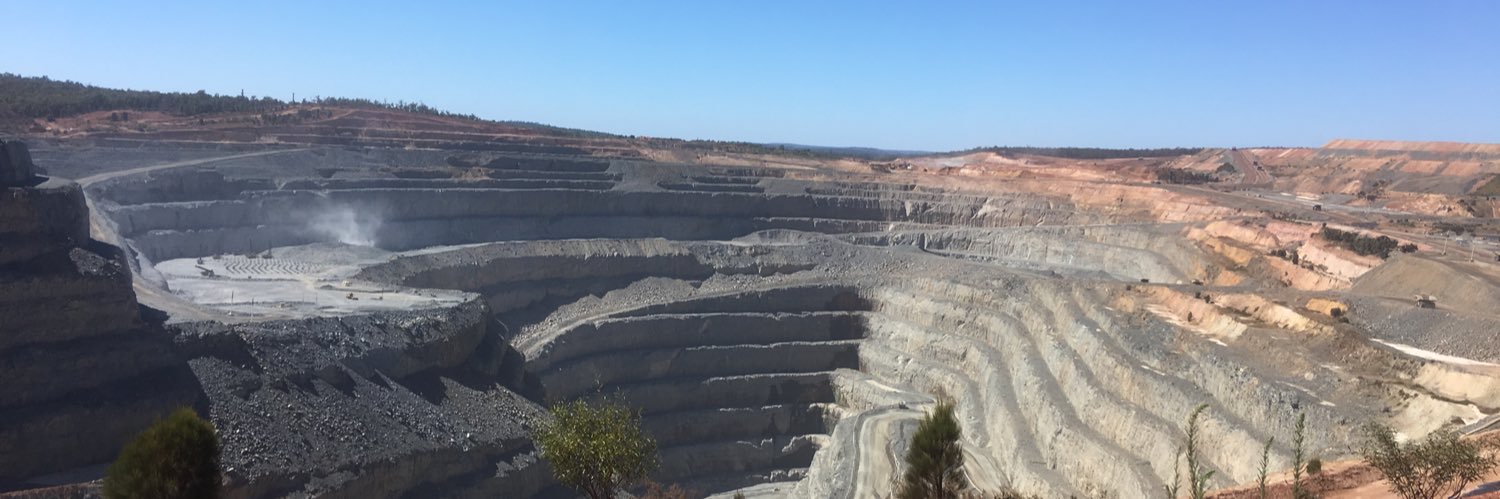
Yes love this, it’s literally a cash point sitting at surface, no multi year wait to access an ore body here. #palm ditto the guys at #fmet also sitting on a cash point with Teck Hughes and Sylvanite. Both companies still really really undervalued vs the opportunities in front of them. Cash is King.
🌍⚡🧲💎🛡️ The race to secure rare earths is no longer a future risk scenario. It is happening right now — and the stakes cover EVs, AI, defence, and national security simultaneously.
A deep dive thread on the Sprott Rare Earths report. 🧵
📌 Attach: Sprott "Why the World Is Racing to Secure Rare Earths" video
First — what rare earths actually are, and why they are irreplaceable 🔬
17 chemically similar metallic elements. Extraordinary magnetism, luminescence, electrochemical stability, and catalytic properties. Found in the Earth's crust in greater abundance than many common minerals — but rarely concentrated in one location, and exceedingly difficult to separate economically.
That last point is the key. The challenge is not geological scarcity. It is the separation problem — 15 lanthanide elements share strikingly similar chemical behaviours, making them one of the most technically demanding materials to process on Earth. This is why processing dominance is even more strategically significant than mining dominance.
The demand picture — permanent magnets are 80%+ of the story 🧲
The largest and fastest-growing application: permanent magnets — over 80% of global rare earth demand by value.
The key elements:
Neodymium (Nd) + Praseodymium (Pr) — the motor magnet elements powering every EV drivetrain, wind turbine rotor, and industrial motor on the planet
Dysprosium (Tb) + Terbium (Tb) — the heavy rare earth additions that allow NdFeB magnets to retain strength at high operating temperatures — critical for EV motors, drone actuators, and missile guidance systems
Samarium (Sm) — samarium-cobalt magnets for extreme temperature defence applications
Beyond magnets: rare earths are inside AI data centre hard drives, GPU cooling systems, semiconductor polishing (cerium oxide), fibre optic networks (terbium, praseodymium), nuclear reactor control rods (dysprosium, gadolinium), catalytic converters (cerium, lanthanum), and night vision systems.
The list of industries that cannot function without rare earths is not getting shorter. It is getting longer, faster.
The AI angle — the demand driver most people haven't priced in yet 🤖
80% of rare earths for magnets, storage, and related AI components used in the United States are imported — with the vast majority from China.
⌨️AI data centres are rare earth-intensive in ways that are not obvious:
🧲NdFeB magnets in massive hard disk drive arrays for AI data storage
🧲REE magnets in cooling system fans, pumps, and actuators — cooling accounts for up to 50% of a data centre's total electricity load
Cerium oxide to polish silicon wafers to atomic-level flatness for GPU and AI accelerator chip manufacturing
Yttrium to modify electrical properties in semiconductor compounds for high-performance AI processors
Terbium + praseodymium in fibre optic amplifiers and optical isolators for high-speed AI networking
Every hyperscaler building AI infrastructure — every Nvidia GPU cluster, every Microsoft data centre, every Amazon AI facility — is a rare earth consumer. The AI arms race is a rare earth demand accelerator hiding in plain sight.
The defence dimension — NATO has a rare earth problem 🛡️
NATO formally identifies rare earths as part of its 12 defence critical raw materials, with the majority classified as high risk for supply security.
Why: modern warfare has shifted from boots on the ground to drone and missile-based operations — precisely the applications that are most rare earth intensive:
Military drones require NdFeB or SmCo permanent magnets for compact, lightweight motors, sensors, and actuators that must operate from -55°C to +125°C and at altitudes up to 50,000 feet
Missile guidance systems use REE magnets to control fin actuators and flight surfaces — without them, smart guidance fails entirely
Laser range finders and target designators on tanks, aircraft, and infantry systems use neodymium and yttrium for effective targeting at ranges of tens of miles
Night vision, satellite systems, radar/sonar frequency tuning, communications technology — all rare earth dependent
The numbers behind this: global defence spending hit a record US$2.63 trillion in 2025, up 2.5% in real terms. All 32 NATO member nations met the 2% GDP spending target for the first time in 2025. NATO has now set a 5% of GDP military spending target by 2035.
That trajectory is a direct rare earth demand multiplier. Every additional dollar of defence spending has rare earth content embedded in it.
China's stranglehold — and how it became a weapon ⚠️
Deng Xiaoping in 1992: "The Middle East has oil. China has rare earths."
That strategic vision has been executed methodically over three decades. Today:
China: ~70% of global rare earth mining
China: ~90% of global rare earth refining
And China has already demonstrated it will use this as a geopolitical weapon:
⚠️2010: China cut rare earth shipments to Japan → 26-fold price spike in several elements between January 2009 and August 2011
⚠️April 2025: China implemented export controls on seven medium and heavy rare earths including Dy, Tb, Sm, Ga, Ge and their compounds, metals, alloys, and downstream permanent magnets — requiring state approval for every export, a process that is "often time-consuming, opaque, and frequently results in pricing so high that rare earth exports from China to be used in US military tech are effectively banned"
⚠️October 2025: China extended controls across the entire rare earth supply chain and added further critical minerals
⚠️November 2025: Following a Trump-Xi meeting, many expanded measures were suspended for one year — but this is a temporary pause. The prior controls remain fully in effect. The military end-user ban was never lifted.
The message from Beijing is unambiguous: rare earth access is a conditional privilege, not a guaranteed commodity flow.
The Western response — what governments are actually doing 🇺🇸🇦🇺🇪🇺🇬🇧
Governments have moved from categorising rare earths as critical to committing capital:
🇺🇸🇦🇺 US-Australia FORGE Framework (October 2025):
💰Minimum US$1 billion commitment within first six months
Accelerated, streamlined, deregulated permitting
Price floor mechanisms for producers
US Export-Import Bank: four letters of interest potentially directing ~US$800M into Australian rare earth projects
🇺🇸🇯🇵 US-Japan Bilateral Critical Minerals Partnership:
Joint investments, coordinated policy, technology sharing
DoD above-market floor pricing contracts with MP Materials (US) and Lynas (Australia via JARE)
🇺🇸 Project Vault (February 2026):
US$12 billion public-private partnership
Strategic reserve of critical minerals including rare earths
🇪🇺 EU Critical Raw Materials Act (2024) + Resource EU Action Plan (2026):
🏗️10% EU domestic mining by 2030
⚗️40% domestic processing by 2030
♻️25% from recycling by 2030
~€3 billion mobilised over 12 months for 25–30 strategic projects
France/Germany/Italy stockpiling pilot programme
♻️The recycling target is significant. 25% of EU rare earth supply from recycled sources by 2030 is an explicit policy mandate — and it directly validates the long-loop magnet recycling thesis that Ionic Technologies, ReElements, Ucore, Cyclic Materials and Solvay La Rochelle are building toward, Magnet recycling HyProMag.🧲
The Sprott investment angle — REXC ETF 📈
For investors seeking broad exposure to the Western rare earth supply chain build-out, Sprott has launched the Sprott Rare Earths Ex-China ETF (REXC, Nasdaq) — the only ETF providing focused pure-play exposure to rare earth companies operating outside China, positioned to benefit from supply chain realignment, government price floors, and accelerating demand.
The floor pricing mechanisms being deployed by the DoD and Japan are a structural change in the investment case for Western rare earth producers — reducing the commodity volatility that has historically made junior rare earth companies uninvestable for institutional capital.
🎯The Sprott investment angle — REXC ETF 📈
For investors seeking broad exposure to the Western rare earth supply chain build-out, Sprott has launched the Sprott Rare Earths Ex-China ETF (REXC, Nasdaq) — the only ETF providing focused pure-play exposure to rare earth companies operating outside China, positioned to benefit from supply chain realignment, government price floors, and accelerating demand.
The floor pricing mechanisms being deployed by the DoD and Japan are a structural change in the investment case for Western rare earth producers — reducing the commodity volatility that has historically made junior rare earth companies uninvestable for institutional capital.
♻️⚗️💰🧲Rare earths are not a commodity story. They are an industrial sovereignty story.
Every government is now explicitly funding the answer to the same question: "How do we ensure our military, our AI infrastructure, our energy transition, and our industrial base are not dependent on Beijing's goodwill for the elements that make them work?"
That question does not go away. It gets more urgent with every export control, every geopolitical escalation, every AI data centre that comes online.
The race is on. The Western supply chain is being built. 🌍⚡
📌 @roblun1 | Source: Sprott Rare Earths Report 2026
@sprott #RareEarths #CriticalMinerals #REE #NdFeB #Neodymium #Praseodymium #Dysprosium #Terbium #Samarium #PermanentMagnets #SupplyChain #ChinaDependency #ExportControls #GeopoliticalRisk #NationalSecurity #DefenseSupplyChain #NATO #MilitaryDrones #MissileGuidance #AIDataCenters #ArtificialIntelligence #DataCenters #WindEnergy #EVs #ElectricVehicles #EnergyTransition #FORGE #ProjectVault 🌍⚡🧲💎🛡️🤖🚗💨🏭🎯
If you've been looking for a 'How To' guide on the #FOS Hill, look no further than this run by Oliver Solberg. Behind the wheel of the #Citroen DS3 WRX, the then-17-year-old Swede put on a show in the Timed Shoot-Out with one of the wildest runs we've ever seen!
Join GOOCH & HOUSEGO PLC's Results for the six months ended 31 March 2026 TOMORROW at 4:00pm - Click below to register. #GHH
https://t.co/29pHPvS8MA
🎥 Legendary investor and Power Metal shareholder @RealRickRule sits down with CEO Sean Wade (@SeanWade1970) to break down the "mining merchant bank" model.
£1.9m into £22.8m on Guardian Metal. The gap between the share price and the asset base. And what's next in uranium, royalties and tokenisation.
⬇️ Watch the interview:
https://t.co/t2Cd2CN0Ei
#ProjectIncubator #Mining #RuleSymposium 🇬🇧 $POW 🇺🇸 #POWMF
✍️ #MTL has awarded contracts to several service providers to advance the development and construction of the La India project. First gold production is on track for December 2026 ⤵️
Huge kudos to our team on the ground for their diligent work leading to this discovery of this new zone.
This is exactly why we continue exploring at Pilot Mountain in parallel with our important ongoing PFS related work-streams.
Much more work ahead, but we are very encouraged by what we are seeing thus far.
#tungsten #gmtl #gmet
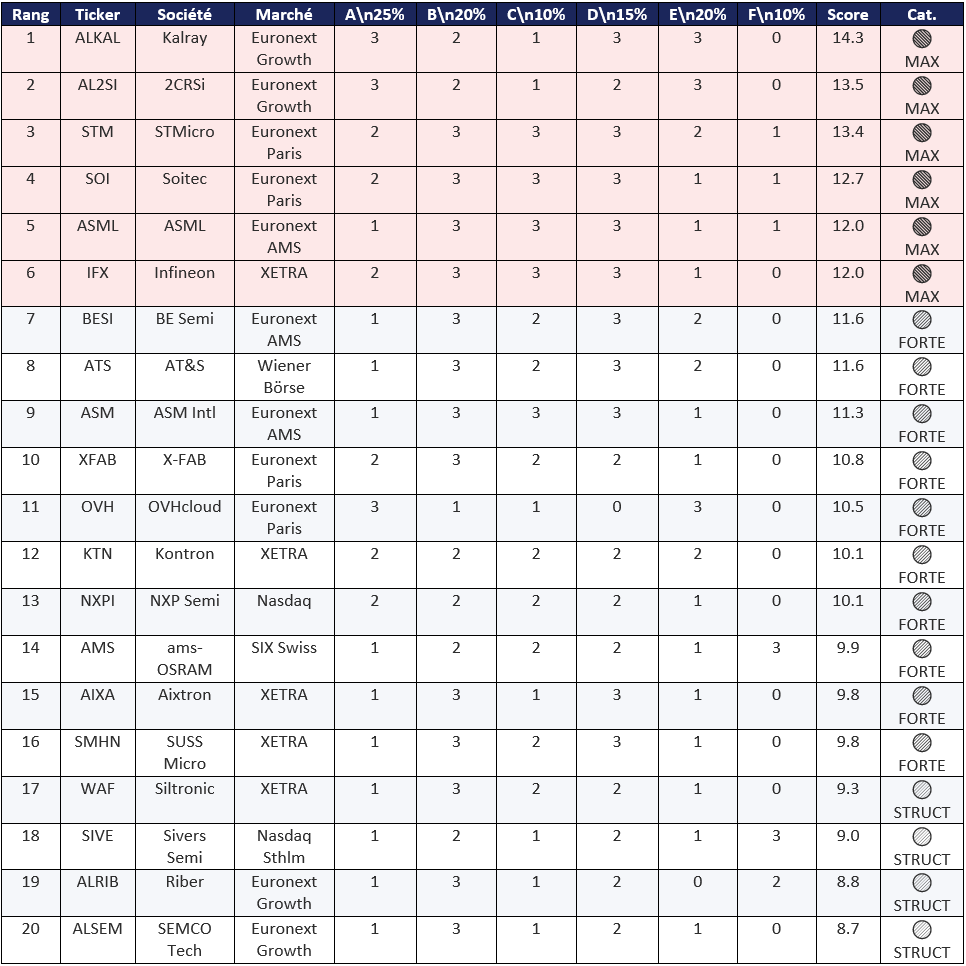
J'ai publié tout à l'heure l'analyse complète du Chips Act 2.0. J'ai essayé également de traduire les mesures réglementaires en un score.
L'objectif : identifier quelles sociétés cotées européennes ont le plus d'alpha face à ce nouveau cadre réglementaire.
Le score est construit sur 6 critères directement tirés du texte de loi et pondérés selon leur impact sur les flux de commandes :
A. Demand-side (25%) : exposition aux mécanismes de création de demande (Demand Forum, Grand Challenges, procurement public souverain). C'est le pivot central du Chips Act 2.0.
B. CADA / AI Gigafactories (20%) : capacité à fournir le hardware des datacenters souverains et des AIGF (200 Mds EUR d'investissements, triplement de la capacité datacenter EU).
C. FOAK / Strategic Project (20%) : éligibilité au statut First-Of-A-Kind élargi à toute la chaîne de valeur (permitting accéléré à 12 mois, guichet unique).
D. IPCEI AST (15%) : positionnement sur les technologies couvertes par le 3e IPCEI semi-conducteurs (AI chips, photonique, packaging avancé, EDA).
E. Region of Excellence (10%) : ancrage physique dans les clusters semi EU labellisés (Dresde, Grenoble, Eindhoven, Leuven, Catane, Villach).
F. Photonique / Quantum (10%) : exposition aux deux ajouts structurels du Chips Act 2.0 (PIC comme 6e composante, pont vers le Quantum Act).
Chaque société est notée de 0 à 3 sur chaque critère. Score pondéré sur 18 points maximum.
le Top 20 est en image
Ce qui en ressort : les large caps (ASML, Infineon, STM) scorent haut grâce à l'infrastructure et aux clusters. Mais l'alpha asymétrique est dans les small/mid caps exposées simultanément au demand-side ET au CADA. Le marché price déjà les premières. Pas encore les secondes.
Je vous invite à consulter l'article si le détail vous intéresse.
⚠️ Analyse basée sur des documents réglementaires publics. Aucune recommandation d'achat ou de vente. Vous êtes seul maître à bord de vos investissements.
Great to see Alex Newman of @IChronicle revisit Power Metal yesterday, covering our busy run of newsflow and our Project Incubator model.
He picks out the £22.8m return on our £1.9m early-stage investment in Guardian Metal Resources (GMET), uranium confirmed, identified and delineated across three Athabasca Basin licences, Tati gold permitting in Botswana, and new investments in Greyridge Exploration and Chile's Next Minerals.
Read the full article here:
https://t.co/WPfJASCrlZ
Investors' Chronicle reiterates its Buy recommendation.
#Uranium #Copper #Gold 🇬🇧 $POW 🇺🇸 #POWMF