Our markets have a path from bonding curve to liquidity pool.
At the reserve target, a market can graduate. Moving reserves and opening its Uniswap v4 pool are separate steps.
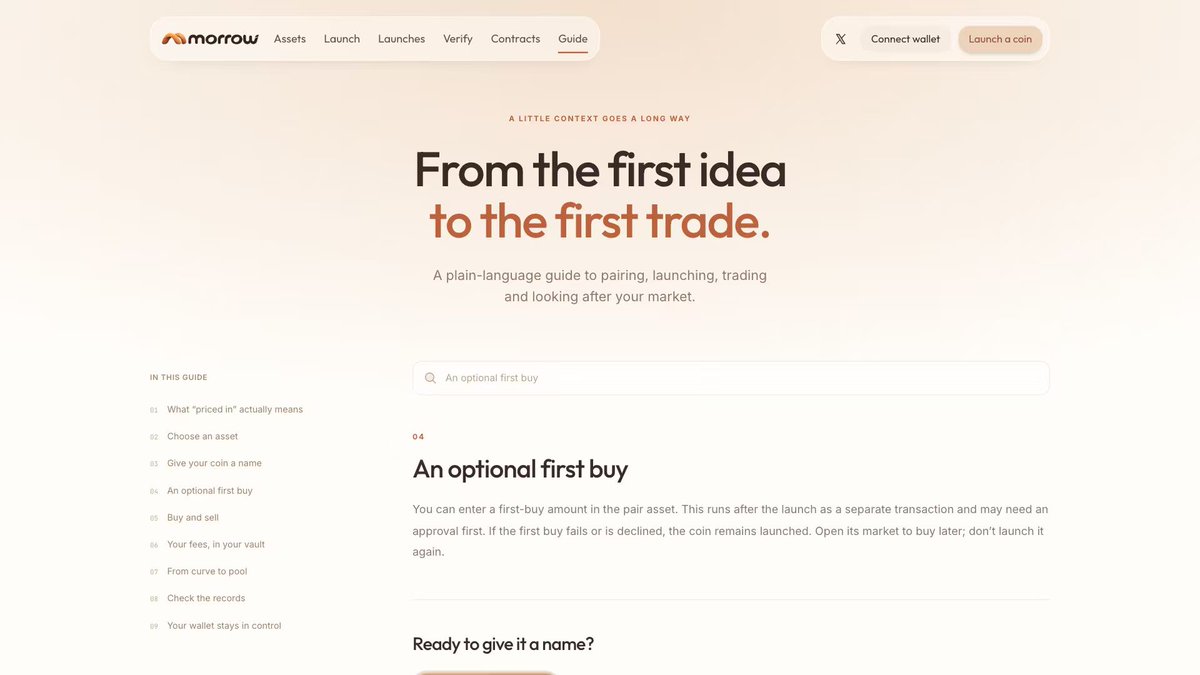
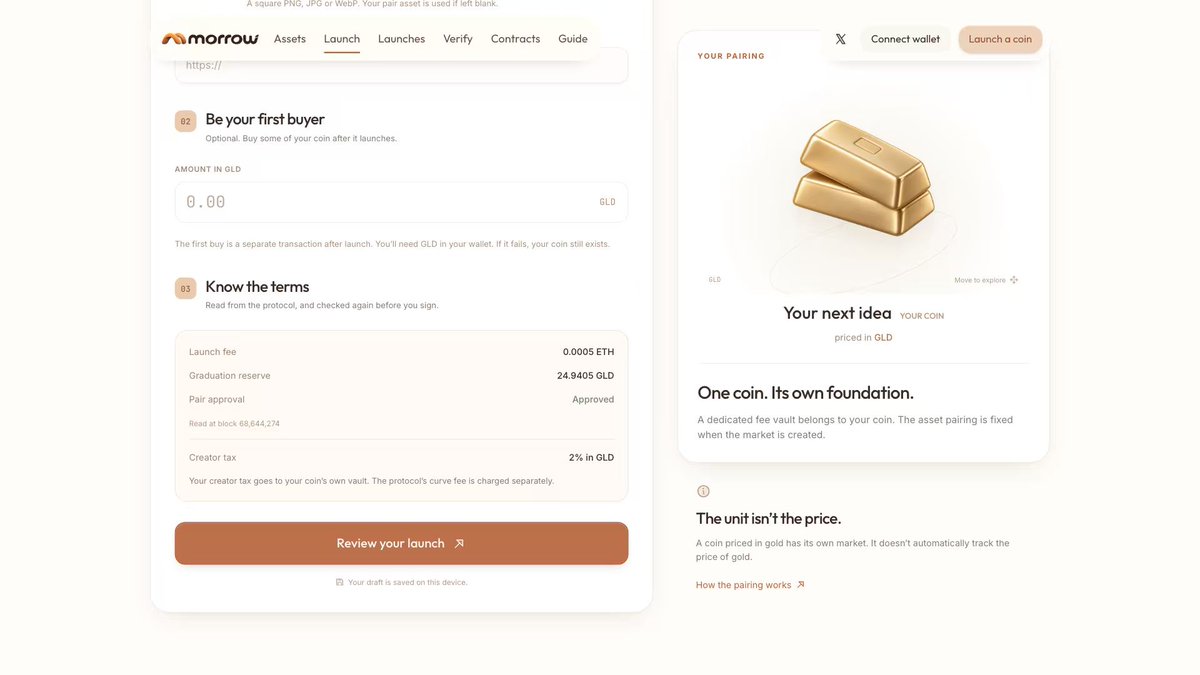
Your first buy is optional on Morrow.
We separate it from the launch transaction. If you skip or decline that buy, your coin is still created once the launch confirms. You can return to its market later without launching it again.
Pick an asset on Morrow and launch a coin against it. Buys, sells, trading fees and reserves use that asset. The pair is fixed; the coin has its own price.
We give every coin on Morrow its own creator vault.
The 2% creator tax is collected in the pair asset. Claim moves available fees into the vault; Withdraw sends them to its owner. The protocol's curve fee is separate.
On a coin's market, Buy and Sell both use its chosen pair asset.
We show estimated output and fees before the wallet request, and set a minimum output for the trade. A submitted transaction is complete only after the chain confirms it.
Our markets start on a bonding curve.
Quotes depend on the curve's current reserves, trade size and fees. As trades change those reserves, the next quote changes too.
That's how a new coin gets its own market price.
Bringing a coin to Morrow starts with your idea and a pair asset.
Set the name and ticker, add the details, then review the fees. The launch transaction creates your coin, its bonding curve and a creator vault owned by your wallet.
On Morrow, creators choose what their coin's market runs in: GLD, cbBTC, USDG and more.
We keep that choice fixed at launch. Every trade, fee and reserve uses the same pair asset. Each coin still has its own price.
We built Morrow around one choice: what should your coin's market run in?
CA:0x8530de5fc84766a5d2accdd921c1ccc5f0f24e2c
Choose a pair asset, create a coin, and manage its market on Robinhood Chain. That asset becomes the currency for trades, fees and reserves.
https://t.co/mKsmqQLoke
Pick an asset on Morrow and launch a coin against it. Buys, sells, trading fees and reserves use that asset. The pair is fixed; the coin has its own price.