Moth is a technology company building the next era of Media and Entertainment by delivering consumer products and services powered by quantum computing.
Q-DAY is a GTA V mission that Moth has built with Alejandro Aguirre using Atlas, in which you help Jay put together a quantum computer one stolen part at a time.
After every heist an Atlas job measures the error rate of the part you’ve brought back, and if it’s too high you have to go out and steal another.
Once the machine is finished, encryption breaks and Los Santos falls into riots, and how the riot plays out is decided by a quantum job that has been running quietly in the background since Jay first pitched the plan.
Q-DAY is out now on GitHub for GTA V Legacy and Enhanced - https://t.co/bBPR2t0CTY
Moth has set a new record for encoding and reading back data on a quantum computer, advancing an area of the field that is critical to almost all applications of societal impact.
Our new method, Tessa, encoded 1,568 numbers across all 120 qubits of @IBM Quantum's Nighthawk r2 processor and recovered the image from the chip. The largest previous experiment of this kind recovered 128 values, making Tessa an order of magnitude more successful.
Encoding is fundamental to computing. Whether we are sending messages, streaming music or sharing photos, almost everything we do with a computer depends on translating information into data that can be stored in memory and read back.
For the foreseeable future, quantum computers will have no equivalent of that memory. Data has to be encoded into fragile qubits through operations that each add noise, so any advance in the field of encoding is important for the entire quantum industry.
The video attached to this post is an early look at Tessa applied to video.
Read our press release: https://t.co/dnQVpCVSjA
Read the paper on arXiv: https://t.co/2mhsCQKdam
Read our blogpost: https://t.co/FC5iXxMLaG
Try Tessa yourself on Atlas (alpha): https://t.co/xy0F1FVHn8
#Moth #Quantum #IBMQuantum
During the first week of November, students from the UAL Creative Computing Institute built projects with our Atlas Alpha platform, then presented them at IBM's London office. Most of them had never studied physics or advanced mathematics.
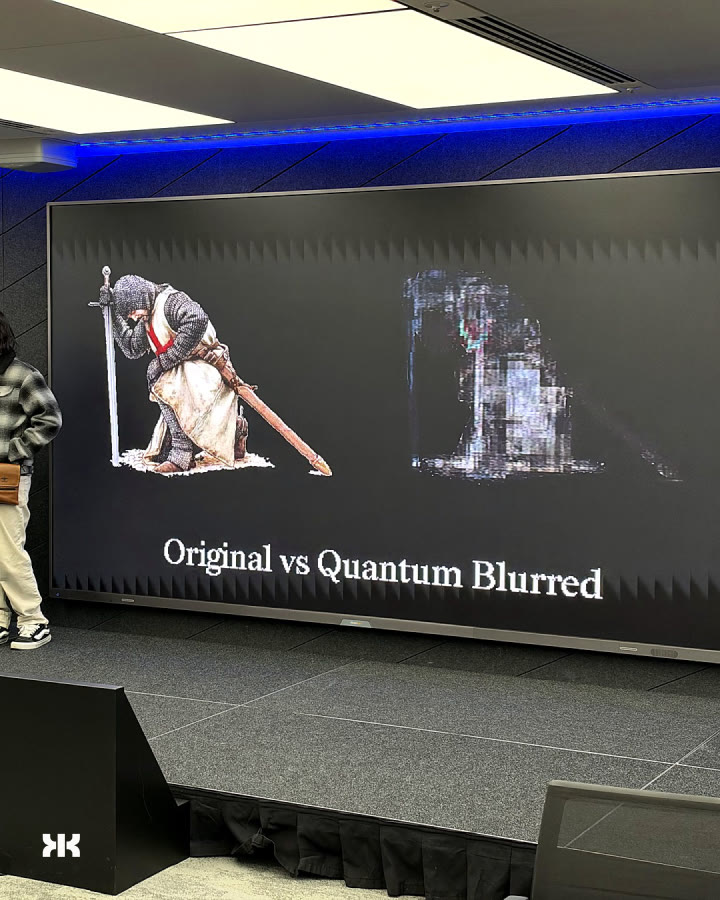
The Creative Quantum Hackathon was run by @UAL Creative Computing Institute, @IBM Quantum and Moth as part of @qiskit Fall Fest 2026, with Astryd Park and Stewart Smith introducing the students to Atlas. The teams made games, generative artworks and interactive demos, using Atlas engines including Labyrinth, Quantum Blur and TelaBlur.
Most people who use quantum computers will never program one gate by gate. The work now is building the layer between the hardware and the people with ideas.
Congratulations to Q/SCAPE (Best Use of Quantum), BIG BANG (Most Refined), and Hannah Hannah and QUANT-BIRD (joint Most Original).
Thank you to the students for their projects, to the team at IBM London for hosting, and to UAL CCI for bringing the group together.
#Moth #Quantum #UAL #CCI #IBMQuantum #Qiskit #QuantumComputing
"The next leap in quantum computing will not come from hardware alone." - Harry Kumar, Co-founder, Moth
Quantum Zeitgeist has published a guide to the rise of quantum games. It covers the games that run on real quantum hardware, the games that teach quantum computing and citizen science games that use players as research instruments, and looks at where Moth and our Atlas Alpha platform sit in that field.
Read the full article here - https://t.co/LgbaULuzpH
Phantom Space is a browser tool that turns images and videos into volumes that can be moved through.
Each pixel is placed in depth by its brightness, and with video the frames can be stacked so that depth becomes time.
The point clouds are then reoriented by the Quantum Blur engine, with light effects added via the Entanglement Shader, both of which are available for anyone to try through our Atlas Alpha platform.
Phantom Space: https://t.co/VTWYNKpHaP
Use Atlas Alpha today - https://t.co/xy0F1FWfcG
$1,000 for quantum mods for GTA V
If you can build a single-player PC mod with Atlas and use our quantum engines for whatever you like in GTA V then you can win a part of the $1000 cash bounty split between the top 3
Entries close Sunday 9 Nov. Link here - https://t.co/TtgFzEcnp3
What you’re seeing in the video:
This is Quantum Paint, a GTA V mod built on our Atlas Alpha platform. It gives the car a colour-shifting paint job calculated by a quantum simulation.
The colours come from the Entanglement Shader engine. It models what happens to light as it bounces through a stack of extremely thin transparent layers. This is the same physics that makes soap bubbles and oil films look rainbow-coloured. The simulation produces a table of which colour you see at each viewing angle. The mod uses that table to repaint the car many times a second, based on where the camera is.
There are five paint jobs, and you can switch between them in-game. Each one is generated from a different set of physical settings in the simulation: how many layers there are, how reflective they are and how strongly they interact.
The car’s decals are a separate image, processed through the quantum blur engine. It spreads the pattern out using quantum interference, so the surface has a mottled texture rather than flat colour.
Anyone can build with the engines on our Atlas Alpha platform. We are currently running a GTA mod bounty with cash prizes - https://t.co/TtgFzEcnp3
@homee589769 Yes, thin-film interference. The quantum part is in how the layers are modelled- they’re coupled through entanglement which changes the colours you get. The simulation runs ahead of time and the mod reads the result based on the camera angle
For Halloween, our CSO James Wootton and Head of Quantum Applications João Ferreira built a demo game in which the characters are quantum particles.
Braided is a 2D demo game running on our Atlas alpha Platform. You play a zombie split into two halves and each half is a Majorana, a quasiparticle first described by Ettore Majorana in 1937, when the halves recombine, they either annihilate or form a fermion.
That outcome isn’t scripted - it’s set by a plan shared across all the Majoranas and held non-locally through entanglement, the effect Einstein called ‘spooky’. The paths your halves walk around other particles change it. This is ‘braiding’ which gives the game its name.
Braided runs on Majorana Lattice, an Atlas engine built from Matching Codes, a family of quantum error correcting codes. Error correction is easy to emulate on classical hardware, so the game can run quantum software fast enough to play.
Build your own spooky Quantum game using Atlas at https://t.co/MSxxQDS3we
Click below to read the blog and to play the game -
https://t.co/B4QOrVQIrq
Congratulations to William Wong, who won the FQxI challenge at the @Moth_Quantum hack.
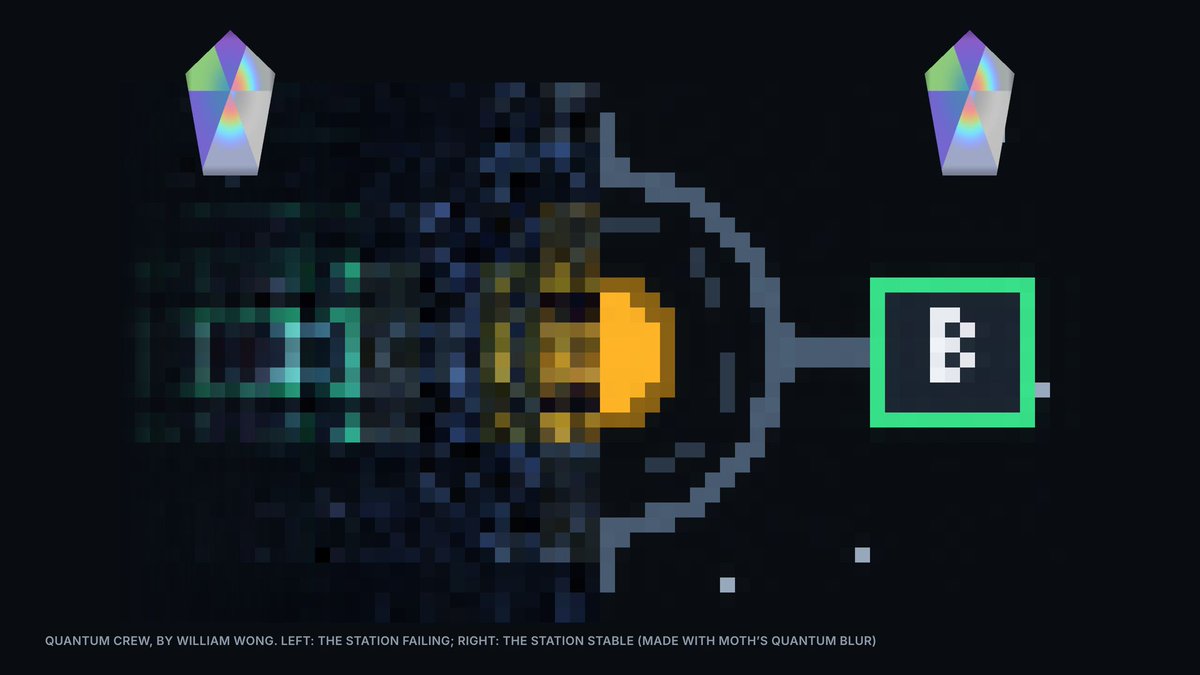
We asked entrants to teach a general audience something about quantum physics, using Moth’s Atlas engines. William made Quantum Crew, a party game where two teams try to keep a space station running without talking to each other. However carefully they plan, they can’t get more than 75% of rounds right. Give each pair a set of entangled crystals and they reach about 85%.
Physicists use this kind of test to show that entangled particles can’t just be carrying instructions set in advance. We also liked that the game shows what entanglement can’t do: the crystals never let the players send each other a message.
Can you make GTA V quantum before GTA VI drops?
We're putting up a $1,000 prize pool, split between the three best single-player mods built with our Atlas Alpha platform. No quantum experience needed.
Entries close 9th November.
Not affiliated with or endorsed by Rockstar Games or Take-Two Interactive.
https://t.co/TtgFzEcnp3
Moth Hack Winner: Hanah Rahman
Title: Quantum Nose (What the Noise Remembers)
Challenge: Make it audible
Engines used - Quantum Blur
A molecule’s vibrations, slowed 120 billion times until they can be heard. Pick acetophenone, cyclopentadecanone or muscone, play its chord, then swap hydrogen for deuterium and hear the C-H notes drop by 5.35 semitones. Quantum Blur renders a blurred version of each, and a blind test asks if you can identify them.
Congratulations Hanah. Start using Atlas Alpha today - https://t.co/MeFsozRDTl
Moth Hack Winner: Terence Broad
Title: Latent Quantum Blur with RAVE
Challenge: Quantum-native 2
Engines used - Quantum Blur
A new way to remix audio, combining a neural network with a quantum algorithm. RAVE compresses a sound into a compact latent representation, Quantum Blur reshapes it, and RAVE turns the result back into audio.
The demo remixes the Amen Break.
Congratulations Terence. Start using Atlas Alpha today - https://t.co/MeFsozSbIT
Moth Hack 2026
It’s always creative people who engage with new technologies first - they start pushing the domain forward
Use Atlas Alpha today - https://t.co/j47nctOG4y
Moth Hack Winner: William Wong
Title: Quantum Crew
Challenge: Guest Challenge @FQXi
Engines used - Quantum Blur & Entanglement Shader
A multiplayer game that teaches a Bell inequality by letting players feel it first. Pairs keep a space station’s coolant stable without talking, and find that no plan beats 75% of rounds. Then they receive two linked crystals and climb to about 85%, the most quantum mechanics allows.
Congratulations William. Start using Atlas Alpha today - https://t.co/MeFsozSbIT
Moth Hack Winner: Nicola Buttigieg
Title: QRC-Mosaic: Mapping Retro-Futuristic Trajectories via Quantum Reservoir Computing
Challenge: Quantum-native 2
Engines used - QRC Train & QRC Generate
A mosaic arranged by a quantum reservoir rather than by colour. Metadata from 140 years of retro-futuristic artwork and abandoned inventions passes through a 5-qubit reservoir, which places each image on an 8x8 grid.
The result clusters by creator, origin and era, read through line and density rather than colour.
Congratulations Nicola. Start using Atlas Alpha today - https://t.co/9aZIFa0P1W