#Bitcoin market has been futures-driven for a long time but is less so compared to the last bull market.
Futures-to-spot trading volume ratio decreased by 63% compared to the peak.
High spot trading volume is good for the market, imo.
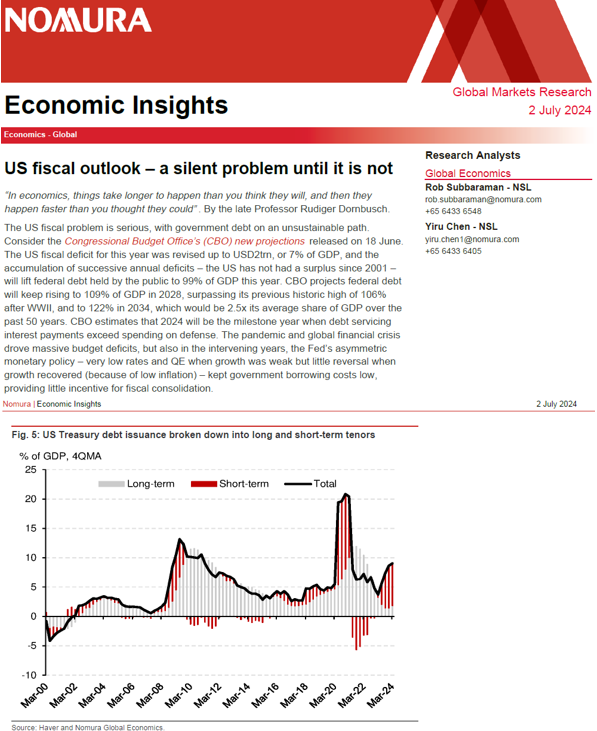
Markets are increasingly focused on the way the US abuses its fiscal space. Here's @Nomura Global Chief Economist @RobSubby who has one of my favorite charts in this week's report: total net new debt issuance is around 9% of GDP currently, with 80% of that issuance in Bills...
Since February 1st:
1. $SPX posted biggest earnings decline since Q3 2020
2. CPI/PPI data “revised” higher
3. PCE inflation rising for 1st time since Oct. 2022
4. Added 75 bps in rate hike expectations
Meanwhile, $SPX is down just 2%.
What will it take to break this market?
SUMMARY OF POWELL TESTIMONY (3/7/23):
1. Peak rate will be "higher than anticipated"
2. Revisions show inflation "higher than expected"
3. Minimal deflation in services
4. Decisions to be made "by meeting"
5. Inflation "to be bumpy"
A pivot from hawkish to more hawkish.
This is incredible:
Market futures are now pricing in 3 rate HIKES and 2 rates CUTS all in 2023.
Just 2 weeks ago, markets saw no more rate hikes in 2023.
Just this morning, markets saw no more rate cuts in 2023.
Market futures officially have no clue what the Fed will do.
This week's CPI report is the first that will be calculated with a new methodology.
Example:
- 2022 CPI = 2019+2020 consumption
- 2023 = ONLY 2021 consumption
Previously, CPI was calculated using 2 years of data, now it will be just 1.
What a convenient time to change this.
On August 1, 2012, Knight Capital lost $440,000,000 in 48 minutes.
Before that, it PRINTED money.
Here's the mind blowing story of how it happened:
Knight was an electronic trading firm that traded over 3,300,000,000 shares daily comprising 17% of total volume on the New York Stock Exchange (NYSE).
The rush for new business
In October 2011, the NYSE proposed a private market called the RLP. The RLP would allow traders to transact large volumes of shares with each other. The RLP was approved in June 2012 with a go-live date of August 1, 2012.
Knight rushed to update SMARS, its trading system, in preparation. SMARS executed thousands of orders per second by splitting them into smaller ones.
It took 17 years of dedicated work to build Knight into one of the leading traders on Wall Street. It took less than an hour to end it.
The Powder Keg
The updates replaced unused code in SMARS that was purposely designed to lose money. It was dubbed the Powder Keg and was used for testing Knight's algorithms by buying high and selling low.
They repurposed a flag which once activated the Power Peg. Now it activated the new RLP code - not Power Peg.
During deployment, an engineer failed to copy the new code to the last server, leaving the old code. The deployment was done manually, there was no review or documentation so the error was missed.
The damage
At 9:30 am on August 1, 2012 the last server began to receive orders. In response, SMARS sent thousands of orders per second that would buy high and sell low.
Market volumes were double the normal level and by 9:34 am traced the volume spike back to Knight.
Without documented procedures, Knight reverted to the old code still running on the last server and reinstalled it on the others. All servers now had the defective Power Peg code activated by the flag.
Knight finally shut down SMARS at 9:58 am. By then the damage was done.
Knight executed 4,000,000 trades in 154 stocks totaling more than 397,000,000 shares. It was net long in 80 stocks worth $3,500,000,000 and net short in 74 stocks worth $3,150,000,000.
Goldman Sachs bought the unwanted position and cost Knight $440,000,000. By the next summer, it was acquired by a rival.
Let me get this straight:
To secure votes for his Speakership, Kevin McCarthy agreed to a “secret plan” to cut:
Health care for families
School lunches
Air traffic
Food safety
And much more
Every day, Republicans in Congress show us how unfit they are to lead.
How can dollars be “backed” by US Treasuries if US Treasuries are just a promise for future dollars?
Maybe the dollar is backed by anything it can be exchanged for, which is everything.