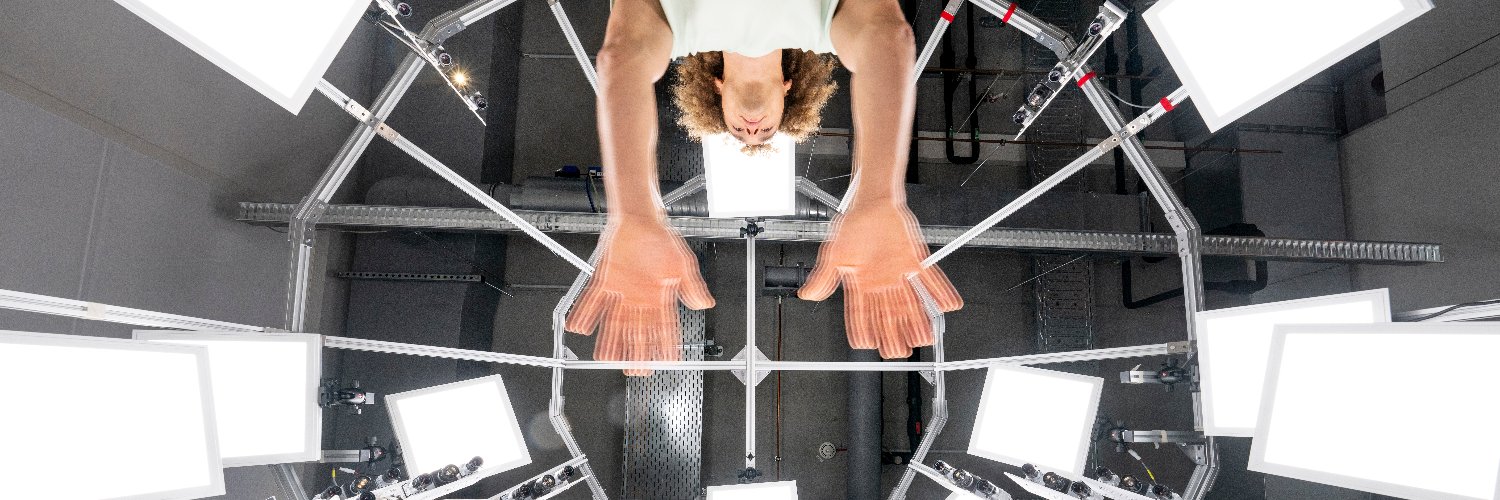
At the Max Planck Institute for Intelligent Systems we aim to understand the principles of Perception, Action and Learning in artificially intelligent systems.
If you have access to this, it's an excellent article about @Cyber_Valley, @meshcapade, and how we are driving an AI -economy forward in Germany.
(S+) In Deutschland entsteht eine innovative KI-Szene: Das Cyber Valley im Neckartal https://t.co/O62MVMwsGk via @derspiegel
Our Institute opens the RIGI 2025 application portal! As part of the Robotics Institute Germany, RIGI is a paid internship program for Bachelor’s and Master’s students, @MPI_IS in #Stuttgart. Find out more here: https://t.co/Z4vBVirrd9
#Internship#Robotics#MaxPlanck#Research
In fall, Zhijing will start a position as Assistant Professor at the @UofT University of Toronto! Last year, Zhijing was awarded three Rising Star awards: https://t.co/aw08xGcFml
Congratulations @ZhijingJin on your Ph.D.! It was Summa Cum Laude! Zhijing is in our Empirical Inference Department, working with the director @bschoelkopf on socially responsible natural language processing NLP by causal inference. #LLM https://t.co/i9QRIYJ0hU
Zhijing connects causal NLP work, which improves robustness, fairness & interpretability of NLP models, and impactful social applications i.e. the cause and effect of public policies and social trends, she looks at AI safety, and responsible AI for social good.
Scientists @MPI_IS & @Uni_Stuttgart invented compact wearable devices that deliver rich, expressive, and pleasant tactile sensations that go beyond the buzzing vibrations of today’s consumer devices. The team published their findings in Advanced Science: https://t.co/xL675sGWqe
Scientists @MPI_IS & @Uni_Stuttgart invented compact wearable devices that deliver rich, expressive, and pleasant tactile sensations that go beyond the buzzing vibrations of today’s consumer devices. The team published their findings in Advanced Science: https://t.co/xL675sGWqe
Day 22 of our advent calendar, featuring how an algorithm predicts the location of a person’s bones using only an external 3D body surface observation. #KI#AI#ComputerVision#MaxPlanck
Day 21 of our advent calendar, featuring cameras that are set up for an eye movement tracking project by our Optics and Sensing Lab.
#Ki#AI#MaxPlanck#Robotics#ComputerVision
Day 20 of our advent calendar, featuring a team from our Haptic Intelligence Department and from ZWE Materials which characterize biological material using scanning electron microscopy to inspire new technologies. #AI#KI#Robotics#MaxPlanck
Day 19 of our advent calendar, featuring our ZWE Medical Systems team. The scientist prepare a sample for magnetic resonance imaging(MRI): https://t.co/bh2iunsOew
Day 18 of our advent calendar, featuring two students observing the nonverbal communication between people using the NICE toolbox. #KI#AI#ComputerVision#MaxPlanck
We are coming nearer to the closing date for applications: it's January 7, 2025! Apply now and become a #MaxPlanck#Research Group Leader: https://t.co/KAYjoQ0tn7
We are hiring new Max Planck Research Group Leaders at our Stuttgart site! We are looking for outstanding candidates in the field of intelligent systems to establish multiple new independent research groups (1/4)
Day 17 of our advent calendar, featuring ISyHand: a robotic hand which can perceive and interact with objects using tactile sensing and teleoperation. It can even gently grip a raspberry! #KI#AI#MaxPlanck#Robotics#Robot
Day 16 of our advent calendar, featuring HASEL artificial muscles operated in reverse work as generators! The HASEL generators developed by our Robotic Materials Department convert mechanical energy into electrical energy, and here the team characterizes their performance #KI#AI
Day 14 of our advent calendar, featuring a team from our Haptic Intelligence Department who have trained a small #robot to imitate the movements of a person #KI#AI#Robotics#MaxPlanck