One of the biggest lie in DeFi is that high yield automatically means high risk.
Most of the time, the real problem is how the yield is generated.
@Xeffy_io is building an ecosystem designed around sustainable value creation and long-term capital efficiency.
One of the first and main products within that ecosystem is XAX.
=====
XAX introduces XAUSD, a vault where users can deposit USDT and gain exposure to professionally managed, delta-neutral strategies designed to generate yield without relying on market direction.
The idea is to make yield generation more accessible while reducing the need for constant monitoring, active trading, or complex strategy management.
=====
XAX is just the starting point.
It serves as a core building block within the broader Xeffy vision of creating financial products backed by real strategy-driven revenue rather than temporary incentives.
In a market where many projects compete by offering the highest numbers, it's worth paying attention to those trying to build something more sustainable.
and Xeffy is doing just that.
Revenue means very little if it has nowhere to go.
That's a problem a lot of ecosystems still haven't solved.
@Xeffy_io is introducing @Pixie_Pocket_, a Strategic Reserve Trust designed to manage treasury operations and token burns across the ecosystem.
It gets interesting when you see how it fits into the bigger picture.
➘ A portion of the revenue generated from Xeffy's core products will flow into Pixie Pocket.
>From there, treasury management and token burn mechanisms kick in.
So instead of revenue sitting idle in a treasury, the system creates a path for economic activity to feed back into the ecosystem itself.
It also gives more structure to the XEF value flywheel.
➘ Trading vault revenue, future RWAs, stablecoin infrastructure, and other products aren't being built as separate business lines.
> They're being connected through a common value layer.
Pixie Pocket looks like another piece of that design.
Not a product users interact with every day, but infrastructure working in the background to connect ecosystem growth with long-term value capture.
Over $100 billion in incentives have been distributed across DeFi over the years, yet most protocols still face the same problem: when rewards slow down, liquidity leaves.
That's not a growth problem.
> That's a design problem. <
@Xeffy_io is built around the idea that, rather than treating incentives as the engine of growth, sustainable value should come from revenue-generating products that reinforce the network itself.
I'll explain...🧵
4,000 NEW MILLIONAIRES… OR THE BIGGEST EXIT LIQUIDITY TRAP?
SpaceX is eyeing a June 12 listing at a $1.75–2 trillion valuation, which is larger than Microsoft's and behind only Apple & Nvidia.
That creates ~4,000 employee millionaires and makes Elon the world’s first trillionaire on paper.
But if we do a reality check:
→ Insiders own 95% (~$1.66T ready to sell)
→ Apple went public in 1980 at under $2B and 15x revenue.
→ SpaceX wants retail to buy at $2T and ~100x revenue in 2026.
This doesn't look like a get-in-early opportunity to me again.
It’s buying the exit for insiders who got in cheap and fresh capital sucked out of existing stocks, creating selling pressure across the whole market.
The lockup schedule is even wilder than usual:
➘ ~60 days post-IPO: 20% unlocks
➘ +30% stock pop = another 10% auto-unlocks
➘ Staggered 7% chunks at days 70/90/105/120/135
➘ Another 28% after Q3 earnings
>> By late November, ~93% of insider shares could be sellable.
We’ve seen this movie before.
Loose lockups = beautiful first weeks, then brutal supply overhang and months of bleeding.
Remember how another space stock $RLKB crashed right after its 2021 IPO but has since exploded +1,496%?
SpaceX could follow the same recovery path for those that are patient.
If you are a long-term SpaceX believer, I’d advise you to wait for the post-lockup dip.
Jumping in now.... you might become the exit liquidity.
Anyways, DYOR.
What’s your play... moon or trap?
Listening live to @strato_net break down how the Uniswap CCA works and why I need to be paying attention.
→ Physical gold & silver tokenized onchain
→ 711+ oz gold and 46,000+ oz silver CPA-audited
→ Built by Ethereum veterans with 11 years of development behind them
Hard assets... Onchain yield.... and Real backing.
Join in👇🏾
I can't think of many protocols where your yield position doubles as a chance to get VIP access to the British Grand Prix, meet F1 drivers, and spend the weekend in hospitality lounges with champagne on tap.
@alturax is making it happen by giving two people the chance to attend the British Grand Prix at Silverstone this July.
The clever part is you don't have to move capital into some separate campaign.
Hold $5k+ in the Altura ecosystem and you're already collecting raffle tickets while your position keeps working.
That's probably the most creative user acquisition move I've seen in DeFi this year.
Snapshot will be taken this Sunday and winners will be revealed on June 15.
After that, somebody is watching Formula 1 from Silverstone.
BlackRock just dumped 3,671 bitcoin:native (~$233M) to cover redemptions while adding 10,566 ethereum:native (~$17M).
At first glance, the numbers look small relative to BlackRock's total holdings.
The interesting part here is the timing of it.
Bitcoin ETFs just recorded their worst week of outflows on record as strong U.S. economic data pushed back rate-cut expectations and pressured risk assets.
Meanwhile, Ethereum continues attracting steady inflows, helped by growing institutional interest and a clearer path toward staking-related demand.
This doesn't look like BlackRock abandoning Bitcoin.
It looks more like portfolio rebalancing into an asset they believe has stronger near-term catalysts.
While retail focuses on BTC price action around $62K, institutions are paying attention to where the next wave of demand could emerge.
bullish signal for ETH for you or just normal fund mechanics?
If you're trading these narratives, check @1winPro Markets Crypto section.
Plenty of Bitcoin & Ethereum events, price predictions, and more to bet on the action.
@TheRealNesfield@workclaw individual AIs are cute but team-based Claws that actually collaborate like real coworkers could finally make AI useful more resourceful.
AI tools failed most teams for one simple reason.
They gave every employee an AI assistant, but nobody gave the assistants a way to work together.
So you ended up with smarter individuals and the same broken workflows.
@workclaw is approaching this problem from a completely different direction.
Rather than having one AI help one person, they're building AI co-workers that operate like an actual team.
Roles, managers, collaboration, shared context, their own tools.
That changes a lot because the companies that win in 2026 won't be the ones with the most AI tools.
They'll be the ones running a second workforce behind the scenes that never sleeps, never drops context, and keeps work moving after everyone logs off.
That's a different operating model entirely.
Things are getting more interesting with AVLT.
@alturax just expanded to Morpho ETH Mainnet with a new AVLT/USDC market, and @0xAlphaping seeded it with $4M+ in USDC liquidity from day one.
For people already following Altura, this isn't another yield update.
It's another way AVLT is becoming productive collateral.
You can now borrow USDC against AVLT, loop positions, and stack additional yield without leaving the ecosystem.
While a lot of yields across DeFi are getting squeezed, Altura keeps finding new paths for AVLT holders to put capital to work.
First external markets.
>Then lending.
>Now deeper Ethereum liquidity through Morpho.
The vault keeps earning and the collateral keeps working.
That's usually what strong assets do over time.
AI stocks might represent the single biggest infrastructure buildout since the invention of electricity.
We're watching hyperscalers pour hundreds of billions into AI data centers and compute power, while market projections point to a massive opportunity.
➘The global AI market currently sits at around $350–400 billion.
» Analysts project it will reach $2.5–3.6 trillion by 2033–2034, with annual growth rates of 26–30% or more.
This growth is being driven by explosive demand for compute, data, and applications.
➩ OpenAI leads with rapid scaling and was recently valued at $852 billion after its latest funding round.
It now generates around $2 billion in monthly revenue, with strong enterprise traction.
➩ Anthropic recently hit a $965 billion valuation.
Its Claude models are gaining traction quickly, with revenue run rates crossing tens of billions.
These leaders show how quickly capital and capability are flowing in and signal that the AI market is about to undergo major changes, including agentic systems, industry-wide automation, and personalized AI everywhere.
If you want to put real conviction behind these trends, check out the Tech section on @1winPro Markets.
You'll find events and predictions tied directly to AI and the hottest developments in tech, offering a sharp way to turn research into action.
Altura just finished distributing 100,000 AVLT, and instead of slowing down, they're putting another 100,000 AVLT into Epoch 5..
You don't have to guess what the leaderboard might pay anymore.
In Epoch 5, minimum rewards are public, with Rank 1 starting at $5,000 and allocations extending down the board.
What started as a deposit campaign is turning into a full activity layer around the @alturax ecosystem, where deposits, points, lending, Pendle positions, and other actions all feed into the same scoreboard.
And unlike a lot of reward programs, the prize is AVLT itself.
There is no vesting, no staking requirement.
Epoch 5 is live.
Are you gonna sleep on this or get in?
MEXC might have quietly launched one of the most misunderstood products in crypto.
Real US stocks.
This product brings confusion because people keep putting completely different things into the same bucket.
➛ A tokenized stock is not the same thing as a real stock.
➛ A tokenized RWA is not the same thing as a real stock.
➛ Pre-IPO exposure is definitely not the same thing as a real stock.
Yet I still see people talking about all three as if they're identical.
The difference starts with one question:
What do you actually own?
==============
If you buy a tokenized stock, you're usually holding a token that tracks the price of a stock.
You're not holding the actual share itself.
If you buy a tokenized RWA stock product, your exposure depends on the issuer and how the structure is built.
If you buy pre-IPO exposure, you're getting exposure to a private company narrative before public listing.
Real US stocks are different.
==============
You're getting exposure to actual publicly listed companies through licensed broker infrastructure.
That distinction matters.
The whole industry seems to be moving toward the same destination, but through different routes.
➢ Ondo is pushing on-chain stock exposure.
➢ Bitget is building around tokenized RWAs.
➢ Gate and Binance are expanding stock access through broker infrastructure.
Now @MEXC has entered the same race with Stocks.
=======
They're not trying to turn stocks into crypto.
They're making stocks accessible through crypto rails.
The process is surprisingly simple.
➴You already have USDT.
➴You already have a MEXC account.
Instead of opening a separate brokerage account, funding it through bank transfers, waiting for settlement, and managing another platform, you can access US stocks inside the same environment you already use.
The service is provided through MEXC's partnered licensed brokers.
That part is important.
The stocks are not tokenized representations.
They're real US equities accessed through broker infrastructure.
The platform currently offers access to more than 7,000 US stocks and ETFs across NYSE and NASDAQ.
MEXC approach is interesting because it combines something traditional investors understand, real stocks, with something crypto users already understand, USDT.
And honestly, that's probably where this industry is heading.
Not crypto replacing everything but crypto becoming the easiest gateway to everything.
===========
This is not a investment advice.
All investments involve risk.
Availability also depends on jurisdiction and local restrictions.
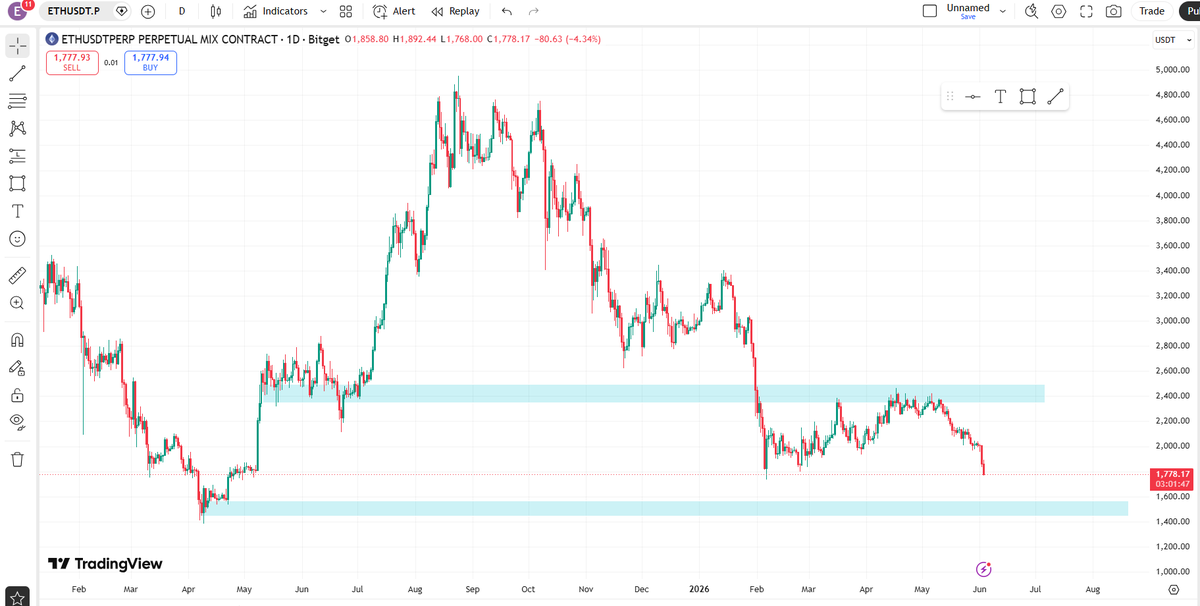
1WIN MARKETS CROWD IS OVERLOADING ON $1,500 $ETH PANIC FOR 2026
The $1,500 headlines are everywhere, look at the actual flow on @1winToken Markets.
a massive $124K volume on the Less than $1,500 bucket (by far the heaviest).
Traders are hammering downside buckets hard… yet many are missing the bigger picture:
» ETH already tested $1,700–$1,900 range multiple times and held
» Institutional inflows + ETF demand still intact
» Historical bear cycles show capitulation this deep is rare without total collapse
My take: The crowd on 1win markets are pricing maximum pain, but fundamentals don’t support a fresh leg to $1,500.
We’re closer to the bottom than most admit.
This kind of skewed positioning creates clean asymmetry… the exact setup where contrarian bets on 1win markets pay off biggest.
Sentiment is loud on fear.
Reality might print something far less dramatic.
Are you betting the overreaction or the flush that never comes?