Since initially discovered on Agent Mesh (Knostic's free reputation service for agentic supply chain - https://t.co/BcrPb9DUes), the actor shipped new variants within days, adding heavy obfuscation to evade static analysis
@k8em0@CyberScoopNews@Andrew___Morris@GreyNoiseIO I had a chance to comment on this during the CISO series Friday. @k8em0 - what do you think, do we need a summit/gathering to talk out this space and improve the overall community?
RE: https://t.co/NSQtueu1Rc
We opened up AgentMesh for free. It’s like a VirusTotal but got extensions, skills, etc. (https://t.co/BcrPb9DUes) You can also check out how we secure coding agents if you like. Free up to 5 licenses. https://t.co/BsCxIZ8zQO
The media and democratic party of WA want you to skip the primary election in August... I would argue it is the most important primary in the history of our state.
Two weeks ago the Chief Justice of the Washington Supreme Court signed the order telling you that you cannot vote on the income tax through a referendum.
Her name is Debra Stephens. She was appointed to the court in 2007 by Governor Christine Gregoire. She was re-elected in 2014 with the endorsement of the Washington Education Association, the union that named passing the income tax as its top legislative priority for 2026. She ran without meaningful opposition in 2020.
In 2023 she was part of the 7-2 majority that upheld the capital gains tax by recharacterizing it as an excise tax rather than an income tax. Tax Foundation analysts said that ruling appeared to signal the court's willingness to reconsider the 1933 constitutional ban on income taxes in Washington.
Two weeks ago she signed the order that closed the referendum path.
She is seeking her fourth full term through 2033. The income tax constitutional challenge is working through the courts right now and will eventually reach whoever holds this seat.
Her four challengers all show $0 in contributions in the current PDC cycle (Public Disclosure Cycle).
Scott Edwards is a tax attorney and former UW tax law professor who litigated against the capital gains ruling she was part of and against Seattle's income tax. His entire legal career has been built on challenging Washington's attempts to expand tax authority.
Todd Bloom is an attorney and Washington State Bar Association Board of Governors member who ran in the 2024 court primary.
Karim Merchant is a criminal defense attorney who states he is committed to fighting government overreach.
David Shelvey is a Sumner attorney who also ran in 2024.Five people on this ballot. Top two advance August 4. General November 3.
The ballot says nonpartisan. The documented record says something more specific.
I publish the full research and sourced breakdowns on Substack every week. Search Shane Kidwell if you want the deeper dive.
@GovBobFerguson@komonews@KIRO7Seattle@KING5Seattle@fox13seattle@seattletimes
@IsForAt I will always remember the opportunity one year to visit his home for the Microsoft Giving campaign family dinner which I have relished for 20 year😔
I sat down with @MrDBCross (CISO, Atlassian | Patent Holder in ML & Authentication | Rain Capital Venture Partner | Ex. Oracle & Microsoft) - for a conversation on AI agent security, why every company will soon have 10x more agents than humans, and how Atlassian uses AI to both build and secure their products.
David has spent 25+ years across cybersecurity and cloud security engineering - with leadership roles across Microsoft, Oracle, and now Atlassian, where he secures one of the world's most widely used developer platforms.
Here's what stood out:
- On AI agents as the next identity crisis: "Agents are the next non-human identity. We had service accounts, but agents are like a clone of a human identity - and that's the challenge. How do you manage those permissions?"
- On the scale that's coming: "Every company three years from now will have 10x the number of agents as they do humans. And I may be conservative. You need to monitor them. And sometimes you need to block them."
- On the 96% unused permissions: "A lot of times you're cloning the human identity for the agent. The HR person has lots of permissions - they can read, write, and change data. That clone doesn't make sense."
- On supply chain risk with coding agents: "Could a coding agent make a mistake and pull a package from an untrusted source? The water always finds the path of least resistance. Agents will do the same."
- On vibe coding governance: "High tech companies have strong development culture and pipelines. But manufacturing, healthcare, retail - they don't. When people vibe code there, they need tools to make sure the software is compliant, secure, and private."
- On AI not replacing your SOC: "AI is not gonna replace the humans. It's gonna augment them. It is a partnership and we're always going to be here."
- On the technical CISO: "Can any CISO survive and say 'I don't know how to do prompting, I don't know what prompt injection is'? If you're not learning to prompt and do things yourself, you are behind."
We also covered AI native SDLC, token budgeting as the new bandwidth, shadow AI and the resurgence of DLP, attribute-based access control for agents, and the IT-ISAC SaaS security white paper.
Listen now 👇
YouTube: Link in comments
Spotify: Link in comments
Views expressed are personal and shared only for community learning
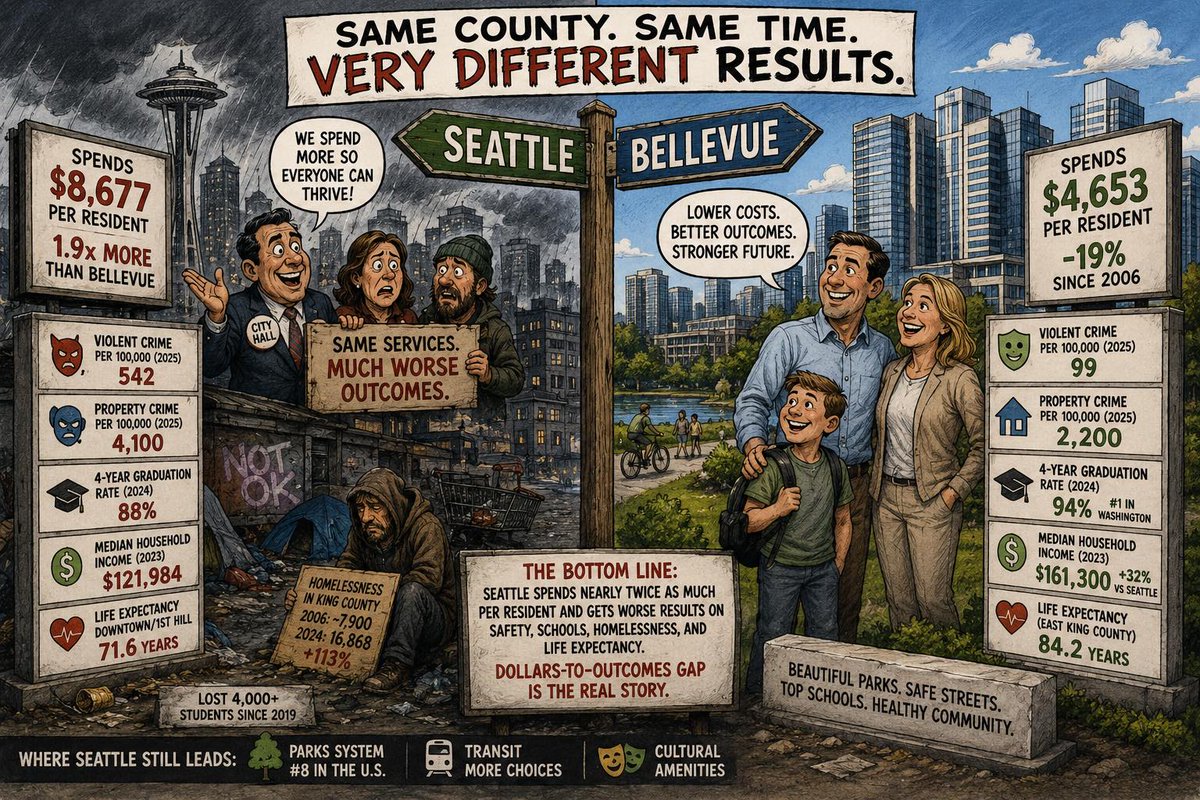
Seattle vs. Bellevue: 20 years of data, side by side
I pulled the numbers and the gap is wider than I expected. Both cities grew about the same (Seattle +40%, Bellevue +34%). But the outcomes diverged hard.
Budget (ex-municipal utilities, real per-capita, 2026 dollars):
• Seattle: $5,997 → $8,677 per resident (+45%)
• Bellevue: $5,741 → $4,653 per resident (−19%)
• Seattle now spends 1.9x more per resident than Bellevue on essentially the same menu of city services
Crime (per 100,000, 2025 estimates):
• Violent crime: Seattle ~542, Bellevue ~99 (5.5x gap)
• Property crime: Seattle ~4,100, Bellevue ~2,200 (1.9x gap)
Homelessness (King County PIT count):
• 2006: ~7,900
• 2024: 16,868 (+113%)
• Seattle absorbs nearly all of the visible unsheltered population. Bellevue, same county, does not.
Schools (4-year graduation rate, 2024):
• Seattle Public Schools: 88%
• Bellevue School District: 94%, ranked #1 in Washington
• SPS has lost 4,000+ students since 2019. Families with options are leaving.
Median household income (2023, inflation-adjusted):
• Seattle: $121,984
• Bellevue: $161,300 (+32%)
Life expectancy:
• East King County (Bellevue area): 84.2 years
• King County overall: 81.2 years
• Seattle Downtown/Belltown/First Hill: 71.6 years
• 15+ year gap within the same county
Where Seattle still wins:
• Parks system, ranked #8 in the U.S. by Trust for Public Land
• Transit (more buses, light rail, walkability)
• Cultural amenities
Bottom line: Seattle spends nearly twice as much per resident as Bellevue and gets worse outcomes on schools, safety, homelessness, and life expectancy. Some of that is because Bellevue is wealthier and less burdened with regional problems. But not all of it. The dollars-to-outcomes gap is the real story, and Seattle’s defenders have a hard time explaining it away.