I used to think velocity limits were just another anti-bot feature.
The more I looked into Newton, the more I realized they’re actually a policy layer that decides before a transfer happens. If a transaction doesn’t satisfy the rules, it never becomes part of on-chain activity.
That changes the conversation completely.
Instead of cleaning up bad behavior after the fact, the network quietly shapes participation from the start. Every policy decision leaves a signed receipt, creating an auditable history of why access was allowed or denied.
The interesting part isn’t lower transaction volume—it’s what kind of community remains. If access depends on following transparent, verifiable rules, the network may naturally attract participants who are willing to operate within them.
But one question still matters:
Does this create stronger long-term conviction, or does it simply reduce activity until liquidity finds an easier path elsewhere?
The answer won’t come from the policy itself. It’ll come from how users behave over time.
#nsfwtwtًً
#NEWT
ethereum:0xd0ec028a3d21533fdd200838f39c85b03679285d
@newton_xyz
Trust Over Speed: What Actually Matters in Cross-Chain
Most people judge cross-chain stuff by speed, how many networks it supports, and how cheap the fees are.
Those numbers look good on paper, but they miss the real part.
The second you send your money from one chain to another, it disappears into layers you can’t really see — relayers, validators, bridges, whatever sits in the middle. At that point you’re just hoping everything goes right. That’s where trust actually gets tested.
A proper protocol shouldn’t make you cross your fingers. It should let you see what’s happening at every step, understand it, and stay in control. Transparency isn’t some extra feature. It’s just as important as connecting the chains in the first place.
Linking up more networks is nice. But giving people real confidence while their funds are moving? That’s what actually matters.
I think the cross-chain protocols that win in the long run won’t be the ones that reach the most chains. They’ll be the ones that take away the most doubt.
What do you think really decides if a cross-chain solution is good or not?
@newton_xyz
ethereum:0xd0ec028a3d21533fdd200838f39c85b03679285d
#NEWT
I keep seeing the same pattern with spending limits and approved payees.
You start with a low limit because you want to stay in control. Then after a few weeks you raise it without thinking twice. Same with payees — you add one after a manual payment and it just stays there forever. Almost nobody ever cleans the list.
These features don’t really get removed or tightened. They only expand. And once they do, more of your spending stops needing your full attention.
It’s not dramatic. It just slowly hands over small pieces of your control without you really noticing.
@newton_xyz
#NEWT
ethereum:0xd0ec028a3d21533fdd200838f39c85b03679285d
Newton Protocol might be exactly what crypto needs for AI agents right now.
Everyone’s rushing to build autonomous bots and strategies, but they usually skip the part where you add real safeguards. When things go wrong with real money, it’s always too late.
Newton is putting controls in place upfront – permissions, limits, policies – so actions don’t just fire off unchecked. It’s simple, but most projects don’t bother until they have to.
The token side has utility for staking and governance, which is solid. But the bigger question is if this setup protects users without getting annoying or complicated.
We don’t need more hype about AI taking over everything. We need systems that work safely when it counts. Newton looks like it’s prioritizing that.
@newton_xyz
ethereum:0xd0ec028a3d21533fdd200838f39c85b03679285d
#NEWT
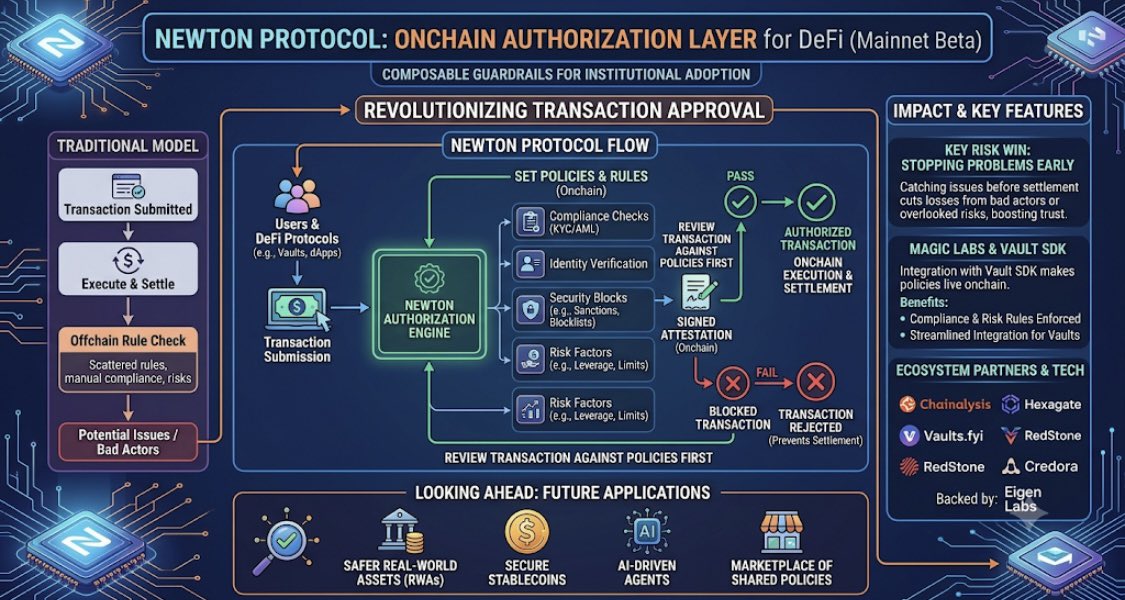
Been following Newton Protocol for a bit and their Mainnet Beta just went live. It’s basically bringing real onchain authorization to DeFi — every transaction gets checked against active policies before it settles, then it drops a signed pass/fail attestation right onchain.
Most tools only show you what already happened. Newton actually stops the bad stuff from happening in the first place. Kinda like how Visa authorizes a card swipe before the money even moves, except this is all happening transparently on the blockchain.
Super useful for those big curated vaults that are holding serious money. Their risk rules don’t have to live in random offchain docs anymore — they can actually be enforced onchain through the Newton Vault SDK.
The Magic Labs team (the same folks behind those embedded wallets with 57M+ users) built this, and they’re working with proper names on compliance and security. $NEWT powers the whole thing.
If you’re into DeFi that actually feels secure, worth keeping an eye on this one.
@newton_xyz #NEWT
Man, I’ve been following Newton Protocol for a bit and their Mainnet Beta just went live. It’s basically bringing real onchain authorization to DeFi.
Instead of tools that just show you what already happened, Newton checks the transaction against the actual policy first and drops a signed pass or fail right onchain. Feels like the missing piece — kinda like how Visa authorizes a card payment before the money even moves.
Super useful for those big curated vaults where risk rules usually live in spreadsheets or offchain processes. Now the rules can actually be enforced where it matters. They’ve got solid partners helping build out the compliance, security, and risk checks too.
@newton_xyz
ethereum:0xd0ec028a3d21533fdd200838f39c85b03679285d
#NEWT
Newton Mainnet Beta just went live and I’m actually pretty hyped about it. It’s the onchain authorization layer that verifies every transaction against real policies before anything settles — like Visa’s approval system but native to crypto.
Super useful for DeFi vaults where risk rules have always been fragmented and offchain. Now they can actually be enforced onchain in one clean layer.
Built by the Magic Labs crew. Worth keeping an eye on.
@newton_xyz
ethereum:0xd0ec028a3d21533fdd200838f39c85b03679285d
#NEWT
#Newt
Yo crypto crew, Newton Mainnet Beta just dropped and I’m actually hyped about this one.
It’s the first real onchain authorization layer for DeFi. Instead of waiting for something to go wrong and then reporting it, Newton checks the transaction against your live policy before it settles and drops a signed pass/fail right onchain. Simple as that.
Feels exactly like how Visa’s network works — the green light happens before the money moves. We finally have that missing piece onchain.
Take those big curated vaults holding serious money. Their risk limits used to live in spreadsheets and offchain processes. Now with the Newton Vault SDK (built by Magic Labs), those rules become actual onchain enforcement. Compliance, identity, security threats, and risk parameters all get handled in real time across four clear domains.
The team pulled in proper partners — Chainalysis + Hexagate for compliance, https://t.co/DYsWqdKorX, RedStone + Credora, and security from Eigen Labs, Succinct, Rhinestone, and Octane. Magic Labs themselves are the ones powering it (57M+ wallets, embedded wallet tech that Polymarket runs on, PayPal Ventures backed).
They’re starting with vaults but already talking about scaling into RWAs, stablecoins, and even AI agents later, all tied together through this “Internet of Policies” marketplace.
What I like most is the risk side: it stops problems at the door instead of cleaning up after. That proactive layer is what a lot of Web3 stuff has been missing if we want bigger players and real capital to feel comfortable.
If you’re building or just watching this space, worth keeping an eye on.
@newton_xyz
ethereum:0xd0ec028a3d21533fdd200838f39c85b03679285d
#NEWT
Newton Mainnet Beta is live and it’s doing something DeFi actually needed — real onchain authorization.
Every transaction gets checked against active policies first (compliance, security, identity, risk), then a signed pass/fail goes onchain. Kind of like how Visa approves before the money moves, except it’s decentralized and happens before settlement.
Huge for curated vaults where risk rules used to sit offchain and fragmented. The Vault SDK makes them enforceable right on the chain. Built by Magic Labs (57M+ wallets) with solid partners on board. ethereum:0xd0ec028a3d21533fdd200838f39c85b03679285d powers it.
This cuts down real risks and gives Web3 sturdier foundations to grow into RWAs and beyond without everything feeling so cowboy.
@newton_xyz
#NEWT
Newton Protocol’s Mainnet Beta is now live and it’s bringing proactive onchain authorization to DeFi.
Transactions get checked against policies first, with a signed attestation posted onchain before anything settles. No more fixing issues after they happen.
DeFi vaults benefit big time as offchain risk and compliance rules become automatic and enforceable onchain. Magic Labs plus key partners are delivering this layer.
It sets up safer Web3 expansion into RWAs and AI agents by cutting hidden risks early.
@newton_xyz
#NEWT
ethereum:0xd0ec028a3d21533fdd200838f39c85b03679285d
Real progress isn’t always louder. Sometimes it’s making every transaction more predictable. @newton_xyz
ethereum:0xd0ec028a3d21533fdd200838f39c85b03679285d #Newt
Especially in something like Newton, where the operators are evaluating policies in real time for onchain automation and AI agents. In those setups, flaky or low-quality participants don’t just slow things down — they destroy the economic value the whole system is trying to create.
Curious what you think. Does adding permissioned elements like this make a network more decentralized in practice, or less?
@newton_xyz
ethereum:0xd0ec028a3d21533fdd200838f39c85b03679285d
#NEWT
Can Automation Become the Trust Layer That DeFi Needs?
The biggest challenge in DeFi isn’t building new products anymore. It’s making sure they can be trusted as millions of people start using them.
When DeFi was smaller, manual reviews and human oversight made sense. Teams could check transactions, update rules, and respond to problems without too much difficulty. But that approach doesn’t seem realistic as the ecosystem keeps expanding.
In my opinion, automation will become less of a luxury and more of a necessity. Not because people are incapable, but because no one can watch every transaction, every wallet, and every smart contract all the time.
That doesn’t mean automation should replace human judgment. Good systems should simply handle repetitive tasks, enforce clear rules, and react faster than any individual could. Humans still need to design those rules, review unusual situations, and improve the system over time.
Of course, automation isn’t perfect either. Poorly written policies or coding mistakes could create problems just as easily as human errors. That’s why transparency and regular testing are just as important as automation itself.
The real goal isn’t to remove people from the process. It’s to let technology handle predictable work while humans focus on decisions that require experience and common sense. If both work together, DeFi can become safer without slowing down innovation.
I believe trust won’t come from promises or marketing campaigns. It will come from systems that behave consistently, follow clear rules, and protect users even when no one is watching.
What do you think—will automated onchain policies become the standard for DeFi security, or should human oversight always remain the final layer of protection?
@newton_xyz ethereum:0xd0ec028a3d21533fdd200838f39c85b03679285d #NEWT
Trust isn’t built by new features alone. Time will tell what lasts. What do you think matters more in the long run for crypto infrastructure: impressive new features or systems that people barely notice because they simply work? @newton_xyz $NEWT #Newt
One thing I’ve been thinking about lately is how much of crypto security still focuses on explaining what happened after a transaction.
That has value, but I think checking a transaction against clear rules before it settles is an even more practical direction.
That’s why @newton_xyz caught my attention. If policy checks become part of the transaction flow instead of something reviewed later, it could make DeFi feel more dependable as it grows.
I’m curious to see how the Newton Mainnet Beta develops from here.
$NEWT #Newt