High atop towering poles and humming transmission lines, the lineman moves with practiced precision, stringing together the invisible arteries of power and communication that keep modern life humming.
Whether battling fierce storms to restore electricity after a blackout or carefully splicing fiber-optic cables for high-speed networks, lineman work blends raw physical endurance, electrical expertise, and split-second decision-making in some of the most demanding environments on earth.
Books chronicling this essential trade capture the evolution from early telegraph linemen to today’s specialists who maintain everything from massive substations and 5G towers to underground conduits and emergency response crews.
Safety harnesses, insulated gloves, bucket trucks, and live-line tools become extensions of the body, while years of training turn the constant risks of voltage, height, and weather into calculated routines that power cities and connect communities.
What draws you most to the world of lineman work—restoring power in disaster zones, building the backbone of tomorrow’s communications, or the stories of the men and women who do it every day?
@unkonfined Mines 13 and leaves me on the weekends. Te best feeling is the smile you see when they see you again.
She tries to act like she doesn’t care, but it’s easy to tell she does
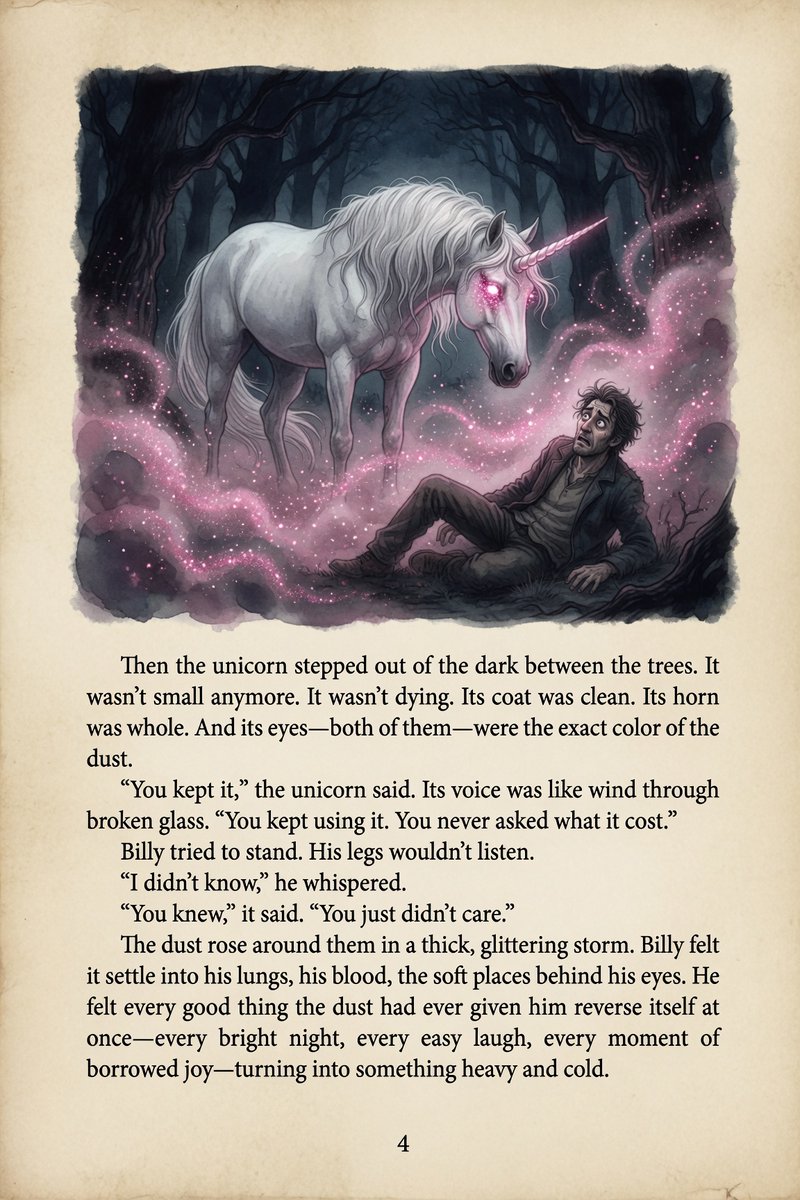
The dust rose around them in a thick, glittering storm. Billy felt it settle into his lungs, his blood, the soft places behind his eyes. He felt every good thing the dust had ever given him reverse itself at once—every bright night, every easy laugh, every moment of borrowed joy—turning into something heavy and cold.
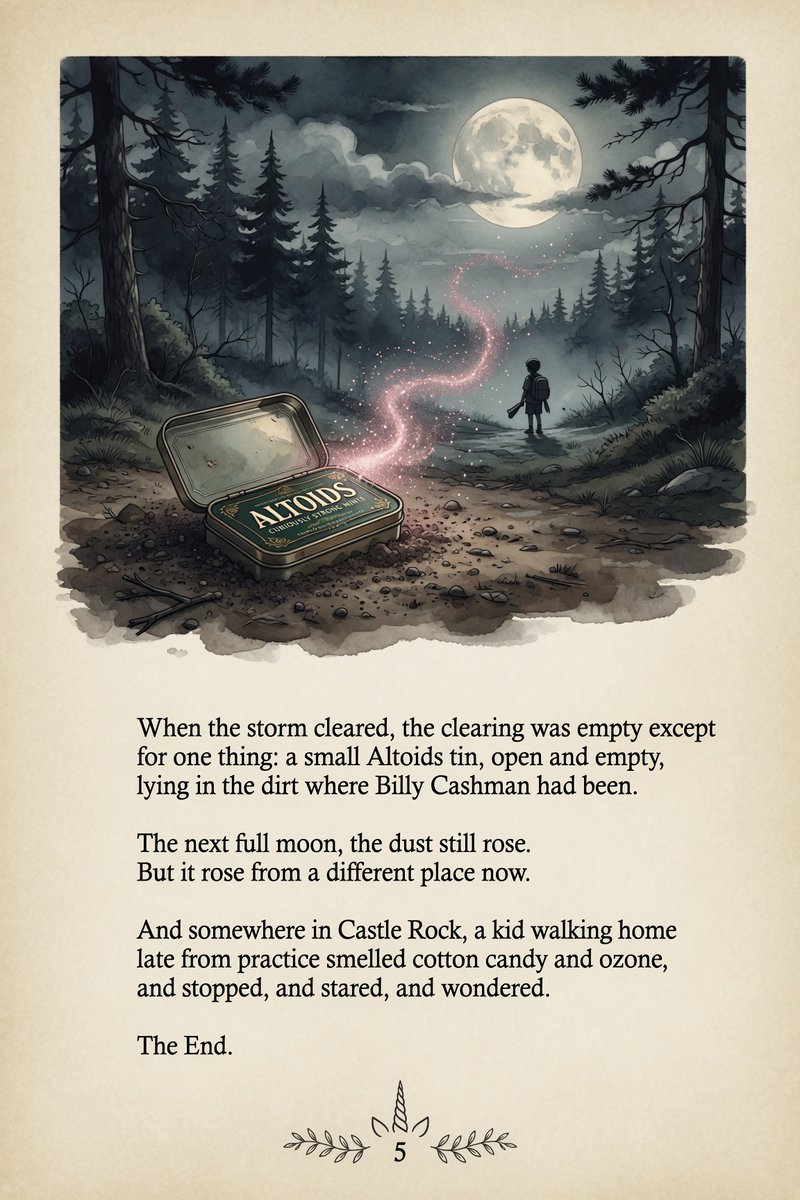
When the storm cleared, the clearing was empty except for one thing: a small Altoids tin, open and empty, lying in the dirt where Billy Cashman had been.
The next full moon, the dust still rose.
But it rose from a different place now.
And somewhere in Castle Rock, a kid walking home late from practice smelled cotton candy and ozone, and stopped, and stared, and wondered.
The End.
It Came from the Horn
The first time Billy Cashman saw the dust, he was eleven years old and already half-convinced the world was trying to kill him.
It was August in Castle Rock, the kind of August that made the tar on Main Street soft enough to leave footprints if you stood still too long. Billy was cutting through the old Randall property on his way home from the Little League field, glove hanging from his belt like a dead animal, when he smelled it: sweet, almost like cotton candy left out in the rain, with something underneath that made the hairs on his arms stand up. Like ozone after a lightning strike. Like the inside of a battery.
He found the unicorn in the clearing behind the collapsed barn.
It wasn’t majestic. It wasn’t glowing. It was the size of a small pony, its coat the dirty white of old snow, and it was dying. One leg was twisted at an angle that made Billy’s stomach do a slow roll. Its horn—spiraled, yellowed, cracked near the base—dug into the soft dirt as it breathed. And every time it exhaled, a fine shimmer of glitter drifted from its hindquarters and settled on the leaves.
Unicorn fart dust.
Billy stood there for a long time, glove dangling, mouth open. The creature’s eye, the one that still worked, rolled toward him. There was no wisdom in it. Just pain, and something older than pain.
Then it farted again.
The dust rose in a soft pink cloud, drifted on the hot air, and touched Billy’s sneakers.
That night the dreams started.
By the time he was seventeen, Billy understood three things about unicorn fart dust:
1It never really left you.
2It made everything brighter for a while.
3Then it took something back.
The first time he used it on purpose was the night of the junior prom. He’d scraped a little into an empty Altoids tin from the clearing (the unicorn was long gone by then; only the dust remained, regenerating every full moon like some cosmic practical joke). He mixed a pinch into the punch. The gym lights turned into soft fireworks. The band sounded like the Beatles on a good day. Everyone danced like the world was ending and they were glad about it.
Three days later, Cindy McAllister’s little brother walked into the path of the 4:15 freight. No one ever connected it to the punch. Why would they? It was just glitter. Pretty, harmless glitter.
Billy kept the tin.
Years later, after the first marriage collapsed and the second one never quite started, after the job at the mill and the job at the garage and the long stretch of nights where the bottle was the only thing that quieted the dreams, Billy came back to Castle Rock with a cardboard box of clothes and the Altoids tin still in his coat pocket.
The town had changed the way towns do—new Walmart, old diner closed, kids with phones instead of baseball gloves—but the clearing behind the Randall place was the same. The dust still came with the full moon, soft and pink and smelling of ozone and cotton candy.
Billy sat on a rotten log and waited.
He was forty-one now, face like a road map of bad decisions. The dreams had gotten worse. In them the unicorn was never dying. It was standing. Looking at him. Waiting.
When the dust rose that night, Billy didn’t scrape it into the tin.
He breathed it in.
The world went soft and bright. The trees sang. The stars leaned down close enough to touch. For the first time in years, Billy felt the weight lift off his chest.
Then the unicorn stepped out of the dark between the trees.
It wasn’t small anymore. It wasn’t dying. Its coat was clean. Its horn was whole. And its eyes—both of them—were the exact color of the dust.
“You kept it,” the unicorn said. Its voice was like wind through broken glass. “You kept using it. You never asked what it cost.”
Billy tried to stand. His legs wouldn’t listen.
“I didn’t know,” he whispered.
The unicorn lowered its head until the horn nearly touched Billy’s forehead.
“You knew,” it said. “You just didn’t care.”