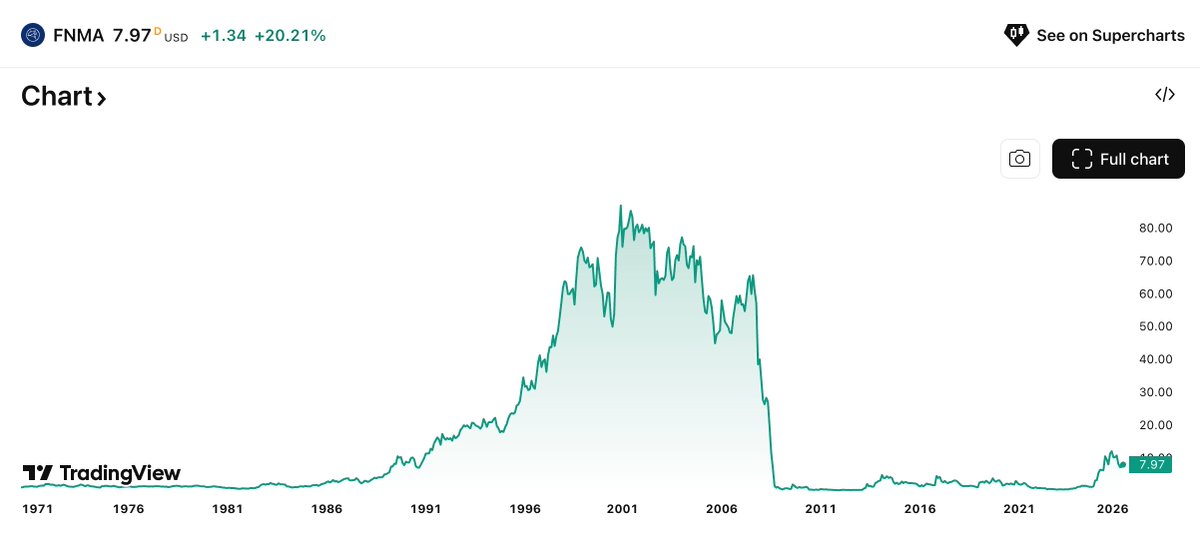
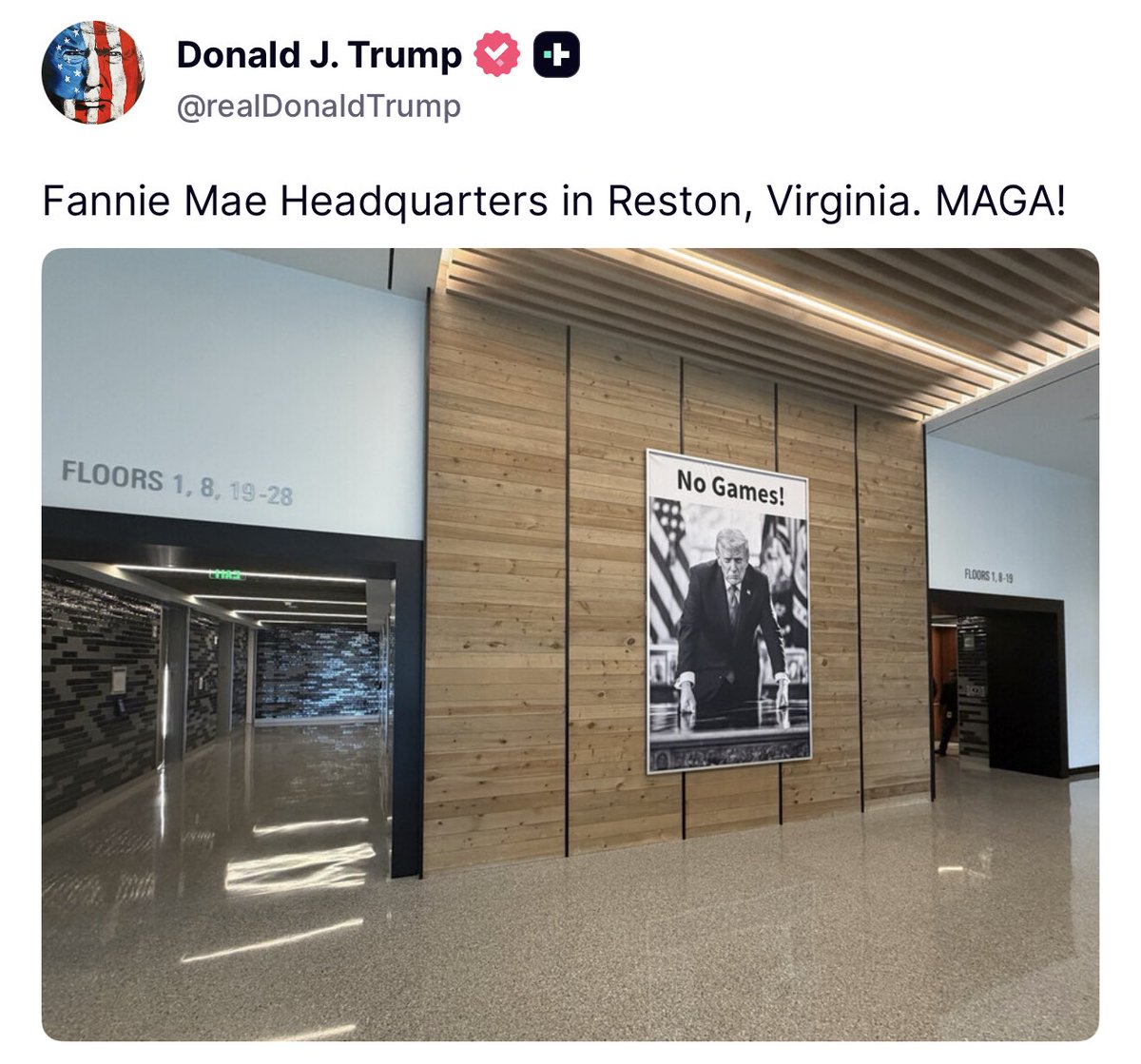
$FNMA $FMCC
@SecScottBessent has consistently articulated the @realDonaldTrump administration's stance on maintaining or improving mortgage spreads in any consideration for privatizing Fannie Mae & Freddie Mac.
Did @pulte signal today that this condition has been satisfactorily met?
Exerpts from May, October, and December of last year attached.
Fannie & Freddie have extraordinarily strong liquidity right now, as reflected in the strength of the MBS market and mortgage spreads. I expect a very strong summer and fall season! I’d like to thank our Great Leadership Teams at both businesses who are “firing on all cylinders”!
An update on Pershing Square USA, Ltd. $PSUS:
Since its IPO on April 29th, PSUS has deployed nearly 85% of its capital in 12 companies including Amazon, Microsoft, UBER, Meta, Brookfield, Restaurant Brands, Fannie Mae and Freddie Mac at prices we believe to be extremely attractive.
The PSUS portfolio, along with the other Pershing Square funds, also includes four new companies, which we will disclose at the time of our second quarter report.
As a result of our investment activity over the last six weeks, we believe the PSUS portfolio is now invested in a number of the highest quality durable growth companies in the world, which are trading near their all-time lowest valuations.
Furthermore, as of this moment, PSUS is trading at a ~20% discount to the net asset value (NAV) of its underlying holdings so a buyer of the stock at today’s price is acquiring the current portfolio at a double discount. We believe the PSUS discount to NAV has emerged due to short-term technical factors related to the IPO that should moderate over time.
Pershing Square management and affiliates are all-in, having acquired more than ten million shares or $500+ million of PSUS in the IPO and in the market thereafter.
In summary, we believe PSUS and its portfolio holdings represent an extremely attractive bargain at today’s share price and we have put our money where our mouth is.
$FNMA $FMCC
Only audio was available earlier when @realDonaldTrump addressed the Fannie Mae & Freddie Mac question on Air Force One.
Here's the corresponding video as well.
Final statement:
"I could’ve sold it in my first term for one tenth of what it’s worth now...and I didn’t wanna do it. NOW I think we...you know...we would consider an IPO, yeah.
In my humble view, this is Trump‘s typical Art of War routine where he keeps everyone guessing.
But the tea leaves I continue to read represent the hill I’m willing to die on.
1. @BillAckman has met with the administration repeatedly and has publicly (and confidently) laid out his plan. He also launched his own IPO where he’s indicated that he’ll reinvest funds raised to replicate current holdings. He also just launched a Trump Accounts endorsement project with Charles Schwab.
2. The administration has been meeting repeatedly for months with attorneys and bankers to make sure all their ducks are in a row.
3. @RobinhoodApp overrode their OTC protocols last week to make an exception in adding F2 to their platform. Random? No way. Robinhood also has exclusivity as the broker and soul initial trustee for the Trump Accounts.
4. Berkshire Hathaway took an $8.5 billion position in a home building company. Bullish much?
5. A pro rate cut Fed Chair who economically aligns with Trump now presides in Warsh.
6. Capital requirements are likely to be reduced when recommendations are made next month regarding Trump's March EO on reviewing regulatory constraints.
7. @SecScottBessent wants to improve the asset side of the balance sheet...and there's too much money to be made for the Sovereign Wealth Fund for Trump not to act. Timing is everything. He won’t steal Elon’s SpaceX thunder. But what better time than the country's 250th birthday to tie in an F2 public offering on the way to restoring the American Dream? It would be the production and pageantry he lives for. Just sayin'.
8. @pulte continues to say that all options are on the table & that they’re locked, loaded, & ready to go. And we're still waiting for he & @cvpayne to "break that Fannie Mae news together ".
9. The Texas Stock Exchange is going live next month...for whatever that's worth.
Cue the doubters and never gonna happeners. Troll away.
Weary and fatigued shareholders...I get it. I hear you. I'm one of you. It's been a grueling ride. Do I get frustrated every time F2 is referred to as a trillion dollar company while we trade like penny stocks on pink sheets?Yes! One trillion percent! But the goaline is close.
Trump isn’t gonna fumble the opportunity to solidify the crown jewel in his his legacy of restoring housing.
When? Who knows. But it's coming...and it will be swift.
Have a great weekend!
GLTA
$FNMA $FMCC
@realDonaldTrump today on Air Force One when pressed on the Fannie Mae & Freddie Mac IPO:
"We’re thinking about an IPO for them…it's not a rush."
IMHO, if he wasn’t going to do it, I believe he would just say so.
There’s too much money to be made on all sides not to do it. But timing is everything.
GLTA
Hi FNMA & FMCC families now we can trade on robinhood. Robinhood supports both companies. I just tried to buy it did let me.. but the mrkt is still closed but we can buy on robinhood now. Yeyey
I think Fannie Mae $fnma takes out its all time high in 2-3 years and in the meantime pushes $30 this year. What is a pink sheet shitter today, will be in your moms IRA, so many etfs, your kids Trump account etc. It will be as normal as a stock name Google Robin Hood etc.
A number of press reports have characterized our and other shareholders’ efforts on behalf of Fannie and Freddie (F2) as seeking a ‘gift’ or ‘handout’ from the government. We, the shareholders of F2, seek no such thing.
Hundreds of financial institutions were bailed out during the GFC by the U.S. Treasury. Nearly all of the financial institution bailouts during the GFC involved an injection of capital in the form of senior preferred stock by Treasury at an interest rate of 5%, plus warrants to acquire common stock in an amount equal to 15% of the face amount of the preferred with an exercise price at the then-current stock price of the rescued institution.
For example, Treasury’s preferred stock investment in Goldman Sachs was in an amount of $10 billion and, in addition, Treasury received warrants on $1.5 billion of GS' common stock at its then market price.
The bailout terms for F2 were materially more burdensome and expensive, with a higher interest rate and substantially more warrant coverage, than that of every other financial institution (other than those of AIG whose terms were similar). Despite the F2 bailouts’ massively more burdensome terms, shareholders are not complaining about the original terms.
Treasury invested $193 billion in F2 in the form of senior preferred stock (SPS), including funding for $2 billion of commitment fees, with a 10% coupon (twice that of the banks). Treasury also received warrants on 79.9% of both companies’ outstanding shares.
Fannie and Freddie have since repaid Treasury $301 billion, which includes interest on the SPS at a blended rate of 11.6%, an interest rate which is 160 basis points more per annum, and have returned the entire $193 billion of outstanding principal, $25 billion in excess of what was contractually owed. In summary, the F2 SPS has been fully repaid according to its original contractual terms plus an extra $25 billion.
Despite the fact that the SPS has been more than repaid in full, Fannie and Freddie have not accounted for these payments on their respective balance sheets, and the $193 billion of SPS remains an outstanding liability as if no principal payments had ever been made.
How can it be, you might ask, if indeed F2 have repaid $301 billion to Treasury when only $276 billion was due could there be any remaining balance of the SPS on the F2 balance sheets?
The answer relates to something called the ‘Net Worth Sweep (NWS).’
During the second term of the Obama administration, on August 12, 2012, two quarters after F2 returned to profitability, Treasury announced that it was unilaterally amending the terms of the SPS stock to provide that Treasury would take 100% of the profits of F2 each quarter in lieu of the 10% annual dividend rate. This was not a negotiated resolution with F2. It was a unilateral amendment of the original terms of the SPS that was done in bad faith.
The supposed rationale for the amended terms of the SPS was akin to the IRS garnishing the wages of someone who will never be able to pay the taxes that they owe. That is, the Treasury said F2 will never be able to pay the 10% coupon, let alone the SPS’ $193 billion principal balance, so it decided instead to ‘settle’ for 100% of F2’s profits forever.
In discovery, shareholders learned that the stated justification for the amendment was false. In mid 2012, the Obama administration had come to learn that both companies would soon be reversing tens of billions of reserves on their balance sheets as housing values had increased and the reserves taken during the GFC had been excessive. The NWS was instituted by Obama to forestall F2 from forever being able to recapitalize and be released from conservatorship. The NWS was not a ‘settlement’ for a lesser amount of future payments. It was the outright theft of the forever profits of both companies.
Never before or since has the government ‘swept’ 100% of the profits of any company, let alone a financial institution in conservatorship, a form of government intervention where the goal is rehabilitation of the institution, and where the hierarchy of corporate claims has always been respected.
The accounting for the NWS payments while it was in effect (until Secretary Mnuchin terminated the NWS in Trump’s first term) was also unusual. The NWS was treated by F2 as a quarterly adjustment to the dividend rate on the SPS such that the dividend amount owed was made equal to the after-tax profits of F2 for that quarter with no limitation.
In other words, regardless of the amount of profit F2 generated for the quarter – whether or not it was in excess of the original 10% annual dividend – the dividend payable under the NWS was made equal to the quarterly profit. The absurd terms of the NWS sweep therefore made it impossible for any partial or full repayment of the SPS to take place as every dollar paid to the Treasury on the amended terms of the SPS was considered a dividend payment, even if the amount was massively in excess of the original contractual SPS terms.
The absurdity of the NWS was made clear just two quarters after the NWS went into effect. Fannie Mae generated a profit of $59 billion in the first quarter of 2013, and the SPS dividend rate for that quarter was set at $59 billion so the entire amount was swept to the government, more than 10 times the contractual dividend rate.
I had the opportunity to discuss F2 and the NWS with Warren Buffett about a decade ago and he said that he “couldn’t believe what the government had done.”
In short, the shareholders of F2 are simply asking the government to respect the original and highly burdensome terms of the SPS. There is no dispute that Treasury has received more than the original 10% coupon and full repayment of principal of the SPS, that is, an extra $25 billion.
We and the millions of other shareholders of F2 are simply asking the administration to honor the original SPS terms and properly account for the $301 billion of payments, thereby eliminating the SPS liability from both companies’ balance sheets.
Shareholders have not asked for the extra $25 billion to be returned to the two companies. Treasury can decide whether to keep those funds or return them to the companies.
Accounting for the repayment of the SPS has other important implications. Namely, it is critically important that conservatorships respect the rule of law, in particular, the contractual terms of corporate instruments and the hierarchy of claims. Otherwise, no financial institution that gets into trouble will be able to raise rescue capital in the private markets.
Notably, the treatment of F2 in conservatorship explains why Silicon Valley Bank and other recent large bank failures since the GFC were unable to raise private capital and avoid government intervention or a forced sale to J.P. Morgan. If the government with the stroke of a pen during conservatorship can at a whim wipe out common and preferred shareholders, no one is going to step in to try to save a financial institution that gets into trouble, and only the top few banks will be possible rescuers of big banks that fail.
Furthermore, because of F2’s history, their reputation in the capital markets has been greatly damaged. F2 raised $22 billion of preferred stock in the year or so prior to conservatorship as the government pressed both companies to raise capital. Institutions were willing to invest billions of dollars of capital into both institutions before they failed because, based on all precedent conservatorships, the contractual terms of all financial instruments and the hierarchy of claims had been preserved. Unfortunately, in light of the precedent of the net worth sweep, no investor can be confident that they won’t be wiped out in a future conservatorship so none has been willing to take the risk.
Some have proposed that Treasury simply convert the SPS into junior preferred and common stock and massively dilute shareholders. Putting aside the potential legal challenges to this approach, the result will be that Treasury will at best own something approaching 95% of both companies rather than 79.9%.
While the government’s percentage ownership stake would be larger in the SPS conversion approach, the value of the government’s larger stake would be considerably lower as the companies would become un-investable. Who would invest in F2 alongside the government when they just wiped out the previous owners?
In the SPS conversion scenario, the government’s stake, at best, if it could be sold, would trade at a massively discounted valuation, well below the value of the government's stake if Treasury retained only its contracted for 79.9% stake and respected the original terms of the SPS. In other words, a slightly smaller ownership stake of much more highly valued companies would equate to considerably more value for Treasury and taxpayers.
In a public letter to Rand Paul after his first term in November of 2021, President Trump recognized that the net worth sweep was theft from the shareholders of Fannie and Freddie. He wrote:
“Another Obama/Biden scam in legal trouble was when they allowed the Federal Housing Finance Agency (FHFA) to steal the retirement savings of hardworking Americans who had invested in Fannie Mae and Freddie Mac…The idea that the government can steal money from its citizens is socialism and is a travesty brought to you by the Obama/Biden administration. My Administration was denied the time it needed to fix this problem because of the unconstitutional restriction on firing Mel Watt. It has to come to an end and courts must protect our citizens.”
I couldn’t have said it better than President Trump.
Now that you have the time, Mr. President, let’s Stop the Steal!
🚨 BREAKING: President Trump reveals he will be SURGING housing affordability in 2026 with "the most aggressive housing reform plans in US HISTORY" and a new Fed Chair
Now THAT'S how you do it🔥
"Wait til you see...I'll soon announce our next Fed Chair, who believes in lower interest rates by a LOT. Mortgage payments will be coming down even FURTHER."
"The yearly cost of a typical mortgage increased by $15K under Democrats. In 11 months, we got that down by $3K!"