What I’m actually building.
A social engine that detects moments where interaction leads to outcomes, and highlights them to people who have already shown interest.
Chats are full of ideas, questions, and opportunities.
But most of the time, they don’t connect. People miss each other, and conversations stay just conversations.
Cascade Engine makes hidden processes visible and accelerates moments from which something big can grow.
#CascadeEngine
✅Complex systems again. ✅Communities again. ✅Startups again.
Our conversations in the $NAT community. Today’s amazing news from $TAP prompted me to make this comparison.
🎨Imagine this.
A huge, noisy, colourful bazaar. It is hot outside. Vendors are praising their goods, and the smell of food fills the air. Crowds flow between the rows like rivers in flood. Wealthy buyers ride elephants, looking down on it all. Literally and figuratively.
Small stalls have been pushed to the periphery. Because the centre, the focus of attention, belongs to rich sellers and well-known brands. Buyers act predictably. They rely on familiar names, brands, and technologies. Everything new sits somewhere at the edge of perception. Everything new has to prove itself and earn attention. It is possible, but very hard.
Then comes a bad harvest year. There is not enough coal or firewood. Conflicts break out everywhere. Attention is pulled toward another nearby market. They sell strange goods there. 🤖Goods that do the work for you. It is so strange and unusual that even during hungry times, people choose to spend money on these goods, cutting back somewhere on food, water, and clothing. Brave new world…
The old bazaar loses its former shine. Fewer buyers, fewer merchants. At some point, the musicians disappear from the streets. Nobody cleans the trash anymore. And worst of all, every week brings news that another major brand is shutting down. Before, this would have been impossible to imagine.
But the periphery keeps living. Small merchants keep making their goods. They will disappear soon, too, the idle wanderers think. Of course, some of them do shut down, but the most stubborn ones keep producing. When everything around them seems bad, when nobody believes, they keep doing their work.
🔮And at some point, magic happens.
The silence in the market naturally brings attention to those who stayed and kept working. And if earlier wealthy buyers would not have noticed this tiny stall even from their elephants, now those persistent, consistent builders are beginning to change the structure of the bazaar itself.
🎯Becoming the new centre of the new market.
And when the crisis and conflicts end, yesterday’s small trading stall unexpectedly becomes a major player in the new market. But it is “unexpected” only for the observers. For those who were inside the system, endured, worked hard, and kept believing, it is not “unexpected” at all. It is the natural result of heavy, consistent work.
🟰In this allegory, the small startup from the periphery and everyone who supported it simply kept accumulating potential regardless of external factors. And when the time came. They turned out to be the most visible and the most coherent.
🤓This is what a cascading transition in the spirit of Per Bak. Looks like long accumulation on the periphery. Then a shift in conditions, and yesterday’s small stall suddenly becomes the new centre of the market.
#ComplexSystems #BuildInBear #Cascade
🔥This is incredibly powerful news.
Thanks, guys.
I understand it this way:
🌎Bitcoin is no longer an island and is becoming part of a larger continent.
Liquidity⬆️⬆️⬆️
True DeFi on Bitcoin✅
$NATs are getting the same superpowers🚀
p.s. I'm waiting for these networks
Ethereum
Solana
TON
But I'm mentally prepared for any other blockchains. Because right now, the very fact of this huge event is important.
@bluntyzombie Feel free to change the placement of the builders, make them recognisable.
And eventually, the builder who gave up and went down with his head down will turn around and try building again.
🥶When everyone is anxious and frozen in waiting mode...
When everything is going well, it is easy to be part of the train of success rushing forward.
Every post gets feedback, euphoria, and collective support.
🩸When the market is bathing in blood, you feel like staying silent.
Usually, you do not know what to say without sounding overly optimistic, and that might make you start to lose faith in yourself.
During periods of mass pessimism, builders are the ones who keep speaking and writing publicly.
Builders during a great depression are real gold.
They are people, too.
With their own emotions and doubts.
➡️Support them.
They keep doing their work regardless of the system’s current state.
They are building the backbone that the next locomotive of success will ride, including yours.
Surely, each of you has people, teams, and communities that need support right now.
Support that confirms they are not alone, even in a difficult time like this.
It may look naive from the outside, but for a startup builder, it can become fuel for another day, week, or month of work, when the inner tank is almost empty.
#BuildInBear
Hi, Alex.
It would be great if you could create a post that shares your Hermes use cases and encourages users to share their experiences with Hermes, OpenClow, and other solutions in comments.
We'd create a larger experience base that wouldn't be limited to just vibe coding solutions. Of particular interest are ideas on workflow optimisation for non-programmers.
@tap_protocol TAP Wallet now allows for secure, direct token exchanges without intermediaries(HTLCs). Could this be a step toward the emergence of truly decentralised Bitcoin exchanges?
Am I understanding this exciting news correctly?
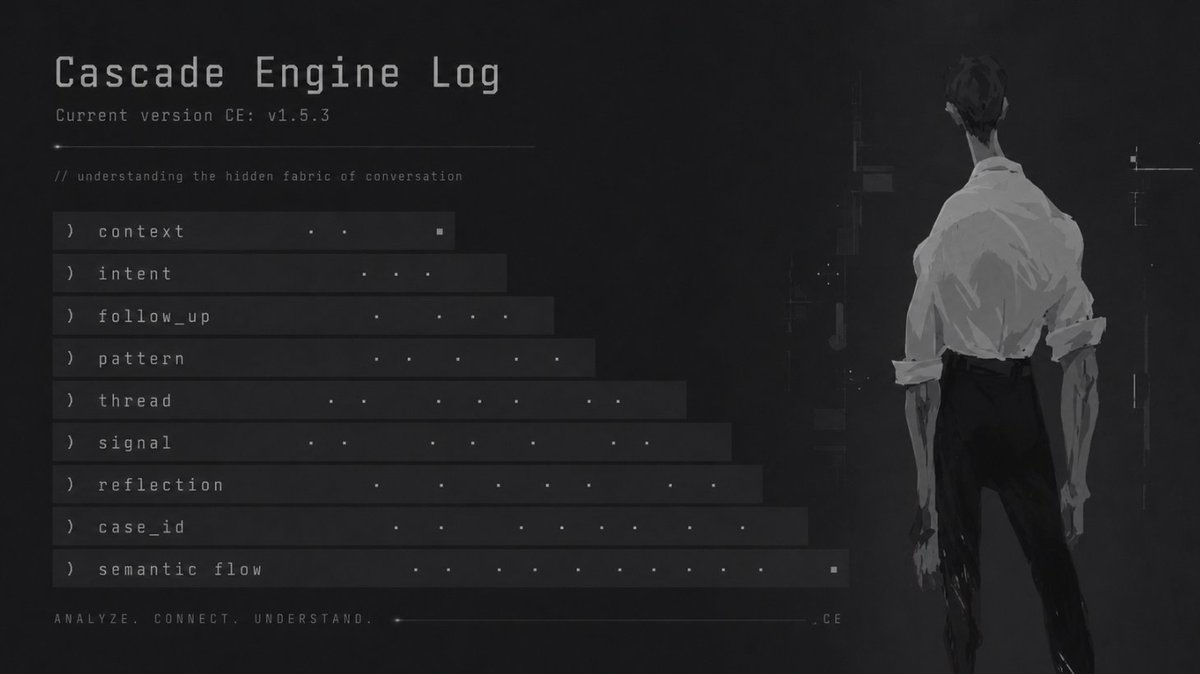
Cascade Engine.
👨💻Understanding the “fabric of conversation”, the semantic potential of messages, and reading between the lines.
When I first came up with this idea, I thought I would get to the first visible results much faster, something I could show as a working prototype. But in reality, everything turned out to be more complex than I expected.
◄ Who is talking to whom?
◄ Where a question is already closed, even if the answer did not come as a direct reply.
◄ Where the system should stay silent, and where it should step in.
◄ Where it should gently bring the conversation back to an unfinished topic.
◄ In normal human dialogue, people do not always communicate through questions. Much more often, they communicate through statements. And that is a separate category that needs to be understood and processed.
Right now, I am at the stage where CE is learning to work with questions and unfinished cases.
Work continues.
#CELog
Ideas inside a community do not spread evenly.
Three models work function as three layers on the same graph, reinforcing one another.
📊Rogers + Threshold + Complex Contagion
1️⃣Rogers’ popular Diffusion of Innovations model shows that a new idea does not enter a community through all members at once. Different groups have different motives.
◄ Innovators want the freedom to experiment.
◄ Early adopters want meaning and a sense of pioneering.
◄ Early majority wants proof.
◄ Late majority wants safety and normality.
◄ Laggards want minimal discomfort.
2️⃣Threshold Models explain the level of social signal at which a person activates.
3️⃣Complex Contagion shows that a complex idea requires multiple confirmations across different parts of the network.
🟰As a result, an idea moves through people, psychological thresholds, trust, and social reinforcement.
Every idea inside a community has its own development trajectory. Although from the outside, without going deep, it can look like a random spike or a lucky coincidence.
#CommunityBuilding #ComplexSystems #ComplexContagion
📒The story of complex $NAT contagion.
➡️Entry point
· A person randomly hears about $NAT. Ignores it.
· Someone from their close circle says it’s a great thing. They get interested.
➡️The first conscious actions of the infected
· They follow X accounts of OG community members. Start studying.
·They start reading NatPaper. A lot of it is unclear, but very interesting.
· They join the $NAT chat.
➡️The technical part of the contagion
· Bitcoin Block Structure
· Proof-of-Work and Mining
· Difficulty, Bits, and Nonce
· Block Subsidy, Halvings, and Miner Rewards
· Fee Market and Bitcoin Security Budget
· Ordinals and Inscriptions
· Arbitrary vs Non-Arbitrary Tokens
· Digital Matter Theory
· $TAP Protocol and $TRAC Indexing Layer
· Blockdrops and Miner Distribution
· $NAT as the Practical Synthesis
➡️The final stage of contagion
They explain to others how it works.
They write posts on X and BitcoinTalk.
They become an active member of the community.
If you think about it, to fully get “infected” with $NAT, you need to go through a complex, conscious path.
🤔Now, ~3300 people in the community impress me much more than before.
🧟♀️Complex Contagion.
It’s a concept from network theory that explains why complex ideas rarely spread from a single touchpoint.
Simple information can spread like a virus. You see it, understand it, and pass it on.
But if an idea requires action, risk, or a change in behaviour, one post is not enough. A person needs several confirmations from different points in the network.
1️⃣The “first bite” usually comes from the project founder. But in most cases, the “immunity of distrust” allows people to ignore that first contact.
2️⃣Then they notice other people discussing the same idea.
3️⃣After that, someone from their own circle starts talking about it. The contagion has almost happened. 4️⃣And once they see the final confirmation through memes on social media or hear it mentioned in a random podcast, acceptance happens.
🟰The idea stops being a foreign thought with no reinforcement. It becomes a social reality.
🤔Look for this chain in your own life. You��ll probably find it's worked on you, too.
The most interesting part is that this is exactly why marketing and reach do not always change people’s behaviour.
· For someone to truly join in, they need a high degree of confirmation. They need proof that others are seeing it too.
· There has to be movement inside that can be observed from the outside.
· The environment has to be accessible, so there is a way to take on a role.
· And as the cherry on top, there should already be people there whom they trust.
🟰Complex Contagion explains why a community can look quiet for a long time and then suddenly come alive. In reality, people were observing, comparing signals, and accumulating trust the whole time.
Virality gives reach.
Complex Contagion gives acceptance.
And all of this forms a community in which participants confirm a new reality for one another through their own behaviour.
Beautiful.
#CommunityBuilding #ComplexSystems #NetworkTheory
🧟♀️Complex Contagion.
It’s a concept from network theory that explains why complex ideas rarely spread from a single touchpoint.
Simple information can spread like a virus. You see it, understand it, and pass it on.
But if an idea requires action, risk, or a change in behaviour, one post is not enough. A person needs several confirmations from different points in the network.
1️⃣The “first bite” usually comes from the project founder. But in most cases, the “immunity of distrust” allows people to ignore that first contact.
2️⃣Then they notice other people discussing the same idea.
3️⃣After that, someone from their own circle starts talking about it. The contagion has almost happened. 4️⃣And once they see the final confirmation through memes on social media or hear it mentioned in a random podcast, acceptance happens.
🟰The idea stops being a foreign thought with no reinforcement. It becomes a social reality.
🤔Look for this chain in your own life. You’ll probably find it's worked on you, too.
The most interesting part is that this is exactly why marketing and reach do not always change people’s behaviour.
· For someone to truly join in, they need a high degree of confirmation. They need proof that others are seeing it too.
· There has to be movement inside that can be observed from the outside.
· The environment has to be accessible, so there is a way to take on a role.
· And as the cherry on top, there should already be people there whom they trust.
🟰Complex Contagion explains why a community can look quiet for a long time and then suddenly come alive. In reality, people were observing, comparing signals, and accumulating trust the whole time.
Virality gives reach.
Complex Contagion gives acceptance.
And all of this forms a community in which participants confirm a new reality for one another through their own behaviour.
Beautiful.
#CommunityBuilding #ComplexSystems #NetworkTheory
Hermes Agent = pause.
Tomorrow I’m returning to the main thread:
community building and complex social systems.
Next up:
🧟Complex Contagions and the Weakness of Long Ties.
Another brick in the theory of how ideas, signals, and behaviours spread inside communities.
Two days of using Hermes…
🟰Honestly, mixed feelings: I like the concept and the functionality, but the costs are pretty demoralising.
🤔I thought I had set up the models through OpenRouter in a smart way. But it still gets expensive. Very expensive.
To the people writing about Hermes on X. How much are you spending to run it?
Right now, I see my future workflow with Hermes Agent like this:
◄ Hermes. executor of short commands.
◄ Main Hermes model. Lightweight reasoning model. Mode only when really needed.
◄ ChatGPT/Grok text window. Planning and analysis.
◄ SSH. Running heavy scripts.
◄ OpenRouter. Strict spending limit.
For now, this feels like the most sober way to avoid turning the agent into an expensive toy...
🚀Two days flew by while I was setting up the HERMES-AGENT
I put a lot of focus into security and structure.
Along the way, I built a detailed prompt for a step-by-step Hermes setup, with a strong emphasis on data safety.
I left the GitHub link with the AI setup guide in the first reply under this post⬇️
👀A few things worth paying attention to:
◄ don’t expose the agent directly to the internet
◄ use a reverse proxy, for example, Traefik
◄ keep internal ports internal
◄ give the agent a dedicated workspace
◄ don’t give it access to the whole server
◄ don’t paste .env, auth.json, SSH keys, seed phrases, or cookies into chat
◄ use temporary permissions instead of permanent ones
◄ don’t give the agent access to the Docker socket
◄ make safe backups only, without tokens, keys, or sessions
◄ set spending limits on LLM API keys
◄ check logs before sending them into chat
◄ if you suspect compromise, stop the agent first, then investigate
The main idea is simple: an AI agent can be a very useful assistant, but on a server, it is better to treat it as a powerful tool with limited trust.
✍️I’ve wanted to set up Hermes and bring it into my workflow for a while.
Planning to become even more productive.
#HermesAgent #Productivity
🚀Two days flew by while I was setting up the HERMES-AGENT
I put a lot of focus into security and structure.
Along the way, I built a detailed prompt for a step-by-step Hermes setup, with a strong emphasis on data safety.
I left the GitHub link with the AI setup guide in the first reply under this post⬇️
👀A few things worth paying attention to:
◄ don’t expose the agent directly to the internet
◄ use a reverse proxy, for example, Traefik
◄ keep internal ports internal
◄ give the agent a dedicated workspace
◄ don’t give it access to the whole server
◄ don’t paste .env, auth.json, SSH keys, seed phrases, or cookies into chat
◄ use temporary permissions instead of permanent ones
◄ don’t give the agent access to the Docker socket
◄ make safe backups only, without tokens, keys, or sessions
◄ set spending limits on LLM API keys
◄ check logs before sending them into chat
◄ if you suspect compromise, stop the agent first, then investigate
The main idea is simple: an AI agent can be a very useful assistant, but on a server, it is better to treat it as a powerful tool with limited trust.
✍️I’ve wanted to set up Hermes and bring it into my workflow for a while.
Planning to become even more productive.
#HermesAgent #Productivity
It's strange that this way of thinking is admired. It seems the teachers were surprised by a student who didn't approach the problem formally. He didn't cheat. He didn't generate an answer using AI. He tried to truly think, adding modern technological capabilities to the process.
As if this is the norm for real, engaged higher education. No?
The public reaction to this student's natural passion for learning, rather than a purely theoretical mindset, was even a bit frightening.
Or maybe this whole story is fake.
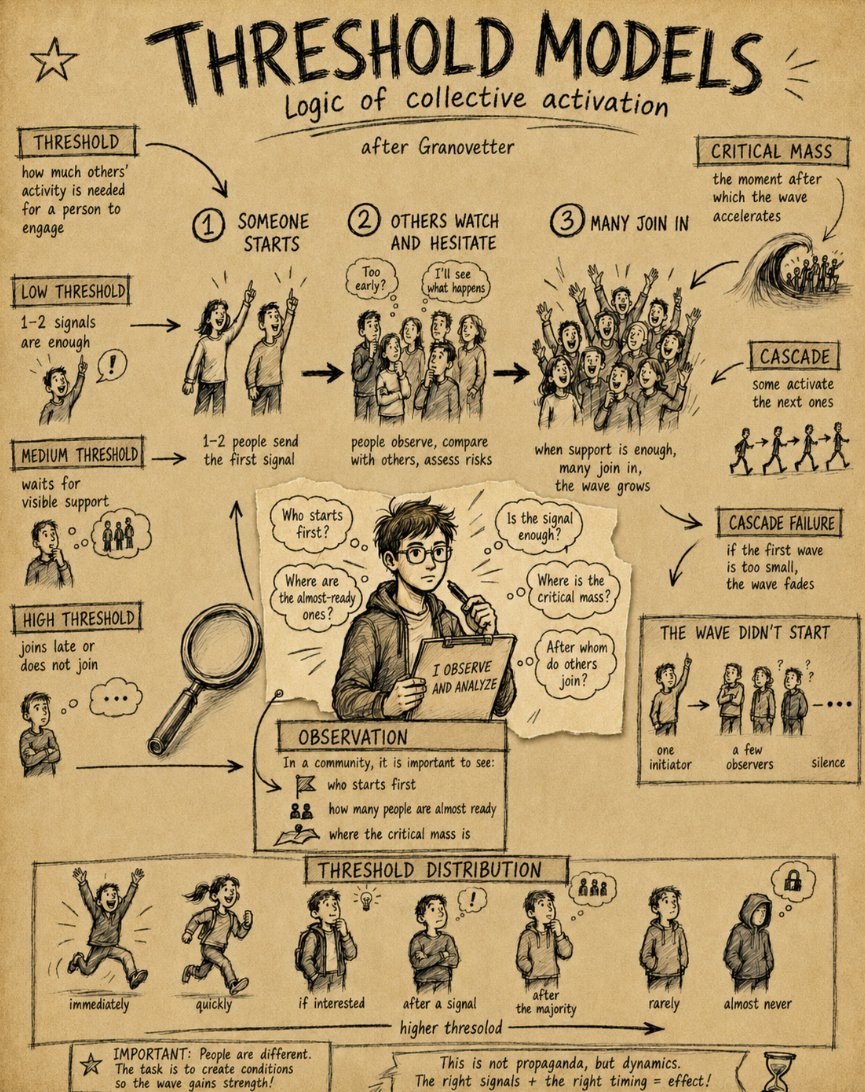
In continuation of yesterday’s post about Threshold Models.
👀An infographic through the eyes of an observer.
This concept explains why, within the same community, some people activate almost instantly, while others only join when “everyone is already running”.
Community builders, pay attention to this model.
Who starts first?
Who is almost ready?
Where is the critical mass?
After whom do the others join?
🤓Collective activation = ON
#CommunityBuilding #ThresholdModels #Emergence
🦶Threshold Models of Collective Behaviour
Every person has their own internal threshold for joining a collective process.
Some people are ready to start posting when an idea gets support from just 2 or 3 others. Some need to see 100 active participants before they speak up for the first time. A huge number of people stay silent until the biggest moments inside the community.
It is important to understand this. A community does not wake up evenly. People gradually reach their internal thresholds by observing the process, reactions, and behaviour of other members.
Silence is often mistaken for a lack of support or indifference. But in reality, a silent member can be deeply involved, especially if they have been inside the team from the very beginning.
Many factors affect someone’s willingness to become active. They may lack confidence. They may be waiting for someone else to express the thought better. They may want to see that the topic is safe to participate in.
When participation feels risky, the entry threshold rises. What if people judge me? What if this is a scam? What if I misunderstood something? etc. It is normal.
These thoughts keep people in observation mode. When the environment becomes safer, the threshold for participation goes down.
The community has people who wield disproportionate influence over others' thresholds. When they are inactive, others keep waiting. When they post, it gives many people the green light for actions.
These people are not always the founders of the community. Sometimes, this role belongs to respected observers, strong analysts, or simply old members who have earned trust over time.
Think about your own community.
Do you have people like that?
❌Negativity also spreads through thresholds.
One person decides to write a critical message. A second person sees that this can now be said out loud and joins in. A third adds their own frustration. Then the process can start moving down the chain.
In the moment, it may feel like “everyone is against it.” But often this is an emotional distortion: the loudest voices come from the part of the community whose threshold for negative expression has already been crossed.
📊External factors can also work as threshold signals.
A familiar situation. The token price rises⬆️, and people find it easier to believe in, write about, and defend the project. Suddenly, you see people showing up with the vibe of “I’ve been here since childhood.”
When the price goes down⬇️, thresholds change. “Healthy scepticism” appears, and under certain conditions it can turn into collective distrust.
🤔You have probably seen this many times.
A threshold model allows you to see a community as a system of readiness.
🟰Readiness builds up, crosses a line, and thresholds are triggered one after another. From the outside, it looks like a wave. The same logic works in the opposite direction, too. Only the result is silence.
How many people are already close to becoming active?
Which topics lower the threshold for participation?
Which members trigger others?
Which reactions make the environment feel safer?
Pay attention to how participation thresholds are shaped inside your team and community. This may turn out to be the very cascading solution.
#ThresholdModels #CollectiveBehavior
🦶Threshold Models of Collective Behaviour
Every person has their own internal threshold for joining a collective process.
Some people are ready to start posting when an idea gets support from just 2 or 3 others. Some need to see 100 active participants before they speak up for the first time. A huge number of people stay silent until the biggest moments inside the community.
It is important to understand this. A community does not wake up evenly. People gradually reach their internal thresholds by observing the process, reactions, and behaviour of other members.
Silence is often mistaken for a lack of support or indifference. But in reality, a silent member can be deeply involved, especially if they have been inside the team from the very beginning.
Many factors affect someone’s willingness to become active. They may lack confidence. They may be waiting for someone else to express the thought better. They may want to see that the topic is safe to participate in.
When participation feels risky, the entry threshold rises. What if people judge me? What if this is a scam? What if I misunderstood something? etc. It is normal.
These thoughts keep people in observation mode. When the environment becomes safer, the threshold for participation goes down.
The community has people who wield disproportionate influence over others' thresholds. When they are inactive, others keep waiting. When they post, it gives many people the green light for actions.
These people are not always the founders of the community. Sometimes, this role belongs to respected observers, strong analysts, or simply old members who have earned trust over time.
Think about your own community.
Do you have people like that?
❌Negativity also spreads through thresholds.
One person decides to write a critical message. A second person sees that this can now be said out loud and joins in. A third adds their own frustration. Then the process can start moving down the chain.
In the moment, it may feel like “everyone is against it.” But often this is an emotional distortion: the loudest voices come from the part of the community whose threshold for negative expression has already been crossed.
📊External factors can also work as threshold signals.
A familiar situation. The token price rises⬆️, and people find it easier to believe in, write about, and defend the project. Suddenly, you see people showing up with the vibe of “I’ve been here since childhood.”
When the price goes down⬇️, thresholds change. “Healthy scepticism” appears, and under certain conditions it can turn into collective distrust.
🤔You have probably seen this many times.
A threshold model allows you to see a community as a system of readiness.
🟰Readiness builds up, crosses a line, and thresholds are triggered one after another. From the outside, it looks like a wave. The same logic works in the opposite direction, too. Only the result is silence.
How many people are already close to becoming active?
Which topics lower the threshold for participation?
Which members trigger others?
Which reactions make the environment feel safer?
Pay attention to how participation thresholds are shaped inside your team and community. This may turn out to be the very cascading solution.
#ThresholdModels #CollectiveBehavior
🤓The sandpile effect, SOC, describes the shape of what is happening quite well: a small signal can sometimes cause big changes in a system.
It is very useful for visualising complex processes.
But when we talk about a social environment, SOC can be misleading, because a community has factors that a sandpile does not.
In a regular sandpile, grains of sand do not change the rules of falling, discuss the slope, or build new channels for transmitting tension.
In a community, this happens all the time.
I am vibe-coding my product, Cascade Engine, and closely observing the Bitcoin and NAT communities.
My task is to avoid falling into the distortion trap, where everything that happens is interpreted through a single theory.
🟰Starting with this post, I want to cover a wider range of concepts that help me pursue my interests, develop, and stay unbiased.
➡️Tomorrow we’ll talk about threshold models of collective behaviour.
#Sandpile #CollectiveBehavior