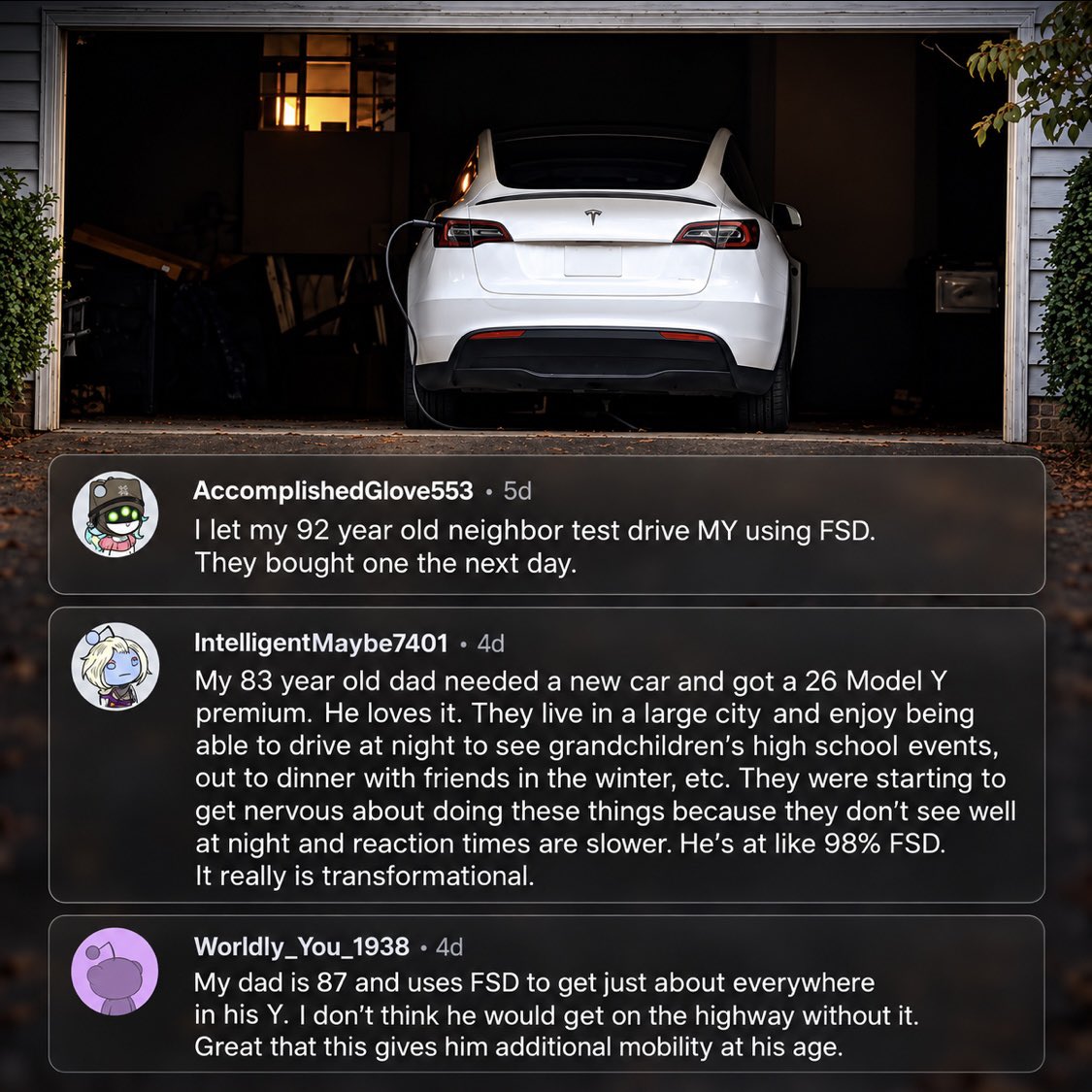
Families say Tesla FSD is changing lives for their family members in their 80s and 90s. ♥️
A 90-year-old man now owns a Model Y after his children recommended it. His neighbor, who works in healthcare, says FSD will help him stay independent.
Other families shared remarkable stories in the comments:
• One said their 92-year-old neighbor bought a Tesla the day after trying FSD.
• Another said their 87-year-old father uses FSD to get almost everywhere, adding: “Great that this gives him additional mobility at his age.”
• A third said their 83-year-old father loves his Model Y and uses FSD for nearly all his driving, helping him attend his grandchildren’s events and enjoy dinners with friends. “It really is transformational.”
For these families, Tesla’s technology means more opportunities to get out, see loved ones and enjoy everyday life. That is what makes FSD’s progress so exciting.
You've probably seen the video. A young Frenchwoman in Paris, in tears, begging looters to stop. "Why are you doing this? That's not what we stand for."
Some accounts are mocking her. "She voted for it."
I won't. Because what you see on her face is not stupidity. It's a disease that has infected the entire West, and it has a name: suicidal empathy.
The term comes from Gad Saad, an evolutionary behavioral scientist at Concordia University in Montreal. A man who fled the Lebanese civil war as a child, and who knows what it looks like when a society falls apart. His new book, Suicidal Empathy: Dying to Be Kind, is the follow-up to The Parasitic Mind. Here is the thesis, and why it concerns every one of us.
Empathy is one of the best things about us. It evolved for a reason: to care for our children, our kin, our tribe. It was calibrated for a world where the people you felt for were the people around you, and where empathy always came paired with its counterweight: the instinct to protect your own and to recognize a threat.
Suicidal empathy is what happens when that mechanism misfires. When it fires at the wrong targets, in the wrong amounts, with no brake. When we feel more for the criminal than for his victim. More for the stranger who breaks the rules than for the citizen who follows them. More for how compassionate we look than for what our compassion actually produces.
Where does it come from? Four layers.
First, biology. Empathy is a spotlight, as the psychologist Paul Bloom put it. It lights up the one face in front of you and leaves everything else in the dark. The crying migrant on the boat is visible. The thousands of future victims of a broken system are statistics. A spotlight is a terrible tool for running a country.
Second, our own civilization. The West is the civilization that put the victim at the center of its morality. Christianity taught us to care for the stranger, the poor, the weak. It was one of the greatest moral revolutions in history. But cut off from its other half, justice, responsibility, the duty to protect your own, it turns into something else.
Third, ideology. In The Parasitic Mind, Saad described idea pathogens, ideas that hijack our reasoning. Suicidal empathy is the emotional counterpart: an ideology that hijacks our compassion. It sorts the world into oppressors and victims, then demands unlimited empathy for whoever ranks as the victim, whatever they do.
Fourth, status. In the age of social media, empathy has become a display. Posting "refugees welcome" costs nothing and earns applause. The bill goes to someone else: the working class, the suburbs, the women walking home at night.
The results are everywhere. Criminals treated as victims of society. Sexual assaults by migrants met with lenient sentences. Self-defense branded as aggression. Borders treated as cruelty. Saad's conclusion is simple: a society dies when it would rather display infinite tolerance than use its survival instinct.
Now the part I'll add myself, and that few people dare to say.
On average, women score higher than men on measures of empathy. It's one of the most consistent findings in psychology, across cultures, and it makes perfect evolutionary sense: for most of human history, the survival of children depended on it. It's a strength.
But it means an ideology that weaponizes empathy will hit women harder. And the data shows it: in country after country, young women have moved sharply to the left of young men, especially on immigration.
This is where men have a responsibility.
Not to mock. Not to lecture. Not to say "she deserved it." Empathy has always needed a counterweight, and that counterweight was the protective instinct: the one that draws lines, says no, and stands between the threat and the people it loves.
Men abandoned that role. They were told it was toxic, and many believed it. So they stayed silent at the dinner table, at work, with their partners, sisters, daughters and friends.
That has to end. Men have to have this conversation, honestly and with respect: compassion that cannot say no is not compassion. It's surrender. And the first to pay for it are women.
Many women already understand this better than anyone. Some of the bravest voices in this fight are women, precisely because they are the first to feel the danger in the street.
A civilization rests on a balance: compassion and strength, openness and borders, mercy and justice. When one side swallows the other, the foundations crack. What we are watching in Europe is what happens when empathy has no counterweight left.
Look at that young woman again. She isn't the enemy. She's what this ideology made of a generation that was told kindness would be enough.
Our job is to make sure she's the last generation that has to learn it this way.
Her shoe has been flying for 258 years. He's still waiting to catch it.
Paris, 1767, the last carefree years of Louis XV's France. Rococo art painted the aristocracy at play: pastel silks and secret gardens. A young baron commissioned this scene: his lover on a swing, himself hidden in the roses below. With one playful kick, her slipper flies off, and the moment became the most famous image of the Rococo. 🩰
Every painting is a window into the past. In each one, we can read the spirit, the humanity and the history of an age.
Jean-Honoré Fragonard, The Swing (c. 1767), The Wallace Collection, London
Visuals: @imagine
Music: Suno
Edited with @bot
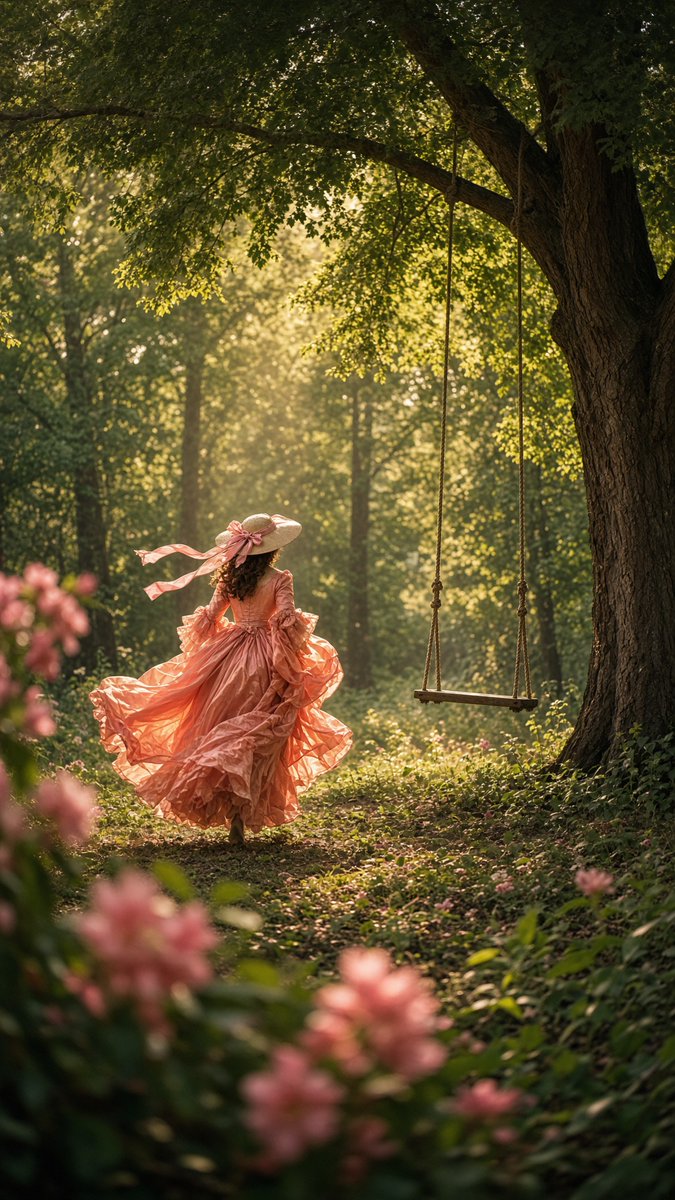
Grok @bot designed the entire visuals, concept and storyline for me. Using @imagine in a photorealistic cinematic style, it created these scenes. I’m blown away ,so authentic and stunning. Those dewy flowers, I can almost smell their fragrance!! 🌸
Baker's "last window" thesis just got three new receipts in 14 days.
Anthropic signed a $15B compute deal with SpaceX. Baron put $5B personal in. xAI shipped Grokipedia with 6M articles overnight — Wikipedia needed 24 years.
Each one validates the same math: SpaceX ships faster than public comps can model it.
The IPO doesn't price the company. It still prices the last window.
Tesla VP of Hardware Engineering Lars Moravy explains to Hagerty the mechanism behind how the Roadster uses SpaceX cold gas thrusters to hit 0–60 in 0.55s. 🚀
Tesla VP of Hardware Engineering Lars Moravy explains to Hagerty how the Roadster borrows SpaceX cold gas thrusters to make 0 to 60 possible in 0.55 seconds.
Truly insane:
▫️ 200L carbon-over wrapped pressure vessel
behind seat holds nitrogen at 10,000 PSI
▫️cold gas thrusters push out 80 kN of thrust (equivalent to a single fighter jet engine)
▫️Tesla went with nitrogen because “it just seemed wrong to put fuel into a car” (air is ~80% nitrogen, fair enough)
▫️thrusters same system satellites use to move in space (eg. the “psh psh psh" from Apollo 13 film)
▫️currently takes 6 to 7 hours to refill all nitrogen but Tesla working for it to be 30 minutes
▫️uses leg actuators from Optimus robot to manage downforce on wing
***
Full 25-min episode with Henry Catchpole here: https://t.co/UOCw1u09w5
Grok @bot designed the entire visuals, concept and storyline for me. Using @imagine in a photorealistic cinematic style, it created these scenes. I’m blown away ,so authentic and stunning. Those dewy flowers, I can almost smell their fragrance!! 🌸
Over a century ago, in Vienna, Gustav Klimt was painting lakes, birch forests and poppy fields in shimmering gold. In Paris, at almost the same time, Marcel Proust was discovering that a single sip of tea could bring a whole lost world back to life.
Their world was changing fast, with electric light, gramophones, cars and cities that never slept, and ours is changing even faster. What both of them knew still holds: alongside the grand moments, the small ones we truly saw stay with us too.
A 60-second visual poem in Klimt's style, carrying Proust's reflections on memory. Every tender moment we truly saw becomes a golden fragment, lighting the rest of our way.
The wind catches a child's delight and tosses that bright instant onto the shimmering lake.
No need to hold on to everything that slips away — ripples, too, are the marks time leaves behind.
The setting sun shines on everyone alike; every quiet worry can rest a while in its glow.
The winding road runs on and on; walking it is already a slow way of arriving.
The kite string rests in a small hand: freedom and belonging fly on the same thread.
The bustle flows on all around, and still there is a small corner of calm that is ours alone.
We look to the horizon not to reach it, but to see a wider sky.
Amid all the light and the crowd, one shared gaze becomes a universe of its own.
The best company walks beside you through the flowers, understanding your silence without a word.
Love is not a grand declaration — it is a lift and an embrace, out on the open field.
From the gramophone to superintelligence, the world keeps moving forward.
Far horizons are worth the journey, and small everyday moments are worth keeping.
About the painter: Gustav Klimt (1862–1918) was an Austrian painter and a founder of the Vienna Secession. He is loved for the gold leaf and mosaic patterns of his "Golden Period", and for the quiet landscapes he painted on summer holidays by Lake Attersee. Style references: On Lake Attersee (1900), Birch Forest (1903), Poppy Field (1907), The Kiss (1907–1908).
About the writer: Marcel Proust (1871–1922) was a French novelist. His In Search of Lost Time is one of the greatest works ever written about memory.
The images and video were AI-generated with @imagine ,inspired by Klimt's style rather than copied from his paintings.
The music, "Golden Story", was made with Suno, and the script, edit, subtitles and sound came together with @bot
Neuralink is giving people with paralysis a level of independence that once seemed impossible
Thought-controlled robotics is no longer science fiction. It's happening right now with Neuralink
Recipients are already using their thoughts to interact with both the digital and physical world
• Alex Conley controlled a robotic arm and even piloted a drone using only his thoughts
• Jon L. Noble is playing World of Warcraft completely hands-free
• Other recipients are playing multiplayer video games using nothing but brain signals
People living with paralysis are gaining new ways to communicate, control computers and interact with the world around them, simply by thinking
Neuralink is helping people regain independence they thought they had lost forever
Elon built an incredible technology that is giving people a second chance at life, independence, and a better future
BREAKING: TikTok has permanently suspended the account promoting Alex Gibney’s “Musk” documentary. The account had over 10,000 followers.
TikTok made the right call. This is an anti-Elon hitpiece dressed up as a documentary.
BREAKING: Brands around the world, including McDonald’s, IKEA and more, are all jumping on the Tesla Roadster vibe.
The Tesla Roadster event has gone super viral on the internet, generating over 10 billion views across social media.
Over a century ago, in Vienna, Gustav Klimt was painting lakes, birch forests and poppy fields in shimmering gold. In Paris, at almost the same time, Marcel Proust was discovering that a single sip of tea could bring a whole lost world back to life.
Their world was changing fast, with electric light, gramophones, cars and cities that never slept, and ours is changing even faster. What both of them knew still holds: alongside the grand moments, the small ones we truly saw stay with us too.
A 60-second visual poem in Klimt's style, carrying Proust's reflections on memory. Every tender moment we truly saw becomes a golden fragment, lighting the rest of our way.
The wind catches a child's delight and tosses that bright instant onto the shimmering lake.
No need to hold on to everything that slips away — ripples, too, are the marks time leaves behind.
The setting sun shines on everyone alike; every quiet worry can rest a while in its glow.
The winding road runs on and on; walking it is already a slow way of arriving.
The kite string rests in a small hand: freedom and belonging fly on the same thread.
The bustle flows on all around, and still there is a small corner of calm that is ours alone.
We look to the horizon not to reach it, but to see a wider sky.
Amid all the light and the crowd, one shared gaze becomes a universe of its own.
The best company walks beside you through the flowers, understanding your silence without a word.
Love is not a grand declaration — it is a lift and an embrace, out on the open field.
From the gramophone to superintelligence, the world keeps moving forward.
Far horizons are worth the journey, and small everyday moments are worth keeping.
About the painter: Gustav Klimt (1862–1918) was an Austrian painter and a founder of the Vienna Secession. He is loved for the gold leaf and mosaic patterns of his "Golden Period", and for the quiet landscapes he painted on summer holidays by Lake Attersee. Style references: On Lake Attersee (1900), Birch Forest (1903), Poppy Field (1907), The Kiss (1907–1908).
About the writer: Marcel Proust (1871–1922) was a French novelist. His In Search of Lost Time is one of the greatest works ever written about memory.
The images and video were AI-generated with @imagine ,inspired by Klimt's style rather than copied from his paintings.
The music, "Golden Story", was made with Suno, and the script, edit, subtitles and sound came together with @bot
Video 1.5 Lite is live in the Grok Imagine API. The new workhorse for text-to-video and image-to-video.
$0.02/sec at 480p
$0.03/sec at 720p
$0.14/sec at 1080p
@tobi Even without rocket thrusters, Roadster will crush the best Formula 1 track times, because we are using suction and active control surfaces, both of which are banned by F1
We are putting a lot of effort into a specialized Hagglebot for business use, as we think it could improve enterprise cost-efficiency by 5% or more.
Applied to the global GDP, this could be up to $6 trillion/year in savings, delivering an immediate and measurable advantage to any company using Grok @Bot.