A dreamer. Maybe I'm on the side of the Angels.... but don't even think for a second that I am one of them. Staffer @ElezioniUSA (and Telefilm Addicted).
SEN. KELLY: How many times have Vance and Rubio been to Ukraine? Zero. Has Trump been to Ukraine? No.
He invited Putin to United States, but he still failed to send anybody at high level in his government to visit Ukraine. Have Kushner or Witkoff been to Ukraine? They have not.
Seven Hezbollah operatives were killed by IDF 551st Brigade forces in southern Lebanon over the past week. Two squads were identified operating from a subterranean route used for storing mortars, ammunition, and supplies. The IDF carried out the eliminations in coordination with air, artillery, and drone assets. Weapons and launch positions near the tunnel were destroyed. - IDF
Tommy Robinson arrestato con l’accusa di terrorismo.
Ha coordinato i gruppi di estrema destra per assaltare Belfast da Mosca mentre era in compagnia di Errol Musk, padre di Elon.
Quando escono i filmati dell’attacco del senegalese posta:“andremo a causare qualche guaio”.
Dopo, lancia alcune parole d’ordine sui social e mobilita i suoi. Poche ore dopo Belfast brucia.
Robinson, che conta quasi due milioni di follower su X, ha recentemente promosso la Brotherhood of Academists, un movimento ultranazionalista russo legato alla Tsargrad Society, l’organizzazione fondata dall’oligarca russo Konstantin Malofeev. Malofeev è sottoposto a sanzioni da parte di Stati Uniti, Regno Unito e Unione Europea; secondo il Dipartimento del Tesoro statunitense, la Tsargrad Society è stata coinvolta in attività di influenza e operazioni a sostegno degli interessi del Cremlino.
NEW: Iranian statements regarding the contents of the US-Iran memorandum of understanding (MoU) indicate that some terms of the agreement are at odds with stated US positions on the Strait of Hormuz in recent months. The agreement has two parts: a first stage that deals with an “end to the war” on all fronts, a resumption of traffic in the Strait of Hormuz, and economic benefits for Iran, including reconstruction funds, sanctions relief, release of frozen funds, and an end to the US blockade. The second stage would deal with the nuclear issue and “one or two other [unspecified] issues.”
Other Key Takeaways:
Iran is likely attempting to structure the MoU and the phasing of a final agreement to reduce US leverage before later negotiations over the nuclear program. Iran is attempting to access at least some of its frozen assets early in the MoU process, for example, which would give it some economic relief before nuclear talks begin.
Iranian media appears to be portraying a possible MoU as a tactical pause in the war rather than a final settlement. The Ghalibaf-affiliated Khorasan outlet argued on June 13 that the emerging agreement only aims to end the current war and does not resolve the underlying issues between Iran and the United States.
Iranian Foreign Affairs Minister Abbas Araghchi’s readout of the MoU is largely consistent with IRGC-affiliated media’s readout of the latest possible agreement, which may indicate a growing consensus among Iranian regime leaders on Iran’s red lines for negotiations. That Araghchi’s June 12 readout and IRGC media’s account of the latest US-Iran MoU are very similar suggests that Vahidi or elements close to him may have successfully driven consensus on their preferred policy outcomes.
In the early hours of this morning, I directed our Armed Forces to intercept a shadow fleet oil tanker attempting to pass through the English Channel.
This successful operation delivers yet another blow to Russia and reminds those fueling Putin's war in Ukraine that we will not let them hide.
I want to thank those involved, including our Armed Forces and law enforcement officers who keep this country safe 24 hours a day, 365 days a year.
Del fatto che la situazione in Crimea sia fuori controllo sono ormai consapevoli anche i russi. Secondo le informazioni raccolte da ATESH, i vertici del comando della flotta del Mar Nero di Sebastopoli starebbero già mettendo al sicuro le proprie famiglie a Novorossiysk, nel territorio di Krasnodar, nella Russia continentale.
La notizia data dal gruppo partigiano, se confermata, avrebbe del clamoroso, dal momento che il trasloco, che nel comunicato viene descritto come piuttosto frettoloso, starebbe avvenendo senza che siano arrivate direttive in tal senso (e che plausibilmente nemmeno arriveranno), amplificando però l’idea che si tratti di una schettiniana fuga da una nave che affonda.
ATESH collega infatti lo spostamento all’attacco sferrato il 27 maggio le Forze di Difesa dell'Ucraina contro il quartier generale dell'aviazione della Flotta del Mar Nero della Federazione Russa in via Gogol a Sebastopoli (l’immagine è di un attacco avvenuto nel settembre 2023). Da allora, i colpi nella penisola soprattutto contro i sistemi di difesa si sono intensificati e la situazione logistica per gli occupanti in Crimea è drasticamente peggiorata.
“Secondo informatori militari - si legge - “alcuni ufficiali si stanno già occupando delle questioni pratiche del trasferimento senza attendere ordini ufficiali: stanno trasferendo le loro famiglie, si stanno sbarazzando dei beni che non possono portare con sé e si stanno sistemando in una nuova abitazione a Novorossiysk. All'interno dei vertici della flotta, l'atmosfera è cupa: chi comprende veramente la situazione preferisce non intervenire.”
Si tratta di un colpo d'immagine e simbolico devastante. Sebastopoli non è una base qualunque. Per la narrazione del Cremlino è la "città della gloria militare russa" e il cuore pulsante della pretesa storica sulla Crimea (nonché quella dalla quale ebbe inizio l’occupazione illegale del 2014). Ammettere, anche solo nei fatti, che Sebastopoli non è più sicura per i comandi di vertice della Flotta mina la retorica della Russia come potenza dominante nel Mar Nero e l'idea che la Crimea sia "protetta per sempre".
Dal punto di vista operativo le conseguenze potrebbero essere altrettanto importanti. Spostare i centri decisionali a oltre 300 chilometri di distanza (in linea d'aria) e separati dallo Stretto di Kerch complica drasticamente la reattività e il coordinamento delle operazioni in tempo reale, specialmente per il supporto aereo e la difesa costiera della Crimea. L'attacco ucraino del 27 maggio ha inoltre fisicamente distrutto o reso inutilizzabili infrastrutture di comunicazione protette. Ricostruirle o adattarle a Novorossiysk richiede tempo, risorse e espone i nuovi siti a problemi di intercettazione o vulnerabilità simili, dato anche che lo stesso porto porto della Russia continentale è stato ugualmente attaccato varie volte da droni aerei e marini.
Il fatto che una penisola che Mosca rivendica come propria, tanto da installarvi il comando della Flotta del Mar Nero, si stia trasformando in un avamposto sempre più isolato (con i ponti del nord quasi del tutto compromessi e quello di Kerch sotto costante attacco) da controllare “da remoto” la dice lunga sulla distanza che c’è tra propaganda di Stato e la realtà sul campo.
The Real Cost of Trump’s Emerging Deal with Iran
The United States appears close to reaching an agreement with Iran. President Trump claims a deal may be signed as early as this weekend, though Iranian officials continue to push back on that timeline.
Before the military campaign began on February 28th, Iran was under heavy sanctions while the Strait of Hormuz remained open. Now, the US is offering sanctions relief and access to frozen assets simply to reopen that same strait.
This means America is paying a real price for a situation that already existed before the war.
If the deal is finalized, Iran stands to gain immediate revenue from oil sales and access to billions in frozen funds, while keeping its enriched uranium stockpile and nuclear infrastructure largely intact. The regime will emerge financially stronger and politically emboldened.
For the region, this carries serious consequences. Hezbollah in Lebanon is already benefiting from the perception of Iranian victory. Iran’s influence in Iraq is likely to grow stronger. The Sunni Arab monarchies now find themselves in a vulnerable position, with their trust in American security guarantees significantly weakened.
A stronger Iran may also push Turkey to deepen its military presence in Syria, bringing Turkish forces closer to Israel’s northern border.
If true, this deal would mean the United States has paid a significant price to return to a position that is actually worse than before the military campaign began.
«Ciò che lega Russia, Cina, Iran e Corea del Nord non è la religione o l’ideologia. La Cina è comunista, la Russia nazionalista, l’Iran teocratico. Ciò che li unisce è la paura del linguaggio liberale: diritti, stato di diritto, separazione dei poteri e tribunali indipendenti». (@anneapplebaum)
Hardline Iranians have been protesting throughout the day against Foreign Minister Abbas Araghchi and Parliament Speaker Ghalibaf over the emerging U.S.-Iran deal. Demonstrators chanted "Death to Araghchi, the dishonorable compromiser," "Araghchi, have shame, stop giving in," and "Ghalibaf, Araghchi, resign, resign."
MORE: An “open” strait under Iranian management is not a return to the pre-war status quo and would mean that Iran has accomplished a key war aim. ⬇️
Iranian Foreign Affairs Minister Abbas Araghchi discussed the strait at length and noted that it is under Iranian and Omani sovereignty and that both countries will collect fees after the MoU. Iran will also manage the strait. Araghchi rejected the term “tolls” but defended Iran charging “service“ fees for passage through the strait, which is effectively an attempt to rebrand Iran’s protection racket as legal administration. Araghchi added that Iran would provide safe passage through the strait for civilian vessels but create separate arrangements for military vessels.
This system of management is at odds with both US policy and long-established maritime legal precedent. US President Donald Trump has repeatedly said, for example, that the strait must be open with no fees or Iranian management. A US official told Reuters that the agreement would “open” the strait, but an “open” strait under Iranian management would be very detrimental to US interests, as ISW-CTP has previously argued in @brian_cartr's essay in the post below.
Iran also continues to use force in an attempt to impose the reality that it controls the Strait of Hormuz. US Central Command (CENTCOM) reported on June 12 that US forces intercepted multiple Iranian drones targeting commercial vessels in the strait. Iranian media separately reported explosions near Qeshm and Sirik islands and said the sounds came from warning shots that Iranian forces fired to enforce control over the strait.
Will Europe Save Hamas in Gaza? I recently met with a high-ranking European official from a country deeply involved in the Israel and Palestine file to discuss Gaza’s future and immediate options for relieving civilians trapped under Hamas’s grip. I presented a simple proposal: create safe zones across the "Yellow Line" into the Israel‑controlled green zone and support new, organized, secure, Hamas‑free communities where Gazans could finally begin rebuilding their lives. Whether the issue is humane living conditions, deradicalization, education, healthcare, or shielding civilians from both Hamas or Israeli strikes, the green zone is the only place where meaningful action is possible. Instead of engaging, the official launched into a long monologue about their country’s contributions to the Palestinian Authority, UNRWA, and other institutions, all while insisting on their own “humility” as a faraway European nation.
Then came the truly alarming part: a casual normalization of Hamas. The official proudly described how easy it had been to work with Hamas before October 7, praising the group for providing “excellent security” and being “easier to work with than others.” What they called pragmatism was, in reality, a twenty‑year pattern of enabling a violent terrorist organization responsible for immense civilian suffering.
When I explained that any Hamas‑free zones would require vetting at the Yellow Line to prevent weapons or operatives from entering, the official reacted with shock. “This vetting would violate international law,” they repeated, insisting that their country could not fund projects with any checks on who enters. I noted the absurdity: I had undergone extensive vetting just to enter their country, and even this building, yet they believed Hamas fighters should be able to walk into new civilian safe zones unimpeded. Their only response was vague appeals to “international law,” which, in their interpretation, seems to require allowing terrorists to hide among civilians.
The meeting ended on an even more surreal note. When the official asked what would happen to Hamas fighters left in the red zone, I said I didn’t care; they could fight the Israeli military on their own all they wanted once they no longer held two million civilians hostage. The official lamented that “this isn’t the old American West” and expressed concern for what would happen to Hamas without human shields. Disgust doesn’t begin to describe my feelings and reactions.
I left convinced of something long suspected: Hamas’s twenty‑year rule was sustained not only by its own brutality but by an ecosystem of NGOs, donor nations, Western European governments, journalists, academics, activists, lawyers, and even self‑styled human‑rights defenders who normalized Hamas, treated it as a legitimate authority, or tolerated its abuses because their hostility toward Israel outweighed their concern for Gazans.
Iran launched multiple one-way attack drones in an attempt to strike commercial ships transiting the Strait of Hormuz. U.S. forces have downed all of them in recent hours as traffic flow through the strait continues unimpeded. The international trade corridor remains open for transit.
NEW: Russian forces may launch an Oreshnik intermediate-range ballistic missile at Ukraine in the next 24 to 48 hours.
Other Key Takeaways:
Russian President Vladimir Putin continued to posture Russian military strength during Russia’s June 12 Russia Day holiday while also acknowledging some of the battlefield setbacks Russian forces have faced in recent months.
A Russian State Duma Deputy from the Communist Party criticized the Kremlin and the broader Russian war-waging strategy ahead of Russia Day, contradicting the Kremlin's narrative.
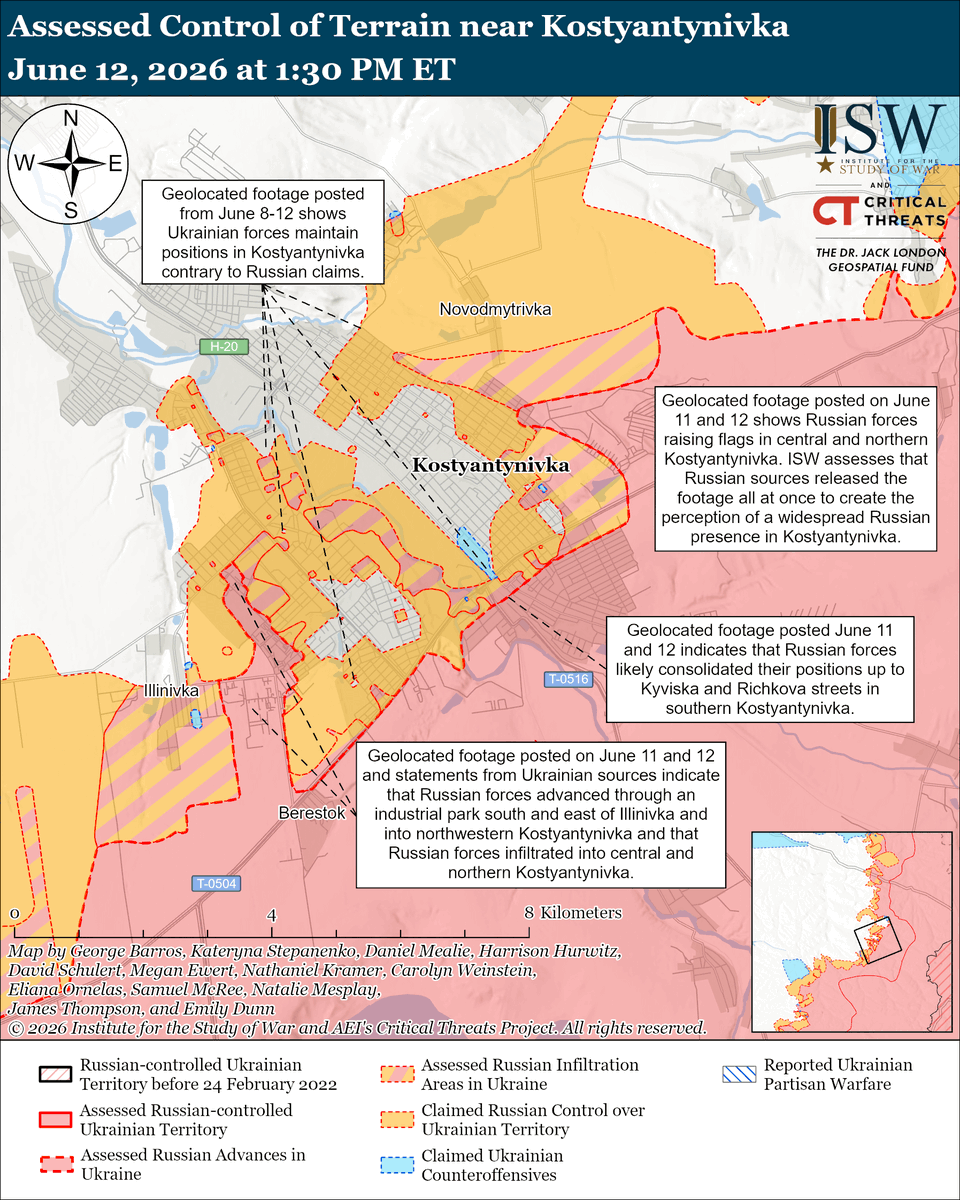
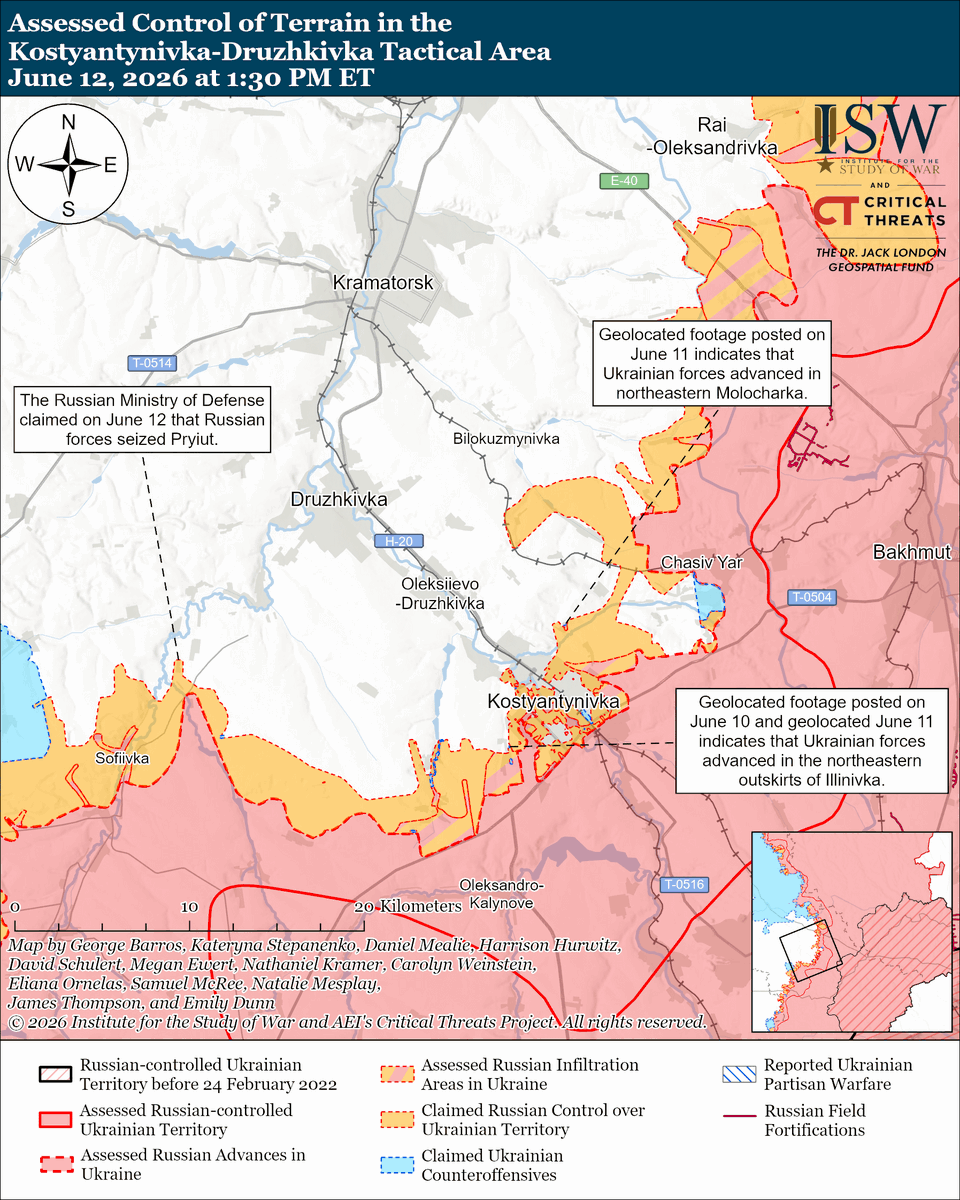
Russian sources released several pieces of footage showing Russian forces operating in Kostyantynivka as part of a deliberate cognitive warfare effort to exaggerate the Russian presence in the city. Russian forces continue to make tactical gains within Kostyantynivka and Ukraine’s ability to defend the southeastern sections of the city is deteriorating, however.
Russian forces continue making tactical gains in Kostyantynivka — Russia’s assessed main effort for the Spring-Summer 2026 offensive — and have likely consolidated some tactical positions within the city beyond infiltration. These gains have taken Russian forces a long time to achieve and have come at a great cost.
Russian forces will likely make tactical gains in Kostyantynivka in Summer 2026 but remain unlikely to achieve a rapid operational breakthrough against the Fortress Belt writ large.
Russia is building at least five long-range drone launch sites in western Russia close to the border with Belarus likely to support drone strikes against Ukraine, possibly by exploiting Belarusian airspace.
Ukrainian forces recently advanced in the Kostyantynivka-Druzhkivka tactical area and in the Oleksandrivka direction.
Ukrainian forces struck Russian oil infrastructure on the night of June 11 and 12. Russian forces launched 117 drones against Ukraine overnight.
@GiorgiaMeloni@GiuseppeConteIT Beh, non è che lei sia migliore. Le sblocco un ricordo: lei è una di quelli di "Noi di Bibbiano" ed è anche quella che diceva che l'ultimo vero difensore dei valori cristiani in Europa è Putin. Si vergogni.
A Syrian source close to the Damascus government says Turkey has recently advised Ahmad al-Sharaa against being drawn into a confrontation with Hezbollah inside Lebanon. Ankara's calculation is that Hezbollah's complete destruction would strengthen Israel - an outcome it considers undesirable.
Working against Turkey's efforts, Trump said this week that al-Sharaa wants to assist in the fight against Hezbollah. Al-Sharaa is expected in Washington next week, where Trump may try to enlist him on the Hezbollah issue despite Turkish objections.
Graham: "The idea of a $300 billion reconstruction fund, given who is in charge of Iran, seems to be tone deaf. It would be akin to a Marshall Plan for Germany with the Nazis still in charge"


![TheStudyofWar's tweet photo. NEW: Iranian statements regarding the contents of the US-Iran memorandum of understanding (MoU) indicate that some terms of the agreement are at odds with stated US positions on the Strait of Hormuz in recent months. The agreement has two parts: a first stage that deals with an “end to the war” on all fronts, a resumption of traffic in the Strait of Hormuz, and economic benefits for Iran, including reconstruction funds, sanctions relief, release of frozen funds, and an end to the US blockade. The second stage would deal with the nuclear issue and “one or two other [unspecified] issues.”
Other Key Takeaways:
Iran is likely attempting to structure the MoU and the phasing of a final agreement to reduce US leverage before later negotiations over the nuclear program. Iran is attempting to access at least some of its frozen assets early in the MoU process, for example, which would give it some economic relief before nuclear talks begin.
Iranian media appears to be portraying a possible MoU as a tactical pause in the war rather than a final settlement. The Ghalibaf-affiliated Khorasan outlet argued on June 13 that the emerging agreement only aims to end the current war and does not resolve the underlying issues between Iran and the United States.
Iranian Foreign Affairs Minister Abbas Araghchi’s readout of the MoU is largely consistent with IRGC-affiliated media’s readout of the latest possible agreement, which may indicate a growing consensus among Iranian regime leaders on Iran’s red lines for negotiations. That Araghchi’s June 12 readout and IRGC media’s account of the latest US-Iran MoU are very similar suggests that Vahidi or elements close to him may have successfully driven consensus on their preferred policy outcomes.](https://pbs.twimg.com/media/HKu-zB9XgAA9s6S.jpg)







![TheStudyofWar's tweet photo. NEW: Iranian statements regarding the contents of the US-Iran memorandum of understanding (MoU) indicate that some terms of the agreement are at odds with stated US positions on the Strait of Hormuz in recent months. The agreement has two parts: a first stage that deals with an “end to the war” on all fronts, a resumption of traffic in the Strait of Hormuz, and economic benefits for Iran, including reconstruction funds, sanctions relief, release of frozen funds, and an end to the US blockade. The second stage would deal with the nuclear issue and “one or two other [unspecified] issues.”
Other Key Takeaways:
Iran is likely attempting to structure the MoU and the phasing of a final agreement to reduce US leverage before later negotiations over the nuclear program. Iran is attempting to access at least some of its frozen assets early in the MoU process, for example, which would give it some economic relief before nuclear talks begin.
Iranian media appears to be portraying a possible MoU as a tactical pause in the war rather than a final settlement. The Ghalibaf-affiliated Khorasan outlet argued on June 13 that the emerging agreement only aims to end the current war and does not resolve the underlying issues between Iran and the United States.
Iranian Foreign Affairs Minister Abbas Araghchi’s readout of the MoU is largely consistent with IRGC-affiliated media’s readout of the latest possible agreement, which may indicate a growing consensus among Iranian regime leaders on Iran’s red lines for negotiations. That Araghchi’s June 12 readout and IRGC media’s account of the latest US-Iran MoU are very similar suggests that Vahidi or elements close to him may have successfully driven consensus on their preferred policy outcomes.](https://pbs.twimg.com/media/HKu-zCRXcAAcLov.png)





