The Japanese government, in partnership with Fogo and Toyota, has supplied Ukraine with another large batch of generators to keep Ukrainian cities powered.
Dozens of the ~25 Kw, Japanese-powered generators have already been delivered, with more on the way.
"Russia is losing influence, but not because of Maduro, not because of Iranians, not because of Syria, but because Ukraine survived. Period.
The main reason why Putin lost his influence he exercised before is because Ukraine refused to capitulate and defended itself and proved that Putin was not all-powerful. It's very clear."
- Garry Kasparov
I was standing in the checkout line at the grocery store. It was crowded and loud.
My dog, Titus—a strong, focused Husky service dog—was sitting perfectly still beside me. His body was lightly pressed against my leg, his posture calm and steady, his eyes locked onto my face. He didn’t look away for even a second.
A woman behind me tapped my shoulder sharply.
“That dog needs a muzzle,” she snapped.
“Look at the way he’s staring. He’s dangerous. It’s irresponsible to bring a dog like that into a store.”
At that moment, the room started to spin. My vision narrowed, the warning signs hitting all at once. I knew I only had seconds.
“He’s not staring because he’s aggressive,” I said, my voice shaking as I gripped Titus’s harness.
“He’s staring because he knows something is wrong with me.”
Then I collapsed.
But I didn’t hit the floor.
I landed on Titus.
He had already braced his body, ready to catch me.
When I came to, the paramedics were there.
Titus was lying across my legs, using his body to create space, keeping everyone back. The woman was gone.
“Good boy,” one of the EMTs said, gently patting his head.
“He didn’t let anyone touch you until we arrived.”
He wasn’t preparing to attack.
He was prepared to do his job.
He was prepared to protect my life. 🐕🦺🖤
Educate yourself before you judge.
Service dogs come in all shapes and appearances—and they save lives. 🚑
Jasmine limb
BREAKING: Music legend Bruce Springsteen just released this incredible song that will be sure to piss Trump off beyond belief.
“Streets of Minneapolis”.
He wrote this song about Alex Pretti and Renée Good Saturday and recorded it yesterday.
Share it far and wide and play it as loud as you can
As I’m preparing to head back to Thomas Aquinas College (arguably the best place on earth) I’m reminded of the paradox that defines it. The education there is about as impractical as one could imagine by modern standards. There are no majors. The entire curriculum is a sustained immersion in the Christian and Western intellectual tradition. There are no courses in entrepreneurship, leadership, or “real-world skills.” What they do have is an uncompromising devotion to the seminar, the text, and the discipline of reasoned inquiry.
And yet, almost without exception, their graduates are among the most employable people I’ve ever encountered. They can think clearly, argue persuasively, read closely, and learn quickly. In a world obsessed with skills training, they have mastered something far more durable: the ability to actually think.
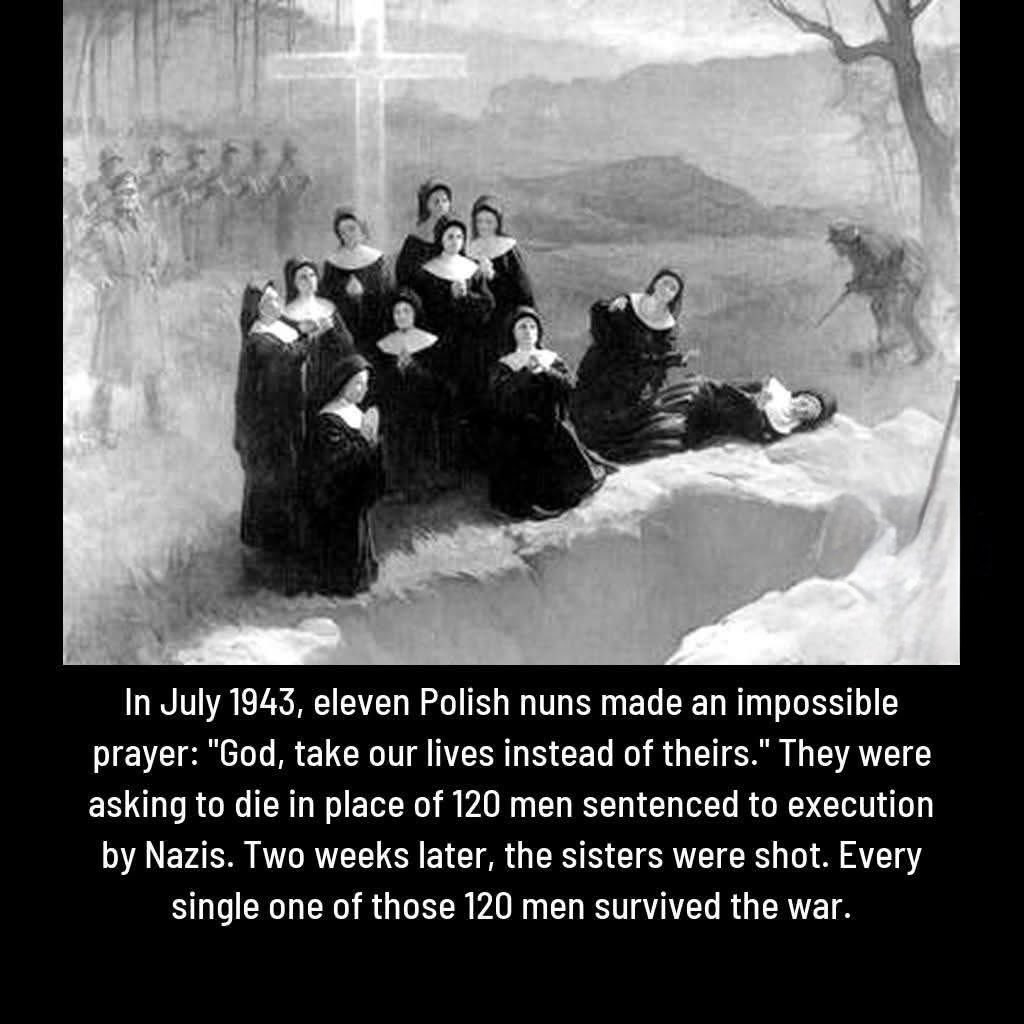
The women of Nowogródek came running to the convent that terrible night in July 1943. They were crying. Begging. The Nazis had just arrested their husbands, their fathers, their sons. One hundred and twenty men. All sentenced to die by firing squad.
"Please," they sobbed to the sisters. "Pray for them. They're all we have left."
The eleven nuns gathered in their small convent room. Outside, Nazi-occupied Poland was a nightmare. Half their town was already dead. The Jewish families who had been their neighbors? Gone. The priests who had served alongside them? Shot.
These women had already lost everything else. Now they were about to lose even more.
Sister Maria Stella was 54, the mother figure of their little community. She looked at her sisters' faces in the candlelight. They were teachers. Nurses. Women who had given their lives to serve others.
They had no weapons. No political power. No way to fight the monsters who controlled their world.
But they had one thing.
"We could offer our lives instead," Sister Maria Stella said quietly.
The room went silent.
Think about that moment. Eleven women, sitting in a tiny room, calmly discussing whether to volunteer to die. Not in a moment of passion. Not in a burst of heroic emotion. Just quiet, determined love.
They talked it through. These 120 men had wives who needed them. Children who would starve without them. The sisters were free from family obligations. They could be spared more easily than fathers.
One by one, each sister agreed.
The next morning, Sister Maria Stella walked to the parish priest. "Father," she said, "if sacrifice of life is needed, accept it from us and spare those who have families. We are even praying for this intention."
They were literally asking God to kill them instead.
What happened next defies explanation.
The execution was suddenly canceled. No reason given. The 120 men were loaded onto trains and sent to labor camps in Germany instead. Some were even released outright.
The sisters' prayer seemed to be working. But God wasn't finished.
Two weeks later, the Gestapo came for the nuns.
No charges. No trial. No explanation. Just an order: "Report to headquarters at 7:30 PM."
Before she left, Sister Maria Stella gave one last instruction. She told Sister Małgorzata to stay behind at the convent. Someone needed to tend the church after they were gone.
Sister Małgorzata watched her eleven sisters walk up the street in their black habits. The townspeople lined the windows, knowing they would never see them again.
The sisters spent their last night in a basement jail cell, praying the rosary together.
At dawn on August 1st, 1943, they were loaded into a covered truck. Five kilometers outside town, in a forest of birch and pine trees, a grave had already been dug.
Eleven women knelt side by side in the dirt.
They said goodbye to each other. Then, one by one, starting with Sister Maria Stella, they were shot.
Their bodies fell into the mass grave together. The youngest was 27. The oldest was 54. Teachers, nurses, servants of God who had asked to die so that strangers might live.
The war dragged on for two more years.
Sister Małgorzata stayed in the empty convent, tending to their secret grave in the woods. The parish priest they had tried to save survived. He joined the underground resistance and kept fighting.
And in 1945, when the war finally ended, something miraculous was revealed.
Every single one of the 120 men survived.
The ones sent to labor camps came home. The ones who had been released lived through the occupation. Not one father. Not one husband. Not one son had died.
One hundred and twenty families were reunited because eleven women had knelt in the dirt and died in their place.
Their prayer had been answered completely.