@cryptomanran This is not a war with the bond vigilantes. A borrower buying its own debt has nobody to fight; it has nobody else to sell to. The vigilantes did not show up. The buyers left.
@amitisinvesting The message is not being rejected, it is being read. A borrower that announces it will buy its own debt has run out of other buyers. The yield rose because the market now knows it.
@elerianm@CNBC The announcement raised the size of the issuer's bid, and the market answered by raising the yield. That is not a reaction to news. It is the long end pricing the reason the US Treasury has to buy its own bonds.
@zerohedge The miss against $10 billion is not the story. The buyback is larger than the last size the US Treasury announced, and the yield rose anyway. When the issuer bids more for its own debt and the price still falls, the market is pricing why the issuer has to buy.
@PeterSchiff A tripled buyback and a higher yield is the issuer bidding for its own debt and losing. When the borrower becomes the buyer, gold is the asset that is nobody's debt.
@MarioNawfal If the house wins on the yen, the gap between US and Japanese yields closes. The US Treasury is already working that side, buying its own bonds to cap the 10-year. The real exposure is the interest expense, already above a trillion dollars a year and rising with the 10-year.
@unusual_whales Growth is not the plan the borrower is running. In August 2026 the US Treasury doubled its bond buybacks to hold its own yields down. The issuer is managing the interest bill directly, not waiting to outgrow it.
@lisaabramowicz1 The stronger comparison is not 2022, when the Fed was already raising. It is the months before a first hike: 1994, 2004, 2015. The gap opened this wide ahead of each of them.
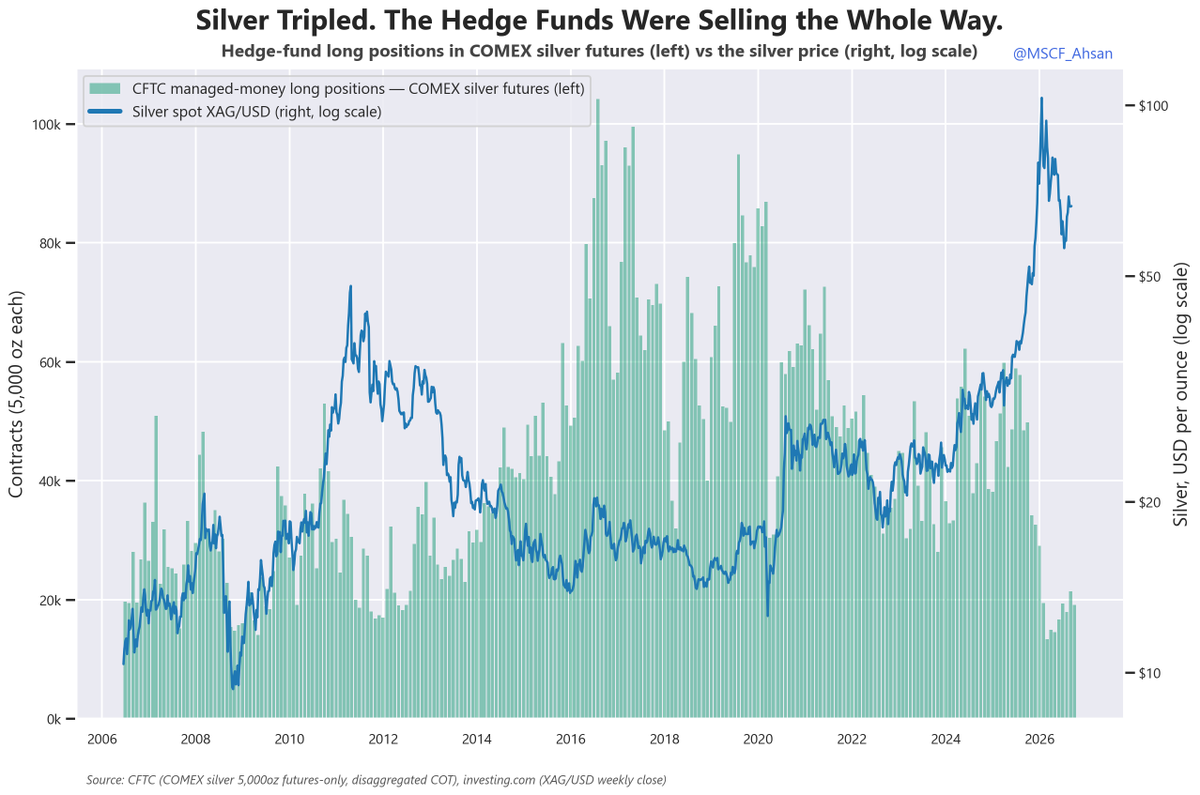
Silver tripled in seven months. The hedge funds were selling the whole way.
Hedge funds' long positions in COMEX silver were near 60k contracts through July 2025 with the metal under $40. By January 2026, two days before the top, they were 19k. Swap dealers were covering, not adding shorts. Open interest was already falling.
A rally that size should pull in futures leverage. The paper book shrank instead. Whoever pushed silver through $100 was not in the futures market.
@jameslavish Each buyback retires a long bond and funds it with a bill, so the life of the debt shortens with every operation. The 2-year says the rate those bills roll into is rising. Which costs more, the long end it bought back or the front end it now owes?
@FinanceLancelot If the liquidity comes, it comes from the same account that funds the bond buybacks. One balance sheet is now capping yields, supporting the yen and seeding accounts. Every dollar it puts into stocks is a dollar it has to sell bonds to raise.
@ces921@TFMetals@SecScottBessent Whatever the number, the message has not changed since August: the issuer is the bid for its own long end. Support for the Treasury market means a buyer who does not sell. That is yield suppression, whatever the schedule calls it.
@dotkrueger If it gets there, the yen carry gets the spread it needs and the US Treasury gets the bill it cannot afford. The same balance sheet is supporting the yen and capping the 10-year. At 5% it cannot do both.
@PeterSchiff Copper measures the economy. Gold measures the money. A ratio at a low says the money has repriced further than the economy has, and the economy has not caught up.
@amitisinvesting The bond market does. The 2-year has climbed past the funds rate, the shape it took before each of the last five hiking cycles. The market has priced the hike; next week decides who was right.
@FirstSquawk The balance sheet is already in use. The US Treasury supported the yen in July and doubled its bond buybacks in August. Currency policy and a capped long end are the same balance sheet spent twice.
@unusual_whales Each strike keeps oil high and yields high. The US Treasury is buying its own bonds to hold the long end down. Every escalation raises the bill it is trying to cap.
Gold miners are not a gold trade. They are a 2x gold trade.
This is the beta of the gold miners ETF to gold, re-estimated every week over the trailing year since 2007. When gold moves 1%, the miners have moved about 2%. In nineteen years that number has never fallen to 1.
The reason is volatility. Gold moves 10 to 20% in a normal year. A miner is an equity with costs, debt and a share price sitting on top of the metal, and it moves 30 to 40%. Same correlation, double the swing.
Whoever expects gold to keep rising gets roughly double in the miners.
@PeterSchiff A penny is worth more than its face because of what it is made of. A Treasury is worth its face because of who stands behind it, and that borrower now buys its own paper.
@Hedgeye Worst to have owned is a statement about the past. Today’s statement is the US Treasury buying back its own bonds to cap the long end. When the issuer becomes the marginal buyer, the decade is not over. It has changed hands.