"The man on the middle cross said I could come..."
This might be the best 3-minutes of preaching I've *EVER* seen. If you don't feel this in your soul, you need to check your pulse 😭🙌
Let’s all be praying for the people of Iran—especially for the many Iranian Christians among them. These are courageous men and women standing up at great personal cost.
It’s worth remembering that the Iranian regime fears its own people more than any foreign power. That tells you something.
Iran is not just a headline or a political talking point. It is an ancient civilization, a biblically significant land, tragically hijacked by terrorists in 1979. But God is not finished with the people of Iran.
Let’s pray for freedom, for protection, and for the Gospel to continue spreading—even in the darkest places. God often does His greatest work when oppression thinks it has the final word.”
Regrettably, I've treated some hat decisions like tattoo decisions, and some tattoo decisions too much like hat decisions. Consequences have come with both.
This post by @JamesClear hits home...
I think about decisions in three ways: hats, haircuts, and tattoos.
Most decisions are like hats. Try one and if you don’t like it, put it back and try another. The cost of a mistake is low, so move quickly and try a bunch of hats.
Some decisions are like haircuts. You can fix a bad one, but it won’t be quick and you might feel foolish for a while. That said, don't be scared of a bad haircut. Trying something new is usually a risk worth taking. If it doesn't work out, by this time next year you will have moved on and so will everyone else.
A few decisions are like tattoos. Once you make them, you have to live with them. Some mistakes are irreversible. Maybe you'll move on for a moment, but then you'll glance in the mirror and be reminded of that choice all over again. Even years later, the decision leaves a mark. When you're dealing with an irreversible choice, move slowly and think carefully.
“Hatred stirs up strife, but love covers all sins.” (Proverbs 10:12 NKJV)
Proverbs 10 marks a shift in the book of wisdom. Gone are the discourses of earlier chapters. In their place come short, pointed observations about how life actually works.
Hatred -- whether overt or simmering under the surface -- stirs. It agitates memory. It rehearses offense. It keeps score. It replays what was said, what was implied and sometimes even what was taken out of context. Over time, that internal stirring spills outward as division, sharp words, suspicion and animosity.
Love, by contrast, does the opposite – it covers.
This verse is not suggesting denial, avoidance or pretending harm didn’t happen. “Covering” in Proverbs is not about excusing wrongdoing, it’s about refusing to weaponize it. Love chooses restraint where hatred chooses escalation.
That distinction is precisely why this verse matters so deeply right now.
We live in a moment where strife is rewarded. Have you noticed how outrage travels so much faster than understanding? And public shaming is rampant on social media … but it’s framed as “accountability”. Disagreement has become dehumanization. It’s all so disturbing
In a divided nation, love that covers sins requires courage. It resists the dopamine hit of being right. And, it refuses to define people by their worst moment. This kind of love interrupts cycles of retaliation that feel justified but ultimately destroy trust and community.
Make no mistake … this kind of love does not ignore truth. It protects it from being distorted by bitterness. Community harmony is not achieved by unanimous agreement; it is realized by people who are willing to prioritize relationship over retaliation. Truly, in a world eager to stir strife, love’s work of covering may be one of the most countercultural and necessary acts of civility we can offer.
Proverbs contains so much wisdom, and the restatement of “love thy neighbor” throughout the Book is at the heart of its most important verses. It’s no wonder that in Proverb 10, verse 12 is the most commonly searched portion of that chapter.
Reflection:
Proverbs 10:12 asks a hard question of every one of us: Am I stirring the fire, or helping smother it?
Action Steps:
• Read Proverbs 10.
• When engaging in public conversations (online or in person) ask: Does this move us toward understanding or deeper division? Love doesn’t retreat from hard conversations, but it refuses to dehumanize.
Wisdom has a voice. In Proverbs 8, we meet her so we can recognize her in the middle of ordinary life.
Wisdom is not a secret. She’s not relegated to rare moments nor reserved for significant milestones. In Proverbs 8, she stands at crossroads, at city gates and along well-traveled roads. These are not symbolic places of reflection or solitude. They are places of movement, decision and consequence. Wisdom meets us where choices are made, where words are exchanged, where direction is set long before outcomes are recognized.
In everyday life, wisdom may be seen in action - OR - it often appears as restraint. It can be the pause before responding when emotions run high. It is heard in the decision to ask a better question instead of defending a position. It shows up when we choose clarity over urgency or truth over approval. These moments may not seem significant at the time, but they can shape the trajectory of our lives.
Proverbs 8 says wisdom is more precious than rubies. Perhaps it’s because rubies have compounding value, increasing in worth over time. Similarly, one wise decision strengthens the next. Over time, wisdom compounds our impact. It influences how we lead, how we manage resources and how we treat those entrusted to our care.
The reach of wisdom extends far beyond the present moment. Proverbs 8 tells us that wisdom existed before the foundations of the world were set. So, she is not shaped by trends, personal preference or cultural sentiment. When we choose wisdom, we align ourselves with something established by God from the very beginning. She is timeless … foundational … and she “rejoices in His whole world and delights in mankind.” (Proverbs 8:31) At her core, she is for us.
Verse 32 follows with a promise: blessed are those who keep wisdom’s ways. Keeping wisdom is not a single act. It is a pattern of listening, reflecting and applying what we already know to be true. It is choosing to live consistently within God’s design, even when that choice requires patience or restraint.
Proverbs 8 ends with a deeply personal invitation. Whoever finds wisdom finds life and receives favor from the Lord. In daily life, this favor often looks like an internal peace that is not easily shaken, confidence that does not depend on recognition and clarity that guides decisions one step at a time.
Wisdom does not ask us to abandon the world in order to follow her. She asks us to live within it more attentively, more faithfully and more aligned with the God who placed her there from the very beginning.
Reflection:
What response or choice you need to make in the coming days would benefit from restraint, clarity or a better question instead of a faster answer?
Action Steps:
• Read Proverbs 8.
• Intentionally seek counsel from one wise, trusted voice and receive it without correcting, qualifying or defending your perspective. Let it sit and resonate to see how it might impact your final decision. Only ask questions to gain clarity if necessary.
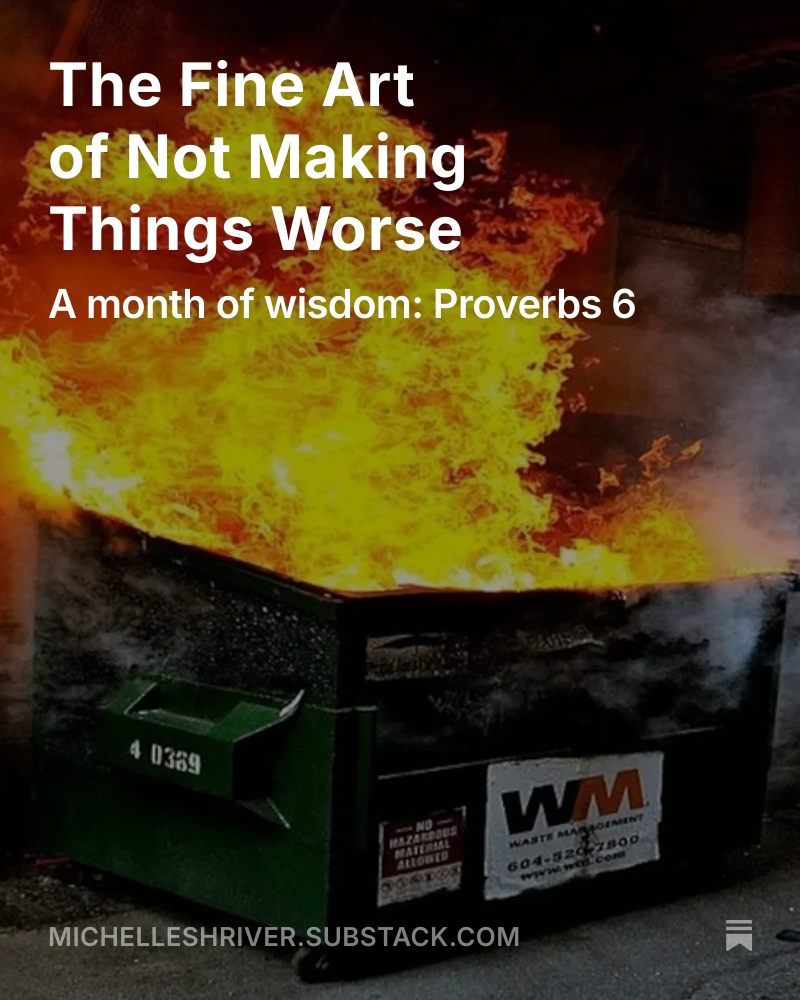
I don’t want to write about Proverbs 6. In one respect, it hits too close to home:
“…if you have put up security for your neighbor…” (Proverbs 6:1) ✅
Such is the life of a private equity investor. And no, it doesn’t always work out.
Proverbs 6 doesn’t offer much sympathy after that first verse either. It doesn’t say, “You meant well.” It says, essentially, “That is dumb -- and now let’s talk about the consequences.”
This is not a subtle chapter. It’s not poetic like Proverbs 3. It’s not aspirational like Proverbs 31. Proverbs 6 feels more like wisdom without a filter. No sugarcoating. No disclaimers. Just a rapid-fire list of behaviors that ruin lives if left unchecked.
There’s the ant -- small, unimpressive and somehow still more prepared than most of us – walking about doing its work while we debate whether tomorrow might be a better day to start. There’s the person who communicates maliciously with a wink, as if deception becomes less harmful when it’s clever. And there’s a list of things God detests, which is sobering … but also clarifying. Pride. Lying. Stirring up conflict. Apparently, God is not impressed by confidence without character or influence without integrity.
Proverbs 6 reads like a divine intervention staged before the mess becomes irreversible.
It warns against financial entanglements because good intentions don’t cancel bad agreements. It calls out laziness not because rest is wrong, but because neglect causes collapse. It confronts adultery and deceit because secret compromises have a way of becoming public catastrophes. And it urges immediate action NOW, not later, because procrastination is often how wisdom gets outpaced by damage.
If Proverbs 6 had a modern subtitle, it might be something like: “Warning Labels for Adult Decisions.”
This chapter assumes something deeply human, which is that we will occasionally overestimate our judgment, underestimate risk and convince ourselves we’re the exception. Proverbs 6 is wisdom showing up unpolished and direct, saying: “No bonus points are awarded for learning the hard way.”
There’s no sugarcoating here. But, with God, there is mercy. Because warnings given in advance are not condemnation, they’re protection!
And sometimes, the most loving thing wisdom can say is simply: Pay attention; there are consequences.
Reflection:
Which warning in Proverbs 6 did you recognize immediately, perhaps because you’ve already lived it? Is there a situation in your life right now where you’re relying on good intentions instead of good judgment?
Action Steps:
• Read Proverbs 6.
• This week, stop postponing the hard conversation, decision or the exit. Wisdom favors timely action.
My word for the year finally came to me.
"INTENTIONAL"
It feels like an expansion of last year’s word (DISCIPLINE), but with more heart behind it. It's less about sheer willpower, and more about alignment. It's also less about doing more, and more about doing what actually matters ... on purpose.
In 2025, I had a set of core principles I wanted to be "disciplined" about. I'd consider my progress on many of them a success, although some still need work. But, intentionality asks a deeper question: Why am I choosing this? (Whatever "this" happens to be.)
In 2026, living will intention will acknowledge that planning matters, but so does surrender.
“In their hearts humans plan their course, but the Lord establishes their steps.” (Proverbs 16:9)
I want to plan wisely, yes, but hold those plans loosely. I want to move forward with clarity, while trusting God with the outcome.
Intentionality will also shape how I show up and not just what I pursue.
“Whatever you do, work at it with all your heart, as working for the Lord, not for human masters.” (Colossians 3:23)
That verse reframes all the things important to me: relationships, work, leadership, daily decisions. It reminds me WHY those things are important and WHO is the Giver of those gifts.
And, finally, I will be intentional about where I'm going, and releasing what doesn't serve me anymore.
“...Forgetting what is behind and straining toward what is ahead, I press on toward the goal to win the prize for which God has called me heavenward in Christ Jesus.” (Philippians 3:13–14)
I won't be dragging past seasons into new ones. I won't be letting old disappointments, successes or identities dictate what God is doing next.
My Facebook cover photo has said this for years: "Life by Design" (not "Life by Default").
2026 will be marked by intentional choices ... intentional boundaries ... intentional growth. Most of all, intentional faith.
A year of living awake, aligned and purposefully walking the path God sets -- step by step.
#lifebydesign #livingwithintention #lifeonpurpose #intentionality #discipline #wordfortheyear #aligned
Most of the decisions that undo a life don’t look dangerous the moment they’re made.
On the surface, this does not appear to relate to Proverbs 5. But look more closely: although this chapter is often read narrowly, it was never meant to be lived narrowly.
Yes, Proverbs 5 is a clear warning about marital infidelity. The language is vivid, even uncomfortable at times. That’s intentional. Solomon isn’t trying to be poetic for poetry’s sake, he’s trying to get our attention before something devastating happens.
At its core, Proverbs 5 is about misplaced desire. It’s what happens when appetite outpaces discernment, and when short-term pleasure overrides long-term consequence.
The chapter describes temptation as sweet at first, smooth and persuasive. That’s what makes it dangerous. Rarely do the most damaging choices announce themselves as reckless. They present themselves as desirable … deserved … intoxicating … even justified.
In business and leadership, this dynamic usually starts with good intentions. It shows up when we justify small deviations for the sake of efficiency, harmony or results. We tell ourselves it’s “temporary”, “necessary”, or simply “how the game is played”. What we end up with is success becoming more important than integrity, influence mattering more than accuracy, and corners cut, boundaries blurred and decisions rationalized.
So, in spite of this chapter’s focus, faithfulness is not limited to marriage. It’s a posture of life. It’s a commitment to live undivided and to honor covenants, both spoken and unspoken. Fidelity is about remaining loyal to values long after the initial emotion that inspired them has faded.
And, perhaps most uncomfortably, Proverbs 5 forces us to confront idolatry.
"Idolatry" is far more expansive than we might think. What are we turning to for affirmation, escape or fulfillment that was never meant to carry that weight? What are we pursuing that cannot ultimately satisfy?
Solomon contrasts fleeting pleasure with sustained joy. One drains life. The other requires restraint, but gives life deeply.
For us, this is a sobering and necessary reflection. Wisdom isn’t proven in what we avoid publicly, it’s revealed in what we choose privately.
Proverbs 5 (and my reflection about it) is not about shame. It’s about stewardship -- stewardship of our hearts, our relationships, our influence and ultimately our future. And it invites us to ask a question that remains timeless and searching: Am I building a life that can sustain me? Or one that will eventually cost me more than I ever intended to pay?
Reflection:
Where in your life or leadership are you tempted to prioritize short-term satisfaction over long-term wisdom? Are there areas where boundaries have relaxed, or where desire has begun to shape decisions more than moral conviction?
Action Steps:
• Read Proverbs 5.
• Before acting this week, pause and ask: What will this choice cost me over time?
@Jason_Trice Thank you @Jason_Trice ! I love Solomon's imagery -- like searching for wisdom as a hidden treasure. It is anything but passive. So much good reading in Proverbs!
Words that you hear early in life stay with you … whether they are kind, helpful and loving or also when they are cruel, hurtful or even untrue. I’d like to think that those reading this are encouraging and loving parents. When you speak to your children (small or adults), you are speaking from wanting to provide guidance that uplifts and also protects.
Hopefully you had parents who did the same. My mom was my biggest cheerleader. She was also the first to call me out when she disagreed with what I was doing. She wasn’t always the most diplomatic, but even when I didn’t want to hear it at the time, I knew (at least deep down) it came from a place of deep care and concern.
Proverbs 4 opens with a voice that feels deeply personal:
“Listen, my sons, to a father’s instruction; pay attention and gain understanding.” (Proverbs 4:1)
Solomon goes on to speak of the words he received from his father David, and how his mother Bathsheba cherished him. The words are spoken in love but also in earnest.
“…Get wisdom. Though it cost all you have, get understanding. Cherish her [wisdom], and she will exalt you; embrace her, and she will honor you.” (Proverbs 3:7-8)
A beautiful oration follows. It reads less like a directive and more like a conversation that seems to assume time will pass before it’s fully understood. I’ve come to realize that wisdom often reaches us before we’re ready to receive it. Perhaps because experience has not yet given the words their weight. What once sounded like caution as a child eventually reveals itself as care.
Like everyone, there have been times when I took a different path – even when I knew the “right” one to take. I didn’t do it with fanfare or drama; I simply held my head high and marched ahead with a false confidence that was misplaced – in me, rather than the One who wants what’s best for me. Some choices ultimately worked out fine, and I can see God’s blessing and redemption. Others have carried consequences that are still unraveling. Looking back, I can trace many turning points to moments where guidance was present, but not yet welcomed.
“The path of the righteous is like the morning sun, shining ever brighter till the full light of day. But the way of the wicked is like deep darkness; they do not know what makes them stumble.” (Proverbs 4:18-19)
Don’t let the word “wicked” get in the way of taking this to heart. I’m sure we can all be honest enough to know our thoughts are not always pure. There are moments when fear, distraction or self-interest influence the direction we take. But Proverbs 4 reminds us that our inner life shapes our outer path. The image of morning light is not about instant clarity, but about gradual illumination. Truth becomes easier to recognize as we keep choosing what is good (what is best for us). Wisdom doesn’t promise a flawless journey; it promises that when we walk with intention and humility, the way forward becomes clearer over time.
I continue to learn that that wisdom isn’t rushed. And I don’t think it “comes and goes”. It stays near. It waits for us to return. And when we do, it meets us with clarity we couldn’t access before.
Reflection:
Are there words of wisdom that have stayed with you over the years, even if you didn’t act on them right away? Is there counsel you understand more clearly now than you did when you first heard it? Is there something you need to do with these revelations?
Action Steps:
• Read Proverbs 4.
• Set aside a few quiet minutes this week, without distraction, to reflect on what wisdom may be asking of you in this season.
• Choose one small adjustment that protects your inner life, allowing wisdom to take deeper root.
There are chapters you admire in the Bible, and then there are chapters that feel like they were written specifically for you. Proverbs 3 is that for me.
It begins with more than instruction; it has an intimacy that is speaks directly to my soul:
“Let love and faithfulness never leave you; bind them around your neck, write them on the tablet of your heart.” (Proverbs 3:3)
It’s pure poetry. And, when internalizing the words, it’s how love and faithfulness become the handwriting of our inner life.
The compass for our future follows:
“Trust in the Lord with all your heart and lean not on your own understanding; in all your ways submit to Him, and He will make your paths straight.” (Proverbs 3:5-6)
These verses have been a guiding force for me—a true north when clarity is absent and outcomes are uncertain. Proverbs 3 doesn’t promise a map, but it does promise a direction. Sitting in prayer, or with a journal on my lap, that trust gives me somewhere (in Whom) to place the weight of my decisions … a way forward when logic runs out and discernment feels elusive.
Even in our finances, Proverbs 3:9 invites alignment: to honor God first, not as a transaction, but as trust. Again and again, I’ve seen provision flow not from control, but from surrender.
Keep reading – it goes deeper. Because things don’t always go as planned, and those around us don’t always want what’s best for us. This 3rdchapter also reframes discipline as as proof of love. Correction here is not harsh; it is purposeful: “…because the Lord disciplines those He loves…”(Proverbs 3:12)
And then there is wisdom herself -- personified as a woman whose ways are pleasant and whose paths are peace. I feel seen in these passages. Wisdom is precious. She is secure.. Her fruit is not just success, but wholeness. “She is a tree of life to those who take hold of her’ those who hold her fast will be blessed.” (Proverbs 3:18)
Proverbs 3 is filled with promise, that includes honor, favor and inheritance. It showcases wisdom that shapes character before outcomes, and peace before applause.
It’s a chapter that doesn’t just tell us how to live, it shows us who we are becoming.
Reflection:
What is currently being written on the tablet of your heart? Where do you need to release control and replace it with trust?
Action Steps:
• Read Proverbs 3.
• Practice honoring God first this coming week, whether with time, attention or resources, and as an act of trust, not obligation.
Wisdom does't simply come with experience and maturity; it must be pursued – actively, urgently and expectantly.
“If you call out for insight and cry aloud for understanding, and if you look for it as for silver and search for it as for hidden treasure…” (Proverbs 2:3–4)
Solomon is not talking about casual curiosity. He is describing a posture of anticipation, the kind that believes something valuable is waiting to be found.
This chapter suggests that wisdom responds to desire. It’s not a student who’s taking notes in a lecture, but an archeologist who treks into the remote places of the world and tirelessly digs, excavates and preserves what she finds.
There is a difference between wanting wisdom and wanting it enough to excavate it out of the earth. Enough to go out of our way to find it. Enough to meticulously and slowly brush away the debris around it. Enough to sacrifice for it.
Wisdom requires asking the harder question instead of accepting an easy answer. It risks being misunderstood or even offending someone who values comfort over tough conversations. Wisdom has to be resilient enough to sit with uncertainty during the search.
I’ve made my worst decisions when I wanted easy over sacrifice. Or, when I wanted an outcome so much that I refused to seek wisdom and barreled ahead, pushing aside the nagging pull to slow down and to obtain different points of view. Or even when I wasn’t willing to have the hard conversation and disappoint someone by saying “no”. I’m paying for some of those foolish decisions even today.
As king, Solomon faced decisions that affected lives, nations and even generations. Proverbs 2 reads like counsel born from that weight. But Proverbs 2 doesn’t just describe what wisdom gives -- it describes what wisdom saves us from. It protects us from paths that appear easy but erode integrity. From voices that sound persuasive but lack truth. From decisions that promise progress but crumble without a foundation .
Wisdom teaches us not only what to pursue, but what to refuse. Oh how I wished I listened to the voice of reason (wisdom) in so many of my past decisions.
This is particularly important for us as leaders. Influence expands options, but not every open door is worth walking through. Not every “yes” moves us forward. Proverbs 2 contains evidence that discernment is not restrictive; it is protective.
If wisdom seems elusive, know that is not hidden to frustrate us. It is hidden to be sought.
Reflection:
Where in your leadership or life have you been settling for surface-level insight instead of searching deeply for wisdom? What decisions might require more listening, more questions or more courage to pause?
Action Steps:
• Read Proverbs 2.
• Identify one decision you are facing (professional or personal) and intentionally seek wisdom before acting. Ask better questions. Invite trusted counsel. Spend time reflecting rather than reacting.
Treat wisdom like the treasure it is.
The end of the year has a way of stirring reflection.
Even among capable, accomplished people, the turn of the calendar often exposes a deeper question beneath the goals and plans of what’s to come. Not just what do I want to achieve, but who do I want to become while pursuing it? How do I want to live this year?
I’ve noticed that the most thoughtful leaders aren’t necessarily searching for more information. They’re searching for clarity. For discernment. For insight to guide decisions when circumstances are complex and outcomes are uncertain.
That search is what has drawn me back to the Book of Proverbs.
Proverbs doesn’t begin with ambition. It begins with wisdom. (Real, lasting wisdom rather than hacks or shortcuts.) Proverbs provides an invitation that has resonated for thousands of years: Come learn how life actually works.
Much of this wisdom comes from Solomon, the son of David -- a man who inherited not only a throne, but the responsibility of leading a nation during one of the most prosperous seasons in its history. Solomon understood influence, wealth, pressure and even temptation at a scale few ever will. Early in his reign, when given the opportunity to ask God for anything, he asked for wisdom, not success, nor security, not even power. He wanted deeper understanding.
And the wisdom Solomon received became legendary. Leaders traveled across nations to hear him speak. His observations were repeated, preserved and eventually compiled, not because they were poetic, but because they were true. They described human nature accurately. They exposed patterns that still play out in boardrooms, households and hearts today.
Even now, centuries later, people quote Proverbs (sometimes without realizing it). Wisdom has a way of outlasting its original audience.
Solomon isn’t the only voice in the Book. Other contributors appear along the way: sages with their moral instructions of do’s and don’ts, Agur’s honest acknowledgment of human limits, a mother’s counsel to a king about leadership and self-control. Together, they form a collection of wisdom shaped across generations.
What I appreciate most about Proverbs is what it does not promise. It doesn’t guarantee outcomes. It doesn’t offer formulas. Instead, it teaches us how to think before we speak, how to choose amongst competing priorities and how to lead without losing our integrity in the process.
At the heart of Proverbs is a simple but demanding truth: wisdom begins with reverence for God rather than performance or perfection. This reverence is an acknowledgment that we are not self-sufficient, and that life works best when we align ourselves with the One who designed it.
This January, I’m returning to Proverbs, one verse each day. I don’t want to rush through it, but to sit with it. To let single thoughts shape the way I move through conversations, decisions and responsibilities that might otherwise feel automatic.
My hope is that this becomes more than a reading plan. I pray it becomes a daily recalibration. Walking through it slowly … deliberately … can remind us that wisdom is not something we arrive at once, but something we practice consistently and patiently over time.
If you’re entering this year wanting more than productivity or momentum, and if you’re longing for discernment that lasts, I’d love for you to join me.
Tomorrow, we’ll begin with the first verse, Proverbs 1.
Most leadership conversations start with strategy. Proverbs starts somewhere else entirely.
“The proverbs of Solomon son of David, king of Israel: for gaining wisdom and instruction; for understanding words of insight…” (Proverbs 1:1–2)
Beyond titles, results and even reputation, Proverbs names its foundation: wisdom. It’s what gives us the ability to receive information. To gain influence. Wisdom is what shapes judgment, character and restraint as well as action.
Solomon was not writing as someone trying to “get ahead”. He was writing as someone entrusted with responsibility – as a king, a son and a leader whose decisions would affect economies and the future of Israelites and so many others. Proverbs 1 reads like a leadership briefing for anyone who knows their choices carry weight, whether in the conference room or at a kitchen table.
Proverbs 1 makes a clear distinction that feels especially relevant in our divisive world today: wisdom is available, but not automatic. It must be received through discernment and truth.
“The fear of the Lord is the beginning of knowledge, but fools despise wisdom and instruction.” (Proverbs 1:7)
The fear of the Lord is not about shrinking back in terror. It is about reverence … awe … an awareness of who God is and who we are in relation to Him. It is the kind of respect that shapes behavior not out of obligation, but out of honor. Like a child who does not want to disappoint a parent they deeply love, this fear is rooted in relationship.
Later in the chapter, wisdom is personified as calling out in public spaces, inviting people to listen before consequences come. The warning is subtle but sobering: wisdom ignored eventually becomes wisdom unavailable. Not because God withholds it, but because habits form, hearts calcify and selfish thoughts overwhelm wisdom itself.
For executive leaders, this matters. Decision fatigue is real. Pressure to move fast is constant. The temptation is to rely on experience alone. Proverbs 1 reminds us that experience without teachability can become a liability.
And for leaders at home, the message is just as clear. Proverbs assumes children are watching, and learning, and absorbing not just what we say, but what we esteem. Wisdom is modeled long before it is taught.
James echoes this centuries later: “If any of you lacks wisdom, you should ask God, who gives generously to all without finding fault.” (James 1:5)
Wisdom is not reserved for the exceptionally spiritual or the exceptionally gifted. It is offered to the willing.
Reflection:
Where in your leadership are you relying on instinct or past experience when God may be inviting you to slow down and listen?
Action Step:
• Read Proverbs 1.
• Before your next significant decision this coming week, pause and ask a better question: “What does wisdom require here?” (Not just, “What does success reward?”)
Tomorrow, we’ll move into Proverbs 2, where wisdom shifts from being an invitation to becoming a pursuit, and the text asks something more of us than attention.
If you'd like to Subscribe to the entire Proverbs series, please click here: https://t.co/Hjn0qeHDmj










![MShriverMAK's tweet photo. Words that you hear early in life stay with you … whether they are kind, helpful and loving or also when they are cruel, hurtful or even untrue. I’d like to think that those reading this are encouraging and loving parents. When you speak to your children (small or adults), you are speaking from wanting to provide guidance that uplifts and also protects.
Hopefully you had parents who did the same. My mom was my biggest cheerleader. She was also the first to call me out when she disagreed with what I was doing. She wasn’t always the most diplomatic, but even when I didn’t want to hear it at the time, I knew (at least deep down) it came from a place of deep care and concern.
Proverbs 4 opens with a voice that feels deeply personal:
“Listen, my sons, to a father’s instruction; pay attention and gain understanding.” (Proverbs 4:1)
Solomon goes on to speak of the words he received from his father David, and how his mother Bathsheba cherished him. The words are spoken in love but also in earnest.
“…Get wisdom. Though it cost all you have, get understanding. Cherish her [wisdom], and she will exalt you; embrace her, and she will honor you.” (Proverbs 3:7-8)
A beautiful oration follows. It reads less like a directive and more like a conversation that seems to assume time will pass before it’s fully understood. I’ve come to realize that wisdom often reaches us before we’re ready to receive it. Perhaps because experience has not yet given the words their weight. What once sounded like caution as a child eventually reveals itself as care.
Like everyone, there have been times when I took a different path – even when I knew the “right” one to take. I didn’t do it with fanfare or drama; I simply held my head high and marched ahead with a false confidence that was misplaced – in me, rather than the One who wants what’s best for me. Some choices ultimately worked out fine, and I can see God’s blessing and redemption. Others have carried consequences that are still unraveling. Looking back, I can trace many turning points to moments where guidance was present, but not yet welcomed.
“The path of the righteous is like the morning sun, shining ever brighter till the full light of day. But the way of the wicked is like deep darkness; they do not know what makes them stumble.” (Proverbs 4:18-19)
Don’t let the word “wicked” get in the way of taking this to heart. I’m sure we can all be honest enough to know our thoughts are not always pure. There are moments when fear, distraction or self-interest influence the direction we take. But Proverbs 4 reminds us that our inner life shapes our outer path. The image of morning light is not about instant clarity, but about gradual illumination. Truth becomes easier to recognize as we keep choosing what is good (what is best for us). Wisdom doesn’t promise a flawless journey; it promises that when we walk with intention and humility, the way forward becomes clearer over time.
I continue to learn that that wisdom isn’t rushed. And I don’t think it “comes and goes”. It stays near. It waits for us to return. And when we do, it meets us with clarity we couldn’t access before.
Reflection:
Are there words of wisdom that have stayed with you over the years, even if you didn’t act on them right away? Is there counsel you understand more clearly now than you did when you first heard it? Is there something you need to do with these revelations?
Action Steps:
• Read Proverbs 4.
• Set aside a few quiet minutes this week, without distraction, to reflect on what wisdom may be asking of you in this season.
• Choose one small adjustment that protects your inner life, allowing wisdom to take deeper root.](https://pbs.twimg.com/media/G95w_x3WcAATg-n.jpg)





