The Sculptor Ipuy and his Wife (and cats)
New Kingdom, 19th Dynasty, c. 1279–1213 B.C.
Facsimile by Norman de Garis Davies (1865–1941) from the Tomb of Ipuy (TT217), Deir el-Medina, Thebes
Read more: https://t.co/R7jAfZ4Rmy
Anello di Carvilio. I sec. d.C ritrovato in una tomba vicino a Grottaferrata appartenente a Aebutia IV. Nell'anello è riprodotta l'immagine del figlio Carvilio morto a 18 anni. Due immagini vedere singolarmente
Motion captured in bronze: Minerva.
These Etruscan votive statuettes (c. 450–400 BCE) depict the warrior goddess with the aegis across her chest, arms raised in a moment of power. Small in scale, yet rich in meaning.
Placed in sanctuaries, they carried prayers and protection into the divine.
On display at the Museo Nazionale Etrusco di Villa Giulia, Rome.
A priestess named Enheduanna claimed authorship to poetry and other texts, sometimes in first-person, more than a Millennium before Homer...
Over 5000 years ago, people living in a part of Mesopotamia called Sumer started to keep records with cuneiform, oldest known system of writing. And roughly a millennium after cuneiform emerged, a priestess named Enheduanna began using this writing system in a new way. Her unique texts are the earliest known example of first-person writing, and she may be the first known writer to claim authorship of her work.
British archaeologists discovered copies of her work in 1927, but it took several decades for scholars to credit Enheduanna as author of her texts (some continue to argue she didn’t write them). Scholars who do believe she authored these texts point to the deeply personal reflections in her writing, as well as fact that these works were consistently attributed to her long after her death.
Enheduanna was born in Mesopotamia, around 23rd Century BC. She was daughter of Sargon of Akkad, who established Akkadian Empire; he appointed Enheduanna to be high priestess of moon god Nanna in Ur. At some point, a Sumerian king ousted her from position and forced her into exile. She wrote about this in her poem “The Exaltation of Inanna,” which describes coup and her pleas to goddess Inanna to restore her position:
He made me walk a land of thorns,
He took away the noble diadem of my holy office,
He gave me a dagger; ‘This is just right for you,’ he said.
“It’s written from a very personal perspective,” says Zainab Bahrani, a professor of art history and archaeology at Columbia University and author of Women of Babylon: Gender and Representation in Mesopotamia. Enheduanna describes “being treated disrespectfully” during coup, and “in one part of it, it seems like she’s describing sexual violation.”
Enheduanna writes in “The Exaltation of Inanna” that she reclaimed her position as high priestess and credits Inanna with making this happen. In addition, she reflects on creative process of writing, comparing composition of her poem to act of childbirth: “I have given birth, oh exalted lady, (to this song) for you.”
Enheduanna was not the first person to write poems or hymns; but what makes her work unique is that she wrote from first-person perspective and claimed authorship of her work. In compilation of hymns that she arranged, she added this postscript:
The compiler of this tablet is Enheduanna. "My king, something has been produced that no person had produced before".
Enheduanna’s work had lasting impact. For hundreds of years after her death, “The Exaltation of Inanna” was an important text in scribal schools, says Sidney Babcock, curator of exhibit She Who Wrote: Enheduanna and Women of Mesopotamia, 3400–2000 BC at The Morgan Library & Museum in New York City.
The poem “became part of the ten canonical texts, core curriculum, shall we say that was taught then for the next 500 years-plus in scribal schools,” he says.
Even today, some scholars do not think that Enheduanna wrote the work that bears her name and her first-person perspective (one theory is that a male scribe composed texts on her behalf). Because many did not associate literacy with women during this period.
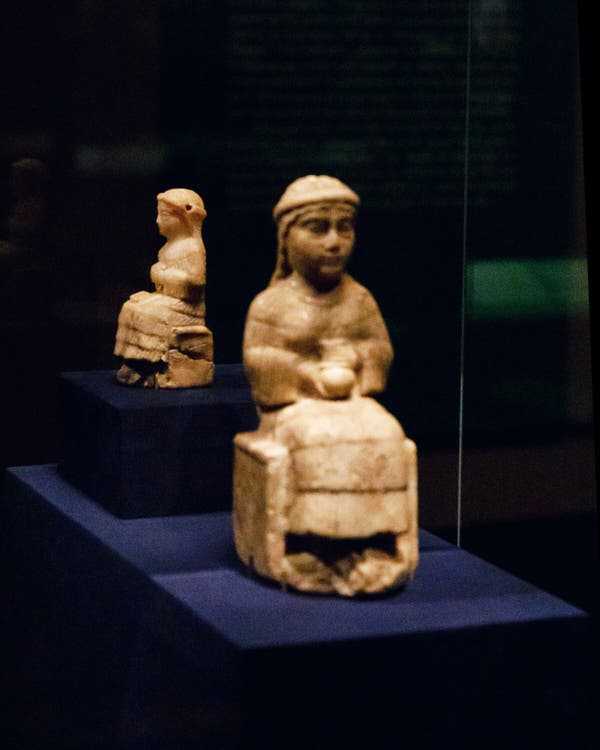
Babcock points to one of artifacts on display in She Who Wrote: a statuette of a woman with a tablet in her lap, 2112-2004 BC. To Babcock, this statuette demonstrates connection between women and literacy. But when a male German scholar wrote about this same statuette a century ago, he confessed that its meaning was unclear to him.
Bahrani says that debate is “not about the evidence as such,” but rather “how one should interpret that evidence.” While she thinks it is important to acknowledge this debate, she believes “firmly” that Enheduanna was an author who wrote her own work.
📷 : Two Mesopotamian sculptures from around 2112-2004 BC, included in “She Who Wrote,” at Morgan Library & Museum.
#archaeohistories