✅ BSc, Computer Science (First Class)
✅ MSc, Computer Science & AI (Highest Honor)
✅ 3 research papers accepted this year
✅ 7 books written
✅ Executive in Residence, Miva University
✅ Computer Science mentor, University of Bristol
Bonus:
✅ MBA (Michigan Ross) - in progress
✅ Stanford Graduate School of Business LEAD Diploma
B.A. French (First Class Honours) – Obafemi Awolowo University
Best Female Graduating Student, Faculty of Arts (OAU)
M.A. French (Distinction) – University of Ibadan
Best Graduating Student, Department of European Studies
Ph.D. French Literature – Purdue University, USA
Student of the Year
DALF C2 (French Language Proficiency)
Chegg Global Student Prize 2024 Top 50 Finalist (Selected from over 11,000 nominations across 176 countries)
I am honored to be nominated by JCI Nigeria as one of the Top 30 Outstanding Young Persons in the category of Academic Accomplishments and Leadership.
I would greatly appreciate your vote and support:
https://t.co/aiGfYjp45z
Thank you. 🙏🏽
The man who explained stoichiometry so clearly that I went on to teach my classmates using the very same analogies he used.
What makes this even more inspiring is the story he shared with us at OAU CDL, Moro. He told us that he initially wanted to study Pharmacy but was admitted to study Chemistry for his undergraduate degree. Rather than seeing this as a setback, he stayed focused and determined, and went on to design drugs during his postgraduate training. He earned the title Dr. Fadare (PhD).
That story was his way of reassuring us that even if you don’t get your first choice of course, you can still make the impact you dream of with focus, resilience, and determination. It taught us not to be downcast, but to stay committed to our purpose.
That lesson has stayed with me for eight years.
A truly great teacher.
Dr. Fadare.
A month after I first met my wife, she flew from Paris to Valencia to visit me. I wasn’t at the airport to pick her up. I’d asked if that was okay and she said yes. I didn’t know it was actually a big deal to her.
2 months later I took the train from Amsterdam to Paris to visit her there for the first time and she commuted an hour by metro just to meet and welcome me at the train station.
I never needed to be told again.
Two years later we got married, moved to Nancy, and she got an internship at Baker & McKenzie Luxembourg. It was cheaper to keep our French apartment and have her commute by train. She returned every evening at 8:11pm. I was at the train station to welcome her every single day.
I kinda agree some men aren’t worth the asking. But men are not mind readers.
Find someone humble enough to hear what you want, and respond. Then show them what love looks like and watch them learn your language.
You have to ask. The right one listens. And then you stop having to.
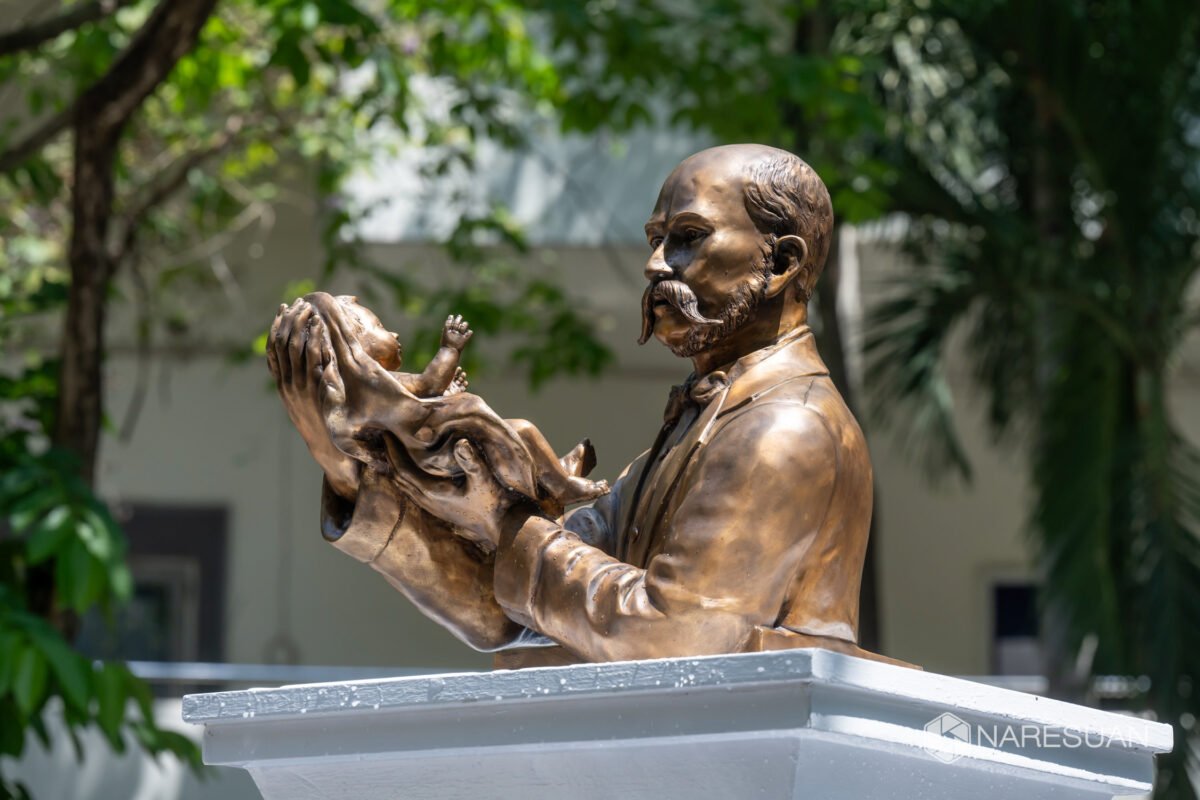
The biggest responsible for the plummeting rate of women who die in childbirth, was Ignaz Semmelweis, also know as the "saviour of mothers". He was mocked and rejected by the medical community and died in an asylum. He saved countless lives with 4 words: doctors, wash your hands.
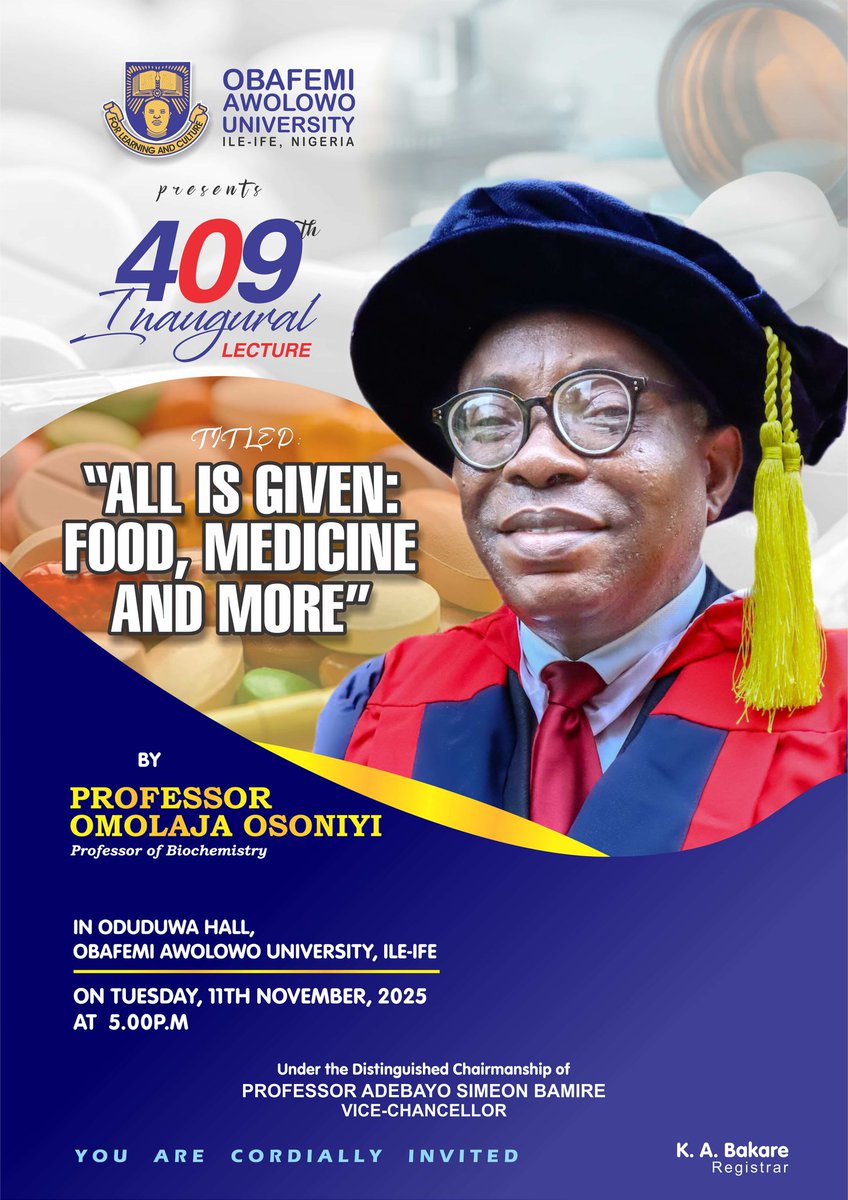
ALL IS GIVEN: FOOD, MEDICINE AND MORE
OAU’s 409th Inaugural Lecture by Professor Omolaja Osoniyi, a Professor of Biochemistry.
Venue: Oduduwa Hall
Date: 11th Nov. 2025
Time: 5PM
Under the Chairmanship of Professor Adebayo Simeon Bamire, VC.
#OAU#GreatIfe#InauguralLecture
I don't like the way a lot of people are sounding dismissive at this, but here's what I think: it is easy to dismiss things like this as trivial, and that’s where a lot of people are losing the plot already.
Emotional intelligence isn’t about knowing what should matter. It rather is about knowing what does matter to the person you love. It's her name, yes. But does she want something more? Of course, yes. Then why withhold and gatekeep the luxury of that beautiful feeling from her?
For her, that “dear” exceeds the reality of being just a word. She revels in it and she sees it as a language of affection, a proof of tenderness, and a care she craves. And when that’s missing, it’s not the word she mourns anymore, rather the warmth and actual tenderness she thought she'd have gotten freely.
And men especially need to learn that women often feel love in subtleties—tone, gestures, endearing and sweet names. This is not a man-to-man relationship, Habeebi. And it’s not a weakness either. Learning that doesn’t make you any less of a man; it makes you more human, more attuned, more loving. And for the Muslim, more inclined to the Sunnah.
When this gets too recurring, it may not be that she’s too emotional. It may perhaps be that one has become too unfeeling. May Allah make us better.
Let me explain the difference between traditional and Western medicine with this pepper soup issue.
Let's say a Western scientist heard this rumor. They'd immediately conduct a study with peppersoup and check if it's correct.
Now let's say they actually found a positive result, i.e, it actually worked, they wouldn't stop there.
They'd reason that surely it can't be the whole pepper soup that's responsible for the effect they're seeing. I mean, first of all, pepper soup is almost entirely water. So what is it? Is the meat? Is it the spices?
So they'd split their study into groups. Some would be fed only the meat, some, only the actual soup.
Let's say the soup group came back positive; they still wouldn't stop there. Surely there are over half a dozen spices in pepper soup. Either it's one of those spices that's causing the effect, or the spices are interacting to cause that effect.
So they'd split up the groups again and cook different kinds of pepper soup, omitting each ingredient each time.
Let's say they did this for a while, and then discovered that the effect only persists when three particular spices are combined and boiled. They still wouldn't stop there.
They'd start studying the chemical properties of those spices before and after they've been cooked. What compounds are in one but not the other?
MEANWHILE, while all of this is going on, there would be another research group trying to analyse what actually happens when women are taking this pepper soup. What happens to their blood pressure? their heart rate? What about their blood lipids?
There would be groups taking blood and adding pepper soup to that blood, and looking at it under the microscope.
All these different groups would be firing papers at one another.
Usually, what this leads to is the isolation of a single compound that was actually responsible for the effect THE ENTIRE TIME.
Then once we have the compound, we can start studying its properties, using the research from the peppersoup blood guys. Does this thing accumulate in the bloodstream? Does it trigger immune responses or cause inflammation? Does it degrade into a known dangerous chemical? Does it trigger cancerous cells? That's how we understand all the known side effects.
And the funniest thing is that this compound may also appear in another random place. Like maybe it also comes out as a waste product when refining petrol or some shit.
Then, since we have the compound, we know how it works, and we know it's a byproduct of an industrial process, we start setting up a factory to mass-produce it for the public.
After all this, we have gone from
> Drinking pepper soup to flush things.
to
> Taking a single pill that's 100x cheaper and 100x more concentrated and effective, to do the same thing.
A layman could look at this and be like, "Why the hell are these people using waste product from refineries to us as drugs?" but they wouldn't get it.
They just wouldn't get it.
The immune system is powerful.
Sometimes, too powerful.
If it goes unchecked, it can turn on us -
attacking our own organs, tissues, even our blood.
That’s why the 2025 Nobel Prize in Medicine matters so much.
It honors three scientists who figured out how the body stops itself from self-destructing.
🧬 Mary Brunkow
🧪 Fred Ramsdell
🧫 Shimon Sakaguchi
Here’s the story :👇
Every day, your body fights off thousands of invaders - viruses, bacteria, fungi.
But the real magic? It knows not to attack you.
That precision is everything.
And for decades, scientists thought they knew how it worked:
Bad immune cells were weeded out early in the thymus (central tolerance). End of story.
Except… that wasn’t the whole story.
Sakaguchi’s bold idea (1995)
He challenged the dogma.
He found a new class of immune cells doing something unexpected:
➡️ They weren’t attacking.
➡️ They were protecting.
He called them regulatory T cells - the immune system’s peacekeepers.
They roam the body and tell other immune cells:
“Stand down. This is us. Don’t attack.”
It was a radical idea at the time. But he was right.
Brunkow & Ramsdell’s breakthrough (2001)
They were studying a mysterious mouse.
It had a single mutation - and developed devastating autoimmune disease.
They found the cause: a gene called Foxp3.
🧬 Foxp3 isn’t just any gene.
It’s the master switch that tells cells to become regulatory T cells - the same ones Sakaguchi discovered.
Mutate it in mice or humans… and the immune system spins out of control.
In kids, that mutation causes a rare and deadly disease: IPEX syndrome.
The missing link (2003)
Sakaguchi came back to close the loop.
He proved that Foxp3 is what powers the regulatory T cells - the body’s tolerance enforcers.
This confirmed the whole mechanism.
➡️ We don’t just delete dangerous immune cells early on.
➡️ We also deploy specialized cells to watch over the rest.
➡️ That’s how we avoid autoimmune chaos.
The impact? Massive.
Their discoveries opened an entire new field: peripheral immune tolerance.
We now have:
🔹 New approaches to treat autoimmune diseases
🔹 Promising advances in organ transplant tolerance
🔹 Immunotherapies that fine-tune the immune system to fight cancer - without turning on the body
Some of these are already in clinical trials.
This isn’t just a scientific triumph.
It’s a reminder that:
✅ Curiosity still drives paradigm shifts.
✅ Going against the mainstream can change everything.
✅ Basic science leads to better medicine.
And sometimes, three scientists working decades apart can quietly solve one of biology’s deepest mysteries.
👉 That’s worth a Nobel.
The 2025 medicine laureates identified the immune system’s security guards, regulatory T cells, which prevent immune cells from attacking our own body.
The fundamental knowledge that researchers have gained through the discovery of regulatory T cells and their importance for peripheral immune tolerance, has spurred the development of potential new medical treatments. Mapping of tumours shows that they can attract large numbers of regulatory T cells that protect them from the immune system. Researchers are therefore trying to find ways to dismantle this wall of regulatory T cells, so the immune system can access the tumours.
In autoimmune diseases, researchers are instead trying to promote the formation of more regulatory T cells. In pilot studies, they are giving patients interleukin-2, a substance that makes regulatory T cells thrive. Researchers are also investigating whether interleukin-2 can be used to prevent organs being rejected after transplantation.
Another strategy researchers are testing to slow an overactive immune system is to isolate regulatory T cells from a patient and multiply them in a laboratory. These are then returned to the patient, who will thus have more regulatory T cells in their body. In some cases, researchers also modify the T cells, putting antibodies on their surface that function like an address label. This allows researchers to send these cellular security guards to a transplanted liver or kidney, for example, and protect the organ from being attacked by the immune system.
There are many more examples of how researchers are testing how regulatory T cells can be used to combat diseases. Through their revolutionary discoveries, Mary Brunkow, Fred Ramsdell and Shimon Sakaguchi have provided fundamental knowledge of how the immune system is regulated and kept in check. They have thus conferred the greatest benefit to humankind.
The 2025 Nobel Prize in Physiology or Medicine has been awarded to Mary E. Brunkow, Fred Ramsdell and Shimon Sakaguchi “for their discoveries concerning peripheral immune tolerance.”
@opemidimeji_xo Prof. Adewale gave us an assignment on it last semester. I find the mechanism interesting, most especially the repression and derepression of the operator gene.