Today, @UCC_Official, along with stakeholders @mtnug, @Airtel_Ug, and @URAuganda, held a press conference to address the public about the growing challenge of illegal public Wi-Fi hotspot operators across the country.
While expanding digital inclusion and keeping internet access affordable remain fundamental goals, all telecom services must operate strictly within the legal bounds set by the Uganda Communications Act, 2013.
Currently, over 4,000 unlicensed operators are illegally reselling commercial and residential broadband. This practice not only undermines legitimate providers but also costs the nation approximately UGX 148 Bn in lost annual tax revenue.
Beyond the financial impact, these unauthorised networks pose serious cybersecurity, data privacy, and consumer protection risks to everyday users, while mounting unapproved equipment on public utility poles creates physical safety hazards.
To resolve these challenges fairly, we are giving all unauthorised Wi-Fi hotspot operators a 7-day ultimatum to halt their services and remove any illegal apparatus before our nationwide enforcement campaign begins.
Recognising the need for constructive engagement, @UCC_Official will host guidance sessions starting this Friday, 16th October 2026, to help willing operators transition to legal operations in line with the licensing frameworks.
In the meantime, the public is strongly encouraged to rely solely on licensed internet service providers to safeguard their data and ensure uninterrupted access.
The whirlwind surrounding Frank’s statements should not be surprising. There are many grounds for disagreement with him. But the abuse he is facing from the so-called Christians should remind us that many self-professing Christians do not act Christianly. They don’t look like, or aspire to look like, the Christ they profess. Perhaps that shouldn’t be surprising either, because many self-professed Ugandan Christians have not encountered the gospel. They have not encountered Christ. They are ‘Christian’ in name, but their deeply held beliefs are far from biblical and historic Christianity. The reasons are many, ranging from a lack of theologically trained pastors and clergy to easy-believism rooted in a spirituality of convenience and sin, to a lack of gospel-preaching churches and sound theological resources.
The result is that, as Ugandan Christians, we have, by and large, let experiential theatrics trump the apostolic teaching passed down through history, and we abuse anyone who questions our deeply held beliefs, not because they are wrong (and sometimes they may be), but because the questioning exposes that most of our long-held beliefs are unexamined. Many carry unexamined beliefs that form their core identity, and questioning these deeply held beliefs is like removing the ground on which they have stood all their lives. Few have taken the labor to be like the Bereans in Acts 17:11, who had the audacity to confirm what the apostle Paul taught from the OT Scriptures. We do not know what the early Church believed and taught because we don’t read and don’t want to read. We don’t take the time to read the early Church’s writings because we often don’t think of Christianity as a Faith and body of doctrine handed down to the Saints to be studied, preserved, and passed down to future generations. Rather, we consider Christianity an experientially relativistic relief. That explains why the common Bible Study question is ‘what does this text mean to you’ rather than ‘what did the author mean here?’
To us, Christianity is only beneficial if it serves our desires and felt needs. We treat the Bible as a painkiller and a prosperity formula that soothes our troubles and helps us cope in the day-to-day trenches of life, a sort of supermarket with many shelves that serve different household needs—the household being ourselves. While there’s nothing inherently wrong with our professions being of practical value, we are in deep trouble if we don’t love the truth of God’s Word more than our comforts, for after all, our Lord is Truth (John 14:6). But the sad reality is that we are more therapeutic than theological, seeing God as an errand-boy and housemaid who exists to serve our immediate needs. We are a Church largely shaped by experientialism rather than by the expository preaching of God’s Word, and we are malnourished because we exchange the nutrients of God’s Word, exposited, for religious junk pandered on many pulpits every Sunday and at lunch hour.
As a result, many professing Christians have not encountered the God of the Bible—only the men and women who claim to represent God. That’s why people will defend their pastors with all their passion. They will attack anyone who questions the authenticity of their pastors’ claims of miracles with all the heart and hearth of a bear robbed of her cubs. And this is understandable, given that what many believe about God is not borne out of a personal and diligent study of Scripture, but from what they have heard their pastors say. The result is that, rather than discussing the ideas raised, we abuse and insult those who raise them. Ad hominem fallacies arise in a context of illiteracy, where conversations about ideas are absent and blind belief is celebrated.
Obviously, such unexamined lives benefit the so-called men and women of God, who have honed their skills at exploiting the unlearned and biblically illiterate for financial gain. The charge that many churches are personal businesses is not without merit, and we cannot dismiss it by merely abusing those who raise it.
UPDATE - Works and Transport Minister Fred Byamukama has given taxi owners and operators until Monday to remove vehicles in poor mechanical condition from the roads. The directive is part of a 100-day campaign starting in Greater Kampala to improve road safety.
Last night after my TV show at about 00:30. After crossing the traffic lights in Ntinda on Kisaasi road, 3 young men rolled a sack I believe of charcoal in my direct lane. I noticed there was a vehicle(probably a gate away car) parked on the pavement on my left. I aimed at them on the space on my right. They scampered and narrowly avoided colliding with an oncoming car. I believe these are the paver criminals littering our city. Take care guys. @PoliceUg
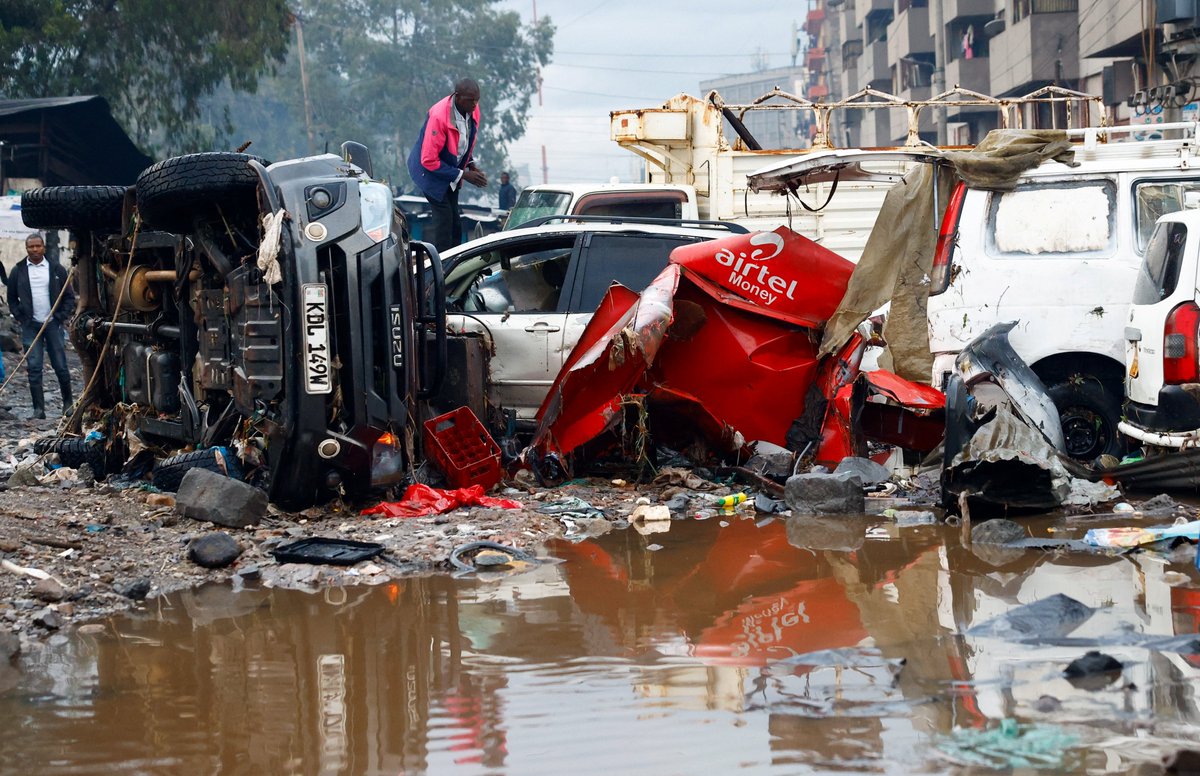
PICTORIAL: Debris and wreckage of private vehicles and public transport buses, locally known as matatus, after floods that killed at least 23 people following heavy rainfall in the Grogan area, a hub for automotive workshops and secondhand spare parts in downtown Nairobi, Kenya, March 7, 2026
#NTVNews
📷REUTERS
When top 4 was our main objective they used to say: playing beautiful football doesn’t win you the league and you need to be nasty and reckless… well we are that now, do you think they will say : ohh they are on right track? No they will say : ohh they don’t play beautiful football no more , set piece FC…