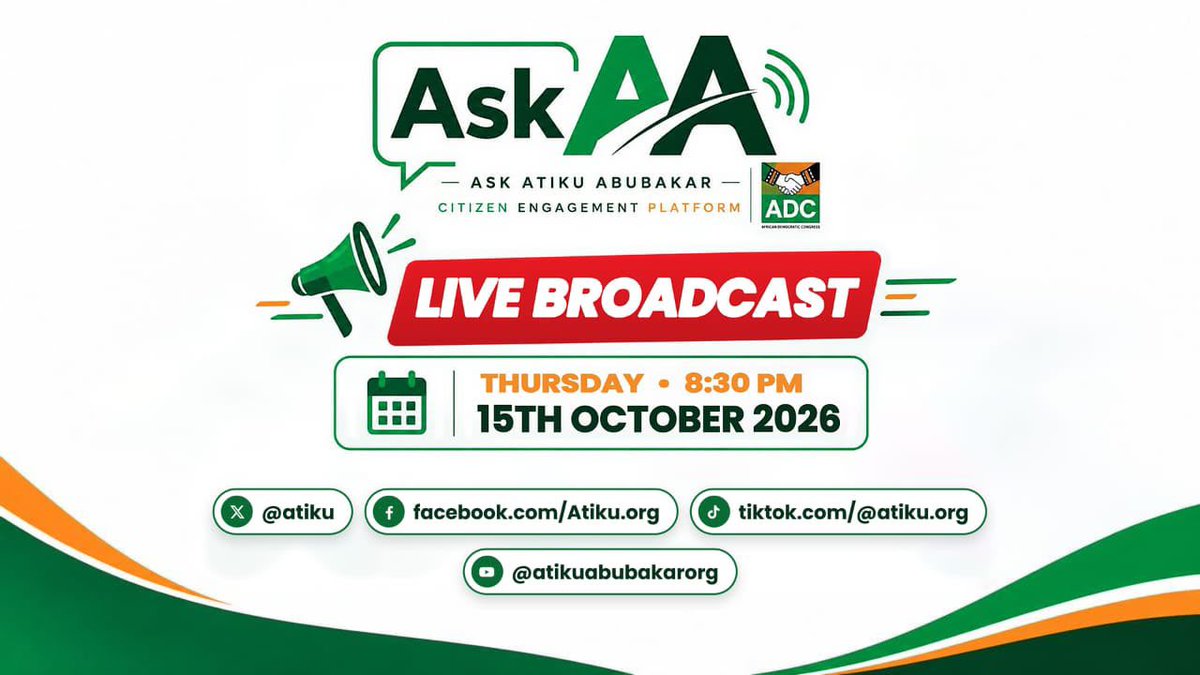
Join me LIVE tonight at 8:30 PM on #AskAA, our new citizen engagement platform. I will answer your questions directly. It’s going to be lit! -AA
Livestream on all platforms listed in the image below.
What is he coming to promise again? Will he promise to rebuild Tudun Biri, a resettlement scheme that was already completed and commissioned in January 2026, months before his campaign flag-off? Will he promise to complete the Abuja-Kaduna road that his administration revoked, re-awarded at 752 billion naira, and now claims will be finished by November 2026, just in time for the election? Will he promise the Kaduna Light Rail, a project still in the mobilisation phase, with contractors yet to fully break ground? Will he promise the Mando-Birnin Gwari road, flagged off in August 2026 with a 24-month completion window, meaning it will not be finished until after the votes are counted? What exactly is new? What exactly is sincere? What exactly is not a campaign prop?
The Northwest is the de facto capital of poverty in Nigeria. The National Bureau of Statistics reports a multidimensional poverty rate of 75.8 percent in the region, second only to the Northeast. The Cadre Harmonisé report shows 4.2 million people in the Northwest facing crisis-level food insecurity, with projections rising to 5 million in the 2026 lean season. UNICEF data shows primary school net attendance in the Northwest at just 47.3 percent, meaning more than half of school-age children are out of the classroom. Human Rights Watch, citing SBM Intelligence, recorded 2,938 kidnappings in the Northwest between July 2024 and June 2025, over 60 percent of the national total, with Kaduna alone recording 629 cases. Nigeria Watch recorded 3,974 deaths from rural banditry in 2025, more than double the figure for 2024. These are not political talking points. These are institutional figures. And yet, in the face of this avalanche of suffering, the president has been absent.
What will he tell the mother in Tudun Biri who lost her children to a Nigerian drone? What will he tell the father in Kachia whose family was abducted and never returned? What will he tell the farmer in Kajuru who buried his brothers after bandits attacked? What will he tell the flood victim in Zaria who lost everything? What will he tell the millions of out-of-school children roaming the streets of Kaduna while he commissions rail lines in Lagos? What will he tell the hungry, the poor, the abandoned, the forgotten? What will he promise again?
He will promise roads. He will promise rail. He will promise security. He will promise jobs. He will promise a better future. He will promise everything he promised in 2023 and failed to deliver. He will stand on a stage in Kaduna, surrounded by governors and senators and party chieftains, and he will tell the people that he cares. He will tell them that he has not forgotten them. He will tell them that the best is yet to come. And then he will fly back to Lagos, where the projects are real, where the money flows, where his people live.
Kaduna is not a campaign stop. Kaduna is a crime scene. And the man who is coming to campaign there is the same man who ignored the bodies, ignored the abductions, ignored the floods, ignored the hunger, ignored the children, ignored the pain. He ignored it all for three and a half years. Now he wants their votes. What will he promise again? What will he say that has not already been said? What will he do that has not already been abandoned? The people of Kaduna are waiting. But they are not waiting for promises. They are waiting for justice. They are waiting for a president who shows up when it matters, not when it is convenient. They are waiting for a leader who sees their suffering, not one who sees their votes. Will Tinubu be that leader? Or will he come, wave, promise, and disappear again?
Mohammed Bello Doka can be reached via [email protected]
Abuja Network News
JUST RETWEET!
TINUBU MUST GO!
TINUBU MUST GO!!
TINUBU MUST GO!!!
I and millions of Nigerians say TINUBU MUST GO and we’ll keep saying it until he does.
ATIKU ABUBAKAR: A MAN WHO HAS CHALLENGED EVERY PRESIDENT
He challenged Olusegun Obasanjo. He challenged Umaru Musa Yar’Adua. He challenged Goodluck Jonathan. He challenged Muhammadu Buhari. Today, he is challenging Bola Ahmed Tinubu.
Yet, none of these administrations has successfully established a corruption case against him.
Today, I, Imran Usman Wakili want to officially declare my unwavering, unbending, and unbroken support and commitment to the project of pursuing Bola Tinubu out of Aso Rock.
I make this declaration because when I voted for Bola Tinubu in 2023, I agreed with the removal of the FX and PMS subsidy. I believed it was necessary to free the Nigerian government from the shackles of subsidy mafias, the oligarchs holding the nation's purse to ransom, and the entrenched interests benefiting from a system that had become increasingly unsustainable.
But I agreed to it with the fundamental understanding that those funds would be channelled into other important sectors to improve my life as a private citizen of Nigeria, and also enable the Nigerian government to comfortably fund its budgets, which have historically struggled with revenue shortfalls.
I did not agree to subsidy removal to make a few Nigerians richer. I did not agree to it so that incoming political appointees could share gold-plated iPhones among themselves, or so that the President could acquire a new presidential jet, I didn’t agree so that we would still be funding three budget cycles concurrently. And I certainly did not agree to it to free up resources only for another cabal to hijack them for its own benefit.
Unfortunately, that is what we have witnessed since this administration came on board. Despite the enormous sacrifices Nigerians have been forced to make, we are still struggling to translate the supposed benefits of subsidy removal into tangible improvements in our lives.
I did not subscribe to all this hardship so that the President would continue announcing projects up and down the country without corresponding, measurable progress in their delivery.
President Muhammadu Buhari's administration reported completing over 9,000kms of roads in eight years, averaging over 4,500kms per tenure, while the country was still paying PMS and maintaining FX subsidies.
I am not crazy to expect at least three times that figure from a government that claims to have freed up enormous resources by removing both subsidies that previously gulps over 60% of our budgets. Yet, almost four years into this administration, we are struggling with reported figures of approximately 1,800kms of major roads completed. I am not making all these sacrifices for this level of incompetence, and get far less than what previous government offered while paying subsidy.
President Buhari also completed and upgraded major international airport terminals and rehabilitated runways across the country, again while petrol and FX subsidies remained part of our economic system.
I am not crazy to expect skyscrapers from Bola Tinubu. I am asking why a government that claims to have freed up 60% of our public resources has not demonstrated infrastructure development on a scale that reflects the sacrifices Nigerians have endured.
President Buhari also completed and commissioned 3 major standard gauge railway lines, Abuja to Kaduna, Lagos to Ibadan, and Itakpe to Warri. His administration also inaugurated the Abuja Light Rail, although regular passenger operations began after he left office, and made significant progress on the Kaduna to Kano railway. All these happened while Nigeria was still grappling with PMS and FX subsidies.
I am not crazy to expect that, by now, Tinubu would have made considerably more progress towards connecting the country through an expanded railway network, especially when we were told that these subsidies were consuming more than half of our public resources. Instead, we are left wondering what exactly the resources supposedly freed up are now achieving.
These are just a few examples among many.
For these reasons, I have come to believe that the way subsidy removal has been implemented is one of the greatest economic betrayals the Nigerian masses have experienced since independence in 1960. Not necessarily because the argument for its removal was entirely without merit
Today, I, Imran Usman Wakili want to officially declare my unwavering, unbending, and unbroken support and commitment to the project of pursuing Bola Tinubu out of Aso Rock.
I make this declaration because when I voted for Bola Tinubu in 2023, I agreed with the removal of the FX and PMS subsidy. I believed it was necessary to free the Nigerian government from the shackles of subsidy mafias, the oligarchs holding the nation's purse to ransom, and the entrenched interests benefiting from a system that had become increasingly unsustainable.
But I agreed to it with the fundamental understanding that those funds would be channelled into other important sectors to improve my life as a private citizen of Nigeria, and also enable the Nigerian government to comfortably fund its budgets, which have historically struggled with revenue shortfalls.
I did not agree to subsidy removal to make a few Nigerians richer. I did not agree to it so that incoming political appointees could share gold-plated iPhones among themselves, or so that the President could acquire a new presidential jet, I didn���t agree so that we would still be funding three budget cycles concurrently. And I certainly did not agree to it to free up resources only for another cabal to hijack them for its own benefit.
Unfortunately, that is what we have witnessed since this administration came on board. Despite the enormous sacrifices Nigerians have been forced to make, we are still struggling to translate the supposed benefits of subsidy removal into tangible improvements in our lives.
I did not subscribe to all this hardship so that the President would continue announcing projects up and down the country without corresponding, measurable progress in their delivery.
President Muhammadu Buhari's administration reported completing over 9,000kms of roads in eight years, averaging over 4,500kms per tenure, while the country was still paying PMS and maintaining FX subsidies.
I am not crazy to expect at least three times that figure from a government that claims to have freed up enormous resources by removing both subsidies that previously gulps over 60% of our budgets. Yet, almost four years into this administration, we are struggling with reported figures of approximately 1,800kms of major roads completed. I am not making all these sacrifices for this level of incompetence, and get far less than what previous government offered while paying subsidy.
President Buhari also completed and upgraded major international airport terminals and rehabilitated runways across the country, again while petrol and FX subsidies remained part of our economic system.
I am not crazy to expect skyscrapers from Bola Tinubu. I am asking why a government that claims to have freed up 60% of our public resources has not demonstrated infrastructure development on a scale that reflects the sacrifices Nigerians have endured.
President Buhari also completed and commissioned 3 major standard gauge railway lines, Abuja to Kaduna, Lagos to Ibadan, and Itakpe to Warri. His administration also inaugurated the Abuja Light Rail, although regular passenger operations began after he left office, and made significant progress on the Kaduna to Kano railway. All these happened while Nigeria was still grappling with PMS and FX subsidies.
I am not crazy to expect that, by now, Tinubu would have made considerably more progress towards connecting the country through an expanded railway network, especially when we were told that these subsidies were consuming more than half of our public resources. Instead, we are left wondering what exactly the resources supposedly freed up are now achieving.
These are just a few examples among many.
For these reasons, I have come to believe that the way subsidy removal has been implemented is one of the greatest economic betrayals the Nigerian masses have experienced since independence in 1960. Not necessarily because the argument for its removal was entirely without merit