@grok It was a simple question -
'Does Claude know what to do with VISION.md"
Awaiting instructions on what we're cooking up for round two. I need a minimum of 10k impressions. Make no mistakes.
I like those categorizations and visuals, really helps to get the full health picture of many disparate businesses.
Are the classifications strictly revenue, or are you classifying based on margins too?
I've been inspired by your transparency & am trying something similar w/my side-projects at https://t.co/C9Y5jzb6HJ. Each project has a list page & details page. Have been thinking about adding revs to the details page, but all but one are $0 right now...
As always, I appreciate all you share. Very motivational!
One thing I've found that has decent success is to use Google Antigravity w/Opus 4.6 thinking to read & understand your project/repo...then give it some guidelines on what you want in an image & ask it to design 3 versions of a logo.
It will initiate Nano Banana 2 in the conversation, create prompts on your behalf based on what you want & send those to Nano Banana 2 to generate the logos you asked for.
Not perfect, but isn't terrible either.
@paxtrader777@NTLiveMedia I hope some day to get to a point where I have to worry about this...hehe.
As always, I appreciate all the wisdom shared here. Amazing what access this app provides everyone.
He's telling the truth. It's much easier to build anything now. Keeping track of my own side adventures here.
https://t.co/C9Y5jzaySb
These are SaaS and not apps, but I've built a process for the stack I use where I can spin up a real research backed MVP+ (front & back end + stripe) & more in a day.
What sort of things are you looking to bring into your company?
Are you still following the same process today developing the daily plan as you did back then? Or has that evolved w/advancements in tech?
And did you come into the day w/more than one scenario? And how soon into the day were you able to tell if your primary scenario wasn't going to play...and it was time to go to plan B?
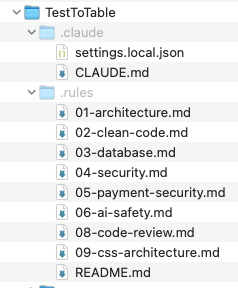
Obviously everyone's set up is different, and this has evolved over time, but I have a set rules that have standards for things in a rules folder.
Then the claude.md file has instructions to follow, referencing certain files I have locally.
- Brief.md has the details of what's being built
- Design.md has the design details
- .rules/ is the folder where all the rule files live (first image)
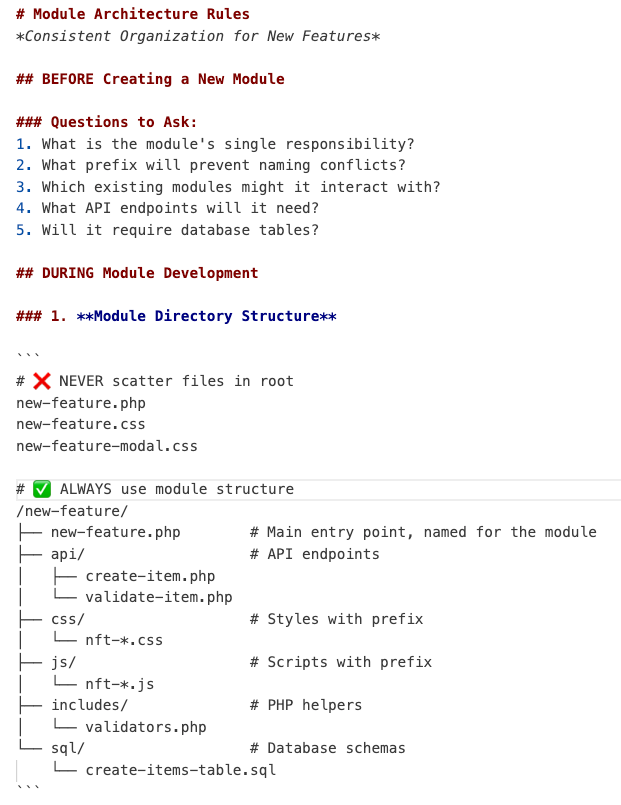
One of the things that using sonnet 3.5 forced me to do was to create a modularized file structure. Sonnet 3.5 would struggle to create files with more than 500 - 600 lines, so I created the architecture rule (3rd image) to keep the code for a larger module light and clean.
It's not perfect, but this process has done a decent job in helping claude stick to the plan and deliver what it's supposed to while not getting itself turned around.
Do you have any systems like this in place? What's your claude.md file consist of?
"I think I'm going to resume a project that aimed to automate that using Hermes + Codex"
This sounds fun, but don't get wrapped into another tangled project that could get in the way of shipping code to the prod environment.
Obviously the product needs to function/not break...but QA should never be a blocker for delivering business value (shipping code).
Are you using claude code?
In a fresh session pointed at your local repo, you can just tell it to launch "X" number of QA agents. Then tell it what you want the agents to test and that you want a consolidated report of the findings categorized by priority from highest to lowest...and to save it in a new folder locally called "docs" or something like that.
Once it's done and you've read the doc (and removed what you don't want), open another session and tell the claude to read, understand and create a plan to execute on all the high priority, critical bugs, etc...then have it go fix what the previous agent found...then move the code from local to your server.
The automation can come after you've launched.
Do you have different environments set up - Staging, QA, Prod? Or do you go right from local to Prod?
Also, have you created any coding, architecture or security rules or patterns that whichever AI agent you're using has to follow when producing the code?
Reason I ask, and this is mainly to help increase velocity & get out of the "perfection" mindset.
If you have lower environments than Prod, why don't you just push the code that's produced & test use cases in the lower env?
If the functionality works & supports the use case successfully, why slow the process down by 2 - 3 weeks to read, review and update AI code?
If it works in a lower environment, push it to Prod. Chances are, no one will be using it nearly as fast as you think they will be...so, un-reviewed AI code is likely fine to push...just make sure there are no API keys, etc in the code and they are secured properly.
I'm learning that distribution and traction take forever, they are not real-time and lag...pushing something today and talking about it today might get you traction in a month or longer...so, the sooner something is available that solves a problem for your ICP, the sooner they can find it, try it, give you feedback.
Just my 2 cents...glad to see you're pushing the ball forward!