Church didn't hang this painting in a group show. He rented a gallery on Broadway, put it on display alone, charged admission, and let hundreds of people line up for seven weeks to see a single sunset.
It was 1860. The country was about to tear itself apart. Church had sketched the view near Mount Katahdin in Maine two years earlier, then spent months in his New York studio turning those sketches into a 40-by-64-inch wall of fire. The sky is the whole painting. Everything below it sits in shadow.
Advance press coverage drove the crowds. Critics called it his finest work. Church was 34 and the most famous painter in America.
The canvas later showed up in the Harrison Ford film Clear and Present Danger, hanging on a wall in the background. No credit.
Frederic Edwin Church, Twilight in the Wilderness, 1860. Cleveland Museum of Art.
Three men paid to be carved in marble kneeling next to a saint. The saint in question was hacked to death on a road outside Milan in 1252.
That's Peter Martyr, a Dominican inquisitor ambushed while traveling from Como to Milan. He was canonized 337 days after his death. Fastest canonization in the medieval Church.
The sculptor, Giovanni di Balduccio, had just finished carving Peter Martyr's actual tomb shrine at Sant'Eustorgio in Milan when he made this relief. The Arca di San Pietro Martire, ca. 1340. This came right after.
The three donors kneeling here got what they paid for. Their faces in marble, next to a saint, forever.
Giovanni di Balduccio, Presentation Scene with Saint Peter Martyr and Three Donors, ca. 1340. Metropolitan Museum of Art.
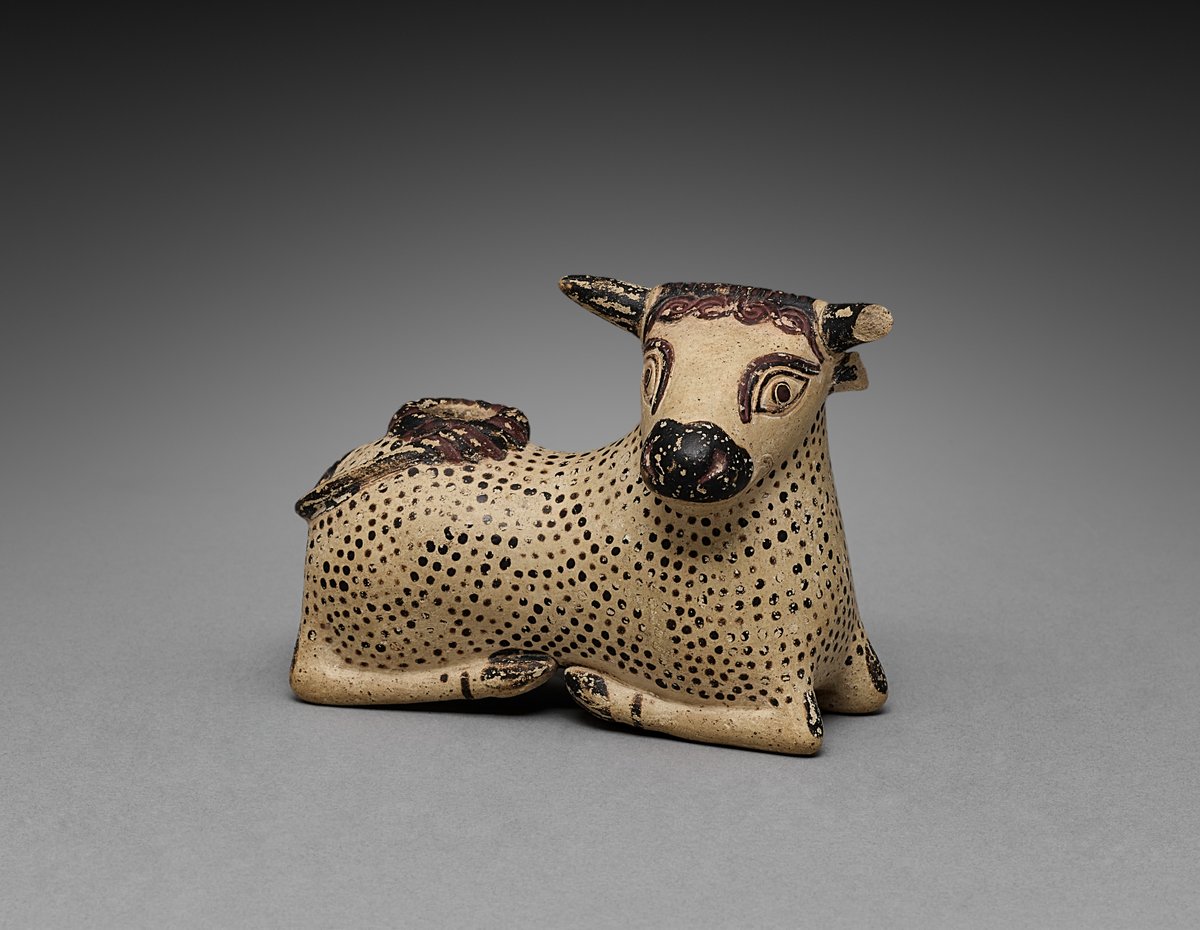
It looked like a 600–575 BCE Greek perfume flask. Small enough to fit in your palm. Shaped like a reclining bull. A hidden filling hole curled inside the tail.
Seven years after it entered the collection, a lab tested it. The clay had been fired recently.
The piece checked every box: stippled body, light Corinthian clay, correct style. But no genuine reclining bull like this has ever turned up at any ancient site. Not one.
In 2020, a second analysis traced the clay. Not to Corinth. Not to Rhodes. Not to Etruria. To Catalonia, in northeastern Spain. Roughly 1,200 miles from where it was supposed to have been made.
The museum still has it. The label now reads: "600–575 BCE or 1900s CE."
Unknown, Oil Flask in the Shape of a Bull, 600–575 BCE or 1900s CE. Cleveland Museum of Art.
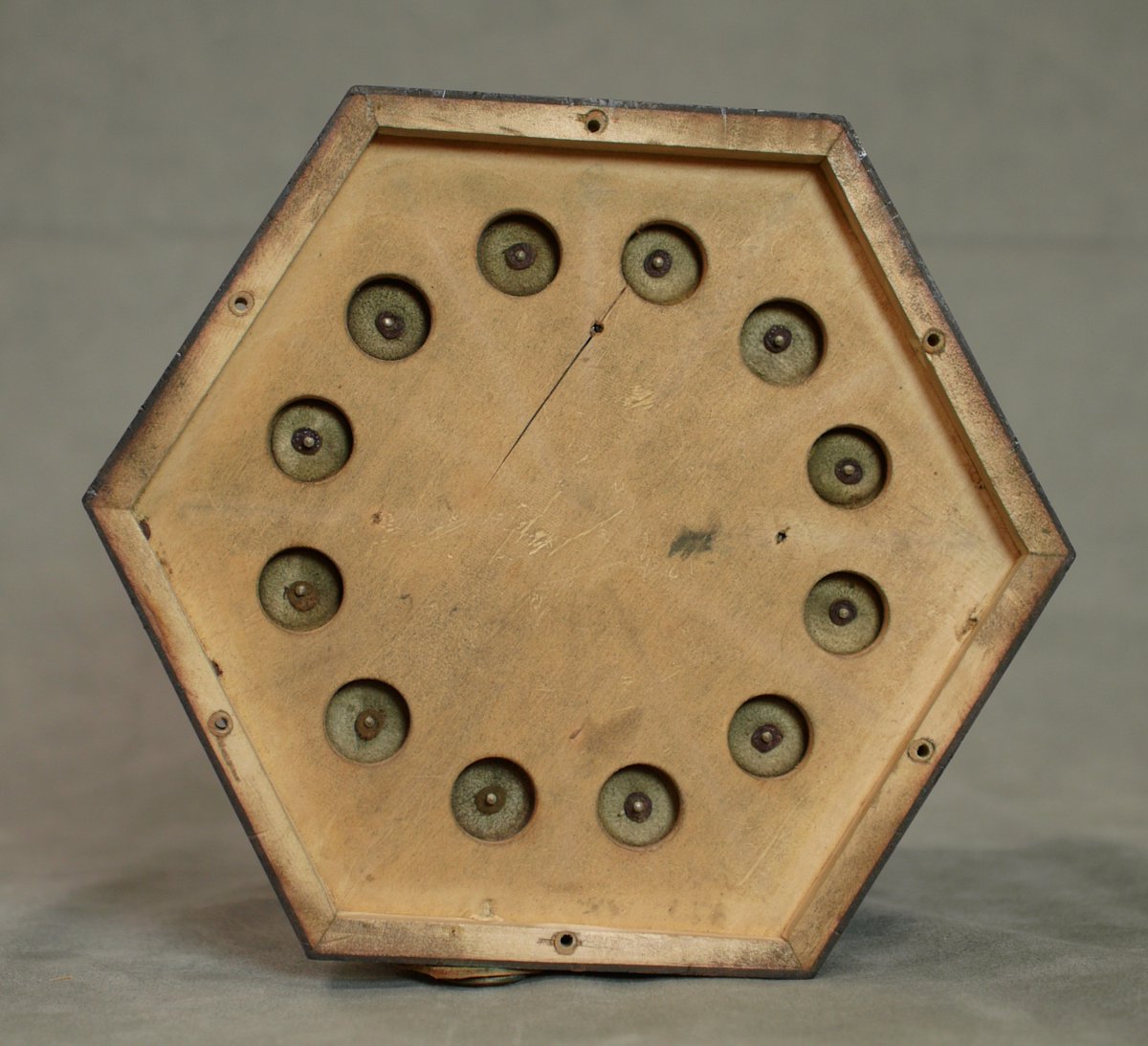
Rosewood body. Nickel-silver fittings. Ivory and tortoiseshell buttons. Mahogany case. The whole instrument is 3 inches tall, under 6 inches wide.
Wheatstone kept revising the design through the 1830s and 1840s. Folk musicians across Britain had already taken it up by the time he finally patented it. He was later knighted. For the telegraph.
Charles Wheatstone, Concertina, 1831–37. Metropolitan Museum of Art.
Charles Wheatstone invented the electric telegraph. He invented the Wheatstone bridge circuit. He also built this.
The concertina was his creation, designed around 1829. This example was made between 1831 and 1837, over a decade before he filed a patent. He was a scientist. Not a musician.
She kept her love letters in this box. Probably.
That's the working theory for what these ivory caskets were. A man gave one to a woman. The carvings were the message.
This one, made in France around 1330, is now three loose panels. The casket itself is gone. What's left: 10 inches of carved elephant tusk showing knights in a tournament, an assault on the Castle of Love, the Fountain of Youth, Lancelot crossing a bridge made of swords.
Every image came from stories the recipient would have recognized. The Roman de la Rose. Chrétien de Troyes. These weren't decoration. They were a vocabulary. Chivalry, fertility, virginity, eternal youth. Carved in sequence, like a sentence.
The tournament scene in the center panel shows two knights jousting with blunted lances. That detail matters. Blunted lances meant the Joust of Peace, not the Joust of War. Courtly. Restrained. The whole point.
Ivory this size, carved this finely, in 14th-century France, was not cheap. The material came from Africa or Asia. The workshops were concentrated in Paris. The clients were aristocracy.
Who owned this one, nobody knows. The casket broke apart somewhere between 1350 and 1978, when the Cleveland Museum acquired the panels.
Unknown, Set of Three Panels from a Casket with Scenes from Courtly Romances, c. 1330–50. Cleveland Museum of Art.
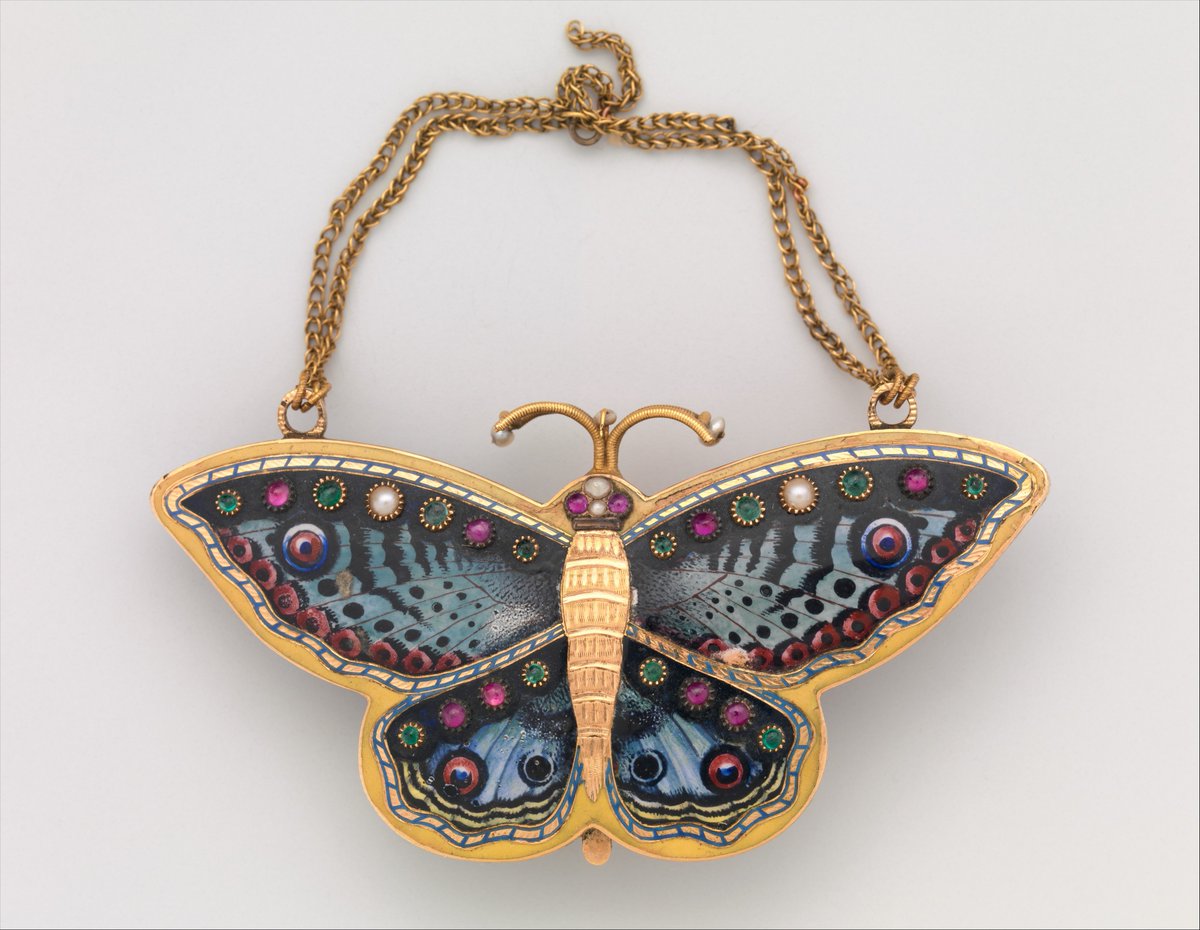
Someone checked the time by opening a butterfly's wings.
The case is gold. The wings are white enamel, edged in seed pearls. The whole thing is 2 5/8 inches tall. Closed, it looks like jewelry. Open the wings and there's a clock face inside. Working clock. In a butterfly.
Made around 1840-50, somewhere in Europe. The maker wasn't recorded. Objects like this were called fantasy watches, made for wealthy women who apparently found the act of checking time too plain.
Nobody signed it.
Unknown, Watch in the form of a butterfly, ca. 1840–50. Metropolitan Museum of Art.
Every December, shepherds carried instruments like this one down from the mountains of Calabria and Abruzzo into Rome and Naples. They played outside churches for nine straight days before Christmas. Same slow melodies. Same drone. For at least four centuries.
George Frideric Handel was in Rome in 1707. He heard them.
He composed Messiah 34 years later. Inside it: a short wordless interlude called the "Pifa," from the Italian word for shepherd's pipe. No singing. No action. Just drones and a pastoral melody for a few minutes. Music historians trace it directly back to the street musicians he heard in Rome.
Most people hear it every Christmas without knowing what they're listening to.
This is a zampogna, the Italian bagpipe with two chanters. Unlike a Scottish bagpipe, you hold one chanter in each hand and play both simultaneously. There is no single-note melody on this instrument. Every note comes with a companion.
Goatskin, wood, metal. 19th century.
The zampognari still come down from the mountains every December.
Unknown, Zampogna, Unknown. Metropolitan Museum of Art.
The Cleveland Museum bought this terracotta boar in 1977. They catalogued it as Etruscan, circa 700–500 BCE. The brown burnished surface, the incised geometric patterns, the naturalistic shape all checked out.
Then the conservators ran tests.
Recent scientific analysis suggests it may have been made sometime in the 1900s. The museum's current label covers the spread: 700–500 BCE or 1900s CE. A 2,600-year margin of error.
In 2018, it became a meme.
Unknown, Vessel in the Shape of a Wild Boar, 700–500 BCE or 1900s CE. Cleveland Museum of Art.
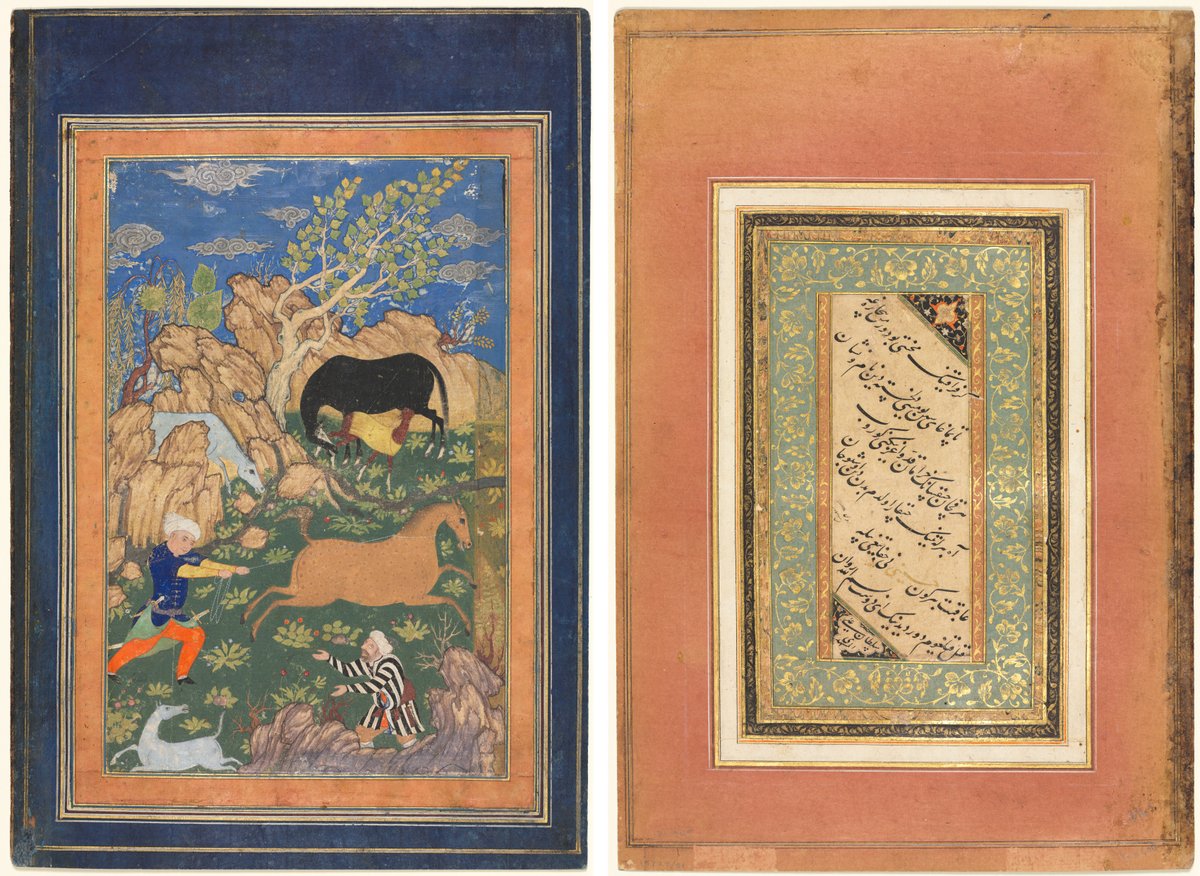
The price of the horse wasn't gold.
Rustam is the greatest hero of the Shahnama, a Persian epic poem of roughly 50,000 verses written around 1010 CE. In this scene, Iran is in crisis: the throne is empty, a foreign army has invaded, and the country needs a warrior. Rustam is ready. He just needs a horse strong enough to carry him.
The herds are gathered for his inspection. A piebald colt catches his eye. For three years, no one had managed to catch it. People already called it "Rustam's Rakhsh." He asks the herdsman the price.
The answer: "If you are a true Rustam, a true deliverer, mount him and make the land of Iran aright. The cost of Rakhsh is the soil of Iran and the deliverance of the world."
Painted in Herat, Afghanistan, in the late 1500s. Opaque watercolor, ink, gold, and silver on paper. It's now in Cleveland, Ohio.
Unknown, Rustam Lassoing his Horse, Rakhsh, in a Landscape (recto); Calligraphy, Persian Verses (verso), late 1500s. Cleveland Museum of Art.
Nobody knows what it says.
This is a stamp seal from the Indus Valley civilization, carved from steatite around 2000 BCE. It's 1.25 inches across. A small hole on the back let the owner hang it around their neck or from a belt, then press it into clay to mark their property or goods.
Thousands of these have been pulled from sites along the Indus River in what is now Pakistan. The bull is a common image. So is the inscription running across the top.
The script has never been deciphered. Linguists and archaeologists have been trying for over a century. We don't know the language, the sound of any letter, or what the writing system is based on. We know this seal belonged to someone. We know they used it regularly. We know it meant something specific to everyone who saw it pressed into a clay tablet in a marketplace 4,000 years ago.
That's it. That's all we know.
Unknown, Seal with Two-Horned Bull and Inscription, c. 2000 BCE. Cleveland Museum of Art.
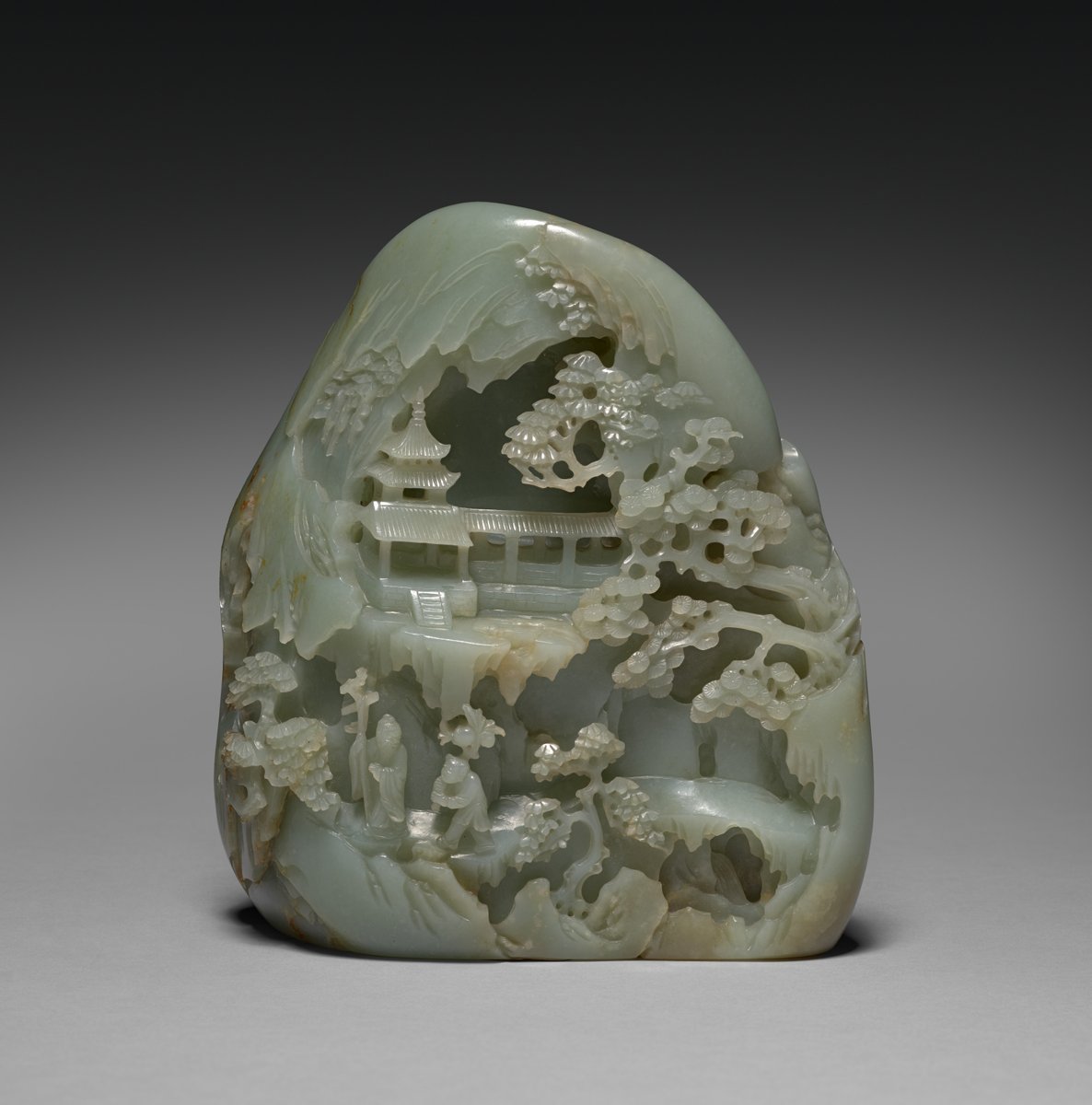
Daoist monks ground jade into powder and drank it with morning dew. The goal was immortality.
Carved during China's Qianlong reign (1736–95), this 7-inch green jade boulder depicts the mountain paradise where immortals were believed to live. A bearded figure stands among the peaks. His servant carries peaches, the symbol of eternal life in Chinese tradition.
Jade also went into tombs. The same material was buried with bodies to preserve the soul, ground into elixirs for the living, and carved into mountains like this one.
Nobody drank their way to immortality. The jade survived anyway.
Unknown, Miniature Mountain with Daoist Paradise, 1736–95. Cleveland Museum of Art.
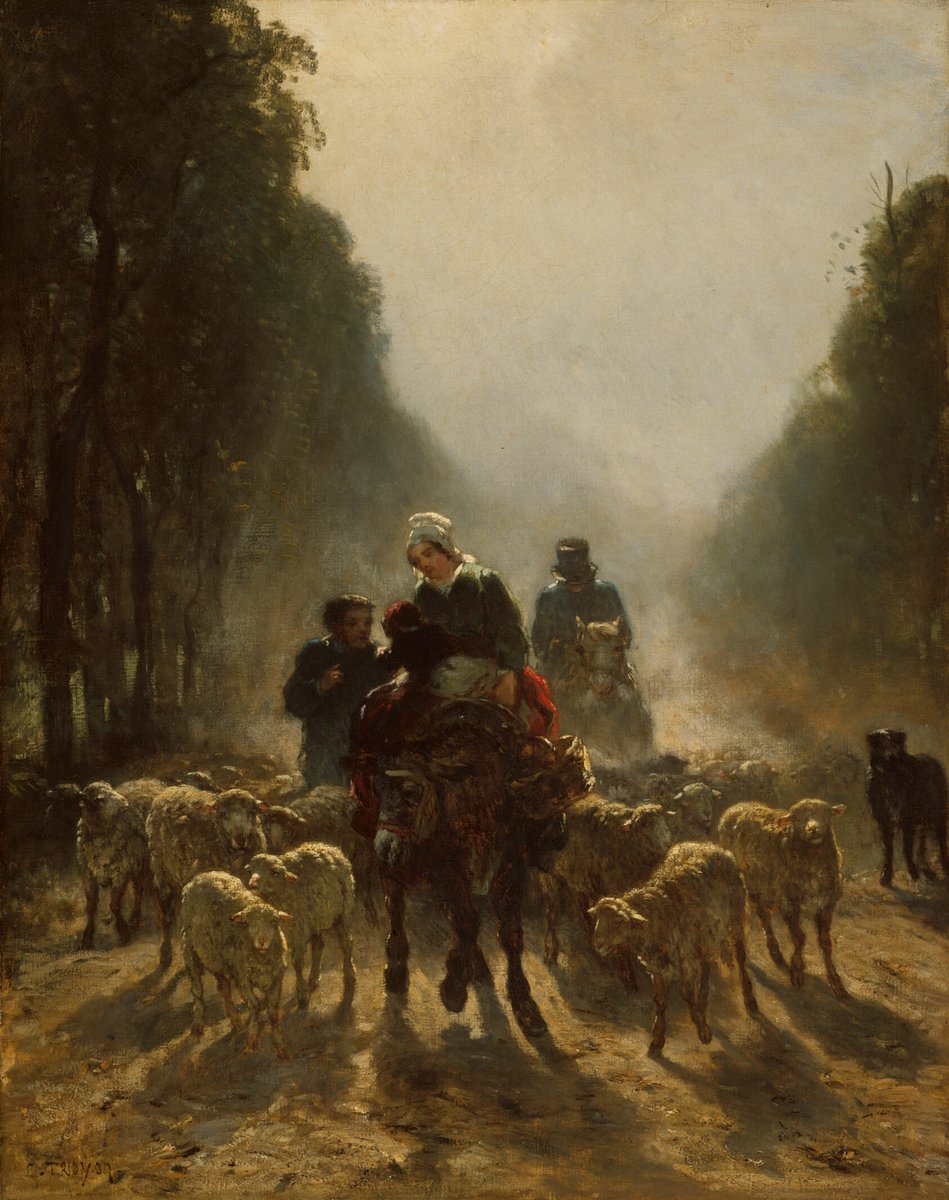
His Barbizon School peers painted forests, light, peasants. Corot painted trees. Millet painted farmers. Constant Troyon painted the animals.
This is 1858. A woman on a donkey, two men, a dog, a herd of sheep, all moving through morning haze toward market. The dust on the road has yellowed the air. The dog is working.
Troyon became so associated with animals that critics gave him a specific title: animalier. Painter of animals. His peers collected it as a compliment. Troyon kept painting cows.
Constant Troyon, The Road to Market, 1858–59. Art Institute of Chicago.
The knights jousting on this panel are using blunted lances. On purpose. It's called the Joust of Peace. Nobody was supposed to get hurt. The point was to look good in front of a crowd.
This ivory panel was the lid of a casket, carved in France around 1340. The scenes come from the Roman de la Rose and Chrétien de Troyes, the most famous romances in medieval Europe. Every aristocrat who received a casket like this would have recognized the imagery immediately: the tournament, knights storming a castle full of women, courtly love staged as a military campaign.
Elephant ivory. 10 inches wide. Made exclusively for the wealthiest families in France. The material alone would have cost more than most people in 14th-century Europe earned in a year.
The leading theory is that a man gave one of these to a woman.
Unknown, Panel from a Casket with Scenes from Courtly Romances, c. 1330–50 or later. Cleveland Museum of Art.
Louis XIV's cabinetmaker wasn't just filling royal commissions. He was inventing a technique that would bear his name for three centuries.
André-Charles Boulle figured out how to cut tortoiseshell and brass into the same pattern simultaneously, then swap the pieces. One cut, two veneers. Every curve in the shell has a matching curve in the brass, fitting together with the precision of a puzzle. The French called it marquetry. The rest of Europe called it Boulle work.
This coffer, roughly the size of a briefcase, held medals or jewels. It sits on gilded bronze feet and is covered in scrolls, vines, and strapwork inlaid in engraved gilt copper set into tortoiseshell, the whole thing framed in ebony and pewter. The amber-brown ground glows. The copper catches light at angles the tortoiseshell doesn't.
Boulle ran the royal workshops at the Louvre for decades. His clients were the king, the princes, the ministers. He was so successful that a fire destroyed his workshop sometime around 1720, taking an estimated 100,000 livres worth of stock with it. He was nearly 80. He kept working.
Attributed to André-Charles Boulle (born France, 1642–1732)
Paris, Coffer, c. 1700–20. Art Institute of Chicago.
Her brother Thomas was in the Tower of London when Anne Boleyn was executed. He had been accused of sleeping with her. He walked out. She didn't.
A few years later, Holbein painted Thomas's sister.
Margaret Wyatt, born around 1509. By the early 1540s, the Wyatts had made it through the bloodiest decade of Henry VIII's reign. Holbein painted her in oil and actual gold on a panel of oak, 17 inches tall.
Holbein died in 1543, most likely from plague. This portrait is from his final years.
Hans Holbein the Younger, Lady Lee (Margaret Wyatt, born about 1509), early 1540s. Metropolitan Museum of Art.
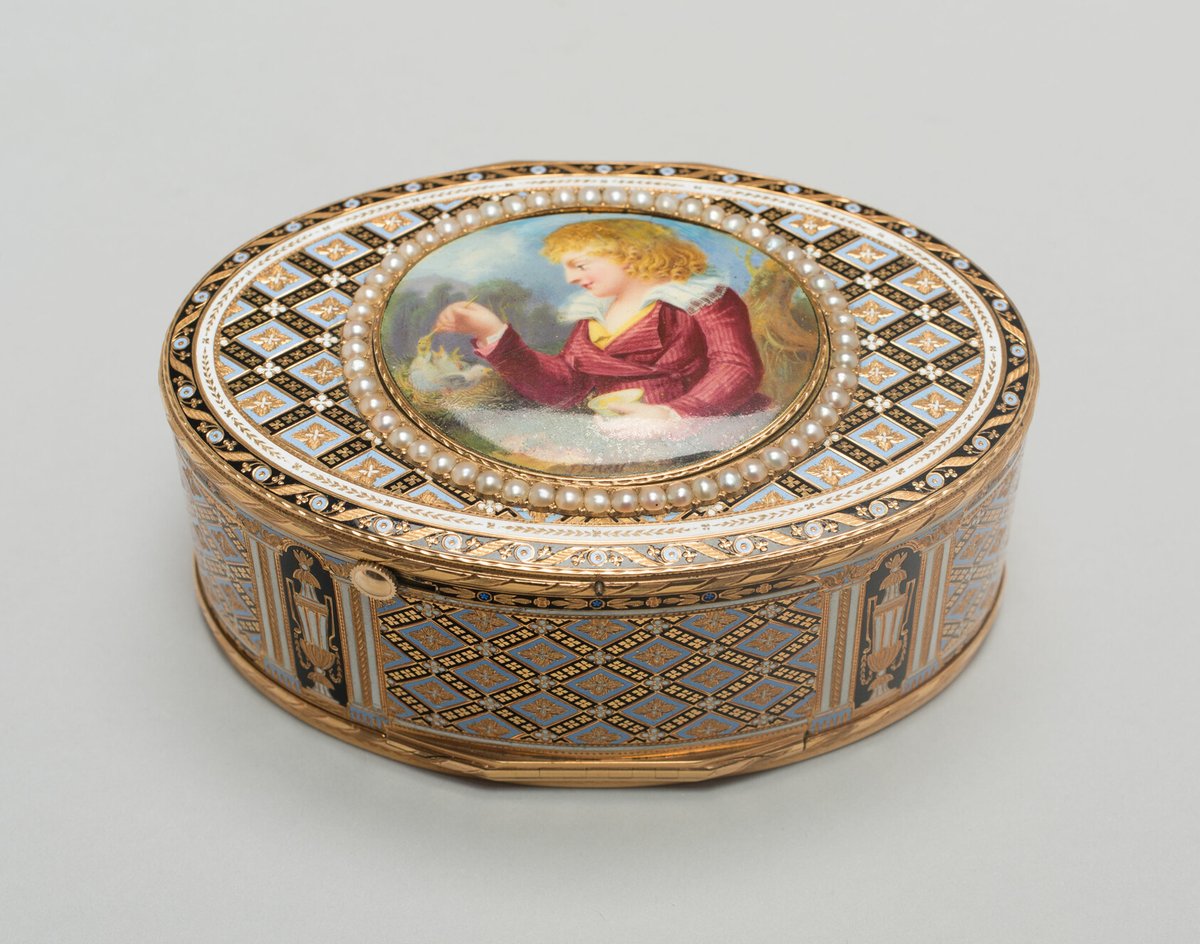
Snuff is powdered tobacco. You don't smoke it. You take a pinch, hold it near your nose, and inhale. In Vienna around 1800, offering someone a pinch from your box was a social ritual. The box was a statement before a word was spoken.
Gold body. Enamel panels. Pearl inlay. Two craftsmen made it: Frisard worked the gold, Heil the enamel. That division of labor was standard for pieces at this level. The work was too specialized for one person.
The whole thing is 3.5 inches wide. Fits in a coat pocket. Meant to be seen for about four seconds at a time.
Gold, enamel, pearl, two master craftsmen. Made to hold tobacco dust.
Jacob Frisard
Austrian, 1753-1812
T. F. Heil
Austrian, Unknown, Snuff Box, Early 19th century. Art Institute of Chicago.
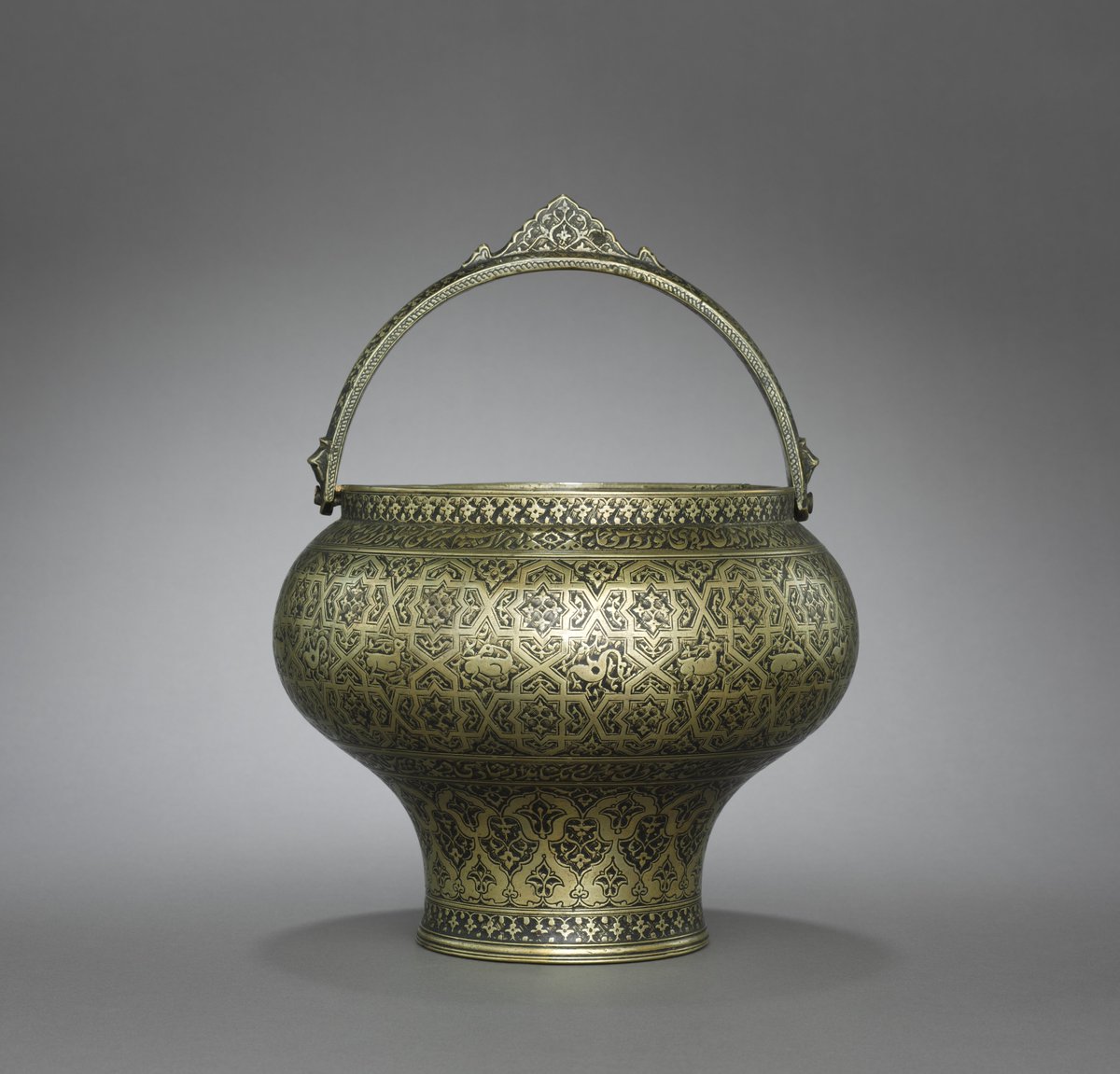
Someone had a poem about detachment from worldly possessions engraved on their fancy brass bath pail.
The hammam, the public bath, was the great equalizer of the Islamic world. You walked in, left your clothes and status outside. A poet named Jami, who died in 1492, had written about why the hammam brings such joy. In his version, a young man asks an elder. The elder answers: "The secret is that the bather has nothing of the trappings of this world. But a bathing-bowl and towel. And even those belong to others."
This pail is cast brass, engraved and inlaid with niello, the black compound that darkens the geometric patterns. Someone in 16th-century Isfahan, wealthy enough to commission it, carried it through the city streets to the neighborhood bath.
The poem about having nothing traveled in a very expensive pail.
Unknown, Bath Pail (Satl), c. 1580–1610. Cleveland Museum of Art.
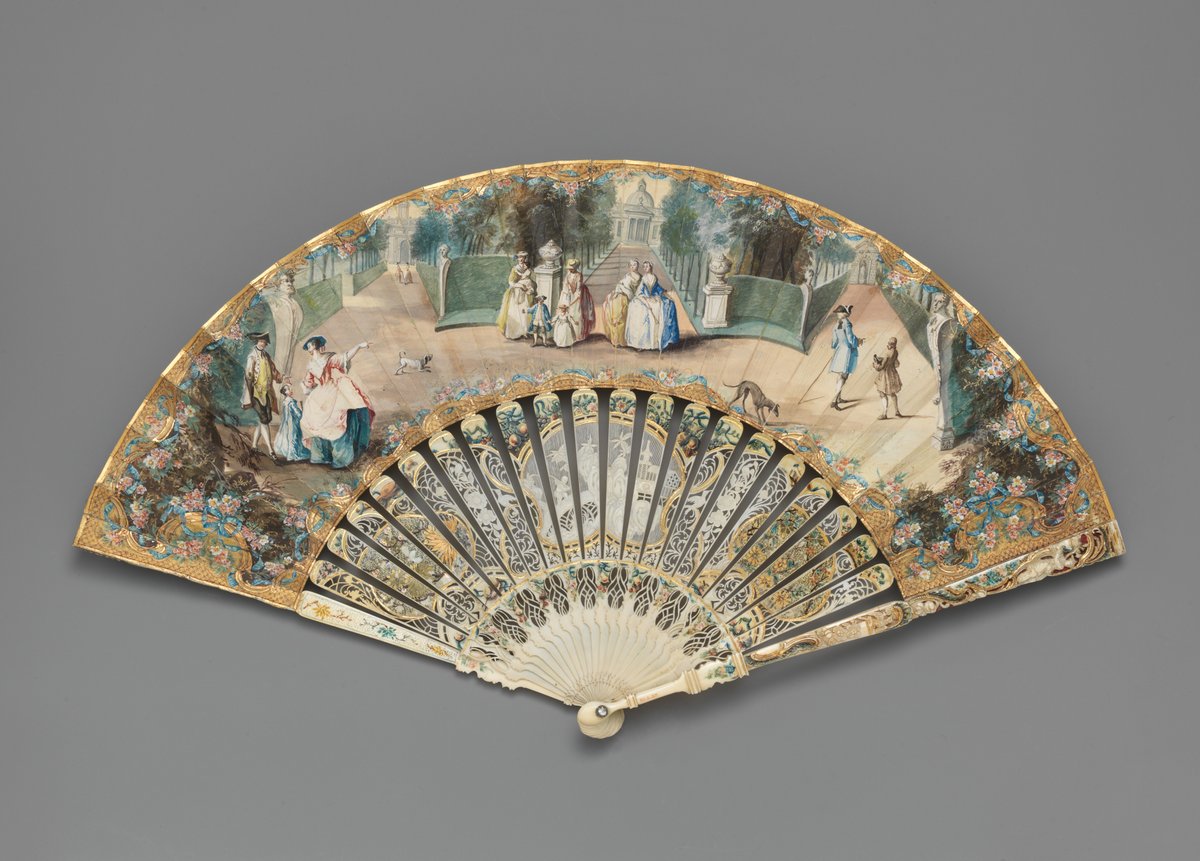
The sticks are ivory. Pierced through, carved, painted, and gilded. The leaf is kid leather. Open it: nearly 19 inches of the Gardens at Chiswick House.
Lord Burlington built Chiswick House outside London, with gardens that became the most imitated in England. Within a decade, every ambitious estate was trying to copy them. Formal French gardens, the kind Versailles made famous, started giving way to something that looked natural but wasn't.
By 1757, Chiswick was fashionable enough to carry in your pocket.
The English garden style Burlington developed there spread across Europe for the rest of the century. Versailles kept its geometry. Nearly everyone else switched.
The original gardens are still there. Free to visit.
Unknown, Folding Fan with Representation of the Gardens at Chiswick, 1757. Metropolitan Museum of Art.
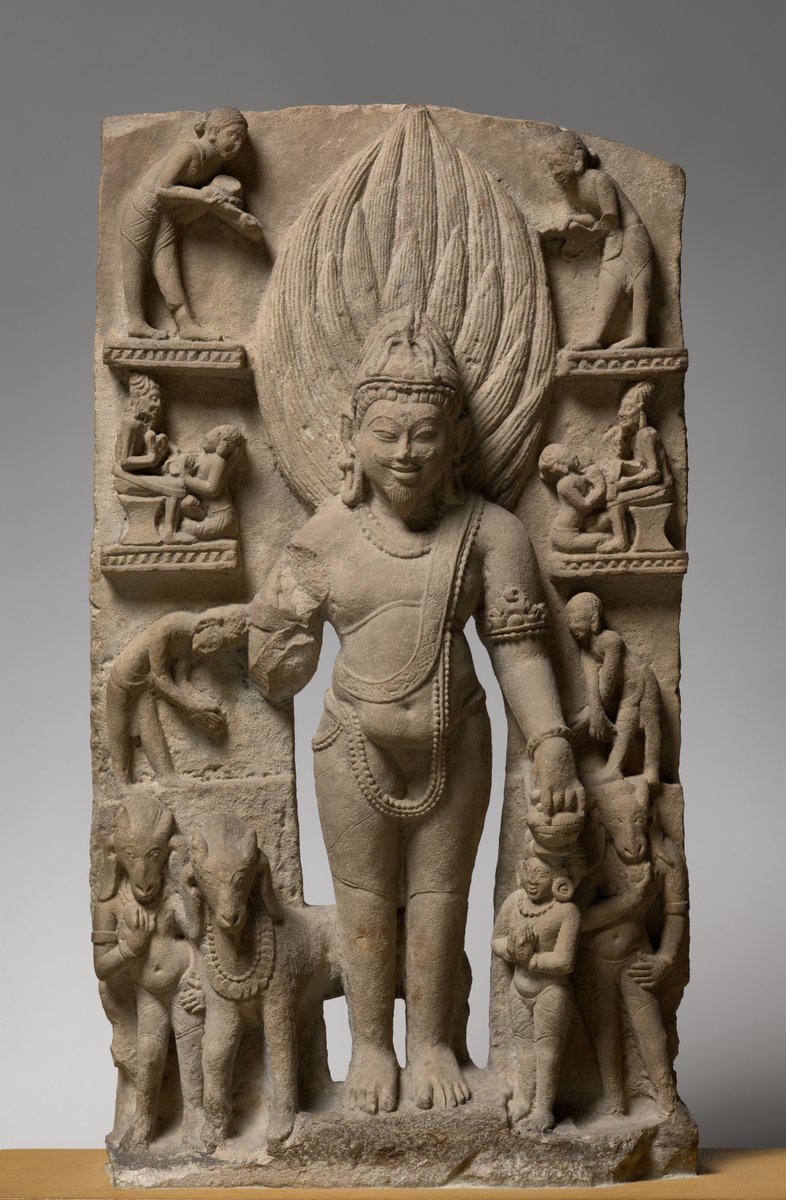
The Hindu god of fire rides a goat.
Agni has been central to Hindu worship since roughly 2000 BC. This sandstone figure was carved in Uttar Pradesh around 1000 AD. By then, three thousand years of fire sacrifice had already passed.
He's 28 inches tall. Flames rise behind him. In the carved registers above, Brahmans perform sacrifices, preach to disciples, and practice what the ancient texts call "hot yoga."
It's on the cover of the Penguin Classics edition of the Laws of Manu.
Unknown, Agni, God of Fire, c. 1000. Cleveland Museum of Art.
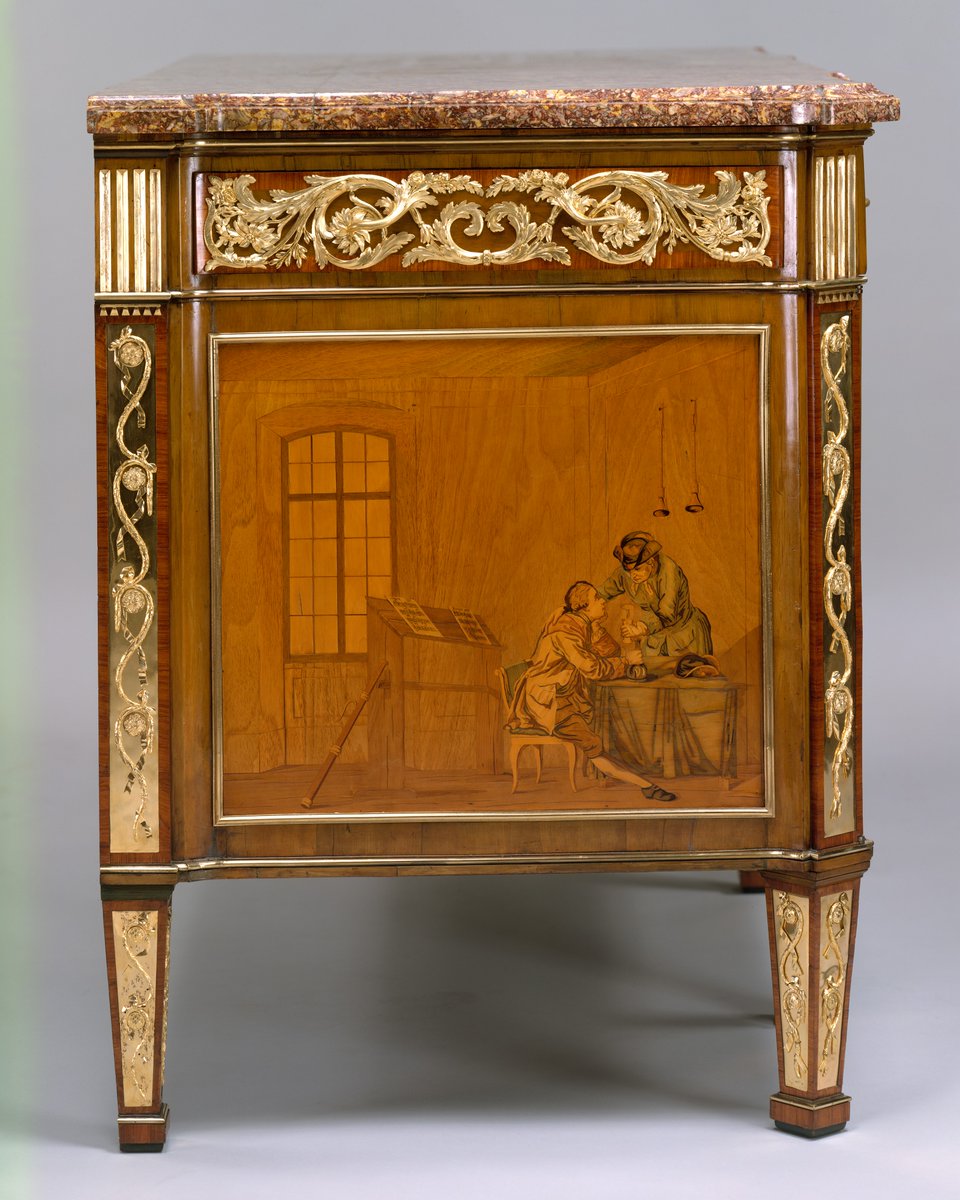
The pictures on the doors aren't painted. They're wood.
Thousands of individually cut pieces from ten named species: tulipwood, boxwood, holly, maple, walnut, hornbeam, mahogany, cherry, oak, pine. Some of them partially stained to hit the right color. All fitted together by hand in David Roentgen's workshop in Neuwied, Germany, to create scenes with figures and dogs that could pass for oil paintings at arm's length.
He built this around 1775. It's 53 inches wide.
David Roentgen, Commode à vantaux, ca. 1775–79 with later alterations. Metropolitan Museum of Art.