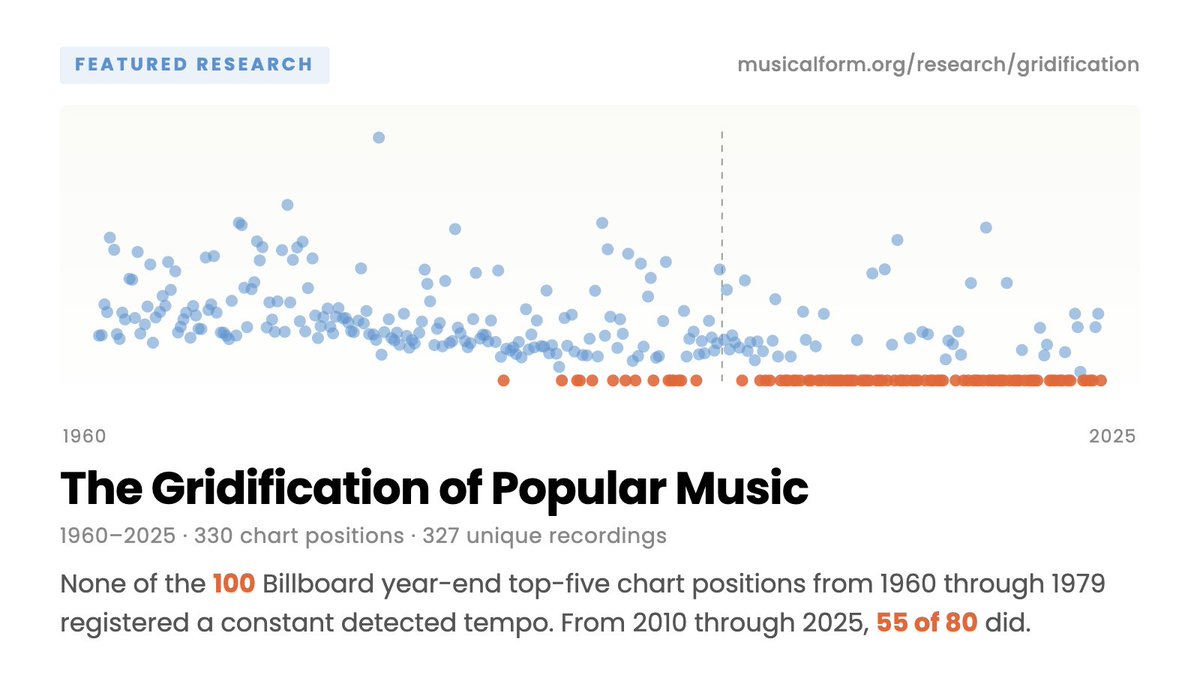
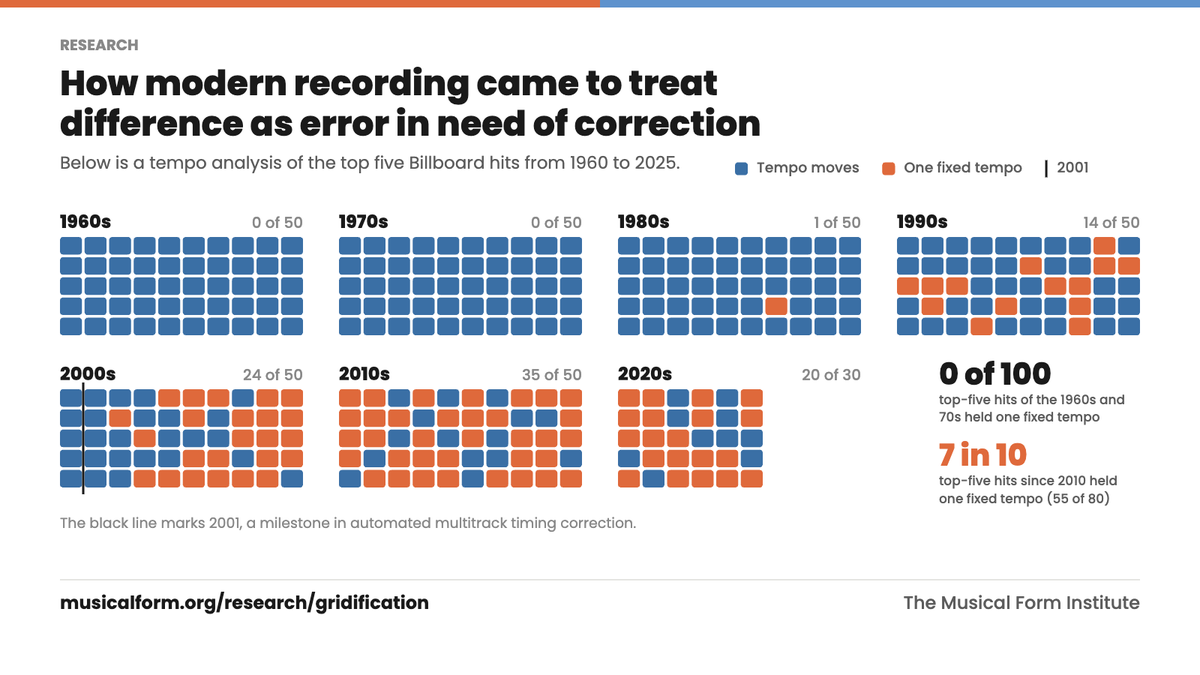
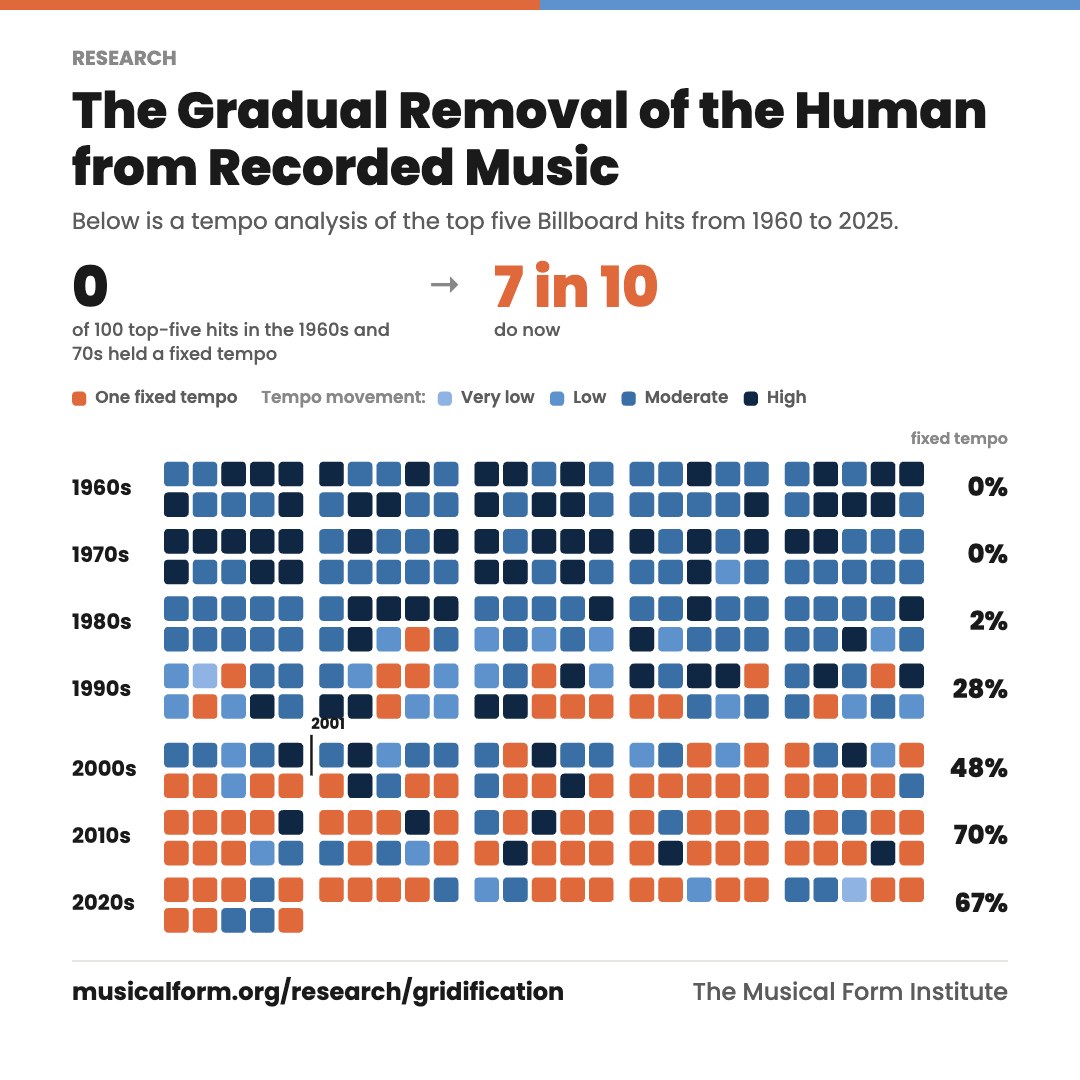
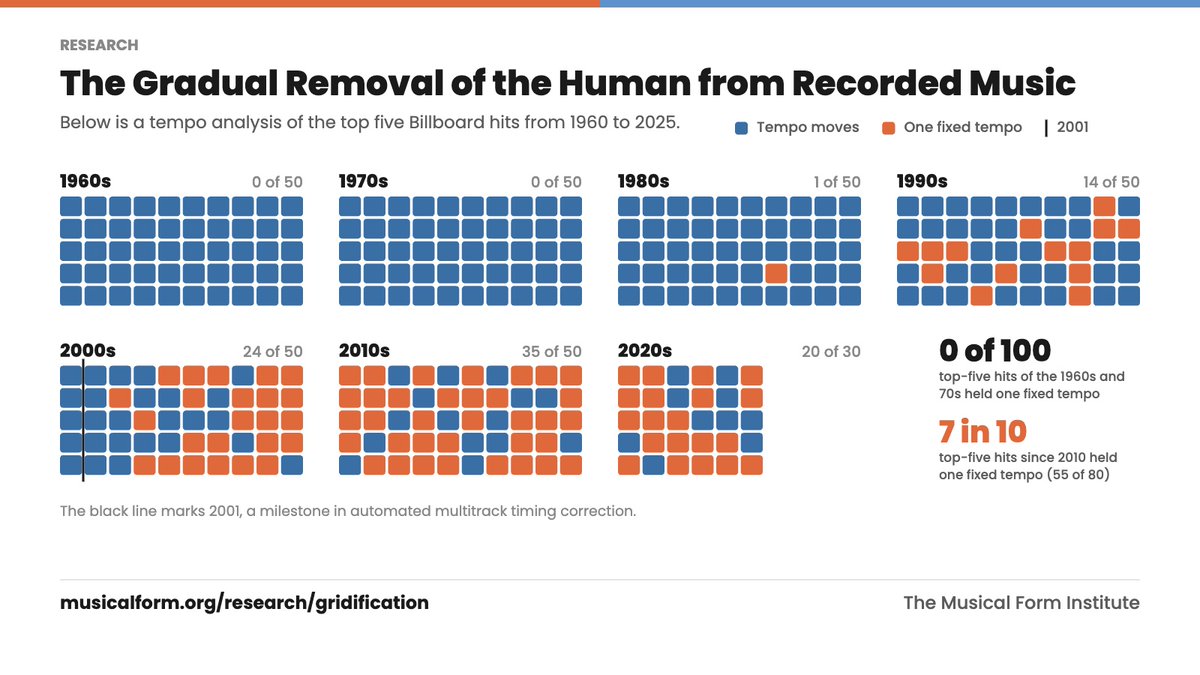
Gridification treats the temporal relationships through which musicians express their historically positioned voices as deviations from a machine-defined standard and corrects them out of the recording.
https://t.co/BMzYhhJdgR
Congrats to Market Crash for their release “I Spy,” which is certified under the Certificate of Embodied Production. Produced without grid correction, pitch correction, or generative AI.
Verify at https://t.co/ZzBxFfXKA8
Suno’s investor claim: it creates an entire Spotify catalog’s worth of music every two weeks.
What took humanity a century to produce, Suno generates in 14 days.
Is what Suno outputs music?
https://t.co/ly9hkbi5Lw
Recording to a click is not the issue.
Our founder’s own drum tracks, recorded to a click and never grid corrected, average 0.2 to 1.10 BPM standard deviation from the mean tempo.
Suno’s investor claim: it creates an entire Spotify catalog’s worth of music every two weeks.
What took humanity a century to produce, Suno generates in 14 days.
Is what Suno outputs music?
https://t.co/ly9hkbi5Lw
The two executives who supposedly represented artists never once used the word music to describe what their artists made. They called it content.
The Suno executive never called what came out of its machine content. She called it music.
https://t.co/d2fMV6IWYE
Something happened to recorded music over the last twenty-five years that most people can hear, and feel, but almost nobody has the language for. At the Musical Form Institute, we call this change gridification.
https://t.co/1ialwvoPzE
Coordination without negotiation is compliance.
When popular music consistently presents coordination without negotiation, it no longer objectifies lived temporal experience.
“Suno is not a tool of creative democratization. It is a machine for monetizing a culture that wants the feeling of creation without the risk of becoming capable of creating.”
CEP-000036: “The Other Side of Tuesday” by Seal Party. Rock, certified September 1, 2026.
39 tempo changes. No grid correction, no pitch correction, no generative AI.
2001: automated multitrack timing correction.
The workflow became standard in commercial music production within a decade. It is now the default condition under which most recorded music is made.
Music is an act before it is an object.
The violence is situated in the system that has learned to preserve the affective surface of music while abolishing the ontological need for the musician.
Tracking to a click, a loop, a tempo map, tape, or direct to lathe? None of that is gridification.
Gridification is correcting human performances to a fixed grid after the fact.
https://t.co/1ialwvoPzE
@stereogum Sure that is great and all, but over the last 25 years, more and more of the music we listen to has been stripped of human expression and replaced with machine-perfect time and pitch.
@RollingStone Over the last 25 years, more and more of the music we listen to has been stripped of human expression and replaced with machine-perfect time and pitch.
In 25 years of professional sessions and hundreds of records, no one in the studio has ever said, “I wish I could do this faster.” Not once.
Speed and scale are not musical values. They are values of content.
You’ve been listening to AI music for 25 years. You just didn’t know it.
Not that machines were secretly composing pop songs in the early 2000s, but that, at meaningful scale, human performance was increasingly subjected to the machine logic of the grid.
https://t.co/HWHTArQRo1