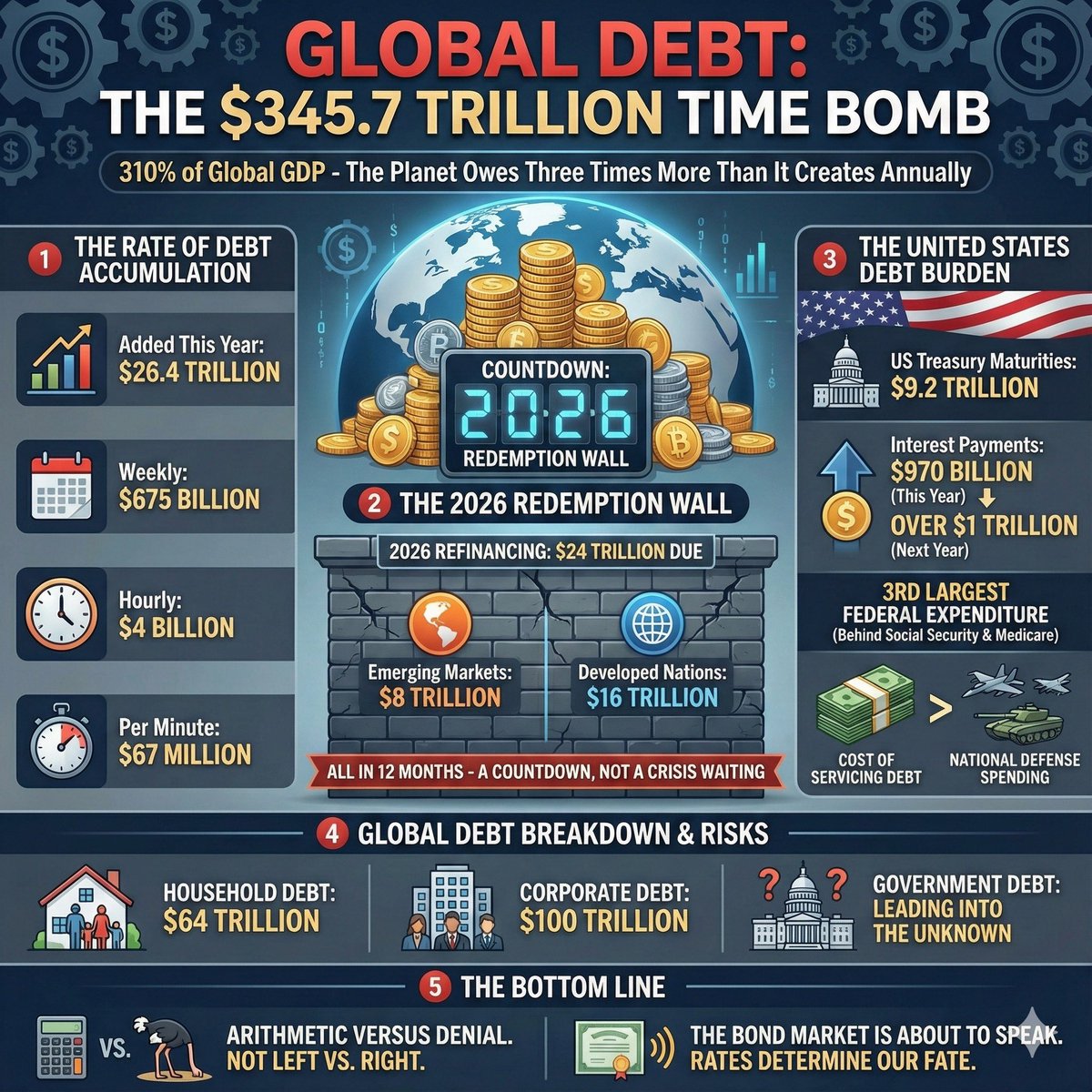
GLOBAL DEBT JUST HIT $345.7 TRILLION
That is 310% of everything the world produces in a year.
Read that again.
Three hundred and ten percent.
The planet now owes three times more than it creates annually. We added $26.4 trillion this year alone. That is $675 billion every single week. $4 billion every hour. $67 million every minute you breathe.
But here is what no one is telling you.
In 2026, $24 trillion comes due for refinancing. Eight trillion from emerging markets. Sixteen trillion from developed nations. All in twelve months.
This is not a crisis waiting to happen. This is a countdown.
The United States alone faces $9.2 trillion in Treasury maturities. Interest payments hit $970 billion this year. Next year they cross $1 trillion for the first time in history, becoming the third largest federal expenditure behind only Social Security and Medicare.
We are now paying more to service yesterday’s decisions than we spend on national defense.
The math is merciless. Every 30 basis point rise in the ten year yield adds $1.8 trillion to America’s borrowing costs over the decade. The margin for error has vanished.
Global household debt sits at $64 trillion. Corporate debt approaches $100 trillion. Government debt leads them all into the unknown.
This is not left versus right. This is arithmetic versus denial.
The 2026 redemption wall will test whether the global financial architecture can refinance obligations at a scale never attempted in human history.
If rates cooperate, we muddle through.
If they do not, funding strains hit at least two major economies within eighteen months.
The bond market is the last honest place on earth.
It is about to speak.
$XDC 📣 - Interesting developments in the 🇺🇸👀🔥⬇️
“Nasdaq files with the SEC to allow tokenization and blockchain listing of stocks.”
#xdc#wearexdc#RWA#XRP#XDCNetwork
$1.6M Hack Forces Ethereum’s Kinto to Shut Down – Another Blow to DeFi Security
A Somber End for Kinto After July’s Exploit: The crypto community is witnessing yet another distressing incident as Kinto – an Ethereum layer-2 DeFi project – has announced it will cease operations on September 30. The shutdown comes as a direct consequence of a major smart contract exploit in July that drained about $1.6 million (roughly 577 ETH) from the protocol. In the aftermath of the hack, Kinto’s team struggled to keep the project afloat. They raised around $1 million in a “Phoenix” recovery effort, but worsening market conditions and loss of user trust made further fundraising impossible. Ultimately, continuing operations became untenable – leaving Kinto’s users with losses and forcing a full shutdown of the platform. The Kinto token’s price accordingly plunged over 80% on the news, reflecting the community’s pain and frustration.
DeFi’s Trust Crisis: Hacks Erode Confidence
Unfortunately, Kinto’s demise is far from an isolated case. The exploit that hit Kinto was traced to a vulnerability in a widely used Ethereum smart contract standard (the ERC-1967 proxy upgrade mechanism), which allowed attackers to drain funds not just from Kinto but several projects in a broader July hacking spree. Incidents like this underscore persistent security challenges in today’s decentralized finance. In fact, billions of dollars have been stolen from DeFi platforms due to smart contract exploits – since 2016, the top 50 DeFi hacks alone have cost investors around $5.5 billion, predominantly on Ethereum and other major chains. Each high-profile hack delivers another blow to user confidence, reinforcing the view that mass adoption of crypto will stall as long as people’s money isn’t definitively safe. It’s hard to imagine everyday users embracing DeFi when a single bug or exploit can wipe out funds overnight. We empathize deeply with all those who lost money in the Kinto hack – these are not just numbers, but real people’s savings and investments. DeFi’s promise of an open financial system will mean little if such catastrophes remain commonplace.
SmartNodes: A Safer Alternative on the Rise
Is there a way to preserve DeFi’s benefits without the constant threat of hacks? SmartNodes offer a promising path forward. Born on Hedera Hashgraph and now expanding beyond it, SmartNode technology reimagines decentralized applications with security and resilience at the core. Unlike Ethereum’s old, slow, costly, and vulnerable smart contracts, SmartNodes run most logic off-chain in secure, distributed nodes while still interfacing with blockchains for consensus. This architecture provides strong multi-layer security guarantees and removes single points of failure. Crucially, SmartNodes are chain-agnostic – the HSuite team behind them envisions a “write once, deploy anywhere” model enabling seamless deployment across multiple blockchains. In other words, the same secure SmartNode-based application can run on Hedera, Ethereum, XRP Ledger, and more, ushering in a true multi-chain DeFi ecosystem. The benefits are striking: by leveraging Hedera’s efficient Layer-1 and an off-chain execution engine, SmartNodes achieve up to 80× lower costs than traditional smart contracts while delivering enterprise-grade security. Their performance and cost-effectiveness far outshine Ethereum’s Solidity contracts, which are notorious for high fees and complexity. For users, this means faster and cheaper transactions and far greater safety for their assets. For developers and projects, it means the freedom to innovate without constantly worrying that one overlooked bug could be fatal.
In the wake of yet another DeFi exploit, it’s clear the status quo isn’t working. If the crypto industry wants mainstream adoption, it must prioritize protecting users’ funds above all else. Every hack like Kinto’s is a reminder that better infrastructure is needed. With SmartNodes and similar advancements, we finally see a path to a more secure and scalable DeFi – one where users don’t have to live in fear of the next exploit. The future starts here.
Only a matter of time before we begin seeing 1 Mil+ transactions on $XDC per day
Network activity on XDC has been on the rise this year
Just a year ago we were seeing under 500K TX/day
During last cycle it was down to ~300K/day
Since June 2025 XDC Network hasn't seen a day below 750K transactions...🤔
This perfectly coincides with the overall adoption and growth we've seen in the ecosystem from collaborations to RWA onboarding, etc.
This is what real network activity & growth looks like.
Expect this trend to continue as global trade continues to go digital.