Millions of pilgrims from different countries gathered in the Iraqi city of Karbala to commemorate Arbaeen, the anniversary of the 40th day of the martyrdom of Imam Hussain (AS) and his companions at the Battle of Karbala.
Follow https://t.co/B3zXG73Jym
WATCH: Palestinian mother documents the moment her daughter endures a panic attack from the sound of Israeli missiles.
Their only crime is being Palestinian.
"We are the nation of martyrdom. We are the nation of Imam Hussain. Come, we are waiting. We are the men of this battlefield for you."
The martyr General Hajj Qasem Soleimani
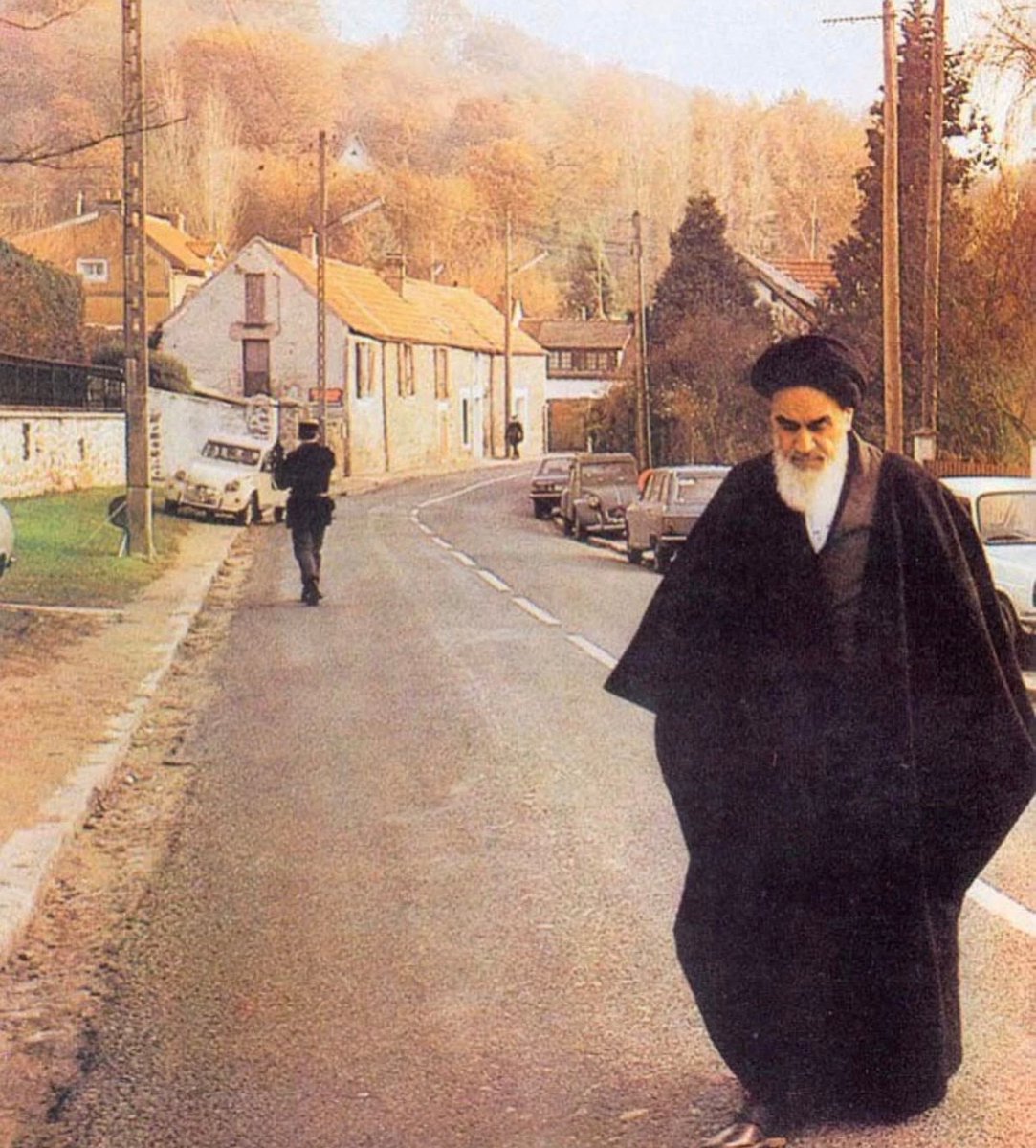
Ayatollah Khomeini, the future first Supreme Leader of Iran, photographed while living in exile in France in 1978.
After spending more than 14 years in exile—first in Turkey and later in Iraq—Ayatollah Ruhollah Khomeini was expelled from Iraq in 1978 under pressure from the Shah of Iran. He eventually settled in the quiet French village of Neauphle-le-Château, just outside Paris.
Although far from Iran, Khomeini’s influence expanded rapidly. Unlike in Iraq, he had easy access to international media, and his speeches were recorded onto cassette tapes, smuggled into Iran, and circulated through mosques, bazaars, and universities. The recordings became a powerful tool for mobilizing opposition to Shah Mohammad Reza Pahlavi.
On February 1, 1979, Khomeini returned to Tehran after the Shah had fled the country. More than 150 international journalists accompanied him on the flight, making it one of the most extensively covered political homecomings in modern history. Millions of Iranians lined the streets to welcome him.
Within weeks, the monarchy collapsed, the Islamic Republic of Iran was established, and Khomeini became the country’s first Supreme Leader, holding ultimate authority over the military, judiciary, and government. His exile, return, and rise to power transformed Iran’s political system and continue to shape the country’s domestic politics and international relations today.
Footage shows blast victims hurried into a hospital in northwestern Pakistan, after a suicide bombing at a police station in Kabal near the Afghan border killed at least 14 people.
Crowds of people had been protesting nearby when the bomb exploded.
In the year 2000, Pakistan’s per capita GDP, at purchasing power parity, was $2880, higher than India’s at $2010 and Bangladesh at $1620. We were 43% richer than an average Indian and 77% richer than an average Bangladeshi. Today we are at $6480, Bangladesh at $9180 and India at $12,560. So an Indian is 94% is richer than us and an average Bangladeshi is 42% richer than us. This is the most important story of our national governance system over the last 26 years.
In the last 4 years we have taken debt of Rs 40,000 billion. In the first 75 years we took debt of Rs 45,000 bn. Our tax revenues have doubled over the last four years and yet people today are poorer than in 2014/15 and 2018/19. 29% Pakistanis are poor (with monthly resources of less than Rs 8485). We eat less of all commodities, including atta and rice, meaning Pakistanis are going hungry. Of course we spend over Rs 400 crore to run the PM house and the President house.
Over this period we have seen Gen Musharraf, President Zardari, Mian Nawaz Sharif, Imran Khan and Mian Shehbaz Sharif at the helm, along with a few caretakers. We have seen military, civilian and hybrid governments. What we have not seen is progress. None.
Education: 39% or over 2 crore 60 lakh kids are out of school. And a majority of kids in school cannot read, write or do arithmetic at their class level. Our education system is failing our kids and we are just spectators at this dismal state of affairs. Is there anyway a nation can develop without its kids being educated? Also Sindh govt just released billions in media ads.
Health: 7500 kids have been infected in Pakistan with HIV (that causes AIDS). Mostly due to used needles and unscreened blood. Pakistan has the second highest neonatal mortality rate in the world, worse than South Sudan, Eritrea and Chad. 40% of our children are stunted. 42% of our women have iron deficiency. 1 in 5 people in the world with Hepatitis is a Pakistani. Also Punjab govt recently bought a Rs 1100 crore plane and 4 Mercedes cars for over Rs 100 crore.
Our provinces are under civilian control since 2008. The NFC making them flush with cash came in 2009. The 18th amendment giving them new authorities came in 2010. But there isn’t a Provincial Finance Award in a single province. No political party (PTI, PPP or Noon) has established empowered local government. They won’t let go of power and cash.
Our system of governance has failed and failed completely. Awaam Pakistan party has been saying it from the day the party started.
Where do we go from here.
Empowered, federally financed and constitutionally protected LGs. Failing which smaller provinces. But now. We cannot afford to wait forever.
Direct elections to all executive offices in local governments and provinces. Essential for breaking the hold of fossilised political parties.
Reform of NFC. School vouchers for all poor kids. Forming of school boards with hiring and firing powers all in govt schools composing of parents and officials. Badly run govt hospitals to be transferred to trusts and govt to keep funding at current levels. Ending of lifetime employment for bureaucrats. You work, you stay. Or go home. No ghost workers or teachers.
Reduce the size of government. Move to economically efficient way of pricing power and gas so they become cheaper.
But parties that are part of the problem and beneficiaries of the system will not want to change. So they need to be removed from the govt. They weren’t fairly elected anyway.
National reconciliation.
Continuous and major reforms.
Otherwise our relative decline will continue. Hunger and illiteracy will become more widespread.