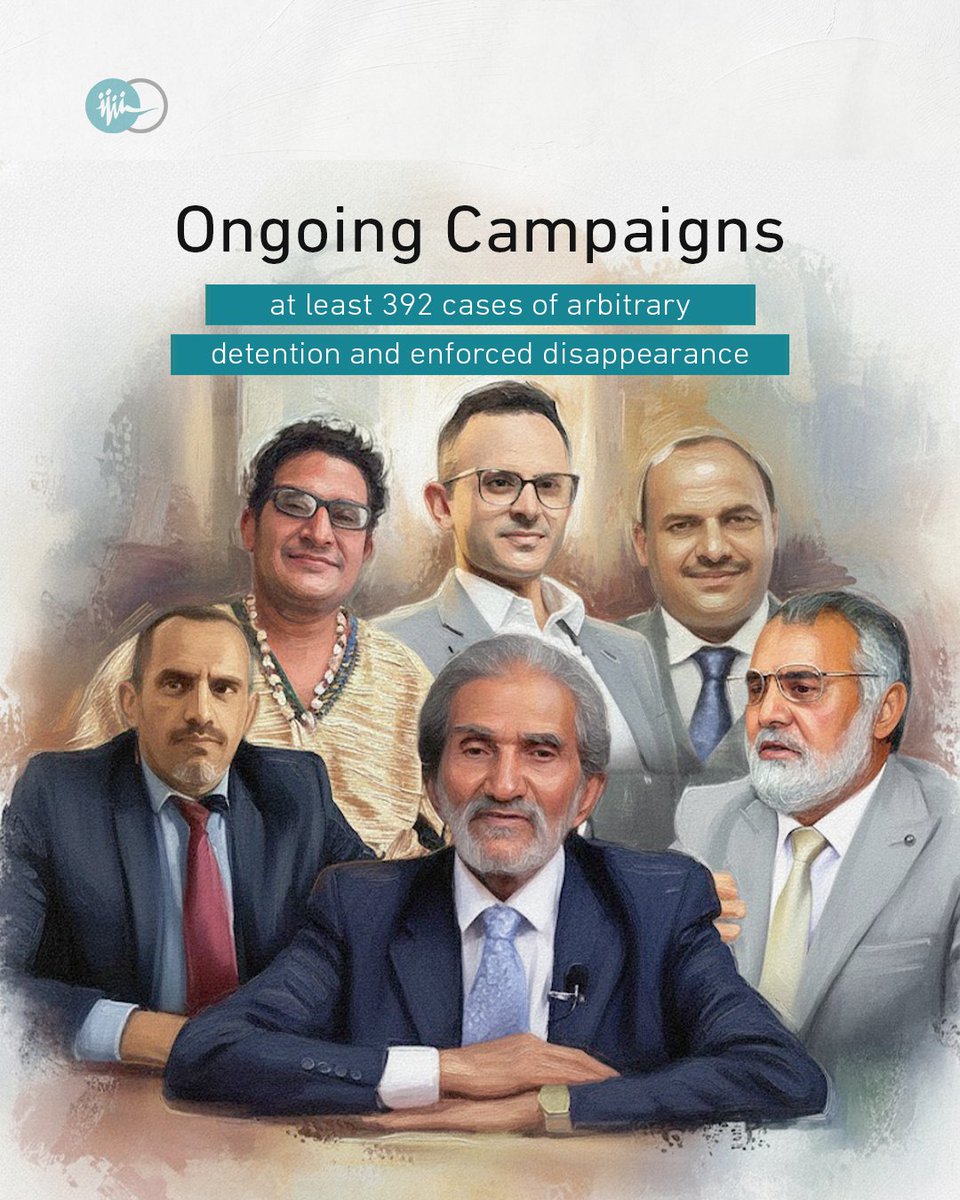
Mwatana for Human Rights stated that the Ansar Allah (Houthi) group has detained dozens of civilians in successive waves of arrests, including local peace mediators, academics, writers, journalists, human rights defenders, government employees, leaders and members of political parties, and participants in peaceful events commemorating the September 26 Revolution. The arrests also included male and female humanitarian, development, and diplomatic workers, as well as staff of UN agencies and international and local organizations. Since the beginning of 2025 through October, the organization has documented at least 392 cases of arbitrary detention and enforced disappearance in Sana’a, Dhamar, Hodeidah, Ibb, Saada, and parts of Taiz and Al-Dhalea, along with other areas under the group’s control.
Full statement here:-
🔗 https://t.co/Cjr9lTF4u9
Mwatana stressed the need for communities affected by U.S. military operations in Yemen to rehabilitate essential service facilities that were damaged or destroyed, including health centers and water and electricity networks, as well as to remove unexploded remnants of bombs and munitions and secure areas affected by them.
Kindly find, at the following link, the complete statement: -
https://t.co/uhQM9dia1B
Mwatana affirmed that victims’ right to know the truth, obtain justice, and receive redress and reparation must be an essential part of any response to the impact of U.S. military operations on civilians in Yemen. These operations, which were conducted in violation of international humanitarian law and resulted in civilian casualties or damage to civilian objects, require independent and effective investigations, the publication of their findings, accountability for those responsible, and ensuring that civilian victims have access to effective remedies and appropriate reparation for the harm suffered, including compensation, rehabilitation, and the reconstruction of damaged property and facilities, depending on the nature of the harm.
Kindly find, at the following link, the complete statement: -
https://t.co/uhQM9dia1B
Affected civilian communities, including those injured and the families of those killed in U.S. airstrikes, have expressed numerous needs related to redress and reparation. These communities are calling for the rehabilitation and repair of essential service facilities that were destroyed, such as health centers and water and electricity networks, as well as for the necessary support for recovery and reconstruction efforts.
Kindly find, at the following link, the complete research paper: -
https://t.co/q5gEx7pjDF
U.S. strikes caused widespread anxiety, fear, and psychological trauma among victims, particularly women and children, who have since lived in constant fear of renewed attacks. The horrific scenes and traumatic experiences they endured during and immediately after the strikes remain vivid in their memories.
Kindly find, at the following link, the complete research paper: -
https://t.co/q5gEx7pjDF
U.S. attacks killed civilians who were the primary breadwinners for their families and caused dozens of other civilian victims to lose their sources of livelihood, either as a result of injuries that caused long-term disabilities or through the destruction of income-generating assets, such as farms, shops, and small factories. In addition, hundreds of civilians lost their jobs and livelihoods in factories, government facilities, and vital infrastructure that were completely or partially destroyed by U.S. airstrikes.
Kindly find, at the following link, the complete research paper: -
https://t.co/q5gEx7pjDF
In addition to destroying livelihoods, U.S. airstrikes targeted essential service facilities, such as water infrastructure and health facilities, on which residents of impoverished rural villages depend almost entirely.
Kindly find, at the following link, the complete research paper: -
https://t.co/q5gEx7pjDF
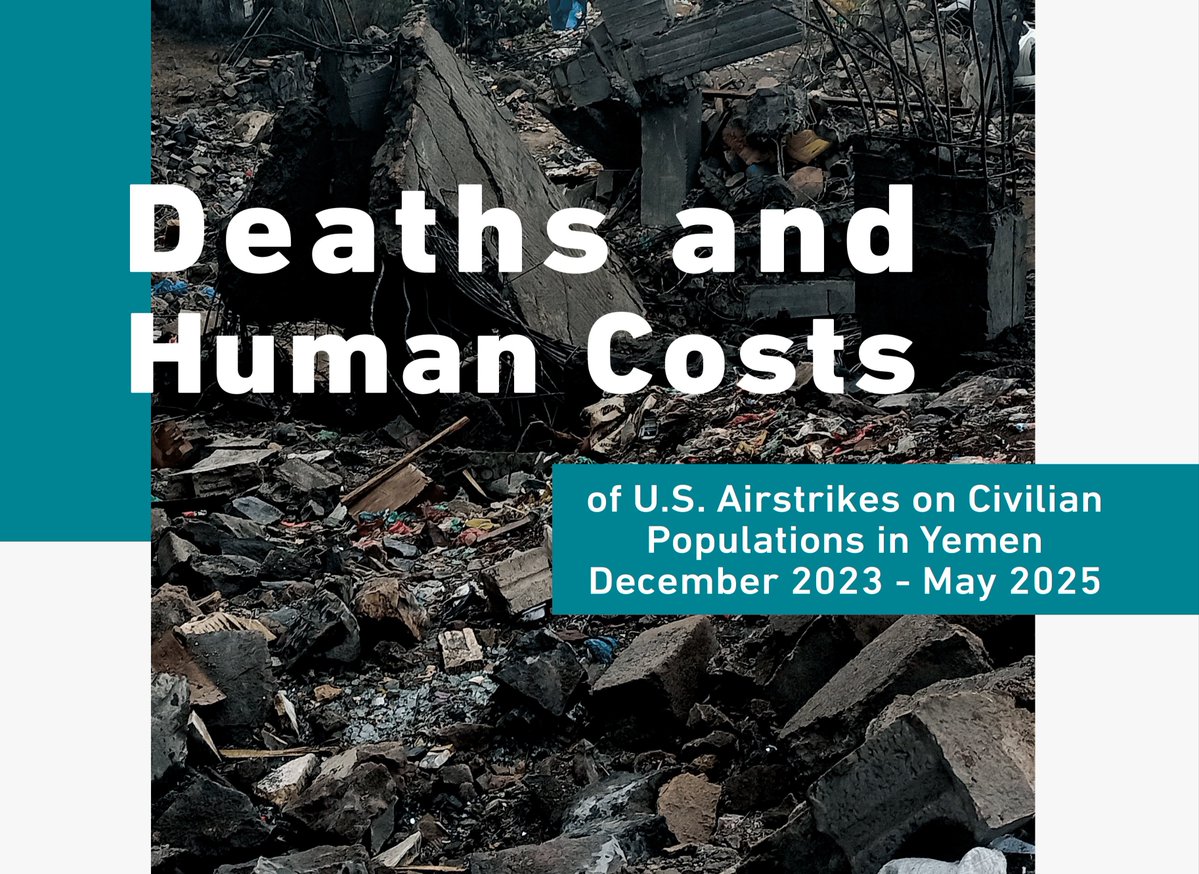
The central research question addressed by the research paper, titled “Deaths and Human Costs of U.S. Airstrikes on Civilian Populations in Yemen,” is to clarify the nature of the direct harm inflicted on civilians and on Yemen’s civilian and economic infrastructure; examine the continuing and long-term impacts of these strikes on civilians; identify victims’ needs to mitigate the economic, social, psychological, and health consequences of the attacks; and document their demands for compensation and access to justice. The paper also analyzes patterns of violations of international humanitarian law in U.S. attacks.
Kindly find, at the following link, the complete research paper: -
https://t.co/q5gEx7pRtd
Among the most enduring impacts are the long-term consequences of U.S. attacks on civilians, which resulted in the loss of breadwinners through death or severe injury and the destruction of livelihoods due to damage to or destruction of farms, shops, factories, workshops, and small businesses. Hundreds of civilian victims lost their jobs when the industrial and vital facilities where they worked were completely or partially destroyed.
Kindly find, at the following link, the complete research paper: -
https://t.co/q5gEx7pRtd
The U.S. strikes reveal a pattern of violations of international humanitarian law, including breaches of the principle of proportionality, failure to take feasible precautions to minimize harm to civilians, and failure to respect the principle of distinction, as demonstrated by attacks on infrastructure, essential service facilities, and other civilian objects.
Kindly find, at the following link, the complete research paper: -
https://t.co/q5gEx7pRtd
“Protecting civilians is not limited to avoiding killing or injuring them; it also includes respecting civilian objects and livelihoods. The United States must assume its legal and moral responsibility to recognize the civilian victims of its military operations in Yemen, provide them with redress and reparation, and hold accountable those responsible for the violations inflicted upon them.”
Radhya Al-Mutawakel, Chairperson of Mwatana for Human Rights
Kindly find, at the following link, the complete statement: -
https://t.co/uhQM9diHR9
“The losses caused by U.S. airstrikes against civilians cannot be regarded as temporary harm that ends when military operations cease. Civilians who have lost loved ones, homes, or sources of income continue to bear the consequences of these attacks, amid economic and humanitarian conditions that do not provide them with even the minimum capacity to recover.”
Radhya Al-Mutawakel, Chairperson of Mwatana for Human Rights
Kindly find, at the following link, the complete statement: -
https://t.co/uhQM9diHR9
Mwatana affirmed that the consequences of the U.S. airstrikes for civilians’ lives continue despite the cessation of military operations months ago. Affected families have lost breadwinners, sources of income, and property, while some have been forced to leave their destroyed or uninhabitable homes, seek shelter with relatives, or rent small spaces for accommodation. Other families have faced difficulties providing care for their children or enrolling them in school, while some of those injured continue to require treatment, surgery, and medical and psychological care that they have been unable to access.
Kindly find, at the following link, the complete statement: -
https://t.co/uhQM9diHR9
Mwatana explained that the U.S. airstrikes documented by the organization and examined in the research paper launched today in partnership with the Costs of War project, housed at Brown University caused extensive damage to homes, shops, farms, residential neighborhoods, industrial facilities, and civilian infrastructure and other facilities. The organization emphasized that the damage extended beyond direct loss of life and injuries to affect household incomes and livelihoods, particularly in areas already suffering from economic deterioration and shortages of essential services, including water, electricity, and healthcare.
Kindly find, at the following link, the complete statement: -
https://t.co/uhQM9diHR9
The 46 documented U.S. airstrikes involved multiple types of munitions and/or bombs and targeted civilian objects protected under international humanitarian law. They resulted in the deaths of at least 213 civilians, including at least 28 children and 12 women, and injured 363 others, including at least 22 children and 13 women. The strikes also caused extensive damage to civilian objects and infrastructure facilities, leaving far-reaching psychological, economic, and humanitarian impacts.
Kindly find, at the following link, the complete statement: -
https://t.co/uhQM9diHR9
Through the research paper it launched today, Mwatana reviewed some of the civilian harm resulting from 46 U.S. airstrikes documented by the organization. Seven of these strikes were carried out during “Operation Prosperity Guardian,” conducted from December 18, 2023, to January 19, 2025, under President Joe Biden, while 39 strikes were carried out during “Operation Rough Rider,” conducted from March 15 to May 6, 2025, under President Donald Trump.
Kindly find, at the following link, the complete statement: -
https://t.co/uhQM9diHR9
Mwatana for Human Rights, in partnership with the Costs of War project, housed at Brown University, has launched a research paper on “Deaths and Human Costs of U.S. Airstrikes on Civilian Populations in Yemen,” documenting the civilian harm caused by U.S. airstrikes conducted during “Operation Prosperity Guardian,” carried out from December 18, 2023, to January 19, 2025, under the administration of President Joe Biden, and “Operation Rough Rider,” carried out from March 15 to May 6, 2025, under the administration of President Donald Trump. The operations resulted in the deaths of hundreds of civilians and extensive damage to civilian objects and infrastructure.
Kindly find, at the following link, the complete statment: -
https://t.co/uhQM9diHR9
The legal support team at Mwatana focuses on ensuring procedural justice for all individuals who come into contact with law enforcement agencies or those detained by armed groups that have become de facto authorities. This is aimed at ensuring that they enjoy all their rights from the moment of detention, through the investigation and defense phases, their detention conditions, and ultimately during the trial.
Kindly find, at the following link, the complete newsletter:
https://t.co/nOb3WCA0NA
During August 2026, Mwatana for Human Rights documented 65 new incidents of violations related to arbitrary detention, enforced disappearance, and torture, with responsibility attributed as follows:
36 violations by the internationally recognized government.
26 violations by The Ansar Allah Armed Group (Houthis)
2 violations by the Southern Transitional Council (STC) forces.
On violation by the Joint Forces.
Kindly find, at the following link, the complete newsletter:
https://t.co/nOb3WCA0NA