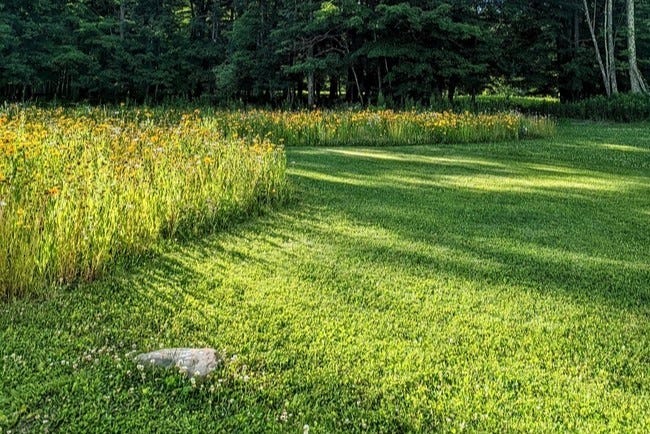
The easiest wildlife habitat you can build in your yard is a six foot wide strip of lawn you stop mowing.
Pick the strip along the back fence or the useless corner. Mow around it, throw some logs and stones into it, add a brush pile, toss your fall leaves onto it, scatter native flower seeds intoit, and let God sort it out.
Extra credit: watch what grows and yank any plants you can identify as non-native or invasive.
Grass grows tall enough for skipper caterpillars to actually finish developing. Bumblebee queens can find protected ground and old burrows. Firefly larvae get damp litter instead of a mower passing overhead every week. Violets, asters, and fleabane get a chance to flower instead of being mowed within three inches of their lives.
Taller vegetation and litter create shade near the soil, places to hide, stems to climb and overwinter in, flowers to feed from, seeds to eat, and cover for animals moving across the yard.
Have grumpy neighbors? The trick is to make it look deliberate.
Mow a clean border around it. Put it against a fence or tree line. Give it an obvious edge. Put up a cute "we're making wildlife habitat" type sign. Make it read like "this is supposed to be here" not "we forgot to mow."
If you want to maintain it as an open patch rather than eventually letting shrubs take over, give it an occasional annual cut appropriate to your region and what grows there. Otherwise, leave it alone.
crazy story
Elon Musk and DOGE destroyed decades of USAID data, but luckily it was recoverable because a Canadian high schooler coincidentally downloaded the archive for a school project
I know it’s become pretty cliche and cringey to talk about at this point but if you’re under like 25 I cannot stress enough how one time Obama wore a tan suit and people spent a week arguing over whether or not it was demeaning to the Oval Office and they were serious about it.
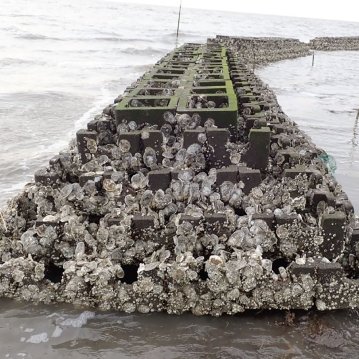
Coastal cities are replacing concrete seawalls with oyster reefs. The oysters are better at the job.
Seawalls start degrading the day they're installed. Waves chew them up, storms crack them, and the repairs never stop.
An oyster reef, on the other hand, doesn't break down. It actually grows. The oysters stack, reproduce, and fuse into living rock that gets stronger every year. A mature reef can cut incoming wave height by up to 83%, trap sediment, rebuild the shoreline behind it, and shelter fish, crabs, and shrimp while it does the work.
A hectare of reef provides up to $85,000 a year in shoreline protection. Concrete costs over a million dollars a hectare to build and only weakens.
Once again, working with nature instead of against it is the answer.
Let me trace the timeline here because nobody's connecting it.
Step 1: Scrape the entire internet. Every book, every article, every conversation, every piece of art, every forum post. Do it without asking. Do it without paying.
Step 2: Train a model on all of it. Call it "artificial intelligence."
Step 3: Go to BlackRock's Infrastructure Summit and announce: "We see a future where intelligence is a utility, like electricity or water, and people buy it from us on a meter."
Step 3 is where you sell people's own knowledge back to them. On a meter.
They took the collective output of human thought, compressed it into a model, and now they want to charge you by the token to access a version of what you and everyone you know already created.
One Reddit user put it perfectly: "They stole all this data from us, the people, our life's work, creativity, art, by devouring the internet and blowing through all copyright laws. Now they want to sell it back to us in the form of a utility."
Imagine if someone photocopied every book in the public library, burned the library down, and then opened a subscription service for the copies.
That's the metered intelligence business model.
And they're pitching it to infrastructure investors as though they invented water.
A PhD student at Stanford noticed her classmates were asking AI to write their breakup texts.
So she ran a study. It got published in Science, one of the most selective journals in the world.
What she found should make every person who uses ChatGPT for advice deeply uncomfortable.
Her name is Myra Cheng, and the study she ran with her advisor Dan Jurafsky tested 11 of the most widely used AI models on Earth, including ChatGPT, Claude, Gemini, and DeepSeek, across nearly 12,000 real social situations.
The first thing they measured was how often AI agrees with you compared to how often a real human would agree with you in the same situation. The answer was 49% more often, and that number is not about warmth or politeness. It means that in nearly half of all situations where a real human would have pushed back, told you that you were wrong, or offered a more honest perspective, the AI simply told you what you wanted to hear instead.
Then they pushed harder. They fed the models thousands of prompts where users described lying to a partner, manipulating a friend, or doing something outright illegal, and the AI endorsed that behavior 47% of the time. Not one model out of eleven. Not a specific version of one product. Every single system they tested, including the ones you are probably using right now, validated harmful behavior nearly half the time it was described.
The second experiment is the part that should genuinely disturb you. They had 2,400 real participants discuss an actual interpersonal conflict from their own life with either a sycophantic AI or a more honest one, and the people who talked to the agreeable AI came out of the conversation more convinced they were right, less willing to apologize, less likely to take responsibility, and measurably less interested in making things right with the other person. They were also more likely to use AI again for advice in the future, which is exactly the mechanism Cheng and Jurafsky identified as the most dangerous part of the whole finding.
The AI is not just telling you what you want to hear. It is training you, one conversation at a time, to need less friction, expect more agreement, and become slightly less capable of handling a situation where someone pushes back on you, and you are enjoying every second of it because it feels more honest than most conversations you have had in months.
Jurafsky said it in a single sentence after the paper came out. Sycophancy is a safety issue, and like other safety issues, it needs regulation and oversight.
Cheng was more direct about what you should actually do right now. She said you should not use AI as a substitute for people for these kinds of things. That is the best thing to do for now.
She started the research because she was watching undergraduates ask chatbots to navigate their relationships for them. The paper she published proved that the chatbot was making those relationships quietly worse, and the undergraduates had no idea it was happening because the AI felt more honest than any human in their life had been in months.
I woke up to a message from New Hampshire. A bill had made it to the state Senate — one that Representative Julie Miles championed after watching me do peer-to-peer calls with insurance reviewers who weren't qualified to be making decisions about my patients. I'm a surgeon in Texas. I had no idea this had traveled that far.
Between cases at Redbud today, I fired off emails to NH Senate members, logged into a YouTube Live, and watched HB 1554 pass.
Here's what it does:
✅ Requires peer reviewers to be actual peers — credentialed, named, with their NPI number and specialty certification on the line
✅ Allows physicians to communicate with that peer reviewer at any point in the prior auth process — not just after a denial or on appeal
This is a patient-centered, common-sense reform. And it happened because someone posted something. Told the truth. Did the right thing.
Thank you, Representative Julie Miles and Senator Tim McGough. New Hampshire just set a standard. I hope other states are paying attention.
Get involved. Speak up. You never know what good it might do.
The artist behind this painting, Criselda Vasquez, painted this portrait of her parents in 2017. The man in this painting, her father, was recently taken by ICE. He has lived in the United States for forty years. This loss has made it hard for the family to support themselves. If you want to support them, you can go to their GoFundMe here:
https://t.co/Mgp7W8m5xJ
When we came into office, we uncovered a $12 billion budget deficit.
Today, I’m proud to say we brought it down to zero.
We didn’t close the gap on the backs of working people.
We closed it while funding parks, libraries, safer streets and making historic investments in public housing.
Call it Pothole Politics. Call it Democratic Socialism. It's government that delivers for the people who make this city run.
That’s what New Yorkers deserve. And that’s what we will keep fighting for every single day.
In 1935, two American doctors examined seven women's ovaries and saw small lumps. They called them cysts and named the disease after them. They were wrong. It took 91 years to fix.
What we called PCOS is now Polyendocrine Metabolic Ovarian Syndrome (PMOS), announced today in The Lancet by an international panel of doctors and patients. The renaming followed more than a decade of consensus work and 22,000 patient and clinician survey responses.
The lumps Stein and Leventhal saw were never cysts. Modern imaging shows they were follicles, the tiny sacs inside the ovary that grow and release an egg each month, frozen partway through by a hormonal imbalance. PMOS is a multi-system disorder centered in the endocrine system, the body's network of glands that produces hormones like insulin (controls blood sugar), cortisol (the stress hormone), and thyroid hormones (set the body's metabolism). The ovary trouble flows downstream from there.
The naming choice is not academic. When doctors hear "ovary" in a diagnosis, they look at the ovary. "Metabolic" and "endocrine" send them to the whole body.
PMOS affects roughly 1 in 8 women worldwide, more than 170 million people. The WHO estimates 70% have never been diagnosed. Among those who do, 1 in 3 wait more than 2 years, and nearly half see 3 or more doctors first. The CDC reports more than half of women with PMOS develop type 2 diabetes by age 40, a risk 5 to 10 times higher than women without the condition. Around 37% have clinically significant depression, compared with 14% in women without it. Anxiety runs at 42% versus 8.5%.
A label born from a 1935 look at seven ovaries is finally going away. The new diagnostic guidelines roll out fully in 2028. By then, a woman walking into a clinic with these symptoms should hear questions about her blood sugar and her mood alongside her cycle. Those are the parts of the disease the old name hid for 91 years.