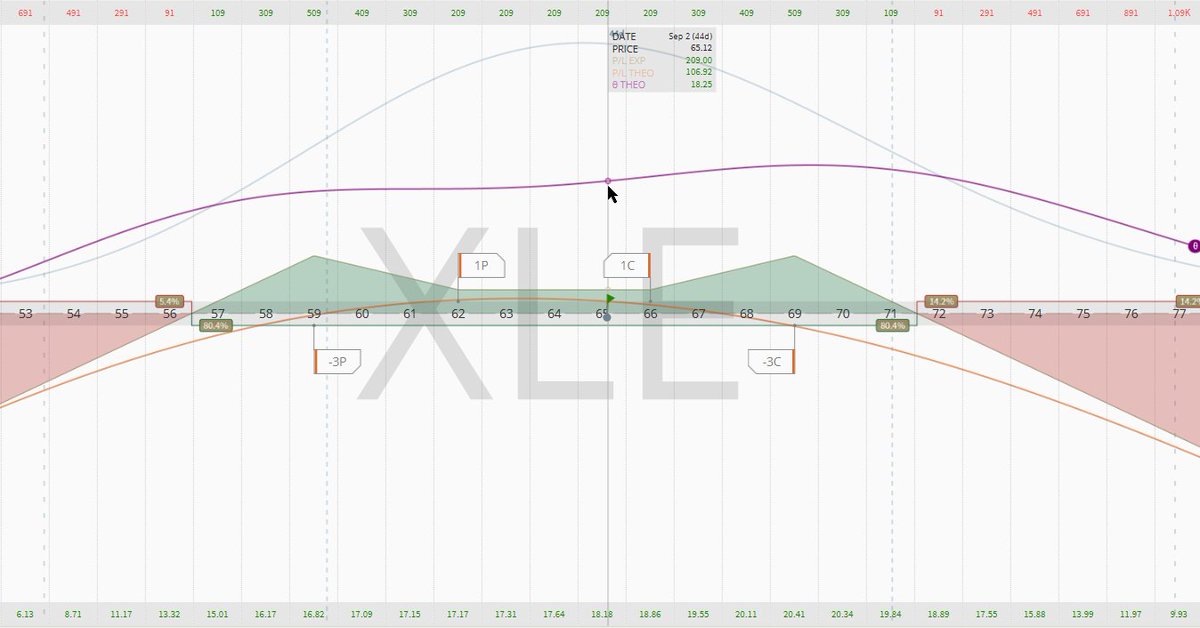
I like "Put Lizards" (as well as "Call Lizards") because they are essentially ratio trades with fatter profit zones, so you don't have to hit a single short strike for max profits
💰👍
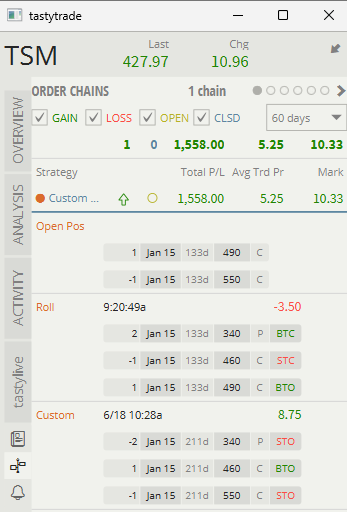
$TSM LEAPS Super Bull
Paid $352 to lock in $519 net profit, leaving a "free" Bull Call Spread
Potential $6K additional if $TSM closes above $550 at January expiry (currently 27% PoT); GTC set for half that amount.
💰15% ROC in 78 days
🛟Removed downside risk
🤑+$6K potential
The Physics of Money
Bono asked me for a light. I asked him for a cigarette.
More than twenty-five years ago, I was at the World Economic Forum in Davos.
Bono was there raising money for some of the poorest people in the world. I was there reporting for Bloomberg.
We were in a lounge when he asked me for a light.
I had one.
I lit his cigarette.
Then I asked him for a cigarette.
He gave me one.
We sat down, smoked and drank coffee.
And we talked about money.
The conversation continued later at the Belvedere Hotel, where I interviewed him for Bloomberg.
What stayed with me was a very simple idea.
That money, like water changes state depending its context.
We talk about it as if money is always the same.
It isn’t.
Money is like water.
It changes state.
Ice. Liquid. Gas.
And the state of your money may matter more than the amount.
When you have very little money, it is ice.
It is frozen.
Rent. Food. Transportation. Medicine. Debt.
Every dollar is already spoken for.
The money can’t move.
Neither can you.
You can’t easily leave the job. Move somewhere else. Take time off. Try something new. Survive a mistake.
This is what we misunderstand about poverty.
It isn’t only the absence of money.
It is the absence of mobility.
As the amount of money increases, the ice begins to melt.
Money becomes liquid.
Now it moves.
You earn it. You spend it. You save it. You invest it.
You can move. You can leave. You can build. You can take a risk. This is where income begins turning into capital.
And this is where we tax money most aggressively.
The worker.
The doctor.
The lawyer.
The executive.
The entrepreneur.
Even people earning enormous incomes are still earning. Their money is flowing through their lives. The more success they have the more brutally they are taxed.
It is liquid.
Then money changes state again.
At enormous scale, for extreme wealth holders money becomes a gas.
It expands rapidly with zero effort or action.
The money expands.
It no longer depends primarily on the activity of the person who owns it.
That is gas.
And this is where the American relationship with money becomes exactly backward.
We largely abandon the people whose money is frozen.
We brutally tax the people whose money is liquid.
And we protect the largest pools of wealth precisely when the money has become capable of expanding on its own.
We neglect the ice.
We tax the liquid.
We protect the gas.
It should be the exact opposite.
Thaw the ice.
Give people enough room to move. Let the liquid flow.
Encourage work to become savings. Savings to become investment. Investment to become ownership.
And when money reaches the point where enormous pools of capital naturally produce more capital — tax the gas.
Not because money is bad.
Because money changes state.
That conversation with Bono stayed with me because he was in Davos asking some of the wealthiest and most powerful people in the world to help some of the poorest.
The entire physics of money was sitting in the same town.
People representing those with almost none.
People earning and building.
People with more capital than they could ever produce through their own labor.
Ice.
Liquid.
Gas.
Money is not life.
It is stored possibility.
With very little, the possibility is survival.
With more, it becomes mobility.
With enormous amounts, it becomes power.
The mistake is believing those are the same thing simply because we measure all three in dollars.
They aren’t.
And an economy should be judged by whether people can move between them.
Can someone who is frozen become mobile?
Can someone who works accumulate capital?
Can someone with capital build something useful?
That is the point.
The physics are simple. Our policy is backward.
Thaw the ice. Let the liquid flow. Tax the gas.
++ I write one of these every day. If you’d rather get them directly from me instead of hoping an algorithm shows them to you, subscribe free to https://t.co/LDZzWhfczR
100 Americans now have more wealth than 170 million Americans.
The 100 wealthiest Americans hold roughly $5.5 trillion.
The bottom half of the country—roughly 170 million people—holds about $4.3 trillion.
That didn’t happen by accident.
The American tax code is exactly wrong.
The American tax code is exactly wrong.
We tax the people who work for their money at the highest percentages.
We tax the people who have the most money at the lowest percentages.
And we allow the people with the most money to control the laws that determine how much tax we all pay.
That’s the system.
Today it was reported that the 100 wealthiest Americans now hold more wealth than the entire bottom half of the country.
100 people: roughly $5.5 trillion.
170 million people: roughly $4.3 trillion.
Now look at where the great fortunes come from.
They overwhelmingly sit on top of dominant corporations or inherited, and marital concentrations of wealth tied to oligopolies and monopolies.
So, spare me the mythology about competition.
There is no meaningful capitalism without competition.
When markets are dominated by a handful of companies, when those companies generate enormous fortunes, when those fortunes acquire political power, and when that power determines tax and competition policy, society is being destroyed.
That’s not a free market.
It’s not innovation.
That’s 100 people taking advantage of 350 million people and laughing to the bank.
And the American tax code fuels it.
If money comes from work, we tax it brutally.
Worker. Doctor. Lawyer. Executive. Entrepreneur.
Earn more through your labor and the government takes more.
Extreme wealth gets different treatment.
Capital produces capital. At enormous scale it becomes an ever-expanding gas that should be the first source of tax revenue.
Instead, it is the last.
We attack income and innovation and protect extreme concentrated ownership—as a matter of policy.
The tax code and the economy are not weather. They don’t simply happen to us.
They are policy.
And the policy of the United States is effectively this:
If you generate a large income, tax it brutally and make the accumulation of wealth extraordinarily difficult -- if you control an oligopoly, inherit the wealth created by one, or marry into it, protect the fortune at all costs.
That is exactly backward.
And it is a despicable lie that protecting the fortunes of these 100 people from taxation is somehow necessary for the future of American innovation while we crush the people actually innovating.
Executives. Entrepreneurs. Designers. Doctors. Lawyers. Teachers. Mental-health professionals. Nurses. Farmers. Hospitality Workers.
Years ago, Senator Ron Wyden took me aside when I was covering politics and showed me what he described as the room where the tax favors were handed out.
That was the education.
The tax code isn’t nature.
It is policy.
And concentrated wealth has concentrated power over that policy.
Then we compound it by refusing to enforce competition.
The result is devastating.
Concentrated markets create concentrated wealth.
Concentrated wealth creates concentrated political power.
Concentrated political power protects concentrated markets and favorable tax treatment.
That’s not competition. It’s a feedback loop.
Meanwhile, government waste, fraud and incompetence destroy public confidence in taxation itself. That gives the beneficiaries of the system the perfect defense:
Why give the government more money?
So, the circle closes.
This is not an unavoidable consequence of capitalism.
It is a catastrophic failure of tax policy and a catastrophic failure of antitrust policy.
A country cannot indefinitely tax income, protect concentrated wealth, tolerate monopoly and expect economic mobility to survive.
The laws created this structure.
The laws can dismantle it.
Tax extreme wealth, starting with these 100 people.
Break up the monopolies.
Anything else is pretending we still have competition.
+++I write one of these every day. If you’d rather get them directly from me instead of hoping an algorithm shows them to you, subscribe for free at https://t.co/LDZzWhfczR
Pre-Market Setup - Sep 03, 2026
Before the bell: the overnight tape, the vol regime you're walking into, and today's catalysts.
━━━━━━━━━━━━━
OVERNIGHT
ES (S&P) -0.03% - implied open ~7,664 (-2 vs close), range 7,651–7,685
NQ (Nasdaq) -0.26% - implied open ~29,069, range 29,032–29,250
→ ES futures down 2 points with -0.03% overnight suggests a subdued open after yesterday's close, while NQ's -0.26% indicates modest tech pressure ahead of cash market.
VOL AT LAST CLOSE - VIX 15.2 · VVIX 86 · SKEW 144 · CONTANGO
VRP +7.6 (VIX − RV20 7.6); vol closed richly priced - a seller's backdrop.
→ VIX at 15.2 with VRP positive at 7.6 means implied vol trades rich to realized, setting up potential compression if the market stabilizes through the session.
MACRO OVERNIGHT - 10Y +0bp · Dollar -0.4% · Crude +2.1% · Gold +2.7% · BTC +0.8%
→ Crude up 2.1 and gold up 2.7 overnight while the dollar fell 0.4 points to a mixed equity signal, though 10Y flat at zero keeps rate repricing off the table for now.
GLOBAL - Asia: Nikkei -0.2% · Hang Seng -0.4% · Shanghai +0.0%
Europe: DAX +0.1% · FTSE +0.5% · Euro Stoxx -0.1%
→ Europe finished mixed with FTSE +0.5 leading while Hang Seng -0.4 and Nikkei -0.2 dragged, creating a slightly positive but fragmented handoff into the US cash open.
HEADLINES
• European TTF Gas Seen at 80 Euros a Megawatt-Hour by End of 2026 (WSJ)
• Why the Fear Gauge Still Isn't Flashing Red Despite the Market's Bond Woes (Barrons)
• We're in a world of persistent inflation, says Peter Boockvar (CNBC Television)
ON DECK - LULU · CIEN
→ LULU and CIEN earnings today provide intraday volatility anchors, though neither moves broad indices directly, leaving the day's character to the vol mean-reversion trade.
━━━━━━━━━━━━━
THE SETUP: ES barely lower on the gap, NQ softer on tech overnight, VIX richly priced relative to realized vol, and two earnings events to absorb make this a day structured for mean-reverting vol compression or tactical fades on rallies.
Not a forecast. A pre-market read.
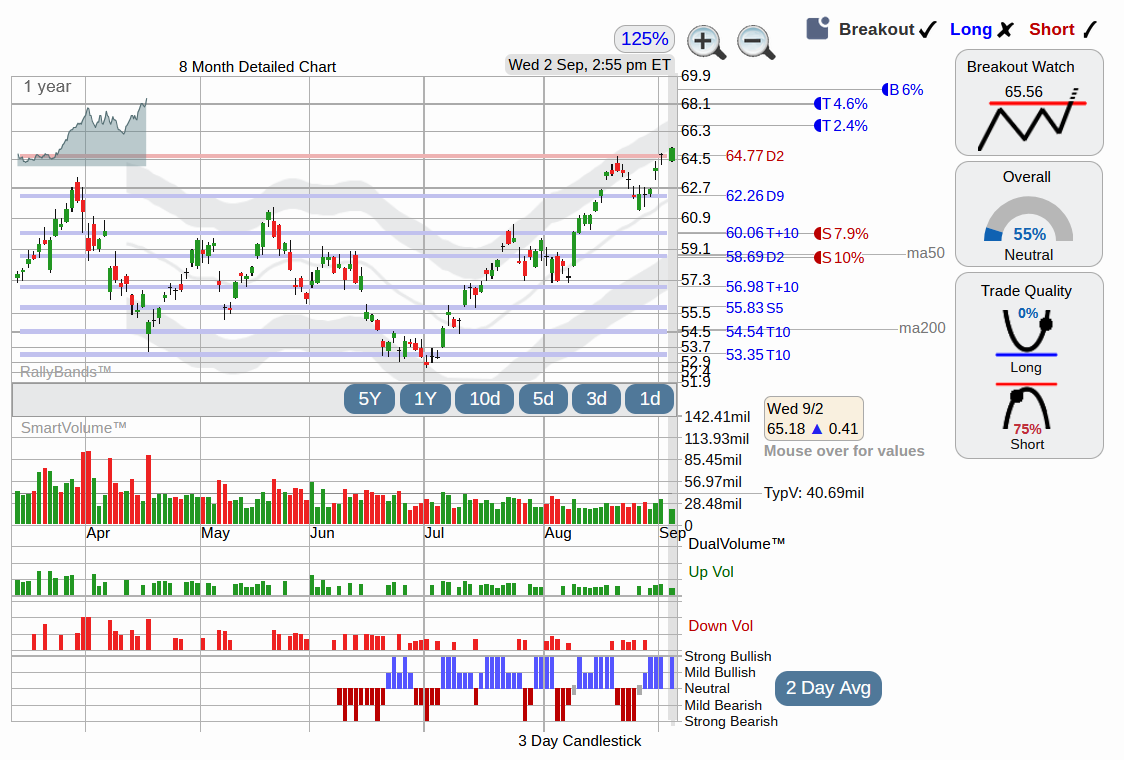
$XLE upside breakout risk; "invested" $285 of the $409 net credit from a managed XLE Strangle to buy an inside (long) strangle, extending the upside (and downside) break-evens by ~$1 each side, while increasing max profit to $420. Inside valley nets $121
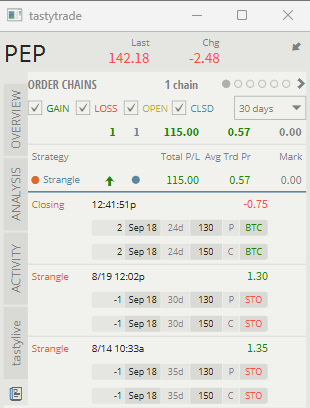
Taking early $PEP profits @ 41% (11 days in the trade)
Gotta follow my trading rules!
💰$110 net profit on $2,675 BPR (4.1%)
⚠️Avoid risk of potential bull breakout📈