Mylo is an AI orchestration layer that cuts your model bill.
One line of config. Your key, your provider, your bill.
We never route above the model you named.
First 7 days we change nothing — you just watch what it would have saved.
Then you decide.
https://t.co/ZSS893vQzt
Your agent does not need Opus to read a file.
It just doesn't know that, because nobody is going to switch models thirty times a task by hand.
Seven days. We change nothing, you pay nothing, you see what it would have saved.
DMs open.
Microsoft started canceling most of its internal Claude Code licenses. Runaway token bills, unsustainable at scale.
If the company that owns a chunk of OpenAI can't make the numbers work, the problem isn't your discipline.
Nobody is choosing which model does what.
2024: about 12 cents to generate 100 lines of code.
2026: one developer running agents can burn $380 a day.
That is $91,200 a year. A full developer salary in Germany, spent on the tool that helps the developer.
Four agents entered a loop in November. They ran for 11 days. The bill was $47,000.
Nobody noticed until it was over.
Budget alerts tell you after it happened. A receipt on every call tells you while it happens. Not the same product.
Few weeks ago a friend, senior engineer, told me Mylo is the wrong product. "You can't invent the bicycle again."
I sent him a Mylo key with a funded OpenRouter key for his daily stuff. He took his words back, said it works properly.
So Mylo stays. Back to building 👀
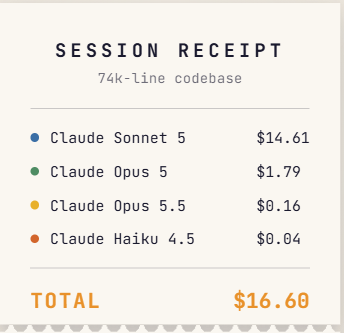
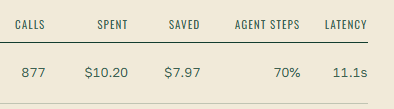
We gave a senior engineer a real 74k-line DDD/CQRS codebase and pointed Claude Code at our address.
Q&A on the codebase, a planning session, then implementation in two passes.
Review passed. Tests updated. Feature works.
Nobody switches models four times mid-session by hand. The work just splits that way.
Two things it got wrong, since we publish those too: the model pushed hard to build a dev plan that bypassed the spec, and it failed to mark completed tasks as closed. Neither broke the work. Both are on us to fix.
Coding agents run $0.03 to $2.60 per task.
Most of that bill is not the code the agent writes.
It's context overhead. System prompts, repo maps, the same files read again on every single step.
You are paying frontier prices to re-read a file. Thirty times a task.
Token prices fell 98% since early 2024.
Enterprise AI bills went up anyway.
A chat query is one call. An agent task is thirty. Gartner puts agents at 5 to 30x the tokens of a chat query.
Cheaper tokens, far more of them. The math does not save you.
Uber gave Claude Code to 5,000 engineers in December.
By April they had burned through their entire 2026 AI budget.
Their CTO said they were back to the drawing board.
Four months. Not four quarters.
Why people hit their usage limits early:
context bloat oversized files leaving Opus selected for trivial tasks
The third one is the whole business.
Seven days of observation. We change nothing. You see the number.
Router vendors: 40-85% savings. More careful reviews: 20-60%, across different benchmarks. A normalized leaderboard: nobody has one.
We don't quote a percentage. Seven days, we change nothing, you see yours.
Send everything to a small model and you get a different bill:
failed tool calls repeated attempts work that never finishes
That's why the model you named is our ceiling. We go down only when we're sure, not by default.
The routing trap developers keep flagging:
Switch models mid-task and you break the cache. Now you pay the full uncached rate.
A "cheaper" switch that costs more.
We hold the model for the whole turn. The cache stays warm.
July 30: OpenAI cuts one model 80%. Aug 11: Anthropic locks in a price. September: the rates you budgeted in August are wrong.
Nobody can hand-pick models in a market that reprices monthly.
That's not a budgeting problem. It's a routing one.
We gave a senior engineer a real 74k-line DDD/CQRS codebase and pointed Claude Code at our address.
Q&A on the codebase, a planning session, then implementation in two passes.
Review passed. Tests updated. Feature works.
Nobody switches models four times mid-session by hand. The work just splits that way.
Two things it got wrong, since we publish those too: the model pushed hard to build a dev plan that bypassed the spec, and it failed to mark completed tasks as closed. Neither broke the work. Both are on us to fix.
Same price per token. More tokens per task.
Opus 4.7 can generate ~35% more tokens than 4.6 for the same input.
Price per token is what they advertise. Cost per finished task is what you pay.
Only one of those shows up on your invoice.
.@AnthropicAI called it a raise.
Sept 14: the temporary 50% Claude Code boost became a permanent 25%.
The arithmetic says most paying users lost ~17% of the capacity they had the week before.
You don't control their pricing. You control which model you call.
$736 in a week, one developer. $15,000 in a month, one team. $130 per employee per month.
People are tracking this by hand in spreadsheets.
Seven days of observation. We change nothing. You see your real number.
DMs open.