🚨 BREAKING: New secrets have just been revealed about a massive underground city beneath Egypt’s Khafre Pyramid.
Spiral shafts. Giant chambers. Possible connections to ancient myths.
1/ Scientists now claim to have found 8 enormous shafts, spiral staircases, and two gigantic chambers more than 2,100 feet underground.
But that’s just the surface of what might be a buried city.
🧵
At some point you’ve just gotta laugh at how bad of a day you’re having. Tow truck gets here and while they were lifting the back to move the truck out of the parking spot, the truck falls off and you hear a loud crunch from something underneath…I really need a mulligan on this one @tesla
Has this ever happened to anyone else before? This @Tesla@cybertruck has ONLY 15 miles on it and 30 min after delivery, it’s paper weight. How is this possible?
Sold my Kia today and picked up my @cybertruck the delivery took 3 hours because of some electrical issue they were fixing on a Brand New cyber truck. No worries, happy to wait. Finally took delivery and took it to the nearby supercharger. It charged to 80% and then… about a dozen errors popped up! It was hot so I rolled down the window. THEN the truck flat out DIED! And the cherry on top, it’s about to storm and now the windows won’t go back up! Brand new truck that I waited half a year for, sold my other car because this was going to be the only car I need and it DIED less than 30 min after taking delivery. @elonmusk this suck!
One day in 1954, a well-dressed businessman landed at a Tokyo airport and handed customs his passport.
Everything looked normal — until officials read his country of origin: Taured. 🛂
No such nation existed. But the man was baffled by their confusion. Taured, he insisted, had existed for over 1,000 years. When they showed him a map, he pointed confidently to a small region between France and Spain — the exact spot where the tiny country of Andorra sits.
"That's my home," he said. "But where is Taured? Why is it called Andorra?"
His passport looked authentic. His other documents — business papers, bank statements — were issued by a country no one had ever heard of. He'd done business in Japan before, he said. His company confirmed the meeting. His hotel had his reservation. Yet the firm and bank he named did not exist. 🌍
Confused and exhausted, officials placed him in a secure hotel room for the night, guards posted outside, his mysterious documents locked away.
By morning, he was gone.
The room had no balcony. The only window opened to a sheer drop. The guards saw no one leave. And his documents had vanished from the locked office too — as if he'd never existed at all.
A bureaucratic mix-up… a Cold War spy with forged papers… or a traveler who slipped in from a world beside our own? 👇
In 1764, something began stalking the hills of Gévaudan, France — and it wasn't hunting animals. It was hunting people. 🐺
Survivors described a creature far larger than any wolf: reddish fur, an enormous head, teeth like a lion's, and an unnatural cunning. It struck fast, often going for the throat or the head, and seemed to choose its victims — mostly women and children working the fields.
Over three years, it killed as many as 100 people.
Panic swept the countryside. The terror grew so great that King Louis XV himself sent professional hunters and soldiers to slay it. They killed wolf after wolf. The attacks continued.
Was it an enormous rogue wolf? A hyena or exotic beast escaped from a menagerie? A trained killer animal controlled by a human murderer hiding behind the legend?
To this day, no one truly knows what the Beast of Gévaudan was.
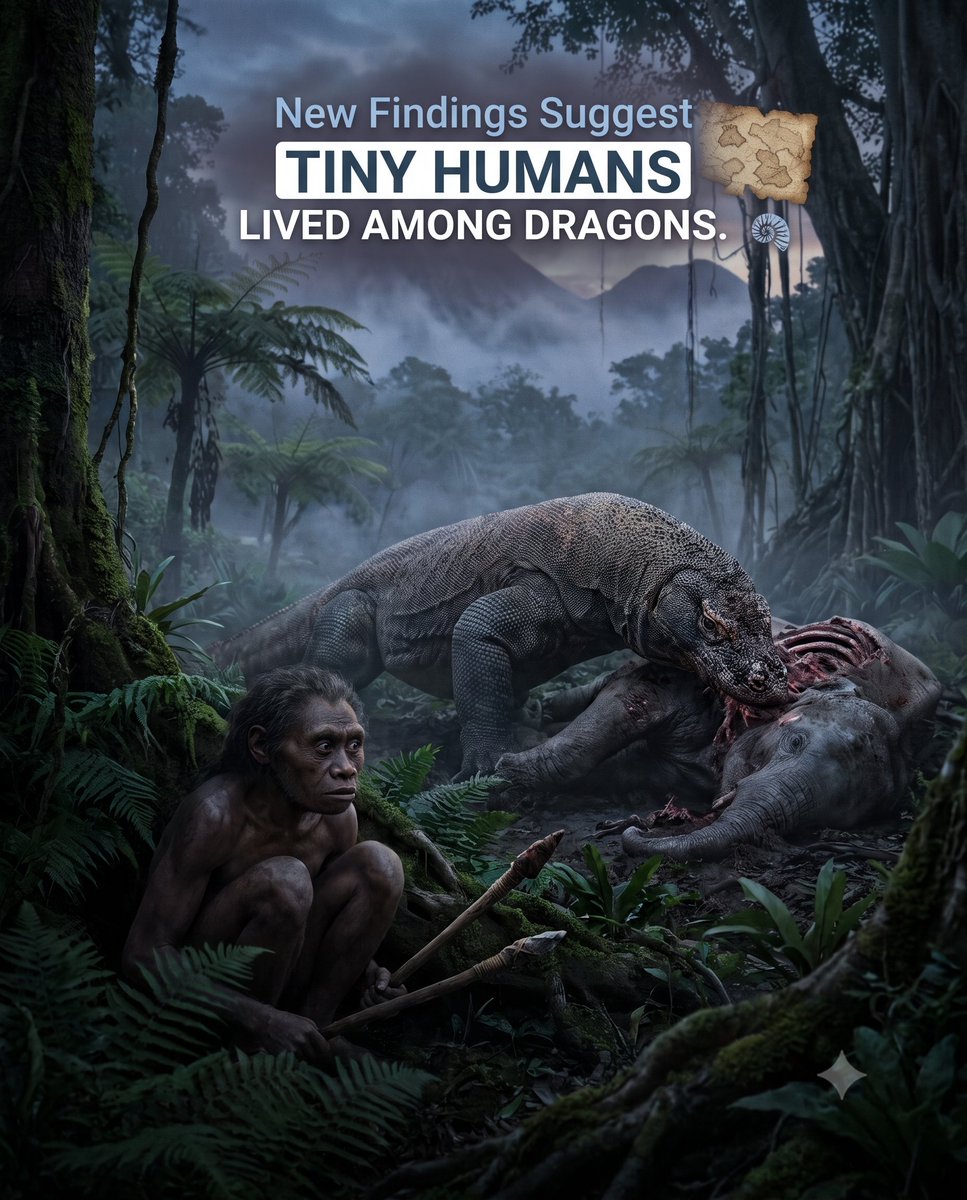
They were real. A species of tiny humans just 3½ feet tall once walked the Earth — and science just rewrote their story. 🦴
On the remote Indonesian island of Flores lived Homo floresiensis, nicknamed the "Hobbits." For years, scientists believed these little humans were clever big-game hunters, bringing down dwarf elephants with tools, teamwork, and fire — impressive feats for a brain the size of a chimpanzee's.
But new research just shattered that image. 🐉
Scientists re-examined the ancient elephant bones found alongside the Hobbits — and discovered the telltale bite marks of Komodo dragons, the island's monstrous apex predators. The dragons had eaten first, claiming the richest, most nutritious parts.
The Hobbits? They were the scavengers. They crept in for the scraps the dragons left behind.
And that "evidence" they cooked with fire? Out of over 3,000 bone fragments, only a single one was burnt — likely from our species, arriving on the island long after the Hobbits were gone.
It paints a haunting new picture: a tiny, fragile people surviving in the shadow of dragons, on an island that time forgot. 🌋
The Dogon, an ancient West African people living along Mali’s Bandiagara cliffs, told Griaule of a star called Po Tolo — the “seed star.” They said it circled Sirius every 50 years, was small, dense, and incredibly heavy — all accurate descriptions of Sirius B, a white dwarf invisible without modern instruments. Yet their knowledge predated its scientific discovery by decades.
Astronomers only confirmed Sirius B’s existence in 1862, and its orbital details weren’t calculated until the 1920s. So how did the Dogon know? Some suggest ancient observation and oral transmission; others point to cultural exchange or pure coincidence. Fringe theories even invoke extraterrestrial contact — though serious scholars reject that.
Whatever the explanation, the Dogon’s cosmic stories reveal something profound: that even without telescopes, ancient peoples studied the skies with astonishing precision. Their myths and science intertwined, reminding us how wonder can be the oldest form of knowledge.
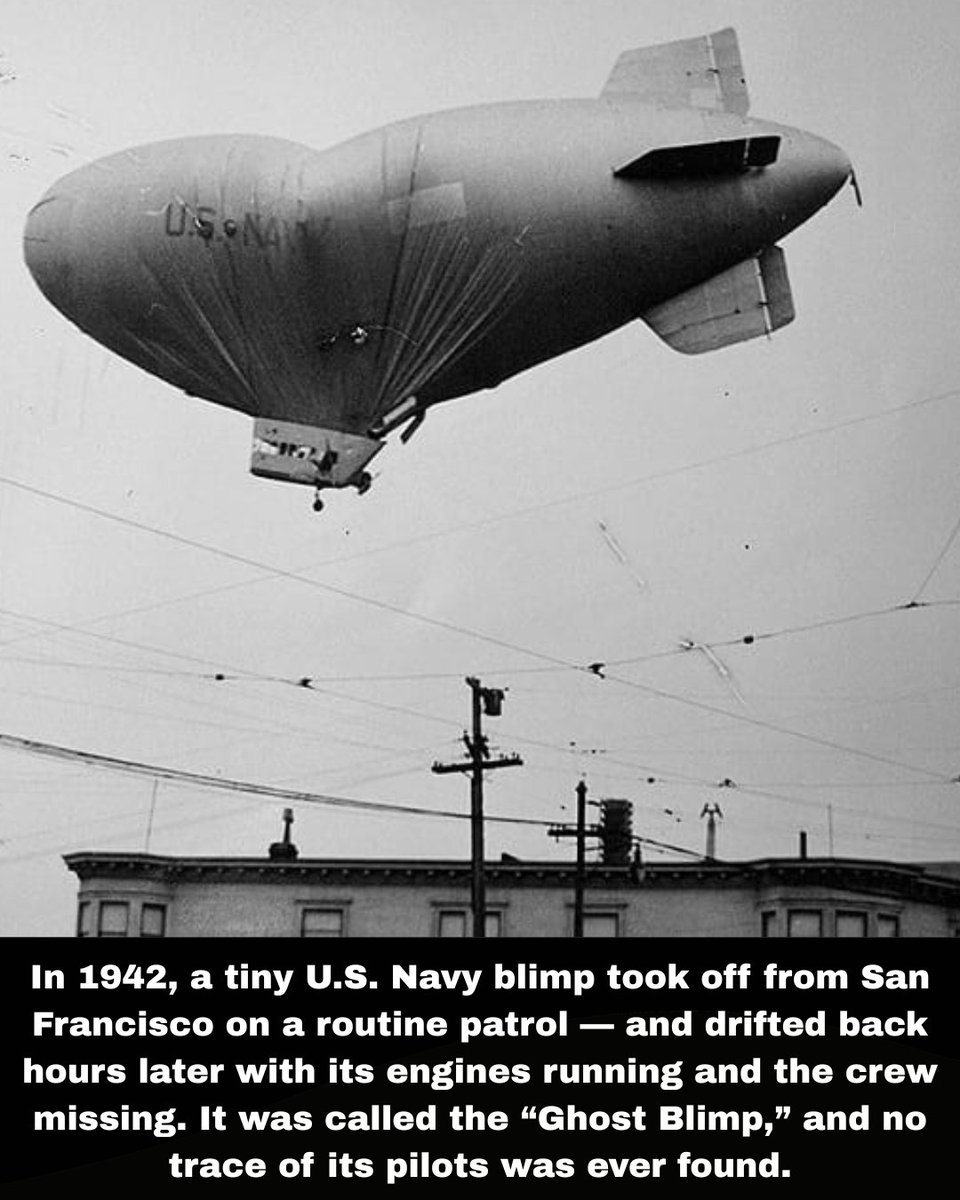
On August 16, 1942, Navy blimp L-8 left Treasure Island, California, carrying two experienced crewmen — Lt. Ernest Cody and Ensign Charles Adams — to search for submarines off the coast. The mission was routine, and they radioed that they’d spotted an oil slick, possibly from a Japanese sub. Then — silence. Hours later, the blimp drifted inland, scraping rooftops before gently crashing in Daly City.
When rescuers opened the cabin, they found something chilling: the engines were on, radio working, parachutes still there, and the door open. But the crew was gone — vanished into thin air. No bodies were ever recovered, and no sign of struggle was found. It was as if the two men had simply stepped out midair.
The Navy’s investigation concluded nothing — no enemy activity, no foul play, no mechanical failure. Theories range from an overboard accident to something far stranger. The Ghost Blimp of 1942 remains one of the eeriest unsolved mysteries of World War II — a haunting story of two men who took to the skies and never came back.
When Hernán Cortés and his men entered Tenochtitlán in 1519, they were stunned. Built on an island in the middle of Lake Texcoco, the Aztec capital glistened with canals, white stone temples, and palaces. Its population — estimated at 200,000 — rivaled or surpassed the largest European cities of the time. Freshwater flowed through aqueducts, markets bustled with goods, and causeways connected the island city to the mainland like spokes of a wheel.
Spanish chroniclers described streets so clean and organized that even horses slipped on their polished stones. The city’s chinampas — floating gardens — produced food year-round with ingenious irrigation systems, sustaining an empire. Visitors wrote that it looked like something out of myth, a place of both beauty and power.
Within two years, it was gone. War and disease brought by the conquistadors destroyed Tenochtitlán, burying one of the world’s greatest civilizations under the rubble of conquest. Yet its legacy lives on in Mexico City, which still sits atop the lakebed where that dazzling metropolis once rose.
In 1930, an archaeologist discovered an ancient clay tablet that seemed ordinary — until he translated it. It turned out to be a 3,700-year-old Babylonian geometry problem that used Pythagoras’ theorem, more than a thousand years before Pythagoras was born.
Expanded Version (3 Paragraphs):
Unearthed in modern-day Iraq, the tablet — known as Plimpton 322 — dates to around 1800 BCE. For years, it puzzled scholars with its strange columns of numbers. When mathematicians finally cracked its code, they realized it described Pythagorean triples — whole-number solutions to right triangles — centuries before the Greek mathematician Pythagoras lived.
The Babylonians, using their base-60 counting system, had created a trigonometric table unlike anything seen in ancient Greece. Instead of measuring angles, they used ratios — a more precise method that modern scientists have only recently rediscovered. The tablet likely helped engineers design temples, canals, or ziggurats with astonishing accuracy.
This small piece of clay rewrote the history of math, showing that long before the Greeks, the Babylonians were already mapping the logic of the cosmos in numbers baked into mud.
On April 12, 1961, the Soviet Union launched Vostok 1, carrying 27-year-old pilot Yuri Gagarin into orbit. In just 108 minutes, he circled the planet once — the first human to leave Earth’s atmosphere and return alive. The world watched in awe as humanity’s dream of spaceflight became reality, not through fiction, but through fire, courage, and science.
Gagarin’s journey was perilous. The capsule had no manual controls, his parachute deployed miles above ground, and the mission was so secret that even his family didn’t know until after liftoff. Yet when he landed safely in a field near Saratov, farmers stared in disbelief at the smiling man in an orange suit who calmly said, “I am a friend of yours.”
Gagarin became an instant global hero — a symbol of human possibility during the Cold War. His flight opened the cosmos, proving that the sky was no longer the limit. Decades later, his words still echo: Earth is small, and it must be protected.
In the late 1950s, author Philip K. Dick drafted a story about a U.S. leader gunned down during a public appearance, a tragedy that throws the nation into chaos. At nearly the same time, Fletcher Knebel co-wrote Seven Days in May, a novel about a military plot following the assassination of a young, idealistic president — a leader named Kennedy. Both works were written before John F. Kennedy even announced his candidacy for president.
When JFK was assassinated in 1963, readers noticed how closely fiction had shadowed reality. Knebel’s story about the fragility of democracy — and the danger of internal conspiracy — suddenly felt prophetic. Even stranger, President Kennedy himself had read Seven Days in May and reportedly praised it, saying its premise was “entirely possible.”
These coincidences, drawn from imagination yet mirrored by history, remind us how often fiction anticipates truth — or perhaps, how deeply writers can sense the tension of their times before the rest of the world catches up.
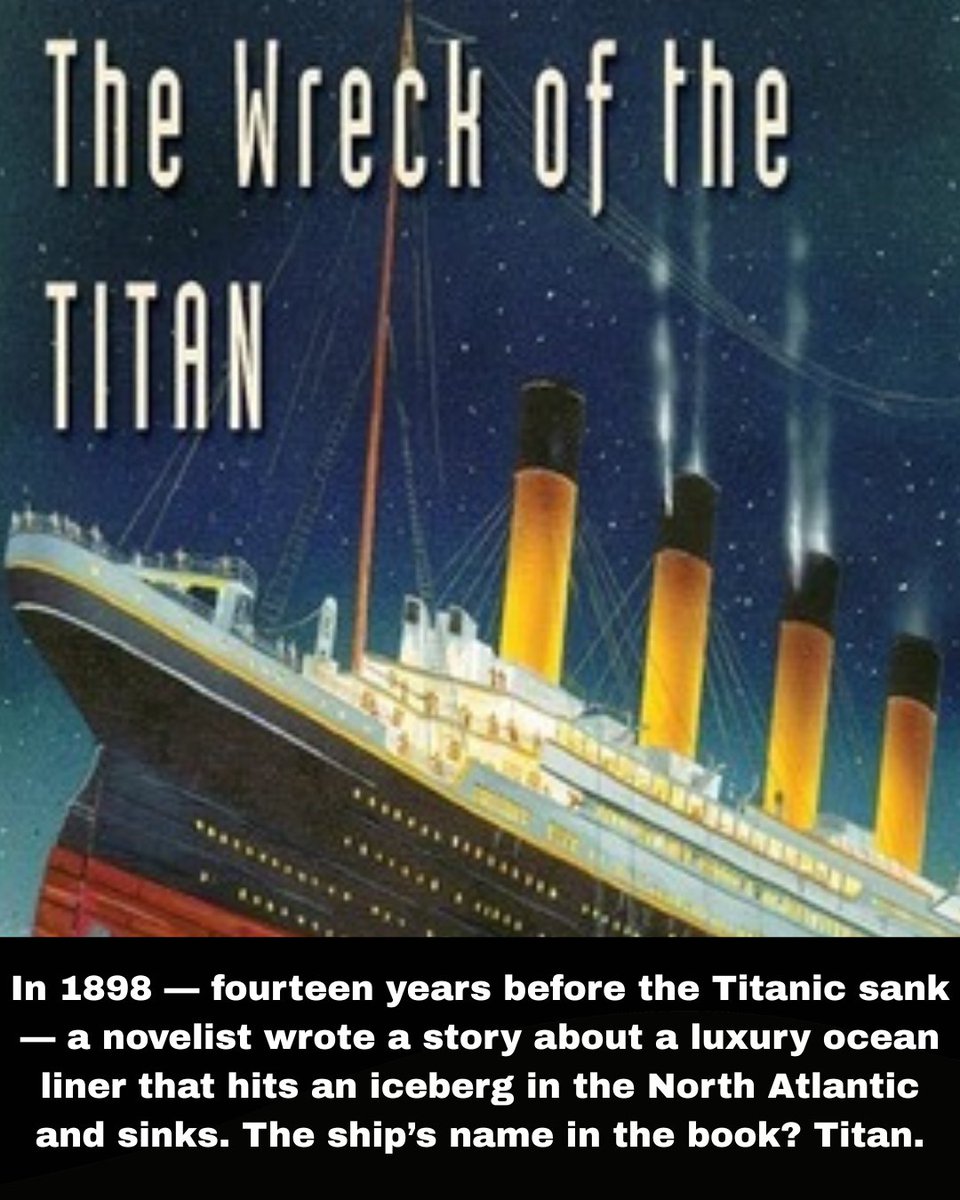
In 1898, author Morgan Robertson published a novella titled Futility: Or, The Wreck of the Titan. The story told of the Titan, the largest ship ever built — a supposedly “unsinkable” luxury liner that strikes an iceberg in the North Atlantic on a cold April night. With too few lifeboats, most passengers perish in icy waters. Fourteen years later, the Titanic would meet the same fate — almost detail for detail.
The similarities are eerie: both ships were about 800 feet long, both struck an iceberg on their maiden voyages, both traveling at around 22–25 knots, both carrying about 2,000 people, and both lacking sufficient lifeboats. Robertson’s fictional ship even sank roughly 400 nautical miles from Newfoundland, the same general area where the Titanic would go down.
After the Titanic disaster in 1912, Futility was rediscovered and hailed as prophecy. Robertson denied any supernatural foresight, claiming he simply knew the maritime industry well. Still, his chillingly accurate tale stands as one of the strangest coincidences in literary and real-world history — fiction that became fate.
On September 12, 1940, Marcel Ravidat followed his dog, Robot, into a hole near the village of Montignac, France. Crawling inside with friends and a lantern, he discovered something extraordinary — vast chambers covered with paintings of bulls, deer, horses, and mysterious symbols. The colors were still brilliant after millennia, preserved by the cave’s sealed air.
Archaeologists soon realized the Lascaux paintings dated back to the Upper Paleolithic era — around 15,000–17,000 BCE. These weren’t crude doodles but masterful works: animals in motion, shading for depth, and symbolic meaning that hinted at early spirituality or ritual. The discovery proved prehistoric humans were not primitive brutes, but artists and thinkers with imagination as rich as our own.
Lascaux became known as the “Sistine Chapel of Prehistory.” Today, the original cave is closed to protect it from damage, but replicas allow millions to experience humanity’s oldest art gallery — a time capsule painted in torchlight, deep in the earth.
In 1932, the U.S. Public Health Service launched what it called the “Tuskegee Study of Untreated Syphilis in the Negro Male.” Six hundred Black men in Alabama — 399 with syphilis and 201 without — were told they were receiving free medical care. In truth, researchers only watched the disease’s progression. Even after penicillin became the standard cure in 1947, the men were deliberately left untreated.
The participants, many poor sharecroppers, suffered and died needlessly. Their families weren’t told the truth, and the doctors continued the experiment for 40 years, recording symptoms rather than saving lives. It wasn’t until 1972, when a whistleblower exposed the study to the press, that it was finally shut down.
The Tuskegee Study became a national scandal — a symbol of racial injustice and medical betrayal. Its legacy reshaped research ethics, leading to laws requiring informed consent and the creation of Institutional Review Boards. But for hundreds of men, that justice came far too late.