Appreciation for leisure built the last generation of strong men in India. Was sitting with a retired member of the armed forces. He knew how to ride horses, enjoy his drinks, relish his golf — all while still producing volumes of highly complex writing with strategic significance. For these men, discipline and leisure are not at cross purposes. They are the same thing.
Contrast this with cervical-necked, low-T techie of today. He works for ungodly hours in front of a computer. His entire existence is sterile and devoid of any real challenges. Most challenges stem from overthinking and from being too soft. He’s not forged in the fires of anything. His great project is not nation building or character building. His great project is a Notion doc that he tends to like a farmer. Say what you will, there is no heroism and glory in modern day computer-based knowledge work.
It’s all optionality-chasing and hyper consumerism.
To bring back leisure, one must learn to do things for their own sake. One must run to the great hobbies not from a desire to upskill or to be productive but because that is what sporting and enterprising men have forever done. Let me also say I have no problem with computers. I’ve built my career on one. But the obsession with the perfect workspace, the headphones, the coffee, the ergonomic chair — all represent a slow death of your vitality. Men have always engaged with the world. They must be outside doing things. They must be participating in life.
Deck sharing platforms are way too expensive.
And worse, most of the useful stuff is locked away.
Founders should be able to know whether an investor opened their deck, how long they spent on it, where they dropped off, or whether they downloaded it.
We built RaiseGate to make all of this accessible.
And today, we are opening sign-ups.
For this week, anyone can join. Starting next week, public sign-ups close and RaiseGate becomes invite-only through existing users.
We are also giving you the Pro plan for free on one condition: invite another founder to use RaiseGate.
Fundraising infrastructure should not be gated behind expensive plans.
Founders should have more control over their own data, not at the cost of their wallet.
Amdavad, Surat, Vadodara- best goddam street food in India - all vegetarian - sometimes eggs. But oh man, Gujjus really appreciate good food. It’s quirky, and absolutely no respect for origin and authenticity - but it’s the best.
We often mistake repetition for failure. Every unsuccessful attempt feels like evidence that we are falling short of our potential. We abandon things, convincing ourselves they simply aren't meant for us. We blame the universe, or spiral into self-pity, which, in its own strange way, can be just as comforting as victory because it absolves us of the need to keep trying.
In reality, however, repetition is the process through which potential is realized. Potential is not something waiting to be discovered, it is something achieved through repeated attempts. Failure is merely what repetition looks like before mastery.
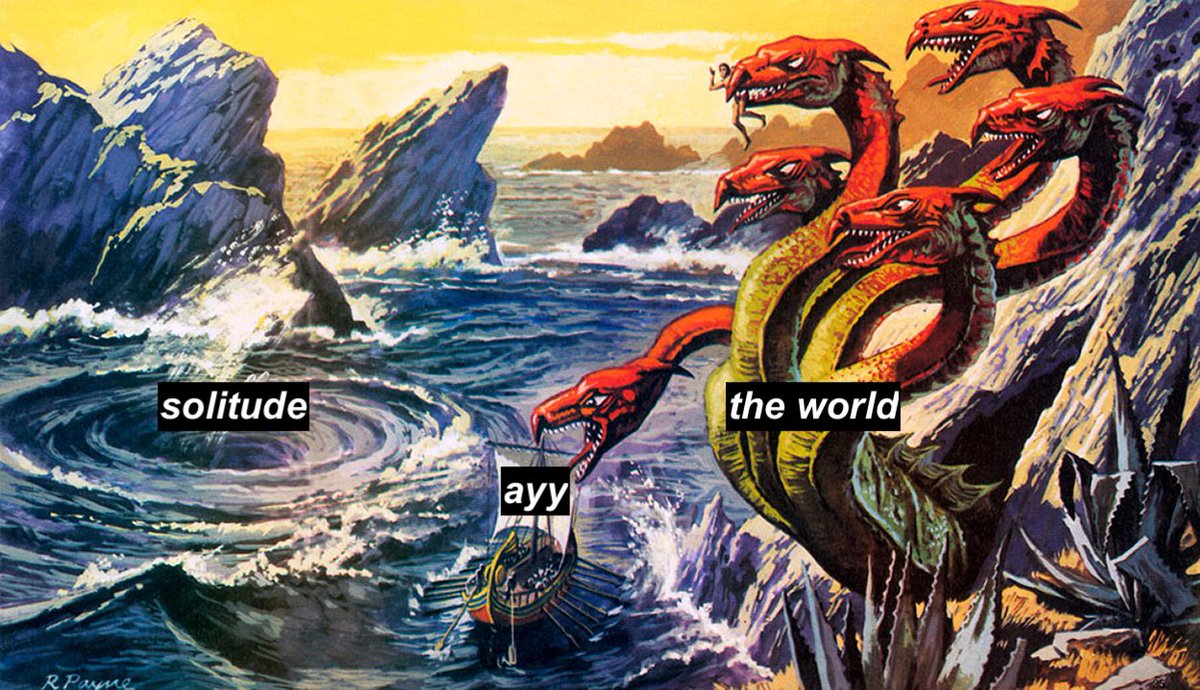
10. “It is easy in the world to live after the world's opinion; it is easy in solitude to live after our own; but the great man is he who in the midst of the crowd keeps with perfect sweetness the independence of solitude.” – Ralph Waldo Emerson
Good morning …Nietzsche on the morality of sympathy and aid…adjacent to criticism of rationalism and effective altruism and many other things in our time as well
In 1873, a painfully shy Yale professor published a series of dense, mathematical papers that practically no one in America could understand.
He was so obscure that his university didn't even bother to pay him a salary for the first nine years of his career.
Yet Albert Einstein later called him "the greatest mind in American history."
His name was J. Willard Gibbs.
He didn't invent a new machine or discover a new particle. Instead, he did something far more profound: he took the invisible, chaotic chaos of chemical reactions and turned it into a breathtaking geometric map.
In doing so, he quietly laid the foundation for modern chemistry, metallurgy, and the materials that built the 20th century.
In the late 19th century, chemistry was a mess of trial and error. Scientists knew that if you mixed certain elements together under heat and pressure, things happened. Sometimes they exploded. Sometimes they froze. Sometimes they morphed into entirely new substances.
But no one knew why. There was no universal formula to predict if a chemical reaction would happen spontaneously or require external energy.
The scientific establishment was trying to solve this by treating chemistry like a giant cookbook, memorizing thousands of individual recipes.
Gibbs looked at this chaotic kitchen and realized they were missing the underlying architecture.
He introduced a radical new concept that we now call Gibbs Free Energy. He proved that every chemical system has a hidden, mathematical bank account of energy available to do work.
But his true genius wasn't just the math; it was how he visualized it.
Gibbs realized that you could map a substance’s temperature, pressure, and energy onto a three-dimensional geometric surface.
Suddenly, the messy, unpredictable behavior of matter became a landscape.
A chemical reaction wasn’t a mysterious magical event anymore. It was just a ball rolling down a hill. If the geometric slope leaned downward, the reaction would happen naturally (spontaneous). If the slope went upward, the reaction was impossible without forcing it. Water turning to ice, iron turning to rust, coal turning to diamond, all of it was just matter navigating the hidden topography of Gibbs' geometry.
When Gibbs sent his work to Europe, the legendary physicist James Clerk Maxwell was so struck by its genius that he literally sculpted a 3D plaster model of Gibbs’ thermodynamic surface with his own hands and mailed it to Gibbs' house in Connecticut.
The philosophical blueprint Gibbs left behind is a game-changer for navigating complex decisions:
You cannot master a chaotic system by memorizing every possible outcome. You master it by mapping the terrain.
Most people approach their life decisions, their careers, investments, or habits like 19th-century chemists. They treat every new situation as an isolated recipe. They ask, "If I mix X and Y today, will it explode?" They look for specific formulas for specific moments.
But life, like chemistry, is governed by an underlying energetic terrain.
If you stop looking at individual events and start looking at the energetic slope of your choices, everything changes. Some habits have a downward geometric slope, they require almost zero effort to maintain once they start rolling, naturally producing massive results. Other goals have an impossible upward slope because you are fighting the natural friction of your environment.
Success isn't about forcing an explosion through sheer willpower. It’s about altering the geometry of your environment so that the outcomes you want become the path of least resistance.
What is a goal in your life right now that feels like an impossible, exhausting uphill battle? Stop trying to force the mixture to react. How can you change the pressure, the environment, or the underlying structure of your day so that success becomes a ball rolling down a hill?
Mirra Andreeva on beating Kostyuk to reach Roland Garros final
"I just told myself that no matter what happens, I'm just gonna fight, give my best. If she ends up winning, she's gonna have to really work for it. With this mindset, I ended up winning."