The sooner politicians understand this, the better it will be for their future and the country’s.
A commoner is not obsessed with India becoming a superpower.
A commoner is least bothered whether the deity is called Arunachaleswarar or Annamalaiyar.
People are growing wary of all such narratives.
What they are actually looking for is:
Employment opportunities that enable a financially dignified life
Freedom from paying bribes to every petty official they encounter in daily life
Good quality water and air
Proper footpaths to walk on
Comfortable space in trains to travel
Affordable, well connected public transportation
Well maintained public places like parks where they can relax with family
Affordable or subsidised quality education and healthcare
At least a minimum social safety net for their retired life or old age
I hope you get the drift.
They want both their quality of life and standard of living to improve.
They want far less ideology- especially divisive ideologies.
All they want are basic improvements in daily life.
Politicians who understand this will have a bright future.
Those who don’t will fade into oblivion.
Driving in India is very easy.
You just have to be alert for:
Potholes
Cows
Dogs
Wrong-side vehicles
Autos
E-rickshaws
Buses
Trucks
Tractors
Pedestrians
Waterlogging
Open manholes
Sudden diversions
Unmarked speed breakers
Random road construction
VIP convoys
People on phones while driving
People not using indicators
People not following lanes
People not following rules
And somehow everyone believes they have the highest priority.
Taxi driver test. Reception test. Breakfast order test. Three interview tests that have nothing to do with job-level competency and everything to do with who you inherently are. The third one was used in Lage Raho Munna Bhai too, where Munna Bhai asks a girl to test her would-be groom by seeing how he treats the waiter at the restaurant they meet.
The larger point all these make: how you behave when no one of crucial relevance to you is watching matters in ways that you cannot comprehend.
Within the context of personal branding, I call this the 'anchor audience concept'. Before you post anything online, ask: if my child, spouse, parent, or closest colleague saw this... would they recognize the same person they know?
You could argue that an older parent may never visit Twitter and you could behave any way you want there away from the prying parental eyes. Ditto with a young son or daughter obsessed with Instagram and your behavior on LinkedIn. But digital platforms are not hard walls - they are extremely permeable and you never know who can see how you behave in which platform.
Even more important is the idea that it is not about who is watching (that should change your behavior) but your own self-awareness. How do you behave when absolutely no one is watching? That's just you, with no audience.
All this matters in personal branding, and I address them in context of what you can do with them, and how you can use them practically to build self-awareness and shape your persona in my personal branding workshops.
There's one coming up for individuals on July 11th that I'm doing for CNBC TV-18. It will be done live (on video). Sign up for it, today: https://t.co/544QSvV6o7
#personalbranding #personalbrand
Every single place in India is just so overcrowded.
- Want to go to a park? Hundreds are already there, not enough space.
- Want to go to a temple? You won’t even get five minutes of peace.
- Want to visit a hill station? Not a single hotel is available.
- Same with Ladakh, Uttarakhand, and everywhere else.
It feels like the calmest place is your own house.
Sending kids to school in the 90s & 00s:
1. Pay tuition fee
2. Buy books and uniform
3. Send kid to school
Sending kids to school in the 2020s:
1. Pay 20% of salary as tuition fee
2. Buy books
3. Buy in house books
4. Buy school mandated stationery
5. Buy uniform because of yet another design change
6. Run to paediatrician, ophthalmologist & dentist for ‘certified medical form’
7. Sign waiver for your kid’s photos & videos to be plastered over social media for the school’s propaganda
8. Buy clothes for red, blue, green,… days because of the no jeans, sleeveless,… rules
9. Buy annual day costume
10. Pay various miscellaneous fees throughout the year for miscellaneous activities
Still school will abdicate all responsibility for child’s safety and welfare and put its image first in case anything happens.
Have I missed out on anything?
India doesn’t have a shortage of rules.
It has a shortage of consequences.
Miss your tax filing:
Penalty.
Miss your EMI:
Penalty.
Miss your train:
Penalty.
The Delhi–Mumbai Expressway was originally targeted for completion years ago.
The Mumbai Coastal Road missed multiple deadlines.
Several Smart City projects missed their timelines.
Government misses a deadline:
New deadline.
Accountability works differently depending on who misses it.
A foreign tourist lands in Jaipur.
Stays in a beautiful heritage hotel
clicks pictures at forts
rides an elephant
eats dal baati
posts: India is magical.
For 3 days,
he experiences culture.
But ask the local citizen living there for 30 years:
How roads become after rain
How traffic feels daily
How pollution increases yearly
How public hospitals struggle
How footpaths disappear under encroachment
A country should not feel developed
only through the eyes of tourists.
Real development is what citizens experience
after the camera is switched off.
One silent scam destroying the middle class is this:
The government collects taxes promising public services.
Then the same middle class pays again privately for everything.
Private schools because government schools fail.
Private hospitals because public healthcare is broken.
RO water because tap water is unsafe.
Inverters because electricity is unreliable.
Gated societies because public safety feels weak.
Private vehicles because public transport struggles.
So what exactly are people getting in return for their taxes besides more taxes?
The middle class is no longer paying once for survival.
It is paying twice for every basic necessity.
My daughter was doing her holiday homework and one book got damaged badly.
We checked online for a replacement.
Same book.
35% cheaper on Amazon.
Yet many schools still avoid sharing proper book details and indirectly force parents to buy from fixed vendors at higher prices.
First high fees.
Then compulsory uniforms.
Then expensive stationery bundles.
Now even books feel like a controlled business.
Education is becoming less about learning and more about extracting money from parents.
Why can't our Govt do a study to find out how much petrol diesel we can save by just
> Filling the potholes and making roads smooth
> Making last mile connectivity with public transport and metro
> Reducing traffic so that cars don't burn unnecessary fuel while covering 4km distance in an hour.
> Removing encroachment and make proper footpath to walk
> Providing parking facilities at metro station so that people can park their vehicle and then use public transport.
If they fix all these things, I'm sure India will have to import a lot less oil than we trying to do by blending ethanol in petrol which is causing low mileage and performance issues in incompatible vehicles.
Tatkal booking on IRCTC has become a joke.
Seats show available, but the moment it turns 10 AM, the site hangs.
10 AM: Seats visible.
10:01: Website freezes.
10:03: All seats gone—even in remote routes.
10:04: Site suddenly smooth.
By the time it works again, all tickets are gone even for small routes.
Then the website runs smoothly because nothing’s left to book.
This used to happen years ago.
Suresh Prabhu had fixed it, but now it’s back.
Agents win, common people lose
again.
#IRCTC #TatkalBooking #IndianRailways
"It is a minor miracle that Indian youth, faced with parental pressure, overbearing states, systemic incompetence and poor job prospects, respond only with a silly meme. Their peers in Nepal, Bangladesh and Sri Lanka have been rather more heavy-handed with their own ageing leaders".
X and the mainstream media today is going to be filled with cynical 'pragmatists' flexing about how one off protests mean nothing, idealism has no place in India, and of course the normal 'everyone but us is anti-national' rhetoric. It simply reveals how unimaginative they themselves are.
If you're young, be respectful, above all be peaceful, but be passionate and loud about your demands. It is your birth right, even if it amounts to nothing. You deserve an honest education system.
Don't let a bunch of people with bent spines and full bellies tell you otherwise.
Every major change in this country began as something small enough to be mocked. A few students gathering. A few placards. A few voices demanding accountability.
And right now, that’s exactly what many people are doing with the CJP protest. Dismissing it before it has even had the chance to grow.
The easiest position in any society is cynicism. It costs nothing. It demands nothing. You don’t have to stand in the heat, raise a question, risk criticism, or challenge authority. You simply sit back and declare that nothing will change. If one day you’re proven right, you call yourself realistic. If you’re proven wrong, history moves on without remembering you.
But movements are not measured by their first day.
The real achievement of the CJP protest is not the crowd size. It is that a stage now exists where none existed before. A pillar has been planted. A space has been created where students can speak about an education system that has repeatedly failed them. Every movement starts by creating a place where silence is broken.
For years, students have been told to study, compete, suffer, and move on. Paper leaks happen. Exam irregularities happen. Careers get delayed. Mental health collapses. Some students even lose their lives under the weight of a system that rarely apologizes and almost never takes responsibility. Yet the moment students organize themselves and demand answers, they are told to be practical.
Practical for whom?
The youth of this country are expected to carry its future, but whenever they ask for fairness, transparency, or accountability, they are treated as an inconvenience.
That is why these movements matter.
Not because they guarantee victory.
Not because they guarantee policy change.
But because they remind young people that citizenship is more than obedience.
An honest education system is not a political demand. It is the bare minimum promise a society makes to its young.
And if today’s protest inspires ten more students to speak, and those ten inspire a hundred more, then something important has already happened.
So support youth movements. Criticize them when necessary, but don’t ridicule them from the comfort of your chair. Every right people enjoy today exists because someone, at some point, was told their protest would achieve nothing.
The people who change societies are rarely the ones predicting failure from the sidelines. They are the ones willing to stand up despite the possibility of failure.
History remembers those who raised their voices.
It rarely remembers those who spent their lives explaining why nobody should.
Jai hind, Jai bharat 🇮🇳
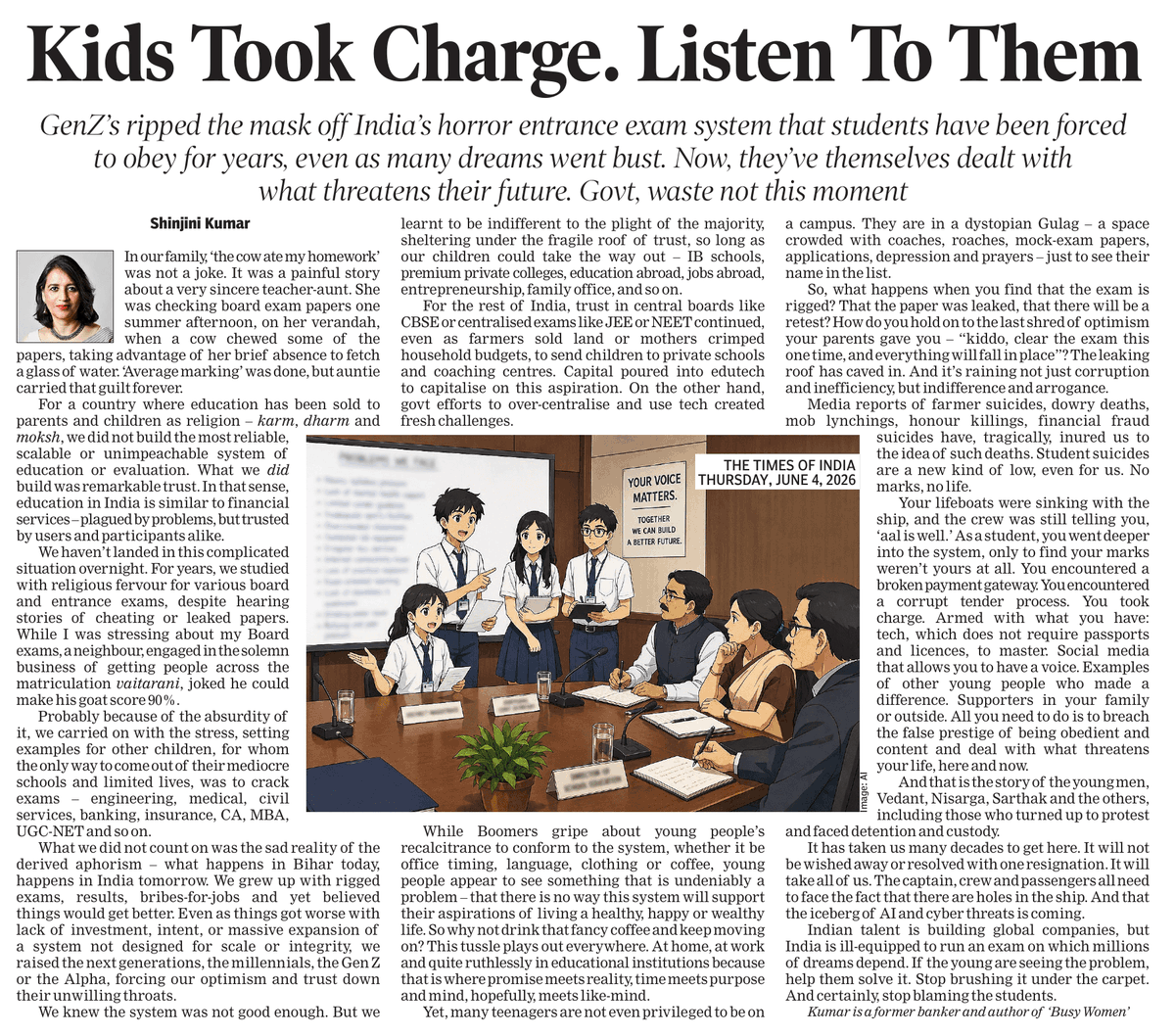
"What happens when you find that the exam is rigged? That the paper was leaked, that there will be a retest? How do you hold on to the last shred of optimism your parents gave you? It’s raining not just corruption and inefficiency, but indifference and arrogance. Indian talent is building global companies, but India is ill-equipped to run an exam on which millions of dreams depend".
बुलेट ट्रेन, 5 ट्रिलियन इकोनॉमी, विश्वगुरु बनने की बाते है, और 1 लाख स्कूलों में बिजली नहीं, वही 98,500 स्कूलों में बेटियों के लिए शौचालय नहीं।
जिस देश के बच्चों को बुनियादी सुविधाएँ न दे पा रहे हो हम तो सच में आत्ममंथन की जरूरत है #education_system
People who celebrate 10-minute deliveries as a sign of India’s progress should read this.
During the Malviya Nagar fire incident, locals say fire brigades reached nearly 45 minutes late. Residents had to spread mattresses to rescue people trapped inside, including foreign nationals.
Development is when emergency services arrive in minutes, not when groceries do.
Students impacted by the bungling by CBSE will be voting age in 2029. They’ll influence their parents, who are equally impacted by the uncertainty over their children’s future. So far the gvt has been slow, and response inadequate. Next batches of students and their parents will be concerned as well.