Just caught in the wild in PDX!!! Somehow, this flyer has been hanging up for over a year🤣 If you haven't seen the epic video for our song 'The Maker', you can find it on the Alternative Tentacles YouTube channel, featuring this insane cast. See it here: https://t.co/iFx9P9g9QV
Just caught in the wild in PDX!!! Somehow, this flyer has been hanging up for over a year🤣 If you haven't seen the epic video for our song 'The Maker', you can find it on the Alternative Tentacles YouTube channel, featuring this insane cast. See it here: https://t.co/iFx9P9g9QV
#ピープルわちゃわちゃ大集合ジャケ貼ろうぜ
Victims Family & Nasalrod
『In the Modern Meatspace』
2つのバンドコラボ。人物より変な生き物が目立つかなぁ(´・ω・`)(別なお題で使いそびれたのでw)
今回はNasalrodの曲⬇️
The Maker
https://t.co/5JiiLPqR5r
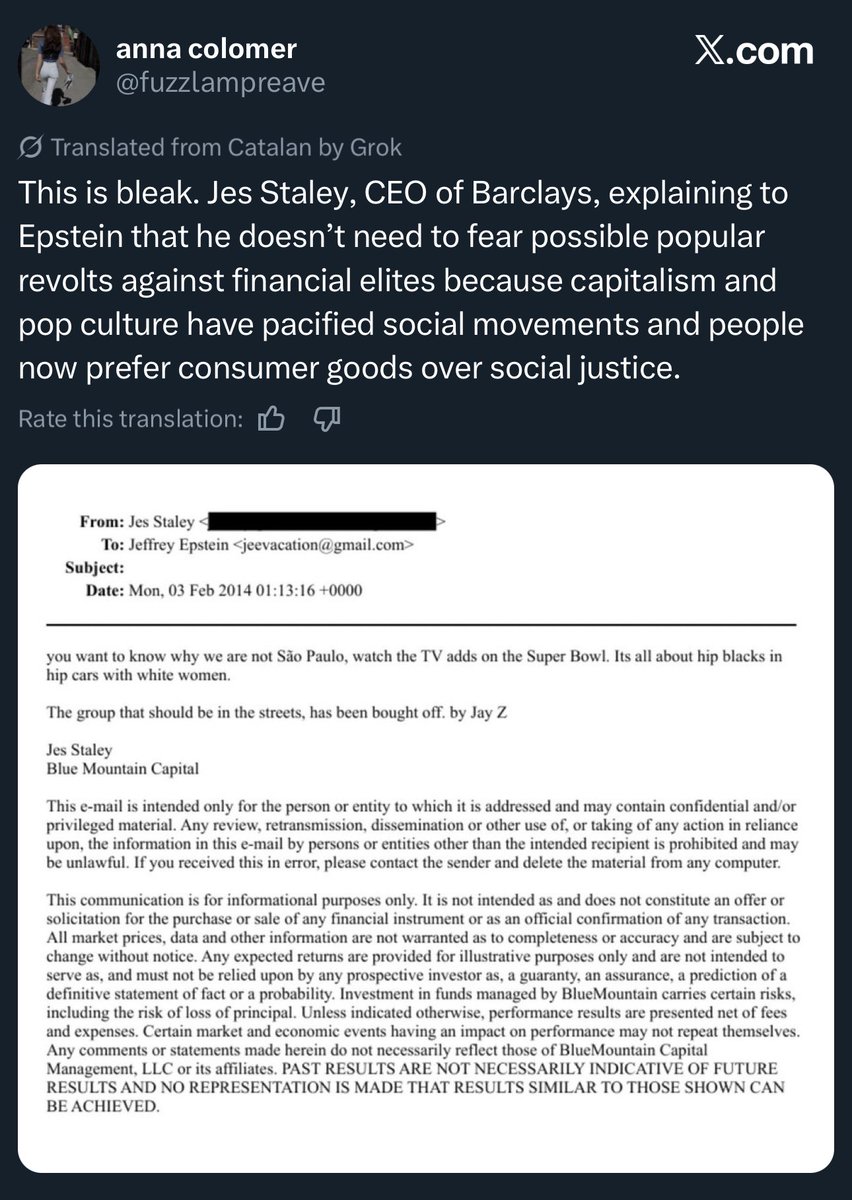
“The group that should be in the streets was bought off by Jay-Z.” Even the oligarchs think you should have pitchforks, they’re just confident you won’t ever bother
Marco Rubio 2 days ago: “Imagine if Iran funded the well-being of its people, rather than its military”
Trump today: “We can’t fund daycare or Medicaid, we need more money for our military”
Sometimes the jokes write themselves.
Paul Schrader's 'Blue Collar' (1978) was a very tense shoot, because Richard Pryor, Yaphet Kotto, and Harvey Keitel argued constantly. There were fights, verbal abuse, walk-offs, and Mexican stand-offs. According to Paul Schrader, Pryor hit Kotto with a chair on camera during filming.
Here is Schrader explaining the tense atmosphere & the reason why he cried during the filming of 'Blue Collar' (1978):
"Schrader: [Richard Pryor was never meant to be the star of the movie]. A lot of the difficulties on the film came out of the fact that | had approached Richard and Harvey Keitel and Yaphet Kotto separately and led each of them to believe that they were the star of the movie, because that’s what it took to get them involved. You were basically introducing three bulls into a china shop and asking them to get along, and you can’t really blame the bulls when things start getting wrecked. Very early on, by the second or third day of production, Richard became convinced that he was playing the black sidekick to Harvey’s Terry Molloy, and Harvey became convinced that he was playing Ed McMann to Richard’s Johnny Carson, and Yaphet was convinced that they were both trying to ace him out, and things got very heavy.
We were shooting in auto plants in Detroit and Kalamazoo in middle of a heatwave and pretty much what was happening on-screen started happening off-screen. Not a day went by without some sort of confrontation. Right after you said ‘Cut’, a fight would start. After about three weeks in, I was in the middle of the set and all of a sudden I started crying and I just couldn’t stop, something I'd never done before. The AD grabbed me and took me outside and walked me around the block and I said, ‘This is not working. The movie is never going to get finished and I'm never going to work again.” But he calmed me down and walked me back in and I guess everyone realized I wasn’t as much the iron man as | had been appearing. Richard looked at me and said, ‘You pu**y —are you gonna be a man or not on this movie?’, and I said, ‘OK, Richard, I’m sorry. It won’t happen again.’
Interviewer: Did things improve from that point on?
Schrader: Part of the problem was to do with Richard’s style of acting. Being primarily versed in stand-up comedy he had a creative life of between three and four takes. The first one would be good, the second would be real good, the third would be terrific and the fourth would probably start to fall off. Whereas Harvey, with his theatrical training, very self-analytical, would work on the meaning of the scene in the early takes and then after ten takes he’d be terrific. Well, there’s virtually no way you can film those two men together, so you’d have to rehearse Harvey with a stand-in and then bring Richard in without any rehearsal.
The other thing that Richard would do when he felt his performance going flat was to improvise and change the dialogue just like he would have done in front of a live audience, and he would never tell me or anyone what he was going to do. In one case I had a two-shot of Richard and Harvey where Richard just started flying, and of course Harvey tried to top him, and as soon as that happened Richard just sort of took off and became brilliant.
Harvey broke a take once because he felt himself being knocked out of shot. I had to grab Harvey and get him down on the floor and yell at him, ‘Don’t you ever break shot!’, because Richard was right behind me trying to get at him.
So the shooting strategy became very limited: ‘I know I may only have one take with these actors, so what’s the best one?’, and you’d work out the minimum coverage you needed and that’s all you got. Sometimes if they were in a good mood you could actually try something a little different, but by the time we shot the last scene, the one with all three of them on the sofa after the party, they hadn’t been talking to each other for a long time, and I had fallen into a prolonged pattern of script negotiations which usually began the night before and went on into the morning of shooting, talking to each of them until they were all happy with the others’ improvisations.
Now the day before the sofa scene Richard had hit Yaphet with a chair on-camera, so I knew it was going to be tough. We lit the scene with extras, put their names on the sofa with pieces of tape, and the crew were all warned. The three of them came into the room in silence, there was no discussion, I said ‘Action’ and we did the first take, which ran to about four or five minutes — much too long. So I said, ‘OK, that’s very good, but it’s too long for us. We’re going to go right again. No one move, no one talk, let’s just do it a little faster. Action.’ We did that take on the same reel of film and that was two and a half minutes. I said, ‘Cut’, and Richard got up, went downstairs, got in his car and drove home. End of movie.
Interviewer: All this must have given you a completely different perspective on the job of being a director than the one you’d envisaged when you were a critic.
Schrader: It did. I said afterwards that if this was what movie-making was like I didn’t want to do this any more. On that film, I very quickly learned to confine myself to talent management, to making sure the actors stayed in character and the storyline remained coherent. I handed over shot selection and lighting and blocking essentially to my crew. I didn’t have time to explore those areas."
('Schrader on Schrader & other writings', edited by Kevin Jackson, 1990)
[P.S: On this day, 48 years ago, 'Blue Collar' was released in the USA]
Jello Biafra, Al Jourgensen, Lee Ving, Janet Weiss, Matt Pike, Steve Turner... En este vídeo sale todo el mundo!
https://t.co/SfULlENavz
https://t.co/8DRL8vMTlI
Wrote about Nasalrod's (@Nasalrod) aburdist resistance to looming totality on their split with Victims Family. Out on Nadine Records. Review links below.
Whoa shit PDX! We are verrry excited to join this truly insane bill with the one & only IGGY POP, DEVO, THE DAMNED & more! What?!?! It's all goin' down @project_pabst on Sat, JULY 26th - at Waterfront Park! Tix on sale at 10am PST this FRIDAY, Feb 28 at https://t.co/y8X03HalNu!!!
Nasalrod Release Star-Studded Video Featuring Members of Ministry, Dead Kennedys, Fear, Poison Idea, Dead Moon, Quasi, Mudhoney and More Before Embarking On Tour
https://t.co/Pqei8A6rsb
Nasalrod release star-studded The Maker-video featuring members of Ministry, Dead Kennedys, Fear, Poison Idea, Dead Moon, Quasi, Mudhoney and many more!
Watch The Maker here:
https://t.co/ud3fOma7gW https://t.co/5hEyAfULJJ via @YouTube