Hardcore BJP supporters or those devoid of logic (mostly, both are same) say if BJP indulged in vote chori, they would have easily won 272+ seats. Let me explain why that was not a feasible option 🧵
"सरकार के पास दिया जलाने के लिए पैसा है - हमारे हॉस्टल के लिए क्यों नहीं?"
यह सवाल कल इंदौर में एक ��ात्रा ने मुझसे पूछा।
गाँव से पढ़ने शहर आई। हॉस्टल है नहीं, तो PG में रहना पड़ता है। सिर्फ़ सुरक्षित रहने में लाखों ख़र्च हो जाते हैं। हर महीने किराए की चिंता, और बेघर होने का डर - इसी में पढ़ाई करनी पड़ती है।
कई लड़कियाँ इसी वजह से पढ़ाई छोड़ देती हैं। सिर्फ़ इसलिए कि रहने की जगह नहीं है।
और आवास भत्ता? महंगाई के साथ बढ़ता नहीं, ऊपर से भ्रष्टाचार की भेंट चढ़ जाता है।
@narendramodi जी - उस बच्ची के सवाल का कोई जवाब है आपके पास?
At a time when the national conversation around students is about paper leaks and young people being beaten for asking questions about their own future, Karnataka has done the opposite. CM DK Shivakumar avaru has constituted a Cabinet Sub-Committee on Student Issues and Education Reforms, chaired by UT Khader avaru, with Basavaraj Rayareddy avaru, Priyank Kharge avaru, Sharan Prakash Patil avaru and Madhu Bangarappa avaru as members.
Look at what the committee has actually been asked to examine. Examination and recruitment integrity, with a mandate to prevent paper leaks and establish a fixed, time-bound calendar. Regulation of fees charged by private institutions and coaching centres, to reduce the financial burden on families. Infrastructure and quality in government schools, PU colleges and universities, including teacher vacancies. Curriculum aligned to real employment opportunities, with stronger apprenticeship and internship pipelines. Student mental health, including specific measures for suicide prevention in coaching hubs and hostels. And access and equity, with support strengthened for SC, ST, OBC, minority and first-generation learner students.
The committee has one month to submit its report after consulting students, parents, teachers and institutions across the state.
CM DK Shivakumar avaru said something that stayed with me. Good governance begins with listening. Our youth have the ambition, our responsibility is to match that ambition with opportunity.
That is the difference between a government that responds to its students with lathis and one that responds by setting up a structure to actually listen and act.
It took 6 to 7 hours of Shri Rahul Gandhi avaru sitting on the ground outside a police station for an FIR to be registered in the case of a 19-year-old shot by security forces while peacefully protesting. Six to seven hours. For an FIR. The most basic step in the criminal justice process.
Imagine how long it would have taken if he was not there. Imagine how long it takes every day for the ordinary person who comes to a police station without a camera crew, without a Parliament membership, without the eyes of the country watching.
That is precisely why he was there. Because he understands that in this country, justice does not move unless someone refuses to leave until it does.
And notice something else. When the cameras finally came and the press gathered outside that police station, Shri Rahul Gandhi avaru stepped back. Sahil spoke. His mother spoke. The victim was at the centre, not the leader who had spent six hours getting him there. That is how he is. He does things because it is right and not because he needs limelight.
Sahil got his FIR filed after six hours. Millions of others are still waiting at counters across this country with no one sitting beside them.
That is the fight Shri Rahul Gandhi avaru has chosen. The person who shows up. Every time.
Karnataka has done what no other state in India has done. CM Shri DK Shivakumar avaru and Shri Priyank Kharge avaru deserve full credit for it. While CBSE mandated AI education from Class 6 across its schools from April 2026, that is a curriculum on paper. Karnataka has built the device to deliver it.
On August 21, CM Shri DK Shivakumar avaru formally launched KEO across government schools. Shri Priyank Kharge avaru took it from concept to production in exactly one year. KEO stands for Knowledge-driven, Economical and Open-source. It is India's first AI-native personal computer built on an open-source RISC-V chip, developed by KEONICS in collaboration with Karnataka's Department of Electronics, IT and BT. It runs on Linux, is priced at Rs 18,999, and comes preloaded with BUDDH, an AI agent trained specifically on Karnataka's school syllabus that works entirely offline. No internet needed. A child in a village with no connectivity gets an AI tutor built for their exact curriculum.
Why does the chip matter? ARM and x86 chips used in most computers require heavy licensing fees. RISC-V is open-source, built at UC Berkeley and free to the world. Building on it cuts the cost and breaks the monopoly.
1,000 units have been deployed in the first phase. KEONICS officials have stated the longer-term plan is to cover 42,000 primary schools, 6,000 secondary institutions and nearly 2,000 government hostels across Karnataka.
Only 15 percent of Karnataka's population has access to a computer today. Karnataka is the only state that has built an AI-native, open-source hardware solution to change that. That is the difference between a curriculum announcement and actual delivery.
As of December 2025, the Naga peace process remains unresolved. What was sold as a final accord through official and media hype was merely a preliminary step. A decade later, it exposes how PR was the priority and objective, real solution was never the goal 🧵
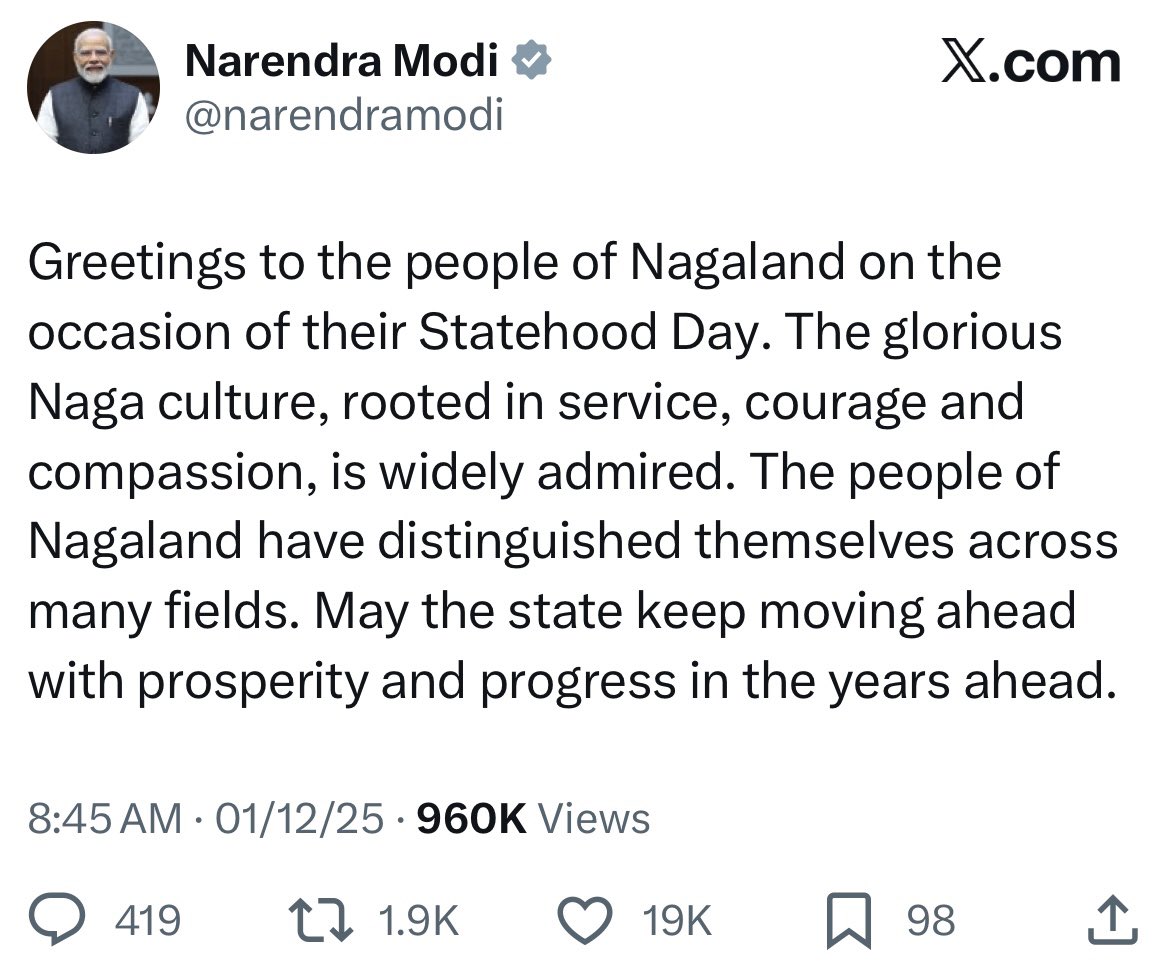
Today, on Nagaland’s Statehood Day, Narendra Modi wished the people, praising their service, courage. It’s a good time to revisit his first “jumla” delivered to people of Nagaland after becoming PM: The Naga Accord. Read on to know how BJP took people for a ride 🧵
By August 2024, negotiations stalled over NSCN IM’s insistence on a separate Naga flag and constitution, which India rejected. In November 2024, NSCN IM threatened a return to armed resistance and called for third party mediation, claiming India violated the framework.
EC has the software, it can in hours remove voter duplication with over 95% accuracy. And you don’t have to be a rocket scientist to know why they are not doing it
Rahul Gandhi addressed a press conference on voter fraud in Haryana focusing on duplication in electoral rolls. He shared specific data from recent exposures to underline systemic issues in voter list management. Read till end to know how EC is complicit in this fraud 🧵
Integration with Aadhaar for optional verification could enhance accuracy to 99 percent but remains unimplemented despite ECs 2020 assurance to explore biometric linkages for error reduction.