Le monde est fou, L'info doit de plus en plus être revérifiée Mais nul ne doit être ignorant de l'autre ... Habitante de la TERRE élevée à l'Ecole de la Vie
✈️🇫🇷 FLASH - L’avion du Premier ministre Gabriel Attal a fait un vol à vide de 7 minutes entre Rochefort et La Rochelle aujourd’hui, pendant qu’il effectuait le trajet en voiture. Il était attendu à l’éco-quartier "zéro carbone" de L’Houmeau. Son service de communication évoque des "raisons de sécurité". (Sud-Ouest)
Bon, j'en ai MARRE ! Des escrocs ont donné ma voix à une IA qu'ils ont entrainé et ont créé un compte Tiktok de vidéos nulles "d'informations" qui utilise donc...ma voix. @tiktok_France Vous pouvez faire quelque chose ? Possible de faire sauter la chaîne ? Ou avocat direct ?🔥🔥
Vous vous souvenez de la promesse faite par Emmanuel Macron de planter 1 milliard d’arbres ?
En enquêtant, on s’est rendu compte qu’une partie d’entre eux étaient plantés… à la place de forêts rasées ! Les subventions pour la replantation ont ainsi un effet pervers : elles incitent les propriétaires à couper des parcelles entières.
Rendez-vous ce lundi 26 février à 21h sur France 5 dans #SurLeFront pour découvrir la face cachée des forêts françaises.
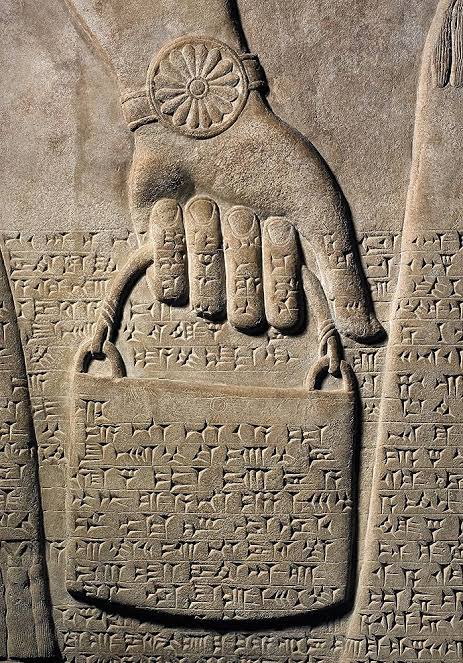
Earliest writing we know of dates back to around 3000 BC and was probably invented by Sumerians, living in major cities with centralized economies in what is now southern Iraq. Earliest tablets with written inscriptions represent work of administrators, perhaps of large temple institutions, recording allocation of rations or movement and storage of goods. Temple officials needed to keep records of grain, sheep, and cattle entering or leaving their stores and farms and it became impossible to rely on memory. So, an alternative method was required and very earliest texts were pictures of items scribes needed to record (pictographs). During its 3000 year history, cuneiform was used to write around 15 different languages including Sumerian, Akkadian, Babylonian, Assyrian, Elamite, Hittite, Urartian and Old Persian.
Writing, recording of a spoken language, emerged from earlier recording systems, 4th Millennium BC. First written language in Mesopotamia is called Sumerian. Most of early tablets come from Uruk, in southern Mesopotamia, and it may have been here that this form of writing was invented. These texts were drawn on damp clay tablets using a pointed tool. It seems scribes realized it was quicker and easier to produce representations of such things as animals, rather than naturalistic impressions of them. They began to draw marks in clay to make up signs, which were standardized so they could be recognized by many people.
From these beginnings, cuneiform signs were put together and developed to represent sounds, so they could be used to record spoken language. Once this was achieved, ideas and concepts could be expressed and communicated in writing. Cuneiform is one of oldest forms of writing known. It means “wedge-shaped,” because people wrote it using a reed stylus cut to make a wedge-shaped mark on a clay tablet. Letters enclosed in clay envelopes, as well as works of literature, such as Epic of Gilgamesh have been found. Historical accounts have also come to light, as have huge libraries such as that belonging to Assyrian king, Ashurbanipal.
Department’s collection of cuneiform tablets is among the most important in the world. It contains approx. 130,000 texts and fragments and is perhaps largest collection outside of Iraq. Centerpiece of collection is Library of Ashurbanipal, comprising many thousands of most important tablets ever found. Significance of these tablets was immediately realized by Library’s excavator, Austin Henry Layard, who wrote :
"They furnish us with materials for the complete decipherment of the cuneiform character, for restoring language and history of Assyria, and for inquiring into customs, sciences, and . . . literature, of its people."
Decipherment of cuneiform began in 18th Century as European scholars searched for proof of places and events recorded in Bible. Travelers, antiquaries, and some of earliest archaeologists visited ancient Near East where they uncovered great cities such as Nineveh. They brought back a range of artifacts, including thousands of clay tablets covered in cuneiform.
Scholars began incredibly difficult job of trying to decipher these strange signs representing languages no-one had heard for thousands of years. Gradually, cuneiform signs representing these different languages were deciphered thanks to work of a number of dedicated people. Confirmation that they had succeeded came in 1857. Royal Asiatic Society sent copies of a newly found clay record of military and hunting achievements of King Tiglath-pileser I to four scholars: Henry Creswicke Rawlinson, Edward Hincks, Julius Oppert, and William H. Fox Talbot. They each worked independently and returned translations that broadly agreed with each other. This was accepted as proof that cuneiform had been successfully deciphered, but there are still elements that we don’t completely understand and study continues.
#archaeohistories
🎻" La musique en elle-même est une forme de guérison " : voici les paroles de la jeune violoncelliste Valentina Irlando qui est atteinte d’une maladie rare à seulement 17 ans. 🎶
🎥 valentinairlando
Une langue, un pas de danse, une recette : quand vous apprenez quelque chose de nouveau, c’est toute une machinerie qui s’active dans votre tête 🧠
Le podcast "Votre cerveau" vous fait découvrir des expériences ludiques pour apprendre à apprendre ➡️ https://t.co/uukniPvIVi
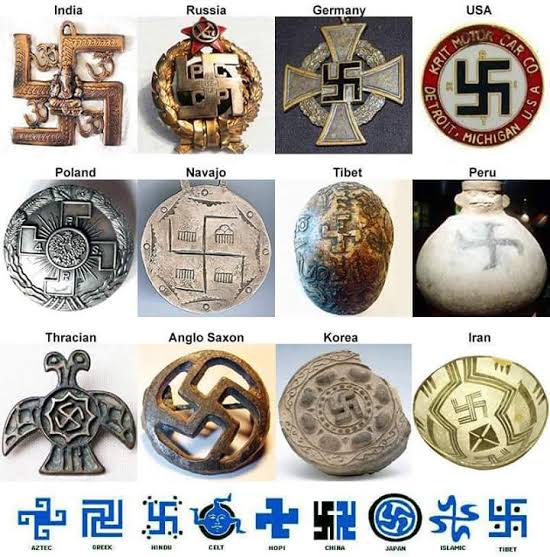
In the Western world the swastika is synonymous with fascism, but it goes back thousands of years and has been used as a symbol of good fortune in almost every culture in the world :
In ancient Indian language of Sanskrit, swastika means "well-being". Symbol has been used by Hindus, Buddhists and Jains for millennia and is commonly assumed to be an Indian sign. Early Western travellers to Asia were inspired by its positive and ancient associations and started using it back home. By the beginning of 20th Century CE, there was a huge fad for the swastika as a benign good luck symbol.
In his book The Swastika: Symbol Beyond Redemption? US graphic design writer Steven Heller shows how it was enthusiastically adopted in the West as an architectural motif, on advertising and product design. "Coca-Cola" used it, Carlsberg used it on their beer bottles. Boy Scouts adopted it and the Girls' Club of America called their magazine Swastika. They would even send out swastika badges to their young readers as a prize for selling copies of the magazine," he says. It was used by American military units during World War One and it could be seen on RAF planes as late as 1939. Most of these benign uses came to a halt in 1930s as Nazis rose to power in Germany.
Nazi use of swastika stems from work of 19th Century German scholars translating old Indian texts, who noticed similarities between their own language and Sanskrit. They concluded that Indians and Germans must have had a shared ancestry and imagined a race of white god-like warriors they called Aryans.
This idea was seized upon by anti-Semitic nationalist groups who appropriated the swastika as an Aryan symbol to boost a sense of ancient lineage for the Germanic people. Black straight-armed hakenkreuz (hooked cross) on the distinctive white circle and red background of Nazi flag would become the most hated symbol of 20th Century, inextricably linked to the atrocities committed under the Third Reich.
"For the Jewish people the swastika is a symbol of fear, of suppression, and of extermination. It's a symbol that we will never ever be able to change," says 93 year-old Holocaust survivor Freddie Knoller. "If they put the swastika on gravestones or synagogues, it puts a fear into us. Surely it shouldn't happen again."
Swastika was banned in Germany at the end of the war and Germany tried unsuccessfully to introduce an EU-wide ban in 2007. The irony is that the swastika is more European in origin than most people realise. Archaeological finds have long demonstrated that the swastika is a very old symbol, but ancient examples are by no means limited to India. It was used by the Ancient Greeks, Celts, and Anglo-Saxons and some of oldest examples have been found in Eastern Europe, from Baltic to Balkans.
- Subscribe for Detailed Post -
#archaeohistories