2/2 From the poetry and spiritual teachings of Rumi and Shams of Tabriz, to Attar’s Conference of the Birds, where the birds journey in search of their king, only to discover that what they were searching for was, in a profound sense, within themselves.
Rumi captured this divine idea in the words often translated as: “What you seek is seeking you.”
Perhaps that is part of what Iran’s awakening is really about.
The freedom Iranians seek is not something that must be given to them by someone else. The courage they need is already within them. The dignity they are fighting for is already theirs. This ancient wisdom is powerful and sits in our DNA.
Perhaps the Iranian people do not need to become something they are not. Perhaps they need to remember who they already are. To remember a civilization that has given the world poetry, philosophy, art, science and profound spiritual thought.
To remember “mehr”: love, compassion, generosity, tolerance, inclusion and https://t.co/9iRcWS5OKs remember that true power is not domination over others, but mastery over ourselves. Perhaps Iran’s future will require more than a change of government. Perhaps it will require a remembering. A remembering of dignity.
A remembering of compassion. A remembering of our connection to one another and to something greater than ourselves. A remembering of the light that has always existed within the Iranian people.
The Islamic Republic does not define Iran nor the great Iranian people. The Islamic Republic may be able to suppress the Iranian people for a time, but it cannot permanently suppress an awakened people.
The fire is still there.
And one day, it will burn bright enough to illuminate a free Iran.
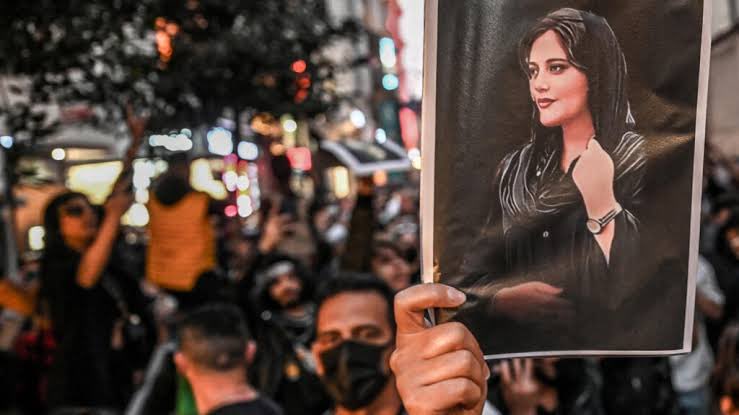
1/2 Tomorrow marks the fourth anniversary of Jina Mahsa Amini’s death after she was arrested and beaten by the morality police over her hijab, I find myself reflecting not only on her tragic death, but on the mass awakening that followed.
For 47 years, the Islamic Republic has subjected Iranians to egregious human rights abuses. Torture, sexual violence, executions, political imprisonment, disappearances and atrocities against children have taken place on a scale that is almost impossible to comprehend. There were countless victims before Mahsa.
So why did Mahsa’s death become the spark that ignited a nation?
Why did her story reach across ethnicities, religions, generations, genders and social classes?
There are many explanations. Decades of accumulated pain. Economic hardship. Corruption. Repression. The growing rejection of gender apartheid and the ideology imposed upon the Iranian people.
But I believe something deeper happened.
Iran awakened.
Perhaps millions of Iranians reached a moment of realization: Yes, we are living under the control of a brutal fundamentalist regime. Yes, we have been abused, silenced and threatened for decades. But we do not have to accept it.
We are not powerless.
Iranians had always resisted. But Woman, Life, Freedom was different. Courage became contagious.
One woman stood, and another found the courage to stand. One person shouted, and another realized they were not alone. People began drawing strength from one another. It was extraordinary. They began to believe in their own power.Fear was replaced by hope.
People could see a light at the end of the tunnel. They began to believe that if enough people stood together, they could actually change the course of their country. That belief was key, because once a people have experienced their own collective power, it becomes very difficult to make them forget it.
When Iranians rose again in January, many carried that memory with them. They remembered Woman, Life, Freedom. They remembered what it felt like to stand together. They came out with courage, determination and hope that perhaps this time the world would stand with them.
Instead, they faced another devastating massacre. Thousands of innocent Iranians were killed, including so many young people, university students, scholars, athletes and ordinary citizens who represented the strongest and brightest hopes of their generation.
The loss was unimaginable. Tragically something else was lost too: Hope.
But, I do not believe the fire has gone out.
You can suppress an uprising.
You can imprison people.
You can kill the bravest among them.
You can force a people back into silence.
But you cannot extinguish an awakening.
You can extinguish the flames temporarily.
But the embers remain. And those embers are what we must protect.
Our role is not to tell Iranians to rise again. It is to help preserve hope, strengthen their belief in themselves and help with preparation, unity and tools they will need when the moment comes again.
But I also believe there is a deeper source of power that we have not talked about enough.
The power within.
The spiritual dimension of human courage.
What happens when people reconnect with something greater than fear? When they remember their inherent dignity? When they rediscover their connection to God, to one another and to the deeper goodness within themselves?
What if the transformation of Iran is not only political?
What if it is also spiritual?
Iran has a long and profound spiritual and civilizational heritage to draw from.
From the ancient Zoroastrian principle of Good Thoughts, Good Words, Good Deeds, to Cyrus the Great, remembered in the Bible as the anointed instrument of God and celebrated for allowing exiled Jews to return home and worship freely.
🧵👇
The regime in Tehran is a direct threat to our people, particularly Jewish and Persian Canadians. This Liberal government has failed to protect them.
Every regime operative willingly helping this terrorist cause must be tracked down and deported to secure our country from terror and violence: https://t.co/4Pl81Bq6pZ
EXCLUSIVE: Canada has awarded millions worth of contracts to an Edmonton resident who is the son of Iran's former VP, and is under investigation for allegedly helping the regime build its missile program & evade sanctions. https://t.co/TTsUi0blq9
What I admired most about my father-in-law, Elmer MacKay, was not his public or political accomplishments, but the hundreds of quiet, unseen acts of kindness and generosity he extended to his community, especially to those who were most vulnerable, forgotten, or in need. These values were instilled in him by his own father, Gordon MacKay, and in turn were passed down to the next generation. Peter was fortunate to be raised by parents who exemplified service to others, compassion and humility: his father, Elmer, through his professorial yet down to earth nature and his mother, Macha, through her lifelong commitment to activism, mental health and public service. May his spirit rest in peace.
https://t.co/Bd6Xy8P68b
https://t.co/h3iOC9mCe7
In his 90th yr our beloved father Elmer was called home. His was an extraordinary life, collecting legions of friends leaving a legacy of hard work & public service. He loved the forest, poetry, sport, law & good debate, the Yankees & especially his family. Deeply missed & alive in our hearts. Sleep well Pop, you earned your rest.
“Do unto others as you would have them do unto you.”
A golden yet simple rule that shines beyond every religion, every culture, and every belief.
We may not be able to change the whole world today, but we can change someone’s world by the way we choose to treat them.
Every act of kindness plants a seed.
Every moment of grace restores hope.
Every person we lift makes the world a little lighter.
And when enough hearts choose kindness, the world begins to change.
Because sometimes, changing the world begins with changing the way we treat the person standing right in front of us.
What is blind tribalism?
It is when our attachment to a group, movement, or cause becomes stronger than our commitment to truth and principles.
It is when we excuse the actions of our own side but condemn the same actions from others. When we stop asking, “Is this right?” and start asking, “Is this my side?”
A healthy movement does not fear questions. It welcomes accountability, debate, and honest reflection.
The moment we stop thinking for ourselves, we stop serving the values we claim to defend.
I just watched the awe-inspiring documentary “The Lost Children”, based on the true story of four Indigenous children who survived 40 days in the Amazon after a plane crash. It was filled with profound life lessons and thought-provoking moments, especially the juxtaposition between the modern world and Indigenous ways of knowing. Modern medicine stood alongside plant-based Indigenous healing. Advanced search-and-rescue technology was matched by generations of Indigenous knowledge of the forest, tracking, and survival.
For me, the most moving part was the story’s denouement, the transformation of the people searching for the children. Groups from vastly different histories, particularly Indigenous communities and members of the Colombian military, whose relationship had long been shaped by mistrust, violence, and pain, became united by a single purpose: finding the children. Slowly, the urgency of the mission softened old barriers. Fear gave way to listening, suspicion gave way to trust, and by the end they embraced each other through tears. It felt like witnessing reconciliation in real time, a beautiful snapshot of humanity at its best. They were able to set aside histories of conflict and power for something greater than themselves.
The children’s strength and survival were equally inspiring. The eldest sister’s courage, leadership, and resourcefulness were extraordinary, and even the baby’s ability to endure such an impossible environment. Whether you understand their survival through resilience, instinct, Indigenous knowledge passed down through generations, or something spiritual, it felt nothing short of miraculous.
The documentary left me with hope. It reminded me that even in diaspora communities carrying histories of trauma, displacement, and division, there is still the possibility for healing. There is room for people to truly see one another, for spirits to connect, and for shared purpose to transform fear into trust. If reconciliation could emerge in the depths of the Amazon under unimaginable circumstances, perhaps it can emerge in our own communities too.
There is always room for second chances.
« So many wars, settling scores,
Bringing us promises, leaving us poor,
I heard them say, love is the way,
Love is the answer, that's what they say,
But look how they treat us, make us believers,
We fight their battles, then they deceive us,
Try to control us, they couldn't hold us,
'Cause we just move forward like Buffalo Soldiers.
But we struggling, fighting to eat,
And we wondering, when we'll be free
So we patiently wait, for that fateful day,
It's not far away, but for now we say,
When I get older, I will be stronger,
They'll call me freedom, just like a wavin' flag,
And then it goes back, and then it goes back,
And then it goes back »
~ K’naan (Waivin’ Flag)
https://t.co/UQkbQlfu1y
“We were concerned about America all these years. America came. They slapped us on the face. We slapped them on the face back. And then America withdrew. So we are no longer afraid of America,'”
This NY Times article reports Iran is moving to seize Tehran’s historic St. Peter Evangelical Church, the city’s oldest Protestant church, and evict the Christian families living on the property. Church leaders say this is part of a broader crackdown on Christians and other religious minorities.
https://t.co/KyPxV24oCb
I’m afraid this is only the beginning of an era of mass crackdowns. A regime that feels untouchable becomes more emboldened. The UN special rapporteur on Iran @drmaisato has already witnessed the intensifying repression⬇️.
UN Special Rapporteur @drmaisato said Iran's human rights situation is in crisis, accusing authorities of intensifying repression before, during, and after the recent conflict through mass arrests, torture, and executions. She said at least 156 executions have been recorded since the war began and criticized the U.S.-Iran understanding for overlooking human rights. Sato urged an immediate halt to executions, the release of detainees, and unrestricted internet access in Iran.
My darling sister Sepideh Kashani has been arrested in Iran, alongside her husband Houman Jokar and sister Sima Kashani. All three have disappeared into the regime's detention enterprise- we don't know who arrested them, where they are being held or why.
Sepideh and Houman are wildlife conservationists. They have already lost more than 6 years of their lives to Evin prison. They are not political. They have already sacrificed so much and their rearrest is devastating.
Sima Kashani suffers from multiple sclerosis and needs urgent medical care. Sepideh and Sima's father has a number of severe health conditions and was recently released from hospital. He needs his daughters at home to care for him.
These are some of the most remarkable, courageous and kindest people in Iran. Sepideh, Houman and Sima are not just another awful statistic in the Islamic Republic's war on its own people.
Please remember their names. Please join me in calling for their urgent release. https://t.co/QfFcK1n0Wx
In my opinion one of the least discussed tragedies in Iran is the profound loss of spirituality. The regime’s repression, carried out in the name of religion, has driven countless people not only away from faith, but also away from the very idea of religion and spiritual life itself.
In doing so, it has stolen something deeply human. Iran is the heir to a remarkably rich and layered spiritual heritage shaped over millennia. Zoroastrianism, Judaism, Christianity, and later Islam all left their imprint on the region, contributing to a civilization where questions of meaning, morality, and the cosmos were deeply intertwined. In earlier intellectual and mystical traditions, observation of the heavens and what we would now distinguish as astronomy, and historically, forms of astrology, were often woven into broader philosophical and theological attempts to understand the order and harmony of the universe.
At the heart of this heritage lies a profound mystical tradition: the idea that faith is not merely law or ritual, but an inner journey toward love, truth, and transformation. This vision found its most enduring expression in Persian poetry and Sufism, through figures such as Rumi, Hafez, Attar, and Omar Khayyam whose works continue to speak to longing, unity, and the search for the divine beyond form.
The regime’s repression, in the name of protecting religion, has for many had the opposite effect: it has not only pushed people away from institutional faith, but also made many wary, even allergic, to the very concept of religion or spirituality. In doing so, it has obscured something deeply rooted in Iranian civilization: a vision of spirituality that was once expansive, poetic, and deeply human.
For many, spirituality remains one of life’s most beautiful and fulfilling dimensions, a source of meaning, peace, purpose, and inner wholeness, and a sense of connection to something greater than oneself.
It is deeply saddening that so many Iranians feel cut off from that possibility. A government that claims to defend religion has, for many, instead made faith itself a source of pain and disillusionment. In doing so, it risks eclipsing one of the most luminous aspects of its own cultural inheritance: a tradition that once found the sacred not only in doctrine, but in poetry, wonder, and the vastness of the cosmos.
Happy Canada Day! I am one proud Canadian. Canada you have provided our family everything one could ever want, safety, freedom, opportunities and room for growth in my body, mind and spirit. Free from fear and free from want. Thank you Canadian Immigrant magazine for the profile piece.
Prime Minister, @shuvmajumdar is correct. The Iranian regime should earn any legitimacy or diplomatic status. Ending executions and freeing political prisoners should be the bare minimum before talks even begin. Reopening the embassy should require far more. So far their track record over the past 47 years is that they are not trusted.
Prime Minister, there’s a fine line between engaging the Iranian regime to further our interests - which you already have the tools to do under Canada’s controlled engagement policy, versus opening a mission, conferring legitimacy on a regime that brutally murdered more than 30,000 people just months ago. And a regime Canada has rightly designated a supporter of terrorism.
If the clerical military dictatorship wants more structured engagement, it should take demonstrable steps towards earning that. Like actually divesting the uranium it enriched for warheads it continues to produce, ending its terror network also operating in Canada, and ending the repression of its own people.
Having any Iranian presence in Canada would be a national security threat. Period.
https://t.co/MyJYprj3tO
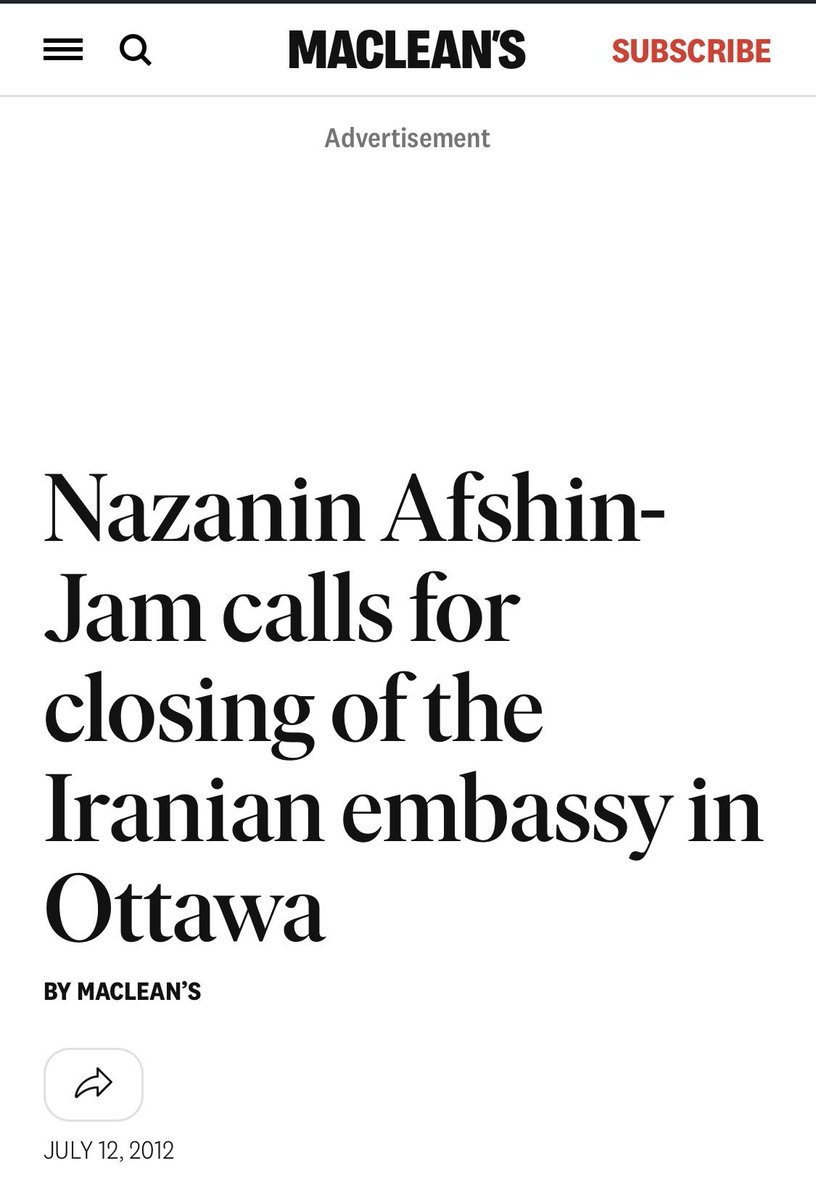
Note the date of this article: 2012. I never thought I would have to revisit this struggle before Iran was free. Shabnam Assadollahi, Shadi P and I fought hard to have the embassy closed back then.
I especially never imagined that, months after the massacre of thousands of innocent Iranians gunned down during peaceful protests, my government and Prime Minister would suggest reopening this embassy. This is a profound betrayal of those who sacrificed their lives for freedom, as well as a disregard for all the Canadian lives lost because of this regime including victims of flight PS752 downed by the regime and all those that continue to suffer intimidation and harassment by regime affiliates here on Canadian soil.
CANADA DO NOT RE OPEN THE EMBASSY OF THE ISLAMIC REPUBLIC!
Our organization, @IJCollective, was the first to report a couple days ago that Mark Carney and his government were privately making the case for why reopening Canada’s embassy in Iran would be beneficial.
When journalists followed up on our lead, they were told the information was incorrect or merely a rumour. We stand by our work. We do not publish reports without credible evidence and reliable sources.
Now, the truth is out. (See article below). Canadians must speak up and oppose any effort to normalize and restore diplomatic relations with the Islamic Republic. This is a regime responsible for the killing of children, the systematic oppression of women under gender apartheid, the sponsorship of terrorism, and the enforcement of a repressive theocratic dictatorship. It has also engaged in transnational repression, targeting dissidents, journalists, activists, and members of the Iranian diaspora far beyond its borders. The regime bears responsibility for the deaths of Canadians, including the victims of Flight PS752, and has repeatedly demonstrated contempt for international law and fundamental human rights.
At a time when Canadians continue to face concerns about foreign interference, intimidation, and transnational repression, reopening an embassy would send precisely the wrong message. We should not be creating new opportunities for a regime that has consistently sought to silence and threaten its critics abroad.
Just months ago, the regime intensified its brutal repression of the Iranian people with the slaughter of tens of thousands of innocent Iranians. Now, it appears poised to be rewarded with renewed diplomatic engagement. Mr. Carney, this is tone-deaf and cruel, not only to Canadians who have suffered because of this regime, but also to the countless Iranians who have sacrificed, suffered, and died in the struggle for freedom, justice, and human rights.
Canada must not allow the Islamic Republic to re-establish a diplomatic foothold in this country or reopen a platform from which it can advance its influence, intimidate diaspora communities, export its hateful ideology or activate its sleeper cells.
Canada, the time to act is now!
https://t.co/Rr714dbjCp
🚨Canada must not reopen the Islamic Republic's embassy!
The Iranian Justice Collective ("IJC") has received credible information that the Government of Canada intends to restore diplomatic relations with the Islamic Republic and reopen its embassy, closed by Conservative Prime Minister Harper in 2012. The ending of diplomatic relations has been the correct, bipartisan policy pursued by Liberal governments since then.
This regime has murdered Canadians, continues to engage in foreign interference and transnational repression on Canadian soil, has engaged in mass murder in recent months, and has never been held accountable for its crimes.
It must not be rewarded.
The IJC will continue to engage with parliamentarians, allies, and civil society to oppose any move that normalizes relations absent meaningful change and accountability.
@MarkJCarney@AnitaAnandMP@stephenharper@PierrePoilievre
From the UN’s Special Rapporteur on Iran @drmaisato “The 14-point memorandum focuses almost entirely on military withdrawal, the reopening of the Strait of Hormuz, nuclear commitments, sanctions relief and a $300bn reconstruction fund, but human rights are barely visible in it.”…
Together with UN experts, I issued a press release on the signing of the US–Iran Memorandum.
The 14-point memorandum focuses almost entirely on military withdrawal, the reopening of the Strait of Hormuz, nuclear commitments, sanctions relief and a $300bn reconstruction fund, but human rights are barely visible in it.
Millions of Iranians took to the streets demanding fundamental change. Their voices must be heard in any negotiation that claims to secure their future.
Any final deal must include accountability and reparations for victims, a moratorium on executions, release of arbitrary detainees, and protection of civic space.
Since the war began, Iranian authorities have detained thousands, with many reportedly tortured or forcibly disappeared. At least 156 people have been executed. Bahá'ís, Kurds and Baluch Iranians remain particularly at risk.
The end of hostilities must not be mistaken for the restoration of rights. For the Iranian people, that work is yet to begin.
Read the full press release here: https://t.co/nYJOx4iktf