Google continues to work on a new "Inbox mode" for Antigravity, where users will be able to see threads that require their attention.
It follows a broader shift we see across other Google AI tools, like Gemini (in the works) and Loop (waitlist). This change positions users in the decision-making seat to approve and review AI outcomes, rather than steering them precisely, as a main interface.
Antigravity is also getting new logic to create AI agents from the prompt, distinguished as "For Me" and "For my Team".
It is getting even more interesting now 👀
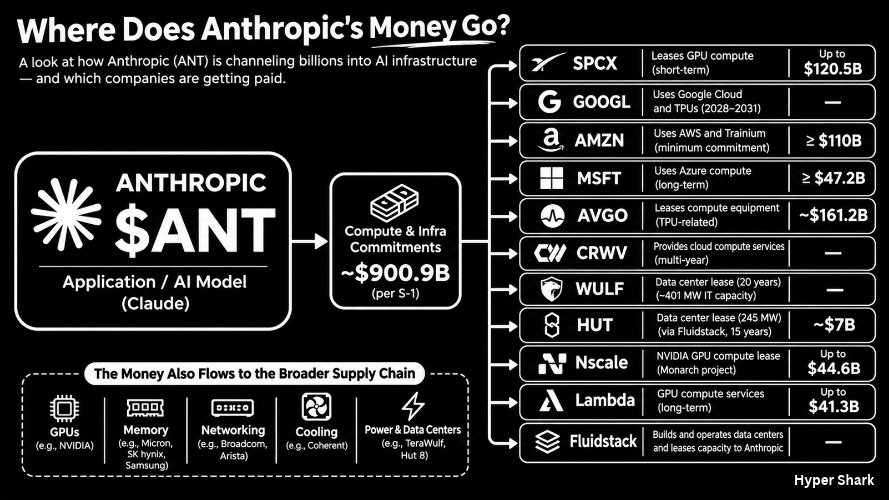
Anthropic is sitting on an enormous cash pile:
Anthropic's cash and cash equivalents are up to a record $237 billion following its IPO.
This comes as its IPO raised $81 billion, with another $26 billion secured through a private placement with selected investors.
By comparison, Alphabet, $GOOGL, Amazon, $AMZN, SpaceX, $SPCX, and Apple, $AAPL, each hold less than 25% of this amount.
Anthropic's cash pile is therefore larger than those 4 companies combined.
This is also 8 times Nvidia's, $NVDA, cash balance, 12 times Microsoft's, $MSFT, and 22 times Meta's, $META.
For perspective, Berkshire Hathaway’s cash pile stands at $377 billion.
Anthropic has a huge amount of cash to deploy.
Google recently announced Loop, its new self-improving AI agent that can autonomously work toward a given goal.
Loop is internally called Jitro; interestingly, that was the exact name for Jules v2.
Here is how it works 👀
1. Users start creating a Workspace by connecting it to a selected Github project and adding basic information.
2. Users can create loops manually or select ones that are already predefined (ex., Harden Application Security)
"Custom Loops" can be created via a prompt or by manually filling in the Loop title, icon, and objective.
> "Loops are mid- to long-term objectives for Stitch Loop to continuously work toward. They can range from highly specific to broad, but should always be something code can achieve," says the description.
3. Users can connect additional context in the form of Integrations, Files, Links, or additional repositories.
More than 100 integrations are available there, including services like Jira, Linear, Datadog, Sentry, Notion, Snowflake, Salesforce, Intercom, Discord, Slack, Figma, and many others.
Custom MCPs are supported as well.
4. After creating a workspace, Loop will start digging into your project details and generate its own Skills about the product and product metrics.
These Skills will live in a separate tab and can be edited in the UI in Markdown.
5. When the Workspace is ready, Loop will suggest metrics and goals based on its own research. Users can convert these suggestions into loops right away.
When a Loop is created, it appears as a running process in the main UI.
6. When a Loop is finished, users will see a list of suggestions for every loop, along with a number associated with a target metric and progress status.
Example Loop:
- Goal - Scale Telegram community contributions.
- KPIs - community members, registered contributors, active members.
A high-level goal would be broken down into sub-KPIs. When users open a dedicated Loop page, all these KPIs will be visible on the dashboard.
Below, Users will see a list of Tasks, Skills, and Activity tabs.
Example Task:
- Telegram channel lacks discussion threads and a dedicated bot.
Each task has a detailed description, labels, and the date when it was updated. Below, users will see tabs for Solutions, Activity, and Evidence.
Activity appears as a summary describing what happened, what was done, and the general Timeline.
Evidence contains links to where Loop pulled the context behind this Task. In my example case, it refers to the TestingCatalog website and the Telegram channel from which it pulled all the numbers.
Example Solution:
- Dedicated Telegram Bot API intake bot with editorial triage webhook (implementation task).
This task is an implementation task that has a clear description, Impact, scope, and Risk labeled.
Users can start the task right from this page to begin solution development via Gemini.
When the task is done, users can review its progress and status and monitor its impact on production by pulling updated metrics and KPIs after the release.
What does all this mean? 🤯
Loop follows how "Product work" is done at Google, a model many other companies also use.
Every Workspace in Loop is equivalent to a scope that is normally handled by a complete product engineering team.
It is no longer a place where users play the role of engineering lead and product lead, orchestrating AI agents.
It is a place where the user plays the role of a senior manager managing several engineering teams, which is a big shift on its own.
We are slowly moving towards autonomous AI organizations. One management layer at a time.
I expect it will still take until 2027 for labs to develop the products and models needed to make substantial progress in this area (assuming AI continues to advance in a semi-regulated format as it is now).
Monitoring 🍿
1) $BTC 74 - 80k soon
2) bottom is in
3) Trump's term is over
4) Democrats will win mid term elections
5) all tariffs will be refunded
6) no strike against Iran
7) stocks will hit new all-time highs
8) alt season begins in 2027
9) no market crash until Q3 - Q4 2026
This is the future.