Nerom Studio is open.
We build AI agents. Agents that run businesses, make calls, lend, spend and bid on real work.
74 projects shipped. 10 award winners. And that was before the studio had a name.
This is day one. We'll be building in public from here. Follow along.
https://t.co/nCyjCYWNYe
Yesterday I said a paid answer is not a right answer. Here is what that looks like after five days of running.
14 of the 56 answers my farm fleet paid for were refused.
The miners didn't go down. They answered. The answers just weren't safe to act on:
A storm alert with no gust speed in it. The spray drone's whole question was "how strong is the wind", so an alert without a number can't clear it to fly.
A satellite read that said "the vision model was unavailable". Well formed and paid for, with no reading inside. The scout drone treats that as no evidence, and irrigation keeps its normal schedule.
A power price with no node and no currency. The rover was about to decide when to charge on a number that didn't say which market or which money it was in.
A rain forecast with no rain chance.
And this morning, an audit of a past decision that came back with no verdict.
Each refusal sent the question to a different miner. 15 re-buys so far. When a re-buy fixed it, the fix came about 7 seconds after the refusal, on average.
What makes this checkable: every answer on @Telegraphprotoc leaves a public record on the node naming the buyer, the question and the answer. Each refusal on my page links to its record, so you don't have to take my word for any of it.
Telegraph Hackathon Season II entry.
I built a farm fleet that pays for its own data before it moves.
Five machines on a farm in Kerman, California: a spray drone, a field rover, a reefer truck, a scout drone and an auditor. Before any of them acts, it buys a live answer on @Telegraphprotoc. Is wind coming? What does power cost this hour? How long is the drive to Fresno? Each answer costs about one cent, paid from an escrow balance.
The part I care about: a paid answer is not a right answer.
On Nov 19 I asked for a storm alert for "Kerman, California". The answer came back with weather for Kerman, Iran. Same town name, other side of the world. The next day a second miner made the same mistake. Every one of those answers was well formed, confident and paid for. A spray drone acting on them would have used wind readings from the wrong continent.
So every answer goes through a guard before a machine may use it. It checks the place, the market, the hour, the units and whether the numbers are plausible. If the answer fails, the machine buys again from another miner. If nothing passes, it does nothing.
The machines are simulated. The answers, payments and receipts are real, on Telegraph testnet. You can watch it run without a wallet.
My entry for the Telegraph Hackathon, Season II.
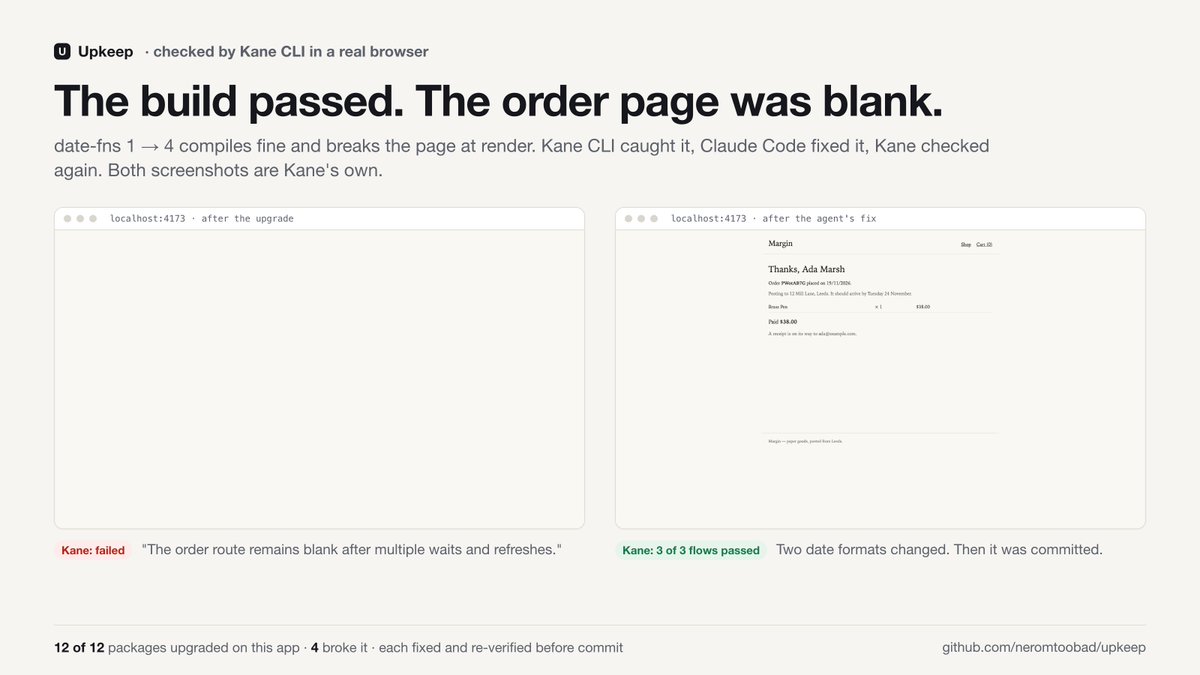
The build passed. The order page was blank.
date-fns 1 → 4 builds fine, then blanks the page. Kane CLI by @testmuai caught it in a real browser, Claude Code fixed it, Kane checked again.
12 of 12 packages upgraded, 4 fixed on the way.
https://t.co/yhEwoUyzcZ #KaneCLIHackDay
@Telegraphprotoc Live, no wallet needed: https://t.co/TKwObqJ8D2
Code (MIT) and a one-command check of every claim: https://t.co/RfLC0IoVUC
Mission 11, Autonomous Systems: https://t.co/MoQsvasXnJ
I built a farm fleet that pays for its own data before it moves.
Five machines on a farm in Kerman, California: a spray drone, a field rover, a reefer truck, a scout drone and an auditor. Before any of them acts, it buys a live answer on @Telegraphprotoc. Is wind coming? What does power cost this hour? How long is the drive to Fresno? Each answer costs about one cent, paid from an escrow balance.
The part I care about: a paid answer is not a right answer.
On Nov 19 I asked for a storm alert for "Kerman, California". The answer came back with weather for Kerman, Iran. Same town name, other side of the world. The next day a second miner made the same mistake. Every one of those answers was well formed, confident and paid for. A spray drone acting on them would have used wind readings from the wrong continent.
So every answer goes through a guard before a machine may use it. It checks the place, the market, the hour, the units and whether the numbers are plausible. If the answer fails, the machine buys again from another miner. If nothing passes, it does nothing.
The machines are simulated. The answers, payments and receipts are real, on Telegraph testnet. You can watch it run without a wallet.
My entry for the Telegraph Hackathon, Season II.
WIF League Season 2 is coming 🛠️
• run your own private league with an invite link • play in $WIF or ETH • ETH pots buy and burn $WIF • anyone can sponsor a pot under their name • league creators earn up to 5% of their pot
Going live soon on @WIFonRH 🔥