The role of PPC marketers is shifting from doing the work to designing the systems that do it.
Claude Skills are a big part of that shift.
Here's how to build them into your workflow ⬇️
https://t.co/SgeSzN5VMZ
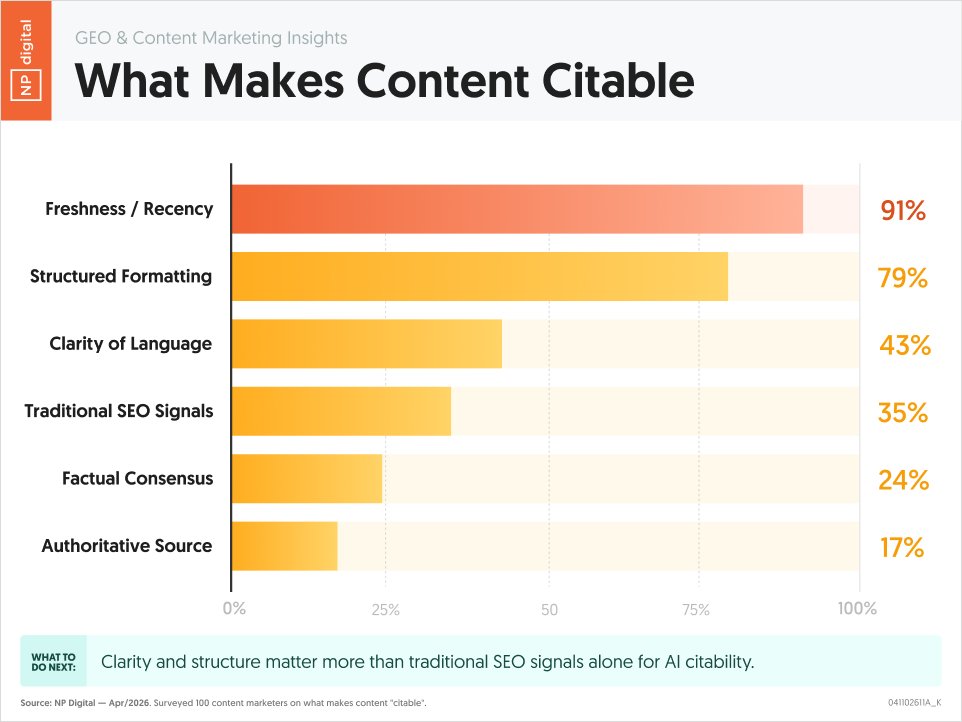
Have you ever wondered what makes content citable by AI?
Most people point to structure and using schema markup.
And although that helps, it's not the number 1 factor.
So what's the number one factor? Freshness!
Just check out the results.
My Perfect Shopify Collection Page Cheat Sheet:
(How to turn browsers into buyers with pages that actually convert)
Most Shopify stores throw up Collection pages without thinking.
A grid of products. A generic title. Maybe a filter.
That's it.
And they wonder why no one's buying.
Here's what a winning collection page actually needs:
1/ SEO-Optimized Title
- Include your target keyword naturally.
- Match what your ICP is searching on Google.
- Ex: "Organic Cotton T-Shirts for Men" not "T-Shirts."
2/ Collection Description (Above the Fold)
- 100-200 words of keyword-rich copy.
- Speak to the customer's problem or desire.
- Google indexes this. Most stores leave it blank.
3/ High-Quality Product Images
- Consistent sizing and style across every product.
- Lifestyle shots mixed with clean product shots.
- Mobile-first. Test how they look on a phone.
4/ Smart Filtering & Sorting
- Let users filter by size, color, price, best sellers.
- Default sort: Best selling or newest first.
- Reduce friction. More clicks = more drop-offs.
5/ Social Proof on the Page
- Show star ratings under each product.
- Add a "Best Seller" or "Staff Pick" badge.
- Trust converts. Especially for new visitors.
6/ Internal Linking Strategy
- Link collection pages from blog posts.
- Cross-link related collections.
- Build topical authority for Google and ChatGPT.
7/ Fast Load Speed
- Compress images. Use lazy loading.
- Remove unnecessary apps slowing you down.
- Every second of load time costs you conversions.
8/ Clear CTA on Each Product Card
- "Add to Cart" or "Quick View" visible without scrolling.
- Don't make them work to buy from you.
---
Your collection page is not a catalog.
It's a sales page disguised as a category.
Treat it like one and watch your conversion rate climb.
SEO is slept on wayy too much in Ecommerce.
I'm here to wake the industry up to its potential.
---
What would you add to this?
Repost ♻️ if you're building a Shopify store right now.
P.S. I share eCommerce + SEO strategies weekly. Follow me for more.
Bad habits can drive your team completely crazy.
You don't even realize you're doing something wrong until it's too late.
I found 7 bad habits that A LOT of the people unconciously make.
These habits destroy team morale.
Here's what they are and how to fix them:
Most people treat SEO like one thing.
It isn’t.
E-commerce SEO and local SEO play by different rules.
Using the same strategy for both is why growth stalls.
Here’s the real split:
Here's how organic CTR rates have changed over time.
Even though it is obvious that it has dropped, keep in mind that a lot of queries that you are losing clicks from are informational queries with low conversion rates.
THE 5 P'S OF MARKETING:
(Full credit to @DimondChase on this one. Saw it and had to share!)
PRODUCT
This is the core offering of your business.
PRICE
Setting the right price is crucial for profitability and market positioning.
PROMOTION
This encompasses all the strategies you use to communicate and market your product.
PLACE
This refers to the distribution channels through which customers access your product.
PEOPLE
Your employees and customer service play a crucial role in the success of your marketing efforts.
HOW TO USE THEM:
PRODUCT
Know your audience's needs and preferences.
Keep innovating to stay ahead.
Deliver quality and reliability to earn trust.
PRICE
Research the market to find the best pricing.
Balance perceived value with competitive rates.
Adjust prices based on demand and market shifts.
PROMOTION
Create a marketing plan with ads, PR, and social media.
Customize promotions to connect with your audience.
Track campaign results and refine as needed.
PLACE
Choose the right distribution channels.
Streamline your supply chain for efficiency and satisfaction.
Make your product accessible when and where customers need it.
PEOPLE
Train employees to embody your brand.
Deliver exceptional customer service to foster loyalty.
Gather and act on feedback for continuous improvement.
Most New Year goals fail for one simple reason.
They’re written for motivation, not for reality.
Every January, people aim higher.
More output.
More growth.
More ambition.
But they forget to ask one question first:
What actually broke last year?
Because setting goals without fixing friction
just creates cleaner plans on top of the same problems.
I’ve learned to approach New Year goals differently.
Less about doing more.
More about removing what slows us down.
Less about big promises.
More about clear constraints.
The goal isn’t to become a different person in January.
It’s to design a year that’s easier to execute than the last one.
That’s why my New Year goals usually fit on one page.
And why they’re boring by design.
I put the checklist in the visual.
Save it if you want a calmer, more effective year.
Repost ♻️ and help others set practical new year goals.
P.S. Wishing you all a very Happy New Year!!
May this year bring both business and personal success for you.
If you exclude COVID, outdoor advertising has continually grown each year.
From $5.6 billion in 2018 to a projected $13.3 billion in 2030.
It may not be getting the attention as Google and Facebook ads, but it works. And in many cases, you can get some good deals, as it has become more of a "secondary" advertising channel than a primary one.
Plus, a lot of outdoor advertising has been transitioning to digital, making it easier to purchase today.